


Table of Contents
- Quick Answer: How Do You Choose Plastic Raw Materials?
- Why Choosing the Right Plastic Raw Materials Matters
- Thermoplastics vs. Thermosetting Plastics
- Thermoplastics
- Thermosetting Plastics
- Common Plastic Raw Materials and Their Applications
- Polyethylene (PE)
- Polypropylene (PP)
- Polyvinyl Chloride (PVC)
- Polyethylene Terephthalate (PET)
- Polystyrene (PS) and ABS
- Engineering Plastics
- How to Select Plastic Raw Materials for Your Product
- 1. Define Mechanical Requirements
- 2. Evaluate Temperature and Environmental Exposure
- 3. Match the Resin to the Manufacturing Process
- 4. Check Regulatory and End-Use Requirements
- 5. Compare Total Cost, Not Just Price per Kilogram
- 6. Validate the Grade Before Full-Scale Production
- Matching Plastic Raw Materials to Manufacturing Processes
- The Role of Additives in Plastic Raw Materials
- Virgin vs. Recycled Plastic Raw Materials
- Common Mistakes When Selecting Plastic Raw Materials
- Future Trends in Plastic Raw Materials
- How to Evaluate a Plastic Resin Supplier
- Conclusion
- Related Articles
- References
- What are plastic raw materials?
- Which plastic raw material is best for manufacturing?
- How do manufacturers select the right plastic resin?
- What is the difference between virgin and recycled plastic raw materials?
- Why are additives used in plastic manufacturing?
- Which plastic raw materials are used in injection molding?
- How can manufacturers reduce the cost of plastic raw materials?
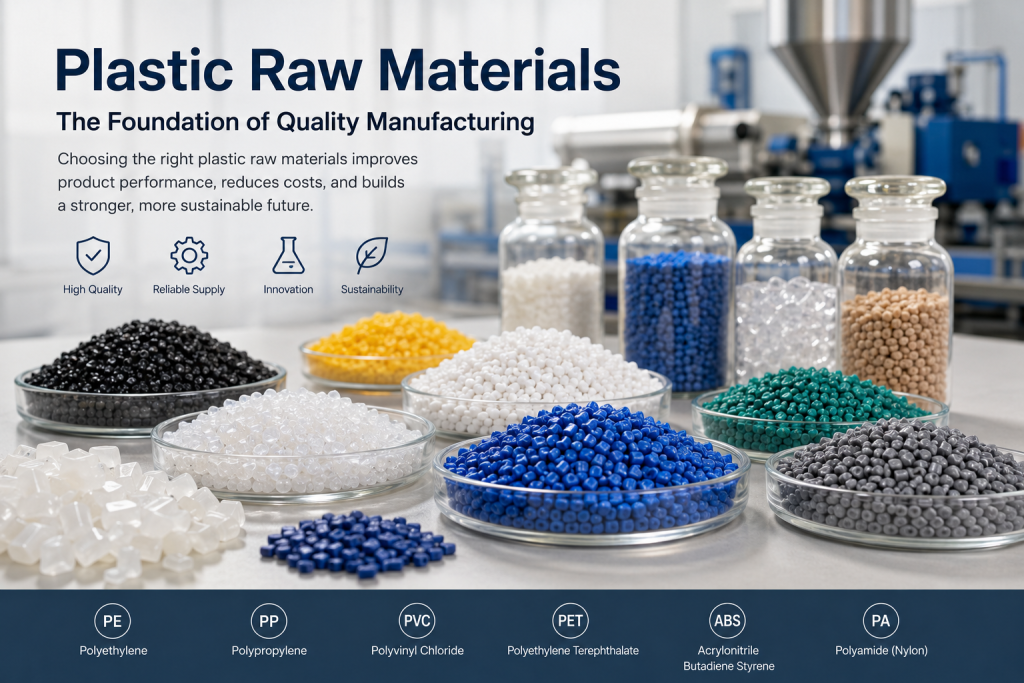
Plastic Raw Materials are the polymer resins used to manufacture products through injection molding, extrusion, blow molding, thermoforming, and other processing methods. Choosing the right material requires evaluating mechanical properties, heat and chemical resistance, processing behavior, regulatory requirements, and total production cost. This guide explains how manufacturers can compare common plastics and select suitable materials for their applications.
Quick Answer: How Do You Choose Plastic Raw Materials?
To choose suitable Plastic Raw Materials, start with the product’s required performance and manufacturing process. Then compare resin grades using their technical data sheets (TDS), processing recommendations, regulatory documentation, and trial results.
- For packaging films: LDPE and LLDPE are common options; HDPE is suitable for applications requiring greater stiffness.
- For rigid containers: PP, HDPE, and PET may be suitable, depending on the product and filling conditions.
- For automotive components: PP, ABS, PA, POM, and other engineering plastics are selected according to strength, temperature, and dimensional requirements.
- For pipes: HDPE and PVC are widely used, depending on pressure, installation, and service requirements.
- For outdoor products: UV resistance, weatherability, and stabilization requirements must be evaluated.
- For recycled-content products: Melt flow, contamination, odor, mechanical performance, and batch consistency require additional checks.
These are starting points rather than universal recommendations. The correct grade depends on the specific application, product design, operating conditions, and processing equipment.
Why Choosing the Right Plastic Raw Materials Matters
Two manufacturers can use similar machinery and molds yet achieve different product quality because their material grades, formulations, and process conditions differ. Plastic resin selection affects production stability, cycle time, surface finish, dimensional accuracy, durability, and the amount of scrap generated.
A low-priced resin may increase the total cost if it requires longer processing cycles, produces more rejected parts, or fails to meet the product’s performance requirements. Evaluating Plastic Raw Materials by total cost per acceptable product provides a more useful comparison than considering resin price alone.
Appropriate material selection can help manufacturers:
- Reduce scrap, rework, and rejected products.
- Improve dimensional stability and surface appearance.
- Maintain consistent processing conditions.
- Meet required mechanical and thermal performance levels.
- Reduce unplanned downtime and production interruptions.
- Improve product lifespan and customer satisfaction.
Thermoplastics vs. Thermosetting Plastics
Thermoplastics
Thermoplastics soften when heated and solidify when cooled. Many grades can be processed repeatedly, although excessive heat and repeated processing may degrade their properties. These materials are widely used in high-volume manufacturing because they support processes such as injection molding, extrusion, blow molding, and thermoforming.
Common examples include polyethylene (PE), polypropylene (PP), polyvinyl chloride (PVC), polyethylene terephthalate (PET), polystyrene (PS), acrylonitrile butadiene styrene (ABS), polycarbonate (PC), and polyamide (PA).
Thermosetting Plastics
Thermosetting plastics undergo a curing reaction that creates a cross-linked structure. Once fully cured, they generally cannot be remelted and reshaped like conventional thermoplastics. Depending on the formulation, thermosets can offer heat resistance, electrical insulation, and dimensional stability.
Examples include epoxy, phenolic, and certain unsaturated polyester resins. They are used in electrical components, composite materials, protective coatings, and applications requiring specific thermal or structural properties.
The choice between thermoplastics and thermosets depends on the product design, manufacturing process, service conditions, and end-of-life requirements.
Common Plastic Raw Materials and Their Applications
Polyethylene (PE)
Polyethylene is a widely used polymer valued for its chemical resistance, low moisture absorption, lightweight structure, and versatility. Different grades offer different combinations of stiffness, flexibility, toughness, and processability.
- HDPE: Commonly used for rigid containers, bottles, pipes, and selected industrial products.
- LDPE: Often used in flexible films, bags, liners, and other applications requiring flexibility.
- LLDPE: Common in stretch films, packaging films, and products requiring puncture resistance and toughness.
When selecting PE grades, compare density, melt flow rate, tensile properties, environmental stress-crack resistance where relevant, and the intended processing method.
Polypropylene (PP)
Polypropylene combines low density with useful chemical resistance, stiffness, and fatigue resistance. Its properties vary by grade, including homopolymer, random copolymer, and impact copolymer types.
Common applications include food packaging, household products, automotive components, closures, reusable containers, and selected medical or laboratory products. For demanding applications, review impact performance, heat resistance, shrinkage, stiffness, and regulatory suitability.
Polyvinyl Chloride (PVC)
PVC is used in rigid and flexible applications. Rigid formulations are common in pipes, fittings, window profiles, and construction products, while plasticized formulations are used in cable insulation, flexible tubing, flooring, and other flexible products.
PVC performance depends strongly on its formulation, including stabilizers, plasticizers where applicable, impact modifiers, and processing aids. Compatibility between the resin and additive system is essential for reliable processing and long-term performance.
Polyethylene Terephthalate (PET)
PET is valued for its strength, transparency, and gas-barrier performance in suitable applications. It is widely used in beverage bottles, food packaging, and polyester-based products.
PET processing requires attention to moisture because absorbed water can cause hydrolytic degradation during melt processing. Drying requirements depend on the grade and equipment and should follow the supplier’s technical documentation. Recycled PET may also require evaluation of intrinsic viscosity, contamination, color, and intended end use.
Polystyrene (PS) and ABS
Polystyrene is available in general-purpose and impact-modified grades. It is used in selected packaging, disposable products, insulation, and consumer applications. Grade selection depends on impact strength, stiffness, appearance, and temperature requirements.
ABS combines rigidity, impact resistance, and surface quality in many applications. It is commonly used in appliance housings, consumer products, equipment enclosures, and automotive interior components. Heat resistance, color requirements, flame-retardant specifications, and molding conditions should be considered before choosing a grade.
Engineering Plastics
Engineering plastics are selected when standard commodity polymers do not meet the required mechanical, thermal, wear, or dimensional performance.
- Polycarbonate (PC): Used where impact resistance and transparency or heat performance are important.
- Polyamide (PA/Nylon): Used in mechanical parts, gears, connectors, and components requiring strength or wear resistance.
- Polyoxymethylene (POM): Often used for precision components requiring stiffness, dimensional stability, and low friction.
- Polybutylene terephthalate (PBT): Common in electrical connectors, automotive components, and selected precision-molded parts.
Engineering grades may have more demanding drying, temperature-control, and processing requirements. Always use the grade-specific TDS rather than relying on general polymer descriptions.
How to Select Plastic Raw Materials for Your Product
The best material is the one that satisfies the product’s performance requirements and can be processed reliably at an acceptable total cost. Before purchasing a resin, document the conditions in which the finished product will be manufactured, used, stored, transported, and disposed of.
1. Define Mechanical Requirements
Identify the required tensile strength, stiffness, impact resistance, elongation, hardness, flexibility, and dimensional stability. Not every product needs the highest value for every property. Over-specifying a material can increase costs without providing a meaningful performance benefit.
2. Evaluate Temperature and Environmental Exposure
Determine the temperatures the product will experience during processing and service. For outdoor products, consider UV exposure, moisture, temperature cycling, and weathering. For chemical-contact applications, evaluate compatibility with the specific chemicals, concentrations, temperatures, and exposure periods involved.
3. Match the Resin to the Manufacturing Process
Different processes require different melt-flow behavior, viscosity, thermal stability, and cooling characteristics. For injection molding, melt flow and shrinkage may affect filling and dimensions. For extrusion, rheology and melt strength can influence output and product uniformity. For blow molding, melt strength and the grade’s suitability for the process are particularly important.
4. Check Regulatory and End-Use Requirements
Food-contact, medical, electrical, construction, and automotive applications may require specific approvals, testing, traceability, or documentation. Confirm that the exact grade and formulation meet the requirements of the destination market and intended use. A general statement about a polymer is not a substitute for grade-specific compliance evidence.
5. Compare Total Cost, Not Just Price per Kilogram
Compare the delivered material price alongside drying needs, cycle time, energy consumption, scrap rate, additive requirements, maintenance, and quality-control costs. The most economical Plastic Raw Materials are those that meet specifications consistently while supporting efficient production.
6. Validate the Grade Before Full-Scale Production
Review the TDS and safety data sheet (SDS), confirm batch documentation, and run a controlled production trial when practical. Measure product performance and processing stability against defined acceptance criteria before approving a material for routine production.
Matching Plastic Raw Materials to Manufacturing Processes
Material selection must account for the interaction between resin properties and processing conditions. The following table lists common starting points, not fixed rules for every grade or product.
| Manufacturing Process | Common Material Options | Important Selection Factors |
|---|---|---|
| Injection molding | PP, ABS, PC, PA, POM | Melt flow, shrinkage, impact strength, drying, and cycle time |
| Film extrusion | LDPE, LLDPE, selected HDPE grades | Melt strength, film toughness, thickness uniformity, and output |
| Blow molding | HDPE, PET, selected PP grades | Melt strength, parison or preform behavior, barrier requirements, and wall thickness |
| Pipe extrusion | HDPE, PVC | Pressure rating, dimensional stability, long-term performance, and applicable standards |
| Thermoforming | PET, PS, PP, and other suitable sheet grades | Sheet quality, forming window, thickness distribution, and heat resistance |
| Rotational molding | Suitable LLDPE grades and other process-approved resins | Powder quality, particle size, sintering behavior, and impact performance |
Before changing a resin grade, check the equipment manufacturer’s guidance and the resin supplier’s recommended processing window. A material that performs well in one process may not be suitable for another without formulation or equipment changes.
The Role of Additives in Plastic Raw Materials
Base resin selection is only one part of formulation design. Additives can improve processing, stability, appearance, and service life, but their effectiveness depends on the polymer, grade, dosage, compatibility, and operating conditions.
- Antioxidants: Help limit oxidative degradation during processing and service.
- UV stabilizers: Help protect suitable formulations against ultraviolet exposure and weathering.
- Slip additives: Help modify surface friction in appropriate film and packaging applications.
- Anti-block additives: Help reduce film layers sticking together during winding and handling.
- Processing aids: Can improve melt processing and surface quality in compatible formulations.
- Impact modifiers: Can improve toughness and impact performance in selected polymers.
- Chain extenders: Can help restore or increase molecular weight in certain recycled or degraded polymer systems, depending on polymer chemistry and process conditions.
- Flame retardants: Help achieve specified fire-performance requirements when the formulation is properly designed and tested.
Not every additive is suitable for every resin. Confirm compatibility, dosage recommendations, regulatory requirements, and potential effects on mechanical properties, color, recyclability, and processing. Explore relevant product categories and technical information before selecting a formulation.
Virgin vs. Recycled Plastic Raw Materials
Virgin and recycled polymers can both be suitable for manufacturing, but they may differ in consistency, processing behavior, appearance, odor, contamination risk, and mechanical performance. The right choice depends on the product specification, recycled-content target, customer requirements, and applicable regulations.
| Selection Factor | Virgin Resin | Recycled Resin |
|---|---|---|
| Batch consistency | Often more consistent within a controlled grade and supply specification | Can vary with feedstock, sorting, recycling method, and quality control |
| Traceability | Depends on supplier documentation and grade controls | Depends on feedstock tracking and recycling-process controls |
| Processing behavior | Typically defined by grade-specific technical data | Should be validated for melt flow, contamination, moisture, and stability |
| Environmental impact | Depends on production route, energy, and material source | May reduce demand for virgin resin, but the outcome depends on collection, processing, energy, and yield |
Recycled material should not be selected on price or recycled content alone. Verify performance in the final application, particularly where durability, appearance, odor, food contact, or long-term service life matters. For recycled polyolefins and PET, suitable stabilization or compatibilization systems may be needed, but their use should be based on testing rather than assumption.
Common Mistakes When Selecting Plastic Raw Materials
Several avoidable mistakes can cause production problems after a resin has already been purchased.
- Choosing only by price: Ignores scrap, processing, and service-life costs.
- Ignoring melt flow: Can lead to incomplete filling, unstable extrusion, or other process issues.
- Overlooking chemical compatibility: May cause swelling, cracking, loss of strength, or premature failure.
- Ignoring outdoor exposure: Can shorten service life when UV and weathering requirements are not addressed.
- Using recycled resin without validation: May introduce variability, contamination, or inconsistent performance.
- Overlooking regulatory requirements: Can make a material unsuitable for its intended market or use.
- Adding incompatible additives: May cause processing problems or reduce final-product performance.
- Skipping production trials: Can allow grade-related issues to go unnoticed until full-scale manufacturing.
Documenting acceptance criteria and verifying materials before production can reduce these risks. Use supplier TDS and SDS documents, appropriate laboratory tests, and controlled production trials to support decisions.
Future Trends in Plastic Raw Materials
Manufacturers are increasingly evaluating material choices in relation to circularity, resource efficiency, product durability, and regulatory requirements. Important developments include:
- Improved recycled polymers and better quality-control systems.
- Polymer formulations designed for specific recycling streams.
- Bio-based plastics for selected applications where their properties and sourcing are appropriate.
- Advanced additives that support durability and processing stability.
- Lightweight materials for transportation and industrial applications.
- Greater attention to life-cycle impacts and material traceability.
These developments do not make one material universally preferable. Manufacturers should assess performance, cost, availability, environmental evidence, and end-of-life options for each application.
How to Evaluate a Plastic Resin Supplier
Consistent material quality depends not only on polymer type but also on grade control, documentation, and supply reliability. Before approving a supplier, consider the following:
- Availability of a current TDS and SDS.
- Clear grade identification and batch traceability.
- Consistency of key properties between batches.
- Evidence supporting relevant regulatory or industry requirements.
- Reliable delivery schedules and clear packaging specifications.
- Technical support for grade selection and processing questions.
- A process for reporting and resolving quality issues.
Compare equivalent grades under the same technical and commercial requirements. When specifications differ, a direct price comparison may be misleading.
Conclusion
Choosing the right Plastic Raw Materials requires more than identifying a polymer or selecting the lowest-priced resin. Manufacturers should match the grade to the product’s mechanical properties, thermal and chemical exposure, manufacturing process, regulatory requirements, and cost targets.
Review technical documentation, compare relevant grades, and validate performance through controlled trials. When necessary, consider a compatible additive system to improve processing stability or product durability. This structured approach can reduce manufacturing risk and support more consistent product quality.
Explore the AasadChimie product categories for relevant industrial chemical information. For product-related questions or assistance with an inquiry, visit the Contact Us page.
Related Articles
- Plastic Additives for Packaging
- Polymer Additives List
- Plastic Additives for Different Polymers
- Plastic Processing Aids
- Antioxidants for Polymers
- UV Stabilizers for Plastics
References
- Plastics Europe — Plastics industry and sustainability information.
- ASTM International — Standards and test methods for materials.
- ScienceDirect — Research literature on polymer properties and processing.
- American Chemistry Council — Chemistry and plastics industry resources.
- British Plastics Federation — Plastics materials, applications, and industry guidance.
What are plastic raw materials?
Plastic raw materials are polymer resins used to manufacture plastic products through processes such as injection molding, extrusion, blow molding, and thermoforming. Common examples include PE, PP, PVC, PET, ABS, and engineering plastics.
Which plastic raw material is best for manufacturing?
There is no single best material for every application. The appropriate grade depends on mechanical performance, operating temperature, chemical exposure, manufacturing process, regulatory requirements, and total production cost.
How do manufacturers select the right plastic resin?
Manufacturers define product requirements, compare resin technical data sheets, check processing compatibility and compliance documentation, and validate candidate grades through testing or production trials.
What is the difference between virgin and recycled plastic raw materials?
Virgin resin is produced from primary feedstock, while recycled resin is recovered and reprocessed from plastic waste or scrap. Their consistency, processing behavior, contamination risk, and mechanical properties can differ by grade and recycling process.
Why are additives used in plastic manufacturing?
Additives can improve properties such as thermal stability, UV resistance, impact strength, surface behavior, and processability. The appropriate additive depends on the polymer, intended application, dosage, and performance requirements.
Which plastic raw materials are used in injection molding?
Common options include PP, ABS, PC, PA, and POM. The correct grade depends on melt flow, dimensional requirements, impact performance, heat exposure, and the part's intended use.
How can manufacturers reduce the cost of plastic raw materials?
Manufacturers can compare equivalent grades, reduce scrap, optimize processing conditions, evaluate recycled content where suitable, and assess total cost per acceptable product instead of relying only on price per kilogram.