


Table of Contents
- What Is Polypropylene Compounding?
- Which Raw Materials Are Used in PP Compound Manufacturing?
- What Are the Main Manufacturing Steps?
- 1. Formulation Design and Material Selection
- 2. Raw Material Feeding and Pre-Mixing
- 3. Twin-Screw Extrusion and Melt Mixing
- 4. Venting and Melt Filtration
- 5. Cooling and Pelletizing
- How Do Additives and Fillers Affect PP Compounds?
- How Is Quality Controlled During PP Compound Production?
- Where Are Polypropylene Compounds Used?
- How Can Manufacturers Improve Compounding Efficiency?
- Conclusion
- What is the polypropylene compound manufacturing process?
- Which machine is commonly used for PP compounding?
- Why are fillers added to polypropylene compounds?
- Which tests are used for polypropylene compounds?
- How can manufacturers maintain consistent PP compound quality?
The polypropylene compound manufacturing process transforms base polypropylene resin into a customized material by combining it with additives, mineral fillers, and impact modifiers. This process typically includes formulation design, raw material preparation, melt mixing, extrusion, pelletizing, and quality testing to achieve the properties required for industrial applications.
Understanding the polypropylene compound manufacturing process helps plastic manufacturers select suitable materials, improve production consistency, and meet application-specific requirements. PP compounds are widely used in automotive parts, electrical housings, household products, packaging, and injection-molded components.
What Is Polypropylene Compounding?
Polypropylene compounding is the controlled modification of polypropylene resin to improve selected material properties. Standard PP offers low density, chemical resistance, and good processability, but some applications require greater stiffness, higher impact performance, improved dimensional stability, or enhanced resistance to heat and weathering.
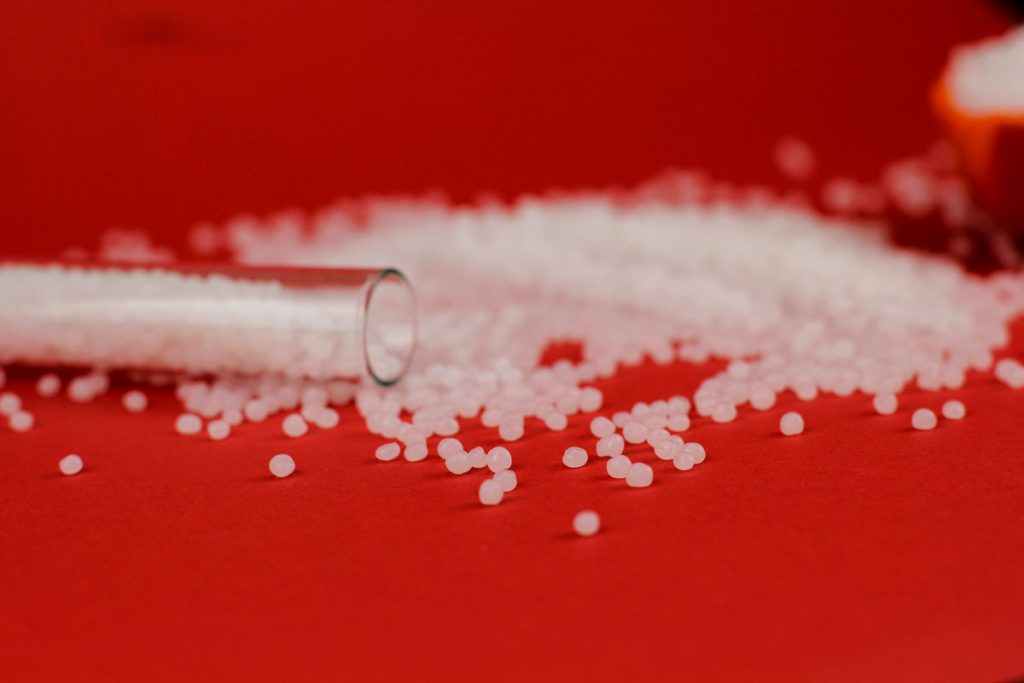
During compounding, the polymer is combined with carefully selected ingredients to create a material suited to its intended application. The finished compound is usually supplied in pellet form for downstream processes such as injection molding and extrusion. Explore polypropylene compounds to learn more about their industrial uses.
Which Raw Materials Are Used in PP Compound Manufacturing?
Raw material selection is the foundation of the polypropylene compound manufacturing process. Each ingredient has a specific purpose, and its suitability depends on the product design, operating environment, processing method, and required performance.
| Raw Material | Main Function |
|---|---|
| Polypropylene resin | Forms the base polymer matrix |
| Impact modifiers | Improve toughness and impact performance in selected formulations |
| Talc | Increases stiffness and can improve dimensional stability |
| Calcium carbonate | Adjusts stiffness, density, and formulation cost |
| Antioxidants | Help limit thermal and oxidative degradation |
| UV stabilizers | Help protect materials used in outdoor environments |
The ingredients must be compatible with the polymer and with one another. For example, mineral fillers may improve stiffness but can reduce impact performance if the loading level or dispersion is unsuitable. Learn more about polypropylene additives and their role in material modification.
What Are the Main Manufacturing Steps?
1. Formulation Design and Material Selection
The first stage of the polypropylene compound manufacturing process is defining the target properties. Engineers evaluate mechanical loads, operating temperature, chemical exposure, sunlight exposure, surface appearance, production method, and cost requirements.
The appropriate PP grade is then selected, followed by the required additives, fillers, and modifiers. Formulation trials may be necessary to balance stiffness, impact strength, melt flow, appearance, and cost.
2. Raw Material Feeding and Pre-Mixing
Each ingredient is weighed and fed according to the approved formulation. Gravimetric feeding systems can improve dosing accuracy, especially when the compound contains small amounts of functional additives. Depending on the equipment, materials may be pre-mixed before entering the extruder.
Accurate feeding helps reduce batch-to-batch variation. Raw materials should also be stored and handled according to their technical requirements to minimize contamination and other material-related problems.
3. Twin-Screw Extrusion and Melt Mixing
Twin-screw extrusion is widely used in the polypropylene compound manufacturing process because it supports polymer melting, distributive mixing, and dispersive mixing. Heat from the barrel and mechanical energy from the rotating screws melt the polymer and distribute fillers and additives throughout the material.
Key operating parameters include barrel temperature, screw speed, feed rate, screw configuration, residence time, and mechanical energy input. The correct settings depend on the formulation and equipment; there is no single temperature profile suitable for every PP compound.
Insufficient mixing may lead to poor filler dispersion or inconsistent additive distribution. Excessive thermal exposure or shear may contribute to polymer degradation. Monitoring process conditions helps maintain consistent melt flow and finished-product quality.
4. Venting and Melt Filtration
Some production lines use vacuum venting to remove volatile substances or entrained air when required by the formulation. Melt filtration may also be used to reduce contamination and unwanted particles. These operations depend on raw material cleanliness, additive chemistry, and the final product specification.
5. Cooling and Pelletizing
After extrusion, the molten compound is converted into pellets. Depending on the production line, manufacturers may use strand pelletizing or underwater pelletizing. Cooling conditions and cutting performance influence pellet shape, size consistency, and handling characteristics.
The pellets may then be screened, conveyed, and packaged for storage or shipment. Clean handling and appropriate packaging help prevent contamination before the material reaches the customer.
How Do Additives and Fillers Affect PP Compounds?
Additives and fillers allow manufacturers to customize polypropylene for specific applications. Their effects depend on ingredient type, concentration, dispersion, and interactions with the polymer matrix.
- Talc: commonly increases stiffness and may improve dimensional stability. Read about talc fillers in polypropylene compounds.
- Calcium carbonate: can adjust stiffness, density, and formulation economics. Its effects depend on particle properties, surface treatment, and loading. See calcium carbonate fillers in plastics.
- Impact modifiers: can improve toughness, depending on the modifier type, concentration, dispersion, and test temperature. Explore polypropylene impact modifiers.
- Antioxidants: help protect polypropylene against degradation during melt processing and service.
- UV stabilizers: help reduce ultraviolet-related degradation in applications exposed to sunlight.
Choosing the right formulation requires balancing performance requirements. Increasing filler content, for instance, does not automatically improve every mechanical property; testing is needed to verify the final material.
How Is Quality Controlled During PP Compound Production?
Quality control verifies that the compound meets its specification and performs consistently in the customer’s production process. The testing plan should reflect the end-use application and the relevant standardized methods.
| Test | Purpose |
|---|---|
| Melt Flow Rate (MFR) | Evaluates melt-flow behavior under specified conditions |
| Tensile testing | Measures tensile strength and elongation |
| Flexural testing | Evaluates flexural strength and modulus |
| Impact testing | Assesses impact performance at a specified temperature and test configuration |
| Density measurement | Checks density and possible batch variation |
| Thermal analysis | Measures selected thermal characteristics using an appropriate method |
| Visual inspection | Identifies visible contamination and pellet inconsistencies |
Results should be interpreted using controlled specimen preparation, defined test conditions, and agreed acceptance limits. Relevant methods and standards can be reviewed in the ISO standards catalogue.
Where Are Polypropylene Compounds Used?
The polypropylene compound manufacturing process enables producers to create grades for a wide range of industrial applications. The selected formulation depends on the required balance of weight, durability, chemical resistance, stiffness, impact performance, and cost.
- Automotive interior trim, panels, and selected technical components
- Electrical housings and industrial enclosures
- Household appliances and consumer products
- Packaging components and reusable containers
- Injection-molded parts with defined mechanical requirements
- Industrial products requiring application-specific polymer performance
Before adopting a new grade, manufacturers should validate it under representative processing and service conditions. Material selection should account for component design, operating environment, regulatory requirements, and the relevant performance tests.
How Can Manufacturers Improve Compounding Efficiency?
Consistent production requires coordination between formulation, equipment, and quality control. Manufacturers can improve repeatability by calibrating feeders, monitoring extrusion conditions, inspecting incoming materials, maintaining equipment, and recording batch-level test results.
When defects occur, troubleshooting should begin with test data. Changes in melt flow may relate to resin grade, formulation, feeding accuracy, or thermal history. Poor surface appearance may be associated with dispersion, contamination, or processing conditions. Controlled trials help identify the cause without introducing unnecessary changes.
Conclusion
The polypropylene compound manufacturing process involves formulation design, accurate feeding, melt mixing, extrusion, pelletizing, and application-specific quality testing. Each stage influences the consistency and performance of the final material.
By selecting compatible raw materials and controlling processing conditions, manufacturers can develop PP compounds for automotive, electrical, household, packaging, and industrial applications. Visit the Aasad Chimie products page to explore available materials, or contact Aasad Chimie to discuss your application requirements.
What is the polypropylene compound manufacturing process?
It is the process of blending polypropylene resin with selected additives, fillers, and modifiers, then melt-mixing, extruding, pelletizing, and testing the resulting material.
Which machine is commonly used for PP compounding?
Twin-screw extruders are widely used because they provide controlled melting and mixing, with screw configuration selected for the formulation and production requirements.
Why are fillers added to polypropylene compounds?
Fillers such as talc and calcium carbonate can adjust stiffness, dimensional stability, density, and cost. Their effects depend on filler characteristics, loading, and dispersion.
Which tests are used for polypropylene compounds?
Common tests include melt flow rate, tensile strength, flexural properties, impact resistance, density, and visual inspection. The exact test plan depends on the application and specification.
How can manufacturers maintain consistent PP compound quality?
They can control raw material quality, calibrate feeding systems, monitor extrusion parameters, maintain equipment, and test representative samples from production batches.