


Table of Contents
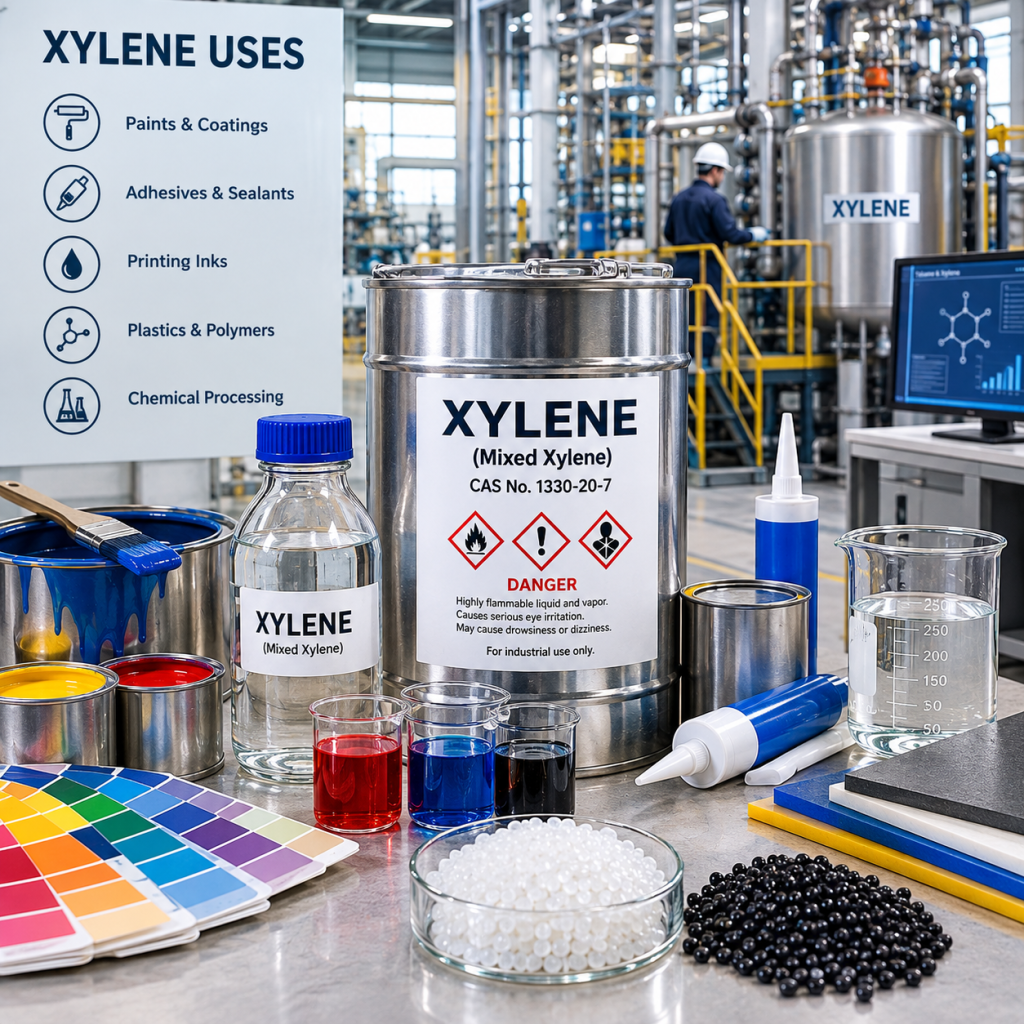
- What Are the Main Xylene Uses?
- Quick Technical Specifications of Xylene
- Xylene Uses in Paints and Industrial Coatings
- Xylene Uses in Adhesives and Sealants
- Xylene Uses in Printing Inks
- Xylene Uses in Petrochemical Production
- Xylene Uses in Industrial Cleaning
- Xylene vs. Toluene: Which Solvent Should You Choose?
- How to Select the Right Xylene Grade
- Safety, Handling, and Storage
- Conclusion
Xylene Uses include industrial solvent applications and petrochemical manufacturing. Xylene is an aromatic hydrocarbon available as three isomers—ortho-xylene, meta-xylene, and para-xylene—as well as commercial mixtures known as mixed xylene. Manufacturers use the appropriate grade according to its solvency, isomer composition, purity, and process requirements.
From paints and coatings to adhesives, printing inks, industrial cleaning, and polyester production, xylene supports a wide range of chemical processes. Choosing the correct grade is essential for product performance, process efficiency, and safe handling.
What Are the Main Xylene Uses?
The main Xylene Uses fall into two categories: solvent applications and chemical feedstock production. As a solvent, xylene can dissolve selected resins and organic compounds. As a chemical feedstock, particular isomers are used to manufacture important downstream products.
The three isomers have the same molecular formula but differ in molecular structure and certain physical properties. Therefore, mixed xylene is not automatically interchangeable with a purified isomer in applications that require a specific chemical composition.
Quick Technical Specifications of Xylene
| Property | Typical Information |
|---|---|
| Chemical name | Xylene; dimethylbenzene |
| Isomers | Ortho-xylene, meta-xylene, para-xylene |
| Molecular formula | C8H10 |
| Molecular weight | 106.17 g/mol |
| CAS number | 1330-20-7 for mixed xylene; individual isomers have separate CAS numbers |
| Appearance | Clear, colorless liquid |
| Boiling point | Approximately 138–144°C for the individual isomers at 101.3 kPa |
| Flash point | Typically around 25–32°C for individual isomers, depending on isomer and test method |
| Density | Approximately 0.86–0.88 g/cm³ at 20°C, depending on isomer |
| Water solubility | Low; approximately 0.2 g/L near room temperature |
These are representative values, not a substitute for product specifications. Commercial mixed xylene properties depend on composition, and buyers should confirm the exact values in the supplier’s technical data sheet (TDS) and safety data sheet (SDS). For chemical identity information, consult PubChem’s xylene reference.
Xylene Uses in Paints and Industrial Coatings
One of the established Xylene Uses is as a solvent in selected solvent-based paints and coatings. It can help dissolve compatible resins, adjust formulation viscosity, and support the application properties required for a particular coating system.
Applications may include industrial metal coatings, protective finishes, automotive refinishing products, and certain wood coatings. Performance depends on resin chemistry, the other solvents in the formulation, application conditions, and the required drying profile.
Formulators should evaluate compatibility, evaporation rate, film formation, and applicable VOC regulations before selecting xylene. It is not suitable for every coating system, particularly where water-based or low-VOC formulations are required.
Xylene Uses in Adhesives and Sealants
Xylene may be used in selected adhesive and sealant formulations where compatibility with the resin or polymer requires an aromatic solvent. It can support dissolution, viscosity adjustment, and application during manufacturing or use.
Potential applications include certain rubber-based adhesives, industrial bonding products, and specialty formulations. The final choice should be based on the polymer system, bonding requirements, substrate compatibility, emissions limits, and workplace exposure controls.
Xylene Uses in Printing Inks
Some solvent-based printing ink formulations use aromatic solvents to dissolve compatible resins and control viscosity. Xylene may be suitable for specific industrial ink systems, depending on the binder, printing process, and drying requirements.
Ink manufacturers should assess pigment dispersion, drying behavior, print quality, and regulatory requirements for the intended market. Xylene should not be assumed to be appropriate for every packaging ink, especially where food-contact or low-emission requirements apply.
Xylene Uses in Petrochemical Production
Beyond its role as a solvent, xylene is an important petrochemical feedstock. The specific isomer determines the downstream application.
- Para-xylene: A major feedstock for producing purified terephthalic acid (PTA) and dimethyl terephthalate (DMT), which are used in polyester and PET manufacturing.
- Ortho-xylene: Used in the production of phthalic anhydride, an intermediate for selected plasticizers, resins, and other chemicals.
- Meta-xylene: Used in producing isophthalic acid and other specialty chemical intermediates.
These applications connect xylene production to polyester fibers, packaging materials, and a range of industrial chemical products. Petrochemical buyers must verify isomer purity and composition because mixed xylene cannot replace a specified purified isomer in every process.
Xylene Uses in Industrial Cleaning
Selected industrial cleaning processes use xylene to dissolve oil, grease, adhesive residues, or certain coatings. It may also be used during maintenance and surface preparation when the material being removed is compatible with an aromatic solvent.
Before use, operators should check the substrate, residue type, ventilation requirements, and disposal procedures. Xylene’s flammability and health hazards make it unsuitable for uncontrolled cleaning or poorly ventilated work areas.
Xylene vs. Toluene: Which Solvent Should You Choose?
Xylene and toluene are aromatic hydrocarbons, but their physical properties and formulation performance differ. Xylene generally has a higher boiling range and evaporates more slowly than toluene. This can be useful in formulations that require a different drying profile, although the best choice depends on the resin and process.
Compare solvency, evaporation rate, compatibility, required purity, worker exposure, VOC restrictions, and total formulation cost before choosing between them. Read our guide to Toluene Uses for a related comparison.
How to Select the Right Xylene Grade
Industrial buyers should match the grade to the intended application. Key selection criteria include:
- Purity and composition: Confirm whether the process requires mixed xylene or a specific isomer.
- Solvency and compatibility: Check performance with the resin, polymer, or material being processed.
- Evaporation behavior: Review boiling range and drying requirements.
- Quality documentation: Request the TDS, SDS, and certificate of analysis (CoA), where applicable.
- Regulatory and safety requirements: Evaluate VOC limits, exposure controls, storage, transport, and local regulations.
Explore our industrial solvents information and visit the Aasad Chimie products page to review available chemical sourcing options.
Safety, Handling, and Storage
Xylene is a flammable liquid. Exposure to its vapors can affect the nervous system, and repeated or prolonged exposure may cause additional health effects. Handling procedures should follow the product-specific SDS and applicable workplace regulations.
Use suitable ventilation, keep the material away from heat and ignition sources, and store it in compatible, tightly closed containers. Appropriate protective equipment and spill-response procedures should be determined through a workplace risk assessment. Consult the United Nations GHS guidance for general chemical hazard communication information.
Conclusion
Xylene Uses span solvent applications in coatings, adhesives, selected printing inks, and industrial cleaning, as well as feedstock applications in petrochemical manufacturing. The most suitable product depends on the required isomer, purity, solvency, evaporation profile, and process specifications.
For sourcing support, review the Aasad Chimie product range or contact our team to discuss your industrial chemical requirements.