


Table of Contents
- What Is Solvent Recovery and Recycling?
- Why Do Industries Use Solvent Recovery and Recycling?
- What Are the Main Solvent Recovery Methods?
- 1. Distillation
- 2. Condensation
- 3. Adsorption
- 4. Membrane Separation
- 5. Filtration and Pretreatment
- Which Industries Use Solvent Recycling?
- Chemical Manufacturing
- Paints and Coatings
- Adhesives and Printing
- Pharmaceutical Manufacturing
- Industrial Cleaning and Degreasing
- How to Select a Solvent Recovery System
- Solvent Recovery and VOC Emissions Control
- Quality Control Before Reusing Recovered Solvent
- Safety, Storage and Waste Management
- How Can Manufacturers Assess the Economics?
- Conclusion
- What is solvent recovery and recycling?
- Which solvents can be recovered and recycled?
- Does solvent recycling reduce industrial costs?
- Which solvent recovery method is most effective?
- Is recovered solvent safe for reuse?
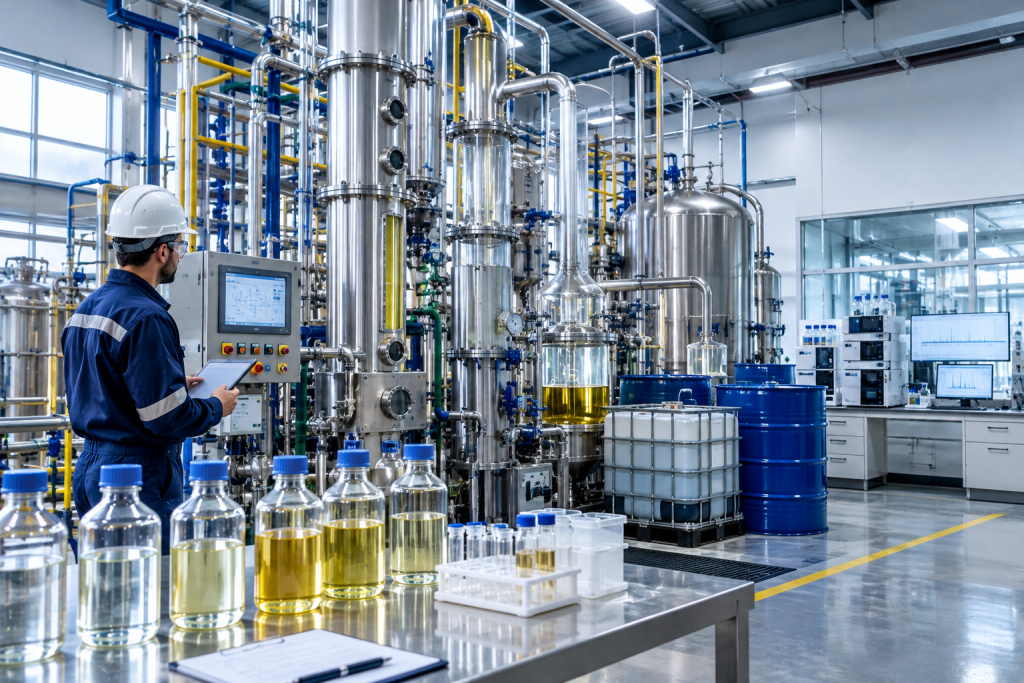
Solvent Recovery and Recycling helps industrial manufacturers recover usable solvents from selected process streams, reduce solvent waste and improve raw-material efficiency. Depending on solvent composition and required purity, recovery may involve distillation, condensation, adsorption, filtration or a combination of separation technologies.
For chemical manufacturers, pharmaceutical producers, coatings companies and industrial cleaning operations, Solvent Recovery and Recycling can reduce dependence on fresh materials when recovered solvent meets the required specification. The right approach depends on contamination, recovery yield, energy consumption, quality requirements and local waste-management regulations.
What Is Solvent Recovery and Recycling?
Solvent Recovery and Recycling involves separating and purifying usable solvent from a spent or contaminated stream. Recovery is the separation process, while recycling means returning the recovered material to an appropriate process or other approved use. Both activities can reduce demand for virgin solvents when the recovered material meets the specification required for its intended application.
During manufacturing, solvents may become contaminated with resins, oils, pigments, water, dissolved solids or reaction by-products. A recovery process must account for these substances because they can affect separation efficiency, solvent quality and equipment performance.
For an overview of materials used in manufacturing, visit the Aasad Chimie products page. The suitability of a recovered solvent must be assessed separately from the specifications of newly supplied material.
Why Do Industries Use Solvent Recovery and Recycling?
Companies evaluate Solvent Recovery and Recycling to improve resource use and manage the cost of solvent-dependent production. Potential benefits include:
- Lower virgin-solvent demand: Suitable recovered material can replace some fresh solvent purchases.
- Reduced waste volume: Recovery can separate usable solvent from contaminants that require further treatment or disposal.
- Improved resource efficiency: Reusing suitable material can keep valuable chemicals in productive use.
- Potential emissions control: Capturing solvent vapors can reduce releases from selected industrial exhaust streams.
- Greater supply resilience: On-site or contracted recovery may reduce dependence on fresh solvent deliveries for some operations.
The economic value of Solvent Recovery and Recycling depends on solvent purchase costs, recovery yield, energy demand, labor, equipment investment, maintenance, analytical testing and residue disposal. The US Environmental Protection Agency’s guidance on hazardous waste recycling explains the broader concept of reclaiming useful materials from waste streams.
What Are the Main Solvent Recovery Methods?
The most suitable Solvent Recovery and Recycling method depends on the physical and chemical properties of the solvent stream. Some processes require only one separation stage, while complex mixtures may need pretreatment and several purification steps.
1. Distillation
Distillation separates components according to differences in volatility. The contaminated liquid is heated, and vapor is collected and condensed. Simple batch distillation may be appropriate for some solvent streams, while fractional distillation can help separate mixtures containing components with different volatilities.
Distillation is less effective when the solvent and contaminants are difficult to separate, form azeotropes or have similar volatility. Heat-sensitive materials, viscous residues and compounds that can decompose during heating may require a different process design or pretreatment.
2. Condensation
Condensation captures solvent vapor by cooling it until some of the vapor returns to liquid form. It can be used in selected exhaust and process-vapor applications. Recovery performance depends on solvent concentration, vapor pressure, operating temperature and condenser design.
Condensation may not recover all solvent from a gas stream. Additional adsorption, absorption or another treatment stage may be needed when lower outlet concentrations are required.
3. Adsorption
Adsorption systems can capture certain solvent vapors on a solid material, commonly activated carbon. When the adsorbent becomes loaded, a suitable regeneration process can release the retained solvent for condensation and possible further purification.
Adsorbent selection and operating conditions must match the solvent and gas stream. Humidity, temperature, competing compounds and the potential for heat generation can affect performance and safety.
4. Membrane Separation
Specialized membranes can selectively separate components from certain liquid or vapor mixtures. Their practical value depends on membrane compatibility, solvent composition, pressure, concentration and the required separation performance. Membrane systems should be evaluated for the specific process rather than assumed to work for every solvent mixture.
5. Filtration and Pretreatment
Filtration, settling, decanting and other pretreatment steps may remove suspended solids, free water or other material before the main recovery stage. These operations do not necessarily remove dissolved contaminants, so additional purification may still be required.
The US EPA’s technical reference on waste solvent reclamation describes methods including mechanical separation, condensation, adsorption and distillation.
Which Industries Use Solvent Recycling?
Solvent Recovery and Recycling can support industries that generate reusable solvent streams during production, formulation, extraction or equipment cleaning. Actual feasibility depends on the contamination profile and the quality required for reuse.
Chemical Manufacturing
Chemical plants may recover solvents used in reactions, extraction, washing and purification. The recovery route depends on process chemistry and whether impurities can be removed without changing the recovered solvent’s composition.
Paints and Coatings
Coatings operations may generate solvent-containing streams during equipment cleaning, formulation changes and production. Recovered material may be suitable for a compatible cleaning task or another approved application, provided its composition and performance meet the relevant requirements.
Adhesives and Printing
Adhesive production, printing and packaging operations may use organic solvents in formulations or equipment cleaning. Recovery feasibility depends on the presence of resins, pigments, binders and mixed solvents that can complicate purification.
Pharmaceutical Manufacturing
Pharmaceutical facilities may recover solvents used in synthesis, extraction and purification. Reuse requires appropriate quality specifications, documented controls and any validation required by the process. Recovered solvent should not be returned to a critical application solely because it appears clear or has a familiar odor.
Industrial Cleaning and Degreasing
Some cleaning operations generate spent solvent containing oil, grease and suspended particles. Depending on the chemistry and contamination level, pretreatment and distillation may allow the solvent to be reused for a suitable task. Facilities should evaluate worker exposure, fire protection, equipment compatibility and residue management before choosing on-site recovery.
How to Select a Solvent Recovery System
Effective Solvent Recovery and Recycling starts with a representative analysis of the solvent stream. Before selecting equipment, document the following factors:
- Solvent identity and composition: Identify the major components and any hazardous or incompatible contaminants.
- Water and solids content: Determine whether pretreatment, drying or phase separation is needed.
- Required recovered-solvent purity: Define the specification for the intended reuse, including any critical impurities.
- Feed volume and variability: Assess batch size, daily throughput and changes in contamination over time.
- Separation feasibility: Evaluate volatility, boiling-point relationships, azeotropes and the potential for thermal degradation.
- Operating costs: Include utilities, labor, maintenance, testing, downtime and management of concentrated residues.
- Safety and compliance: Review flammability, exposure risks, ventilation, hazardous-area requirements and applicable local regulations.
A pilot trial or laboratory separation test can help determine whether the recovered material meets the required specification. Technical decisions should be based on representative samples and documented results, not on a generic recovery percentage applied to every solvent.
Solvent Recovery and VOC Emissions Control
Some organic solvents are volatile organic compounds (VOCs), which can be released during storage, transfer, processing or waste handling. A properly designed vapor-recovery system can capture solvent from selected process exhaust streams and return it for further treatment or reuse.
Solvent Recovery and Recycling can contribute to emissions management, but liquid-solvent recovery and vapor-emission control are different tasks. A system that purifies contaminated liquid may not control fugitive emissions from tanks, pumps, seals or transfer points. A complete management plan should consider closed handling, appropriate ventilation, leak prevention and suitable vapor capture.
Facilities may also compare recovery with substitution, process optimization or lower-emission formulations. The appropriate option depends on performance requirements, worker safety, environmental obligations and the complete operating cost.
Quality Control Before Reusing Recovered Solvent
Recovered solvent should be released for reuse only after the relevant quality requirements have been met. Testing may include identity, water content, purity, acidity, color, residue or other application-specific properties. The exact test panel depends on the solvent and its intended use.
Where solvent is used in a regulated or quality-critical process, the facility should document acceptance criteria, sampling procedures, batch traceability and authorization for reuse. A recovered batch that fails its original specification may still be suitable for a different approved application, but only after that use has been evaluated and accepted.
For comparison, manufacturers can review product information for Ethyl Acetate, Methyl Acetate and Normal Butyl Acetate. These product pages provide context for fresh solvent options; they do not establish that a recovered batch meets any particular grade specification.
Safety, Storage and Waste Management
Spent and recovered solvents may have different hazard profiles from the original material because contaminants can change their flammability, toxicity, reactivity or exposure risks. Containers should be compatible with the material, appropriately closed and labeled, and managed according to the applicable safety data and regulatory requirements.
Recovery equipment may require appropriate electrical classification, bonding and grounding, ventilation, temperature controls, pressure protection and fire safeguards. The specific controls depend on the substances and process design; a qualified safety professional should assess the installation.
Operators should review the relevant Safety Data Sheets and the United Nations Globally Harmonized System (GHS) for chemical hazard classification and communication. Distillation residues, filters and other concentrated waste must also be characterized and managed appropriately. Recovery does not eliminate the need for compliant waste handling.
How Can Manufacturers Assess the Economics?
The financial case for Solvent Recovery and Recycling depends on the amount of solvent recovered at a usable quality and the cost of obtaining that result. A practical assessment compares avoided fresh-solvent purchases and avoided disposal costs with capital investment, energy, labor, maintenance, testing and residual-waste costs.
Recovery may be attractive when the solvent is valuable, the waste stream is reasonably consistent and the recovered product has a reliable use. It may be less attractive when contaminants are difficult to separate, the feed volume is low or the recovered solvent cannot meet the required specification.
For companies operating in Iran, India and Turkey, the assessment should also account for local environmental and waste rules, equipment availability, logistics and the cost of fresh solvent supply. These factors differ by location and facility, so a site-specific evaluation is essential.
Conclusion
Solvent Recovery and Recycling can help manufacturers reduce virgin-solvent demand, recover useful materials and manage solvent-containing waste. Distillation, condensation, adsorption, membrane separation and pretreatment each serve different purposes, and many systems combine more than one method.
The most suitable solution is the one that consistently produces solvent meeting the requirements of its intended reuse while managing safety, energy demand, operating costs and residual waste. For information about available industrial chemicals and solvent options, explore the Aasad Chimie product range or contact Aasad Chimie to discuss your requirements.
Technical note: Recovery feasibility and recovered-solvent specifications should be confirmed through representative testing, process evaluation and applicable safety documentation.
What is solvent recovery and recycling?
Solvent recovery and recycling is the process of collecting used industrial solvents, removing contaminants, and restoring them to a quality suitable for reuse. Common techniques include distillation, condensation, adsorption, and membrane separation. The appropriate method depends on solvent composition, contamination levels, purity requirements, and operating costs.
Which solvents can be recovered and recycled?
Many industrial solvents can be recovered, including ethyl acetate, butyl acetate, alcohols, ketones, and certain aromatic solvents. Recovery feasibility depends on the solvent mixture, impurities, thermal stability, and required final purity. A technical assessment helps determine whether the recovered solvent is suitable for reuse in the original process or another application.
Does solvent recycling reduce industrial costs?
Solvent recycling can reduce the need to purchase virgin solvents and may lower waste treatment and disposal costs. However, overall savings depend on solvent prices, recovery efficiency, energy consumption, equipment investment, and quality-control requirements. A cost-benefit analysis should compare the full recovery cost with the cost of purchasing and disposing of solvents.
Which solvent recovery method is most effective?
Distillation is widely used when solvents have suitable boiling-point differences and can tolerate the required temperatures. Condensation can recover solvent vapors, while adsorption and membrane separation may suit specific mixtures or emission-control applications. The most effective method depends on the feed composition, target purity, recovery rate, and process conditions.
Is recovered solvent safe for reuse?
Recovered solvent can be suitable for reuse when it meets the specifications required by the intended application. Before reuse, it should undergo appropriate quality testing, such as purity analysis and checks for water or residual contaminants. Safety data, process compatibility, and applicable environmental and workplace regulations must also be considered.