


Table of Contents
- What Determines Polypropylene Performance?
- Common Problems Affecting Polypropylene Performance
- How Additives Improve Polypropylene Performance
- 1. Impact Modifiers for Better Toughness
- 2. Mineral Fillers for Stiffness and Dimensional Stability
- 3. Antioxidants for Thermal Stability
- 4. UV Stabilizers for Outdoor Durability
- Choosing the Right Solution for Each Application
- Polypropylene Performance in Industrial Applications
- How to Test and Validate Polypropylene Performance
- How Aasad Chimie Supports Material Selection
- Conclusion
- How can polypropylene performance be improved?
- Which additives improve polypropylene impact resistance?
- How can polypropylene thermal stability be improved?
- What fillers are used in polypropylene compounds?
- How is polypropylene performance evaluated?
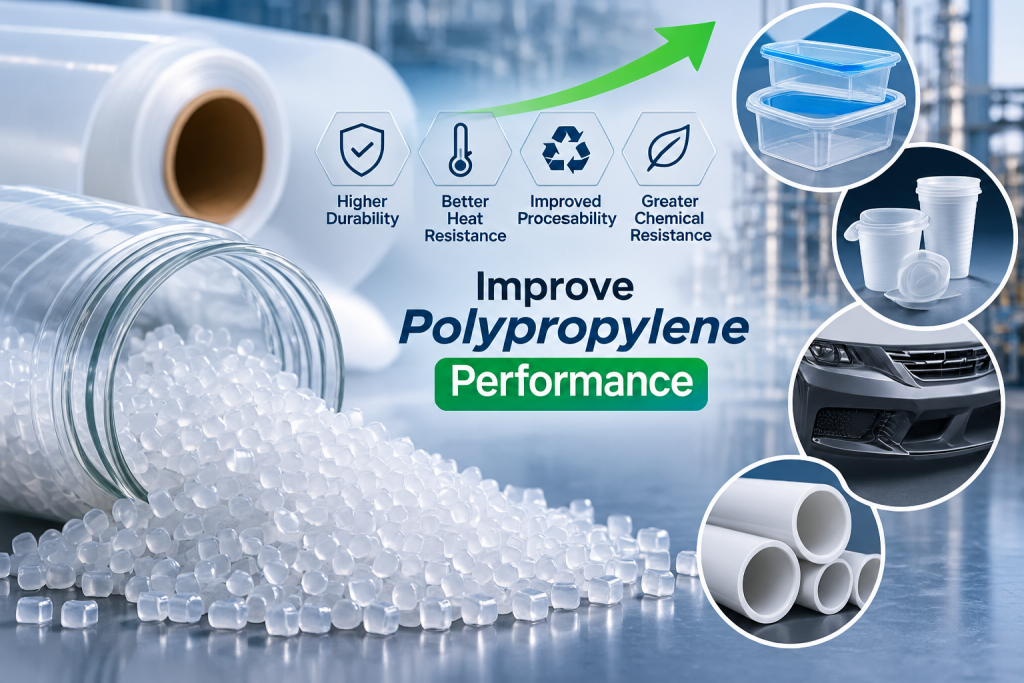
Polypropylene performance depends on the polymer grade, formulation, processing conditions, and intended application. Manufacturers can improve polypropylene properties by selecting suitable impact modifiers, mineral fillers, antioxidants, and UV stabilizers. The right formulation helps balance toughness, stiffness, thermal stability, durability, and processing efficiency while meeting the requirements of industrial plastic products.
What Determines Polypropylene Performance?
Polypropylene (PP) is a versatile thermoplastic used in packaging, automotive components, household products, and industrial parts. Its performance depends on molecular structure, melt flow characteristics, crystallinity, additives, and manufacturing conditions. A grade designed for injection molding may behave differently from one intended for film extrusion or fiber production.
To improve polypropylene performance, manufacturers should first identify the required properties and define measurable acceptance criteria. These may include impact strength, tensile strength, flexural modulus, dimensional stability, heat resistance, and resistance to outdoor weathering.
Common Problems Affecting Polypropylene Performance
- Low impact resistance: Components may crack under sudden loading or become brittle at low temperatures.
- Insufficient stiffness: Parts may bend or deform under mechanical stress.
- Thermal degradation: Excessive processing temperatures or prolonged heat exposure may damage the polymer.
- UV degradation: Sunlight exposure can cause discoloration, embrittlement, and loss of mechanical properties.
- Processing difficulties: Unsuitable melt flow, poor dispersion, or inconsistent processing conditions may affect product quality.
These issues have different causes, so no single additive can solve every problem. Effective polypropylene performance improvement starts with identifying the root cause and matching the material solution to the application.
How Additives Improve Polypropylene Performance
Specialized additives modify selected properties of polypropylene. Their effectiveness depends on additive chemistry, dosage, compatibility, dispersion, and processing conditions. For a broader overview, read our guide to polypropylene additives.
1. Impact Modifiers for Better Toughness
Impact modifiers can improve the toughness of polypropylene compounds and help reduce brittle failure. They are useful in selected automotive parts, consumer products, and industrial components exposed to impact. The formulation must balance impact resistance with stiffness, flow behavior, and other performance requirements.
Learn more about polypropylene impact modifiers and their role in polypropylene compounds.
2. Mineral Fillers for Stiffness and Dimensional Stability
Mineral fillers such as talc and calcium carbonate can change stiffness, dimensional stability, density, surface finish, and formulation cost. Talc is commonly selected when greater rigidity is required, while calcium carbonate can provide a cost-effective option in suitable formulations.
Filler performance depends on particle characteristics, loading level, surface treatment, and dispersion. Higher filler content does not automatically improve every property; it may also affect impact strength, weight, and processability.
Explore our technical guides to talc fillers in polypropylene compounds and calcium carbonate fillers in plastics.
3. Antioxidants for Thermal Stability
Antioxidants help limit oxidative degradation during processing and service. Primary antioxidants interrupt oxidation reactions, while secondary antioxidants can help decompose hydroperoxides. They are often combined according to the polymer grade, processing temperature, and expected service conditions.
Appropriate stabilization can help maintain material properties during processing and use. Learn more about antioxidants for plastics.
4. UV Stabilizers for Outdoor Durability
Polypropylene products exposed to sunlight may require UV protection to reduce weathering-related deterioration. UV absorbers and hindered amine light stabilizers (HALS) work through different mechanisms and may be selected according to the application, pigment system, and expected exposure.
Outdoor products should be evaluated under relevant weathering conditions because the required protection depends on exposure intensity, product geometry, and expected service life. UV stabilization is therefore an important consideration when long-term polypropylene performance is required outdoors.
Choosing the Right Solution for Each Application
The most suitable formulation depends on the product’s functional requirements. The following table provides a starting point for improving polypropylene performance.
| Performance requirement | Potential solution | Important consideration |
|---|---|---|
| Higher impact resistance | Impact modifiers | Balance toughness with stiffness and flow |
| Greater rigidity | Talc or other suitable mineral fillers | Evaluate impact strength and weight |
| Improved oxidation resistance | Primary and secondary antioxidants | Consider processing and service temperatures |
| Better outdoor durability | UV stabilizers and suitable pigments | Match protection to exposure conditions |
| More consistent processing | Appropriate grade selection and processing aids | Check melt flow, dispersion, and equipment settings |
These options are not universal prescriptions. Formulations should be developed and tested against the requirements of the final product. A balanced approach is more effective than maximizing one property at the expense of others.
Polypropylene Performance in Industrial Applications
In automotive applications, polypropylene compounds may require a balance of impact resistance, stiffness, dimensional stability, and heat resistance. Interior trim, housings, and selected structural components therefore need formulations suited to their specific operating conditions.
In packaging, the priorities may include stiffness, flexibility, surface quality, clarity, and resistance to repeated handling. Food-contact applications must also comply with the regulations applicable to the intended market and use.
Industrial and household products have different performance requirements. Outdoor products may need weathering protection, while rigid molded parts may benefit from carefully selected mineral fillers. Improving polypropylene performance requires matching the material formulation to the intended application rather than choosing additives by category alone.
How to Test and Validate Polypropylene Performance
After selecting a formulation, manufacturers should compare the modified material with a suitable baseline grade. Testing should reflect the intended application and relevant industry requirements. International standards can help provide consistent test procedures and comparable results.
- Impact testing: Evaluate resistance to sudden loading using an applicable method, such as ISO 179 or ISO 180.
- Tensile testing: Measure tensile properties using an appropriate method, such as ISO 527.
- Flexural testing: Assess stiffness using an applicable method, such as ISO 178.
- Melt flow testing: Evaluate flow behavior using the relevant procedure, such as ISO 1133-1.
- Weathering evaluation: Select an exposure method suited to the intended outdoor service conditions.
For testing guidance, consult the official standards published by the International Organization for Standardization (ISO). Relevant documents include ISO 527 for tensile properties, ISO 178 for flexural properties, and ISO 1133-1 for melt mass-flow rate. Verify the current edition and applicability of each standard before testing.
Test results depend on specimen preparation, conditioning, equipment, and test settings. Consistent methods are essential when comparing formulations or verifying whether a material meets its performance targets.
How Aasad Chimie Supports Material Selection
Selecting suitable chemicals and additives requires a clear understanding of the intended application, processing method, and target properties. Aasad Chimie provides product information to help industrial buyers evaluate materials for their requirements.
Visit our products page to explore available products, or contact our team to discuss your application and material requirements.
For more technical resources, browse our articles and insights and our guide to plastic additives, types, and uses.
Conclusion
Improving polypropylene performance starts with identifying the properties that matter most for the final application. Impact modifiers can support toughness, mineral fillers can increase stiffness in suitable formulations, antioxidants help protect against oxidation, and UV stabilizers can improve outdoor durability. Careful grade selection, controlled processing, and application-specific testing are essential to verify that the final material meets its performance targets.
By evaluating the intended use and testing the selected formulation, manufacturers can make better-informed decisions about polypropylene compounds and achieve a more appropriate balance of durability, processability, and cost.
How can polypropylene performance be improved?
Polypropylene performance can be improved through appropriate grade selection, impact modifiers, mineral fillers, antioxidants, UV stabilizers, and optimized processing conditions.
Which additives improve polypropylene impact resistance?
Impact modifiers are commonly used to improve the toughness of polypropylene compounds. The right type and loading depend on the target impact strength and required balance of stiffness and processability.
How can polypropylene thermal stability be improved?
Antioxidants help limit oxidative degradation during processing and service. The appropriate stabilization system depends on the polymer grade and thermal conditions.
What fillers are used in polypropylene compounds?
Talc and calcium carbonate are common mineral fillers. They can modify stiffness, dimensional stability, density, and cost, but their effects on impact strength and processing must also be considered.
How is polypropylene performance evaluated?
It can be evaluated through application-specific impact, tensile, flexural, melt flow, and weathering tests using appropriate methods and product specifications.