


Table of Contents
- What Are Polymer Additives?
- Why Are Polymer Additives Important?
- Main Types of Polymer Additives
- Functional Fillers in Polymer Manufacturing
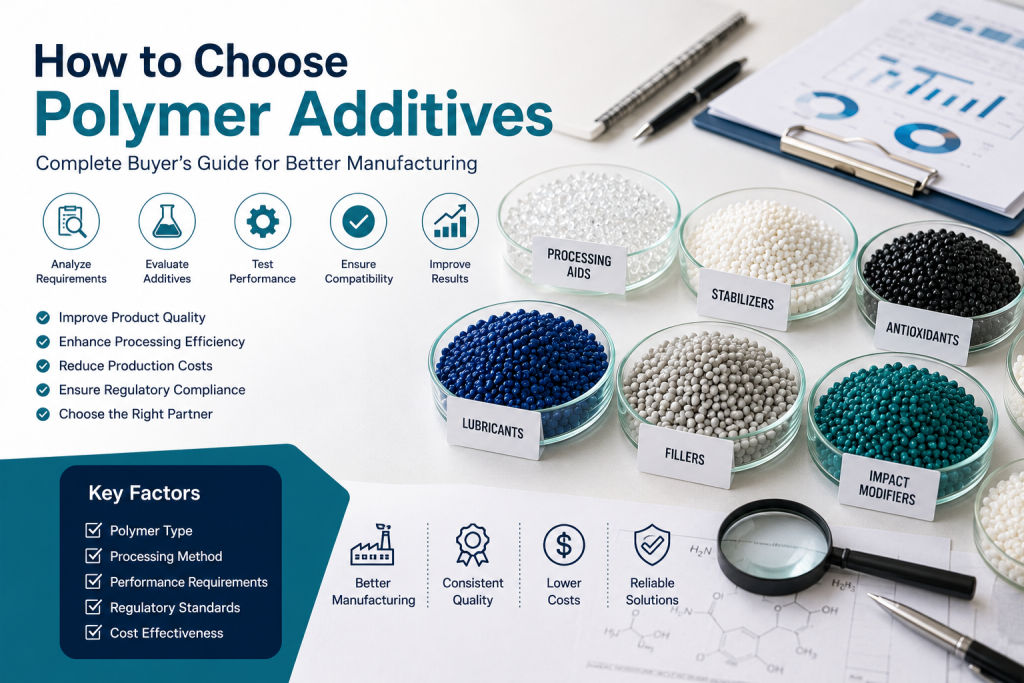
- How to Choose Polymer Additives
- 1. Identify the Base Polymer
- 2. Define the Manufacturing Problem
- 3. Match the Additive to the Required Function
- 4. Check Processing Conditions
- 5. Review End-Use Requirements
- 6. Compare Total Cost
- Common Polymer Processing Problems and Possible Solutions
- Polymer Additive Applications by Industry
- Plastic Packaging
- Automotive Components
- Construction Materials
- Electrical Components
- Consumer Goods
- Medical Plastics
- Supplier Quality and Technical Documentation
- Testing Polymer Additives Before Full-Scale Production
- Common Mistakes When Selecting Polymer Additives
- Future Trends in Polymer Additives
- Conclusion
- Related Articles
- References
- Why Choose AasadChimie?
- What are polymer additives?
- What are the main types of polymer additives?
- How do manufacturers choose polymer additives?
- Can polymer additives reduce production costs?
- Why is compatibility important when selecting polymer additives?
- Should polymer additives be tested before production?
Polymer additives are materials incorporated into polymers to improve processing, modify physical properties, protect against degradation, or optimize manufacturing costs. The right additive depends on the base resin, processing method, product requirements, operating conditions, and intended application.
Manufacturers in the packaging, automotive, construction, electrical, and consumer goods industries use polymer additives to address challenges such as poor melt flow, thermal degradation, low stiffness, surface defects, and inconsistent production. Selecting compatible additives can improve manufacturing efficiency and help produce plastics with more consistent performance.
This guide explains the main types of polymer additives, their functions, selection criteria, processing considerations, common mistakes, and practical testing methods for industrial applications.
What Are Polymer Additives?
Polymer additives are substances blended into a polymer formulation to achieve specific processing or performance objectives. They may be incorporated during compounding or at another appropriate manufacturing stage, depending on the material and production process.
Some additives protect polymer chains from heat or oxidation, while others modify stiffness, flexibility, friction, impact resistance, or surface behavior. Their effectiveness depends on chemical compatibility, dosage, dispersion, processing conditions, and interactions with other ingredients.
Polymer additives are not interchangeable. A material designed to improve melt flow may not provide UV protection, and a filler intended to increase stiffness may not improve impact resistance. Manufacturers should therefore identify the required function before choosing a product.
Why Are Polymer Additives Important?
Plastic manufacturing involves balancing material properties, processing performance, quality requirements, and cost. Properly selected polymer additives can help manufacturers address these priorities without changing the base polymer unnecessarily.
- Improved processability: Appropriate processing aids may support material flow and more stable processing.
- Enhanced mechanical properties: Selected fillers and modifiers can change stiffness, toughness, or dimensional stability.
- Better thermal stability: Suitable stabilizers and antioxidants help protect polymers against specific degradation mechanisms.
- Improved surface quality: Certain lubricants and processing aids can help address friction-related or surface-related problems.
- Reduced production waste: A validated formulation may help reduce defects and inconsistent output.
- Cost optimization: Suitable filler systems and process improvements may reduce overall manufacturing costs.
- Longer service life: Appropriate stabilization can improve resistance to defined environmental conditions.
These benefits are formulation-dependent. Additives should be evaluated against measurable product specifications rather than broad performance claims.
Main Types of Polymer Additives
| Additive Type | Main Function | Typical Considerations |
|---|---|---|
| Functional fillers | Modify stiffness, dimensional stability, and material cost | Particle size, loading, dispersion, and compatibility |
| Processing aids | Support processing behavior and material flow | Resin type, equipment, and operating conditions |
| Heat stabilizers | Help reduce heat-related degradation | Polymer chemistry and processing temperature |
| Antioxidants | Help limit oxidative degradation | Thermal history and expected service conditions |
| UV stabilizers | Help protect polymers against UV exposure | Exposure intensity and outdoor service requirements |
| Lubricants | Modify friction during processing | Surface quality and downstream operations |
| Impact modifiers | Improve impact performance in suitable formulations | Balance between toughness and stiffness |
| Slip agents | Reduce surface friction in selected applications | Film handling, sealing, and printing |
| Antiblocking agents | Reduce sticking between adjacent film surfaces | Optical and mechanical requirements |
Functional Fillers in Polymer Manufacturing
Functional fillers are used to modify selected properties of polymer compounds. Depending on the formulation, they may improve stiffness, dimensional stability, or other material characteristics while changing the cost of the finished compound.
Calcium carbonate is commonly used in suitable plastic formulations. Its performance depends on particle characteristics, surface treatment, concentration, dispersion, and compatibility with the polymer matrix. Excessive loading or inadequate dispersion may negatively affect impact performance, surface quality, or processing behavior.
Manufacturers can learn more about functional fillers, functional filler powder, and advanced functional filler powder.
For formulations involving calcium carbonate, see the guide to calcium carbonate filler masterbatch. The appropriate filler concentration should be established through technical evaluation and application-specific testing.
How to Choose Polymer Additives
Choosing polymer additives requires a systematic review of the resin, production process, performance targets, and economic requirements. The following steps help manufacturers narrow down suitable materials.
1. Identify the Base Polymer
Polyethylene (PE), polypropylene (PP), polyvinyl chloride (PVC), polyethylene terephthalate (PET), ABS, and engineering plastics have different chemical and processing characteristics. An additive suitable for one polymer may perform differently in another.
Confirm the exact resin grade, whether recycled material is present, and which ingredients are already included in the formulation. This information helps identify compatibility requirements and reduces the risk of unwanted interactions.
2. Define the Manufacturing Problem
Identify the issue that needs to be corrected before selecting an additive. Common challenges include poor melt flow, surface defects, low stiffness, excessive shrinkage, UV degradation, thermal oxidation, poor filler dispersion, and high material costs.
Not every defect is caused by the formulation. Equipment condition, contamination, temperature, screw speed, cooling, and residence time may also contribute. Investigating these factors can prevent unnecessary additive changes.
3. Match the Additive to the Required Function
Choose the additive category based on the desired outcome. Processing aids may be considered for specific flow-related issues, stabilizers for defined degradation mechanisms, and functional fillers when the formulation requires changes in stiffness or other properties.
For extrusion challenges, review ways to reduce extrusion defects. Manufacturers working with polypropylene can also consult the guide to improving melt flow in polypropylene.
4. Check Processing Conditions
Processing temperature, residence time, screw speed, shear, and equipment design influence additive performance. Verify that the selected material is suitable for the actual processing window and can be dispersed consistently.
Consider whether the additive affects color, odor, surface finish, printing, sealing, welding, coating, or other downstream operations. A formulation should be evaluated as a complete system rather than as a collection of independent ingredients.
5. Review End-Use Requirements
Finished products may require specific levels of stiffness, flexibility, impact resistance, thermal stability, weathering resistance, or chemical resistance. Outdoor applications may need UV protection, while food-contact or medical applications may require additional compliance documentation and testing.
Confirm the requirements of the target market and the intended application before approving an additive. A general technical data sheet alone may not establish compliance for every end use.
6. Compare Total Cost
The lowest price per kilogram does not always deliver the lowest production cost. Compare the additive dosage, cost per unit of finished product, manufacturing throughput, waste, rejection rates, and downstream processing requirements.
Whenever possible, compare alternative products under similar processing conditions and use measurable acceptance criteria. This helps distinguish genuine cost savings from changes that merely shift costs elsewhere in production.
Common Polymer Processing Problems and Possible Solutions
| Manufacturing Problem | Factors to Investigate | Possible Approach |
|---|---|---|
| Poor melt flow | Resin grade, temperature, and equipment settings | Review processing conditions and compatible processing aids |
| Thermal degradation | Temperature, residence time, and polymer stability | Optimize processing and evaluate suitable stabilizers |
| Poor filler dispersion | Mixing conditions, particle properties, and compatibility | Review dispersion methods and the filler system |
| Low stiffness | Base resin, formulation, and product specifications | Evaluate suitable fillers or reinforcement systems |
| Surface defects | Contamination, degradation, friction, and equipment | Identify the cause before changing additives |
| High manufacturing cost | Dosage, scrap, throughput, and raw material consumption | Compare formulations using total production cost |
These are starting points for investigation, not universal solutions. Manufacturers should confirm the underlying cause and validate any formulation change before implementation.
Polymer Additive Applications by Industry
Plastic Packaging
Packaging manufacturers may use processing aids, slip agents, antiblocking agents, stabilizers, and fillers to meet production and product requirements. Film handling, sealing performance, optical properties, and applicable food-contact requirements must be considered when selecting additives.
Automotive Components
Automotive applications may require specific mechanical performance, dimensional stability, thermal resistance, and durability. The additive package should be selected according to the component specification and the relevant qualification tests.
Construction Materials
Plastic products used in construction may be exposed to sunlight, temperature changes, moisture, and mechanical stress. Depending on the application, manufacturers may evaluate suitable stabilizers, fillers, and modifiers to achieve the required service performance.
Electrical Components
Electrical applications require careful consideration of thermal behavior, dimensional stability, and applicable electrical safety requirements. Material selection should be based on the complete component specification and relevant testing.
Consumer Goods
Consumer products may prioritize appearance, surface finish, impact performance, durability, and cost. The formulation should balance these properties rather than optimizing one characteristic at the expense of others.
Medical Plastics
Medical applications require particularly careful assessment of material suitability, traceability, purity, and regulatory requirements. Only materials supported by appropriate documentation and validation should be considered for a defined medical use.
Supplier Quality and Technical Documentation
A reliable supplier should provide clear product specifications and documentation that allow manufacturers to assess suitability. Before purchasing polymer additives, review the technical data sheet (TDS), safety data sheet (SDS), batch specifications, recommended storage conditions, and relevant application guidance.
Depending on the product and market, additional declarations or certificates may be required. Verify that documents apply to the exact product and intended application; a general company certificate does not automatically establish compliance for every material.
Useful sources for standards and chemical information include ASTM International, ISO standards, the European Chemicals Agency, and PubChem. Manufacturers should also check the regulations applicable to the destination market.
Testing Polymer Additives Before Full-Scale Production
Laboratory evaluation and controlled production trials help determine whether an additive achieves the intended result. Before testing begins, define the baseline performance, target properties, and acceptance criteria.
- Document the existing formulation and production settings.
- Identify the specific problem or property to improve.
- Prepare trial formulations following supplier recommendations.
- Keep unrelated process variables consistent where practical.
- Measure the relevant processing and finished-product properties.
- Check for unwanted effects on appearance, strength, or downstream operations.
- Repeat testing where necessary to confirm consistency before approval.
Depending on the application, testing may include melt flow, tensile properties, impact resistance, dimensional stability, thermal performance, surface quality, or weathering resistance. Appropriate test methods should be selected according to the product specification and applicable standards.
Common Mistakes When Selecting Polymer Additives
- Choosing only by price: This can overlook waste, performance, and downstream costs.
- Ignoring compatibility: Different polymers and formulations may respond differently to the same additive.
- Using excessive filler loading: Higher loading does not automatically improve overall performance.
- Overlooking processing conditions: Temperature and residence time can influence additive effectiveness.
- Ignoring interactions: Additives can affect one another and the properties of the complete formulation.
- Accepting unverified claims: Technical documentation and controlled test results are more useful than unsupported promises.
- Skipping trials: Unvalidated changes may introduce defects or inconsistent output.
- Failing to record results: Trial records help reproduce successful formulations and investigate future problems.
Future Trends in Polymer Additives
Polymer formulation continues to evolve as manufacturers seek better material efficiency, durability, processing consistency, and compatibility with recycling systems. These priorities require careful evaluation because improvements in one property may create trade-offs elsewhere.
- Recycling-compatible formulations: Additives are evaluated for their influence on selected recycling processes and recycled material performance.
- Improved filler dispersion: Better dispersion strategies can help support more consistent properties.
- Advanced stabilization: Formulations are developed to address defined processing and service-life requirements.
- Resource efficiency: Manufacturers assess approaches that may reduce material waste and improve production consistency.
- Application-specific solutions: Additive systems are selected to meet defined performance targets instead of relying only on general-purpose formulations.
New materials and sustainability claims should be assessed through technical data, application-specific trials, and relevant performance criteria before adoption.
Conclusion
Polymer additives play an important role in plastic processing, material performance, and manufacturing cost management. Selecting the right additive requires a clear understanding of the base polymer, the production challenge, processing conditions, end-use requirements, and compatibility with the existing formulation.
Manufacturers should compare suppliers, review technical documentation, and validate formulations through controlled testing before full-scale implementation. A systematic selection process helps reduce avoidable errors and supports consistent, specification-driven manufacturing.
To explore industrial materials, visit the AasadChimie products page. For product information and inquiries about industrial chemical requirements, contact AasadChimie.
Related Articles
- Functional Fillers
- Advanced Functional Filler Powder
- Functional Filler Powder
- Calcium Carbonate Filler Masterbatch
- Improve Calcium Carbonate Dispersion
- Reduce Extrusion Defects
- Improve Melt Flow in Polypropylene
- Industrial Solvents
- Mono Ethylene Glycol
- Isopropyl Alcohol (IPA)
References
Why Choose AasadChimie?
AasadChimie provides information about industrial chemicals and materials for manufacturing applications. When evaluating any supplier, manufacturers should review product specifications, technical documentation, quality consistency, and suitability for their intended process. Careful material selection and appropriate validation support informed purchasing decisions and reliable production planning.
What are polymer additives?
Polymer additives are materials incorporated into polymers to modify processing behavior, improve selected properties, or provide protection against specific degradation mechanisms.
What are the main types of polymer additives?
Common categories include functional fillers, processing aids, heat stabilizers, antioxidants, UV stabilizers, lubricants, impact modifiers, slip agents, and antiblocking agents.
How do manufacturers choose polymer additives?
They should consider the base resin, processing conditions, target properties, compatibility, regulatory requirements, supplier documentation, and total manufacturing cost.
Can polymer additives reduce production costs?
Suitable additives may reduce waste, improve processing efficiency, or optimize formulations. The actual economic benefit must be confirmed through testing and total-cost analysis.
Why is compatibility important when selecting polymer additives?
Compatibility influences dispersion, processing stability, and final product properties. An unsuitable additive may cause defects or negatively affect performance.
Should polymer additives be tested before production?
Yes. Controlled laboratory or production trials help verify performance, identify side effects, and confirm that the formulation meets the required specifications.