


Table of Contents
- What Are Plastic Defects?
- Quick Technical Overview
- Why Do Plastic Defects Occur?
- The Cost of Plastic Quality Problems
- Four Main Categories of Plastic Defects
- 1. Surface Defects
- 2. Structural Defects
- 3. Dimensional Defects
- 4. Processing Defects
- How Plastic Raw Materials Affect Product Quality
- The Role of Polymer Additives in Preventing Plastic Defects
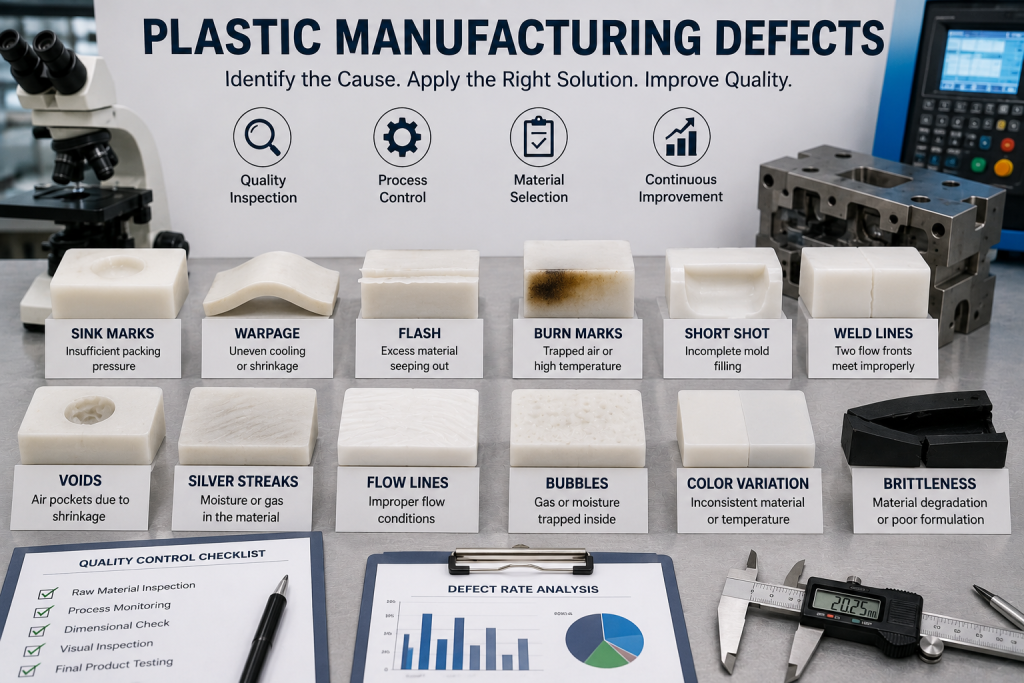
- 12 Common Plastic Defects and How to Prevent Them
- 1. Sink Marks
- 2. Warpage
- 3. Flash
- 4. Burn Marks
- 5. Short Shots
- 6. Weld Lines
- 7. Voids
- 8. Silver Streaks
- 9. Flow Lines
- 10. Bubbles
- 11. Color Variation
- 12. Brittleness
- Plastic Defects Troubleshooting Table
- Best Practices to Reduce Plastic Defects
- A Practical Root-Cause Analysis Workflow
- The Future of Plastic Quality Control
- Conclusion
- Related Resources
- References
- What are the most common plastic defects?
- What causes defects in plastic products?
- How can manufacturers prevent plastic defects?
- Can polymer additives prevent plastic defects?
- Why do plastic products become brittle?
- How can manufacturers identify the root cause of a defect?
Plastic Defects can reduce product quality, increase manufacturing costs, and cause production delays. Problems such as warpage, sink marks, flash, bubbles, and color variation often result from inconsistent raw materials, unsuitable processing conditions, or poor mold maintenance. Identifying the root cause early helps manufacturers prevent recurring failures and improve production efficiency.
Whether a factory manufactures packaging, automotive components, construction materials, household products, or agricultural films, understanding common plastic processing problems is essential. This guide explains 12 frequent defects, their causes, and practical methods to prevent them in industrial manufacturing.
What Are Plastic Defects?
Plastic Defects are imperfections that develop during polymer processing and affect a product’s appearance, dimensions, mechanical strength, or functionality. They can occur during injection molding, extrusion, blow molding, thermoforming, and other plastic manufacturing operations.
Common examples include sink marks, warpage, flash, burn marks, short shots, weld lines, voids, silver streaks, flow lines, bubbles, color variation, and brittleness. Effective prevention requires suitable materials, stable processing parameters, well-maintained equipment, and consistent quality control.
Quick Technical Overview
| Parameter | Details |
|---|---|
| Subject | Plastic processing and product quality |
| Manufacturing methods | Injection molding, extrusion, blow molding, and thermoforming |
| Typical symptoms | Surface marks, distortion, incomplete filling, bubbles, and cracking |
| Potential causes | Material variation, moisture, processing conditions, and tooling issues |
| Prevention methods | Process optimization, material control, maintenance, and inspection |
| Key quality indicators | Scrap rate, dimensional accuracy, surface finish, and mechanical strength |
There is no single temperature, pressure, or cycle time that prevents every defect. Appropriate settings depend on the polymer grade, product geometry, mold design, machine capability, and resin supplier’s technical recommendations.
Why Do Plastic Defects Occur?
Most Plastic Defects do not have one universal cause. A surface imperfection may originate from moisture, contamination, mold design, cooling conditions, or an unsuitable processing window. Changing machine settings without investigating the underlying problem can resolve one symptom while creating another.
Common contributing factors include:
- Incorrect melt, barrel, or mold temperatures.
- Insufficient injection or holding pressure.
- Uneven cooling and inconsistent cycle times.
- Moisture in hygroscopic polymers.
- Inconsistent or contaminated plastic raw materials.
- Unsuitable additives or poor additive dispersion.
- Worn molds, blocked vents, or damaged machine components.
- Incorrect screw speed, injection speed, or residence time.
- Insufficient process monitoring and operator training.
Manufacturers should record processing conditions and compare defective parts with approved samples. This approach helps determine whether the issue is related to the material, equipment, mold, or production process.
The Cost of Plastic Quality Problems
The financial impact of Plastic Defects extends beyond wasted resin. Rejected products also consume machine time, labor, energy, inspection resources, and production capacity. Additional costs may include rework, delayed shipments, customer returns, and warranty claims.
High-volume manufacturers can experience significant losses even when the rejection rate increases only slightly. Tracking scrap percentage, first-pass yield, defect frequency, and downtime helps identify costly problems and prioritize corrective action.
Four Main Categories of Plastic Defects
1. Surface Defects
Surface defects affect the visible appearance of a product. Common examples include burn marks, flow lines, silver streaks, gloss variation, and inconsistent coloration. They may result from moisture, contamination, poor filling behavior, or thermal degradation.
2. Structural Defects
Structural defects affect product integrity or mechanical performance. Voids, internal cracks, weak weld lines, and brittleness can reduce impact resistance or cause premature failure during use.
3. Dimensional Defects
Dimensional problems occur when a component fails to meet its specified geometry. Warpage, excessive shrinkage, and sink marks can affect assembly, fit, and product appearance.
4. Processing Defects
Processing-related problems include flash, incomplete filling, unstable melt flow, and material degradation. These issues may involve machine settings, mold condition, material behavior, or several interacting factors.
How Plastic Raw Materials Affect Product Quality
Consistent raw materials are essential for stable plastic processing. Changes in melt flow rate, moisture content, contamination, recycled content, or additive concentration can influence filling, shrinkage, color, and mechanical performance.
Before changing machine settings, manufacturers should confirm the resin grade and batch, review the technical data sheet, and verify storage and handling conditions. Depending on the application, incoming inspection may include moisture measurement, melt flow testing, color checks, and mechanical testing.
Review relevant product categories on the AasadChimie Products page and evaluate material specifications against the requirements of the intended application.
The Role of Polymer Additives in Preventing Plastic Defects
Polymer additives can improve processing stability or selected product properties when the formulation is contributing to the problem. However, additives cannot correct every manufacturing issue. Their effectiveness depends on the polymer, formulation, dosage, processing method, and compatibility with other ingredients.
- Processing aids: May improve melt flow, surface quality, or processing consistency in suitable formulations.
- Antioxidants: Help protect polymers against oxidative degradation during processing and service.
- UV stabilizers: Help limit degradation caused by ultraviolet exposure in outdoor applications.
- Impact modifiers: Can improve impact resistance in compatible polymer systems.
- Slip and anti-block additives: Can improve film handling and reduce unwanted surface adhesion.
- Chain extenders: May help increase molecular weight in selected polymer systems when the chemistry and process are suitable.
Before introducing an additive, manufacturers should identify the defect mechanism and confirm compatibility with the resin and final application. Correct dosing and controlled production trials are essential for validating the result.
12 Common Plastic Defects and How to Prevent Them
Successful troubleshooting starts with identifying the defect, checking the most likely causes, and validating corrective actions. The following sections explain common problems and practical prevention methods for industrial manufacturers.
1. Sink Marks
Sink marks are shallow depressions on molded surfaces. They commonly appear near thick sections, ribs, bosses, or areas where material cools and shrinks unevenly.
Common causes:
- Insufficient packing or holding pressure.
- Inadequate holding time.
- Thick wall sections or abrupt thickness changes.
- Gate freeze-off before sufficient packing occurs.
Prevention: Review holding pressure and time, check gate dimensions, and improve wall-thickness consistency where possible. Confirm that the gate remains effective during the packing stage. Increasing pressure alone may not solve a geometry-related problem.
2. Warpage
Warpage occurs when a plastic part bends or twists after processing. It is generally associated with uneven shrinkage, residual stress, or differences in cooling across the component.
Common causes:
- Uneven mold cooling.
- Nonuniform wall thickness.
- Incorrect packing conditions.
- Material orientation and shrinkage differences.
Prevention: Balance the cooling system, review mold design, and optimize packing and cooling conditions. Check material shrinkage data before changing resin grades.
3. Flash
Flash is excess plastic that escapes through a mold parting line, ejector pin clearance, or another unintended opening.
Common causes:
- Excessive cavity pressure.
- Insufficient clamping force.
- Worn or damaged mold surfaces.
- Incorrect mold alignment.
Prevention: Inspect the mold, verify clamping performance, and review injection and holding pressures. Reduce pressure only when process evidence indicates that excessive cavity pressure contributes to the problem.
4. Burn Marks
Burn marks are dark or discolored areas that may appear near the end of a flow path or around trapped-air locations. They can result from compressed gas, excessive shear heating, or polymer degradation.
Common causes:
- Insufficient mold venting.
- Excessive injection speed in specific areas.
- Excessive melt temperature or residence time.
- Degraded or contaminated material.
Prevention: Inspect and clean mold vents, review injection speed profiles, and verify melt temperature and residence time. Follow the resin supplier’s recommended processing window.
5. Short Shots
A short shot occurs when molten polymer fails to fill the mold cavity completely. The result may be a missing section, incomplete edge, or undersized feature.
Common causes:
- Insufficient available injection pressure or material volume.
- Restricted gates or runners.
- Low melt temperature or unsuitable flow conditions.
- Trapped air or inadequate venting.
Prevention: Check material feed, gates, runners, and vents. Review injection speed, pressure limits, and melt temperature together. Confirm that the machine has sufficient capacity for the part and mold.
6. Weld Lines
Weld lines form where two or more melt fronts meet around holes, inserts, or separate flow paths. The meeting surfaces may not fuse adequately, reducing local strength or creating visible marks.
Common causes:
- Low melt or mold temperature for the selected material.
- Insufficient flow-front pressure or speed.
- Contamination or material degradation.
- Gate placement that creates unfavorable flow paths.
Prevention: Review gate location, flow path, venting, and processing conditions. If a weld line cannot be eliminated, evaluate its mechanical performance under the intended service conditions.
7. Voids
Voids are internal cavities that may form when material shrinks during cooling and the remaining melt cannot compensate for the volume change. They are often found in thicker sections.
Common causes:
- Insufficient packing.
- Thick sections with high internal shrinkage.
- Early gate freeze-off.
- Unsuitable cooling conditions.
Prevention: Optimize packing pressure and time, examine gate design, and reduce unnecessary thick sections. Use suitable inspection methods when internal integrity is critical.
8. Silver Streaks
Silver streaks are shiny lines on a plastic surface. Depending on the polymer and process, they may indicate moisture, trapped gas, contamination, or material degradation.
Common causes:
- Moisture in hygroscopic resin.
- Excessive melt temperature or residence time.
- Contamination from other materials.
- Air entrainment during plasticization or filling.
Prevention: Follow the resin manufacturer’s drying instructions for moisture-sensitive polymers. Inspect dryers, material handling systems, and regrind storage. Verify the cause before changing processing settings.
9. Flow Lines
Flow lines appear as visible bands or patterns caused by changes in melt-front movement, temperature, or surface solidification. They are especially noticeable on cosmetic surfaces.
Common causes:
- Unstable or unsuitable filling speed.
- Low mold temperature for the application.
- Gate placement or flow-path restrictions.
- Changes in wall thickness.
Prevention: Review the filling profile, mold temperature, gate design, and part geometry. Adjust conditions within the material’s recommended range and compare samples under consistent lighting.
10. Bubbles
Bubbles are gas-filled regions visible on or beneath the surface of a plastic product. They can result from moisture, trapped air, volatile substances, or gas generation during processing.
Common causes:
- Moisture or volatile contaminants.
- Insufficient venting.
- Air trapped during filling.
- Thermal degradation of the polymer.
Prevention: Check material dryness where applicable, remove contamination, and inspect venting. Review screw recovery, back pressure, and melt temperature if air entrainment or degradation is suspected.
11. Color Variation
Color variation occurs when products from the same production run show inconsistent shade, brightness, or color distribution. It can affect appearance and cause batches to fail customer specifications.
Common causes:
- Inconsistent pigment or masterbatch dispersion.
- Incorrect dosing or mixing.
- Temperature fluctuations or polymer degradation.
- Contamination or variation between raw material batches.
Prevention: Verify dosing equipment, mixing conditions, and material compatibility. Use an appropriate masterbatch and follow its recommended let-down ratio. Compare colors with an agreed reference under controlled lighting and use instrumental color measurement where required.
12. Brittleness
Brittleness occurs when a plastic component cracks or fractures under impact or deformation that it should normally withstand. It may be associated with polymer degradation, an unsuitable resin grade, formulation issues, or excessive recycled content for the application.
Common causes:
- Thermal or oxidative degradation.
- Inappropriate polymer grade or molecular weight.
- Contamination or poor material compatibility.
- Unsuitable additive formulation.
- Uncontrolled recycled-material composition.
Prevention: Confirm the resin grade and processing history, avoid excessive heat and residence time, and test the mechanical properties required for the end use. An impact modifier may help in compatible formulations, but dosage and performance should be validated through trials.
Plastic Defects Troubleshooting Table
| Defect | First Checks | Potential Corrective Action |
|---|---|---|
| Sink marks | Wall thickness, packing, gate freeze | Optimize holding conditions and part design |
| Warpage | Cooling balance, shrinkage, residual stress | Balance cooling and review geometry |
| Flash | Mold condition, clamping, cavity pressure | Repair tooling and optimize pressure |
| Burn marks | Venting, melt temperature, residence time | Improve venting and control thermal exposure |
| Short shots | Feed, gates, pressure limits, vents | Correct flow restrictions and filling conditions |
| Weld lines | Gate position, flow fronts, temperature | Improve flow design and validate strength |
| Voids | Packing, thick sections, gate freeze | Improve packing and reduce excessive thickness |
| Silver streaks | Moisture, contamination, degradation | Control drying and material handling |
| Flow lines | Filling profile, mold temperature, gate | Optimize flow and surface solidification |
| Bubbles | Moisture, gas, venting, degradation | Remove the verified source of gas |
| Color variation | Dosing, dispersion, contamination | Standardize mixing and color checks |
| Brittleness | Resin grade, degradation, impact strength | Validate material and formulation changes |
Best Practices to Reduce Plastic Defects
A consistent quality management process helps manufacturers identify production issues before they result in large quantities of rejected parts. The following practices support better process stability and product quality.
- Qualify suppliers and inspect incoming material batches.
- Follow resin drying and storage recommendations.
- Record machine settings for approved production runs.
- Monitor temperatures, pressures, cycle times, and material feed.
- Maintain molds, vents, cooling channels, and machine components.
- Control the proportion and quality of regrind and recycled materials.
- Inspect critical dimensions and surface appearance during production.
- Train operators to recognize early warning signs.
- Document corrective actions and verify their effectiveness.
- Use statistical process control when appropriate for production volume and risk.
A Practical Root-Cause Analysis Workflow
When a defect appears, follow a repeatable investigation instead of changing several variables at once.
- Define the symptom: Record where the issue appears, how frequently it occurs, and which products or mold cavities are affected.
- Check recent changes: Review resin batches, additive dosing, machine settings, mold maintenance, and operator adjustments.
- Inspect materials and equipment: Verify moisture, contamination, feeding consistency, mold condition, and sensor accuracy where relevant.
- Test controlled adjustments: Change one variable at a time where practical and document each trial.
- Validate the result: Inspect appearance, dimensions, and relevant mechanical properties before approving new settings.
- Standardize the solution: Update work instructions and monitor subsequent production runs.
The Future of Plastic Quality Control
Machine vision, automated inspection, process sensors, and data analytics are increasingly used to detect production abnormalities. These technologies can identify surface imperfections, monitor dimensional variation, and alert operators when process signals move outside established limits.
Automated inspection does not replace root-cause analysis. Reliable results depend on suitable sensors, validated inspection criteria, and a clear process for investigating alerts and implementing corrective action.
Conclusion
Preventing Plastic Defects requires a coordinated approach to raw material selection, mold design, process control, equipment maintenance, and product inspection. The appropriate solution depends on the defect mechanism and the polymer system involved.
By documenting production conditions, investigating root causes, and validating corrective actions, manufacturers can reduce scrap, improve product consistency, and control manufacturing costs. Additives can support performance when a formulation issue is confirmed, but they should be selected according to technical compatibility and verified results.
For product-related inquiries, visit the AasadChimie Products page or contact the team through the Contact Us page.
Related Resources
References
- ASTM International — Standards and testing methods for materials and products.
- Plastics Europe — Plastics industry information and resources.
- Society of Plastics Engineers — Plastics processing and engineering resources.
- ScienceDirect — Scientific research on polymer processing and materials.
- American Chemistry Council — Chemistry and plastics industry resources.
What are the most common plastic defects?
Common defects include sink marks, warpage, flash, burn marks, short shots, weld lines, voids, silver streaks, flow lines, bubbles, color variation, and brittleness.
What causes defects in plastic products?
They may result from inconsistent raw materials, moisture, unsuitable processing parameters, mold design problems, contamination, equipment wear, or material degradation.
How can manufacturers prevent plastic defects?
Manufacturers can improve quality by controlling processing conditions, inspecting raw materials, maintaining molds and equipment, and validating corrective actions through appropriate testing.
Can polymer additives prevent plastic defects?
Some additives improve processing stability or selected material properties. Their effectiveness depends on the polymer, formulation, dosage, and processing conditions.
Why do plastic products become brittle?
Brittleness can result from polymer degradation, an unsuitable resin grade, contamination, poor material compatibility, or a formulation that does not meet the product's impact requirements.
How can manufacturers identify the root cause of a defect?
They should document the symptoms, review material and process changes, inspect equipment, conduct controlled trials, and verify results through visual, dimensional, or mechanical testing.