


Table of Contents
- Quick Technical Specifications of Methyl Ethyl Ketone
- What Are the Main Methyl Ethyl Ketone Uses?
- Methyl Ethyl Ketone Uses in Paints and Coatings
- Methyl Ethyl Ketone Uses in Adhesives and Sealants
- MEK Uses in Printing Inks and Packaging
- Methyl Ethyl Ketone Uses in Industrial Cleaning
- MEK in Polymer and Chemical Processing
- MEK vs. Acetone and Other Industrial Solvents
- How to Select the Right MEK Grade
- Safety and Storage Considerations
- Conclusion
- What are the main Methyl Ethyl Ketone Uses?
- Why is MEK used in paints and coatings?
- Is methyl ethyl ketone suitable for cleaning plastics?
- What is the difference between MEK and acetone?
- Is methyl ethyl ketone flammable?
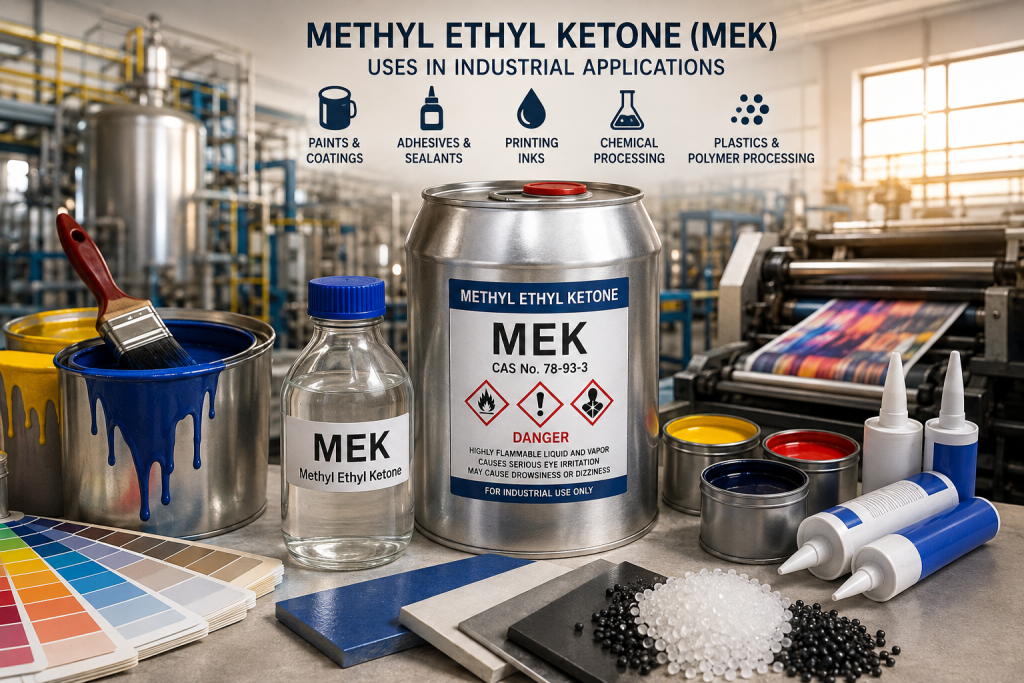
Methyl Ethyl Ketone Uses include solvent applications in paints, coatings, adhesives, printing inks, and selected industrial cleaning processes. Also called MEK or 2-butanone, methyl ethyl ketone is a volatile organic solvent valued for its strong solvency, relatively rapid evaporation, and compatibility with many industrial resins and formulations.
Manufacturers select MEK according to the required purity, resin compatibility, drying profile, and process conditions. Understanding its physical properties and safety requirements helps industrial buyers determine whether it is suitable for a specific application.
Quick Technical Specifications of Methyl Ethyl Ketone
| Property | Typical Value |
|---|---|
| Chemical name | Methyl ethyl ketone |
| Synonyms | MEK, 2-butanone, butan-2-one |
| Molecular formula | C4H8O |
| CAS number | 78-93-3 |
| EC number | 201-159-0 |
| Molecular weight | 72.11 g/mol |
| Appearance | Clear, colorless liquid with a characteristic odor |
| Boiling point | Approximately 79.6°C at 101.3 kPa |
| Flash point | Approximately -6°C in a closed-cup test; method-dependent |
| Density | Approximately 0.805 g/cm³ at 20°C |
| Water solubility | Partially miscible with water; miscible with many organic solvents |
Values are representative and may vary with test methods and product specifications. Check the supplier’s technical data sheet (TDS), safety data sheet (SDS), and certificate of analysis (CoA), where applicable. For additional chemical information, consult PubChem’s MEK reference.
What Are the Main Methyl Ethyl Ketone Uses?
The principal Methyl Ethyl Ketone Uses involve dissolving compatible organic materials, adjusting formulation viscosity, and controlling solvent evaporation. MEK can be used alone or blended with other solvents to achieve the required balance of solvency and drying performance.
Its suitability depends on the chemical composition of the formulation. It should not be considered a universal solvent because different resins, plastics, and coatings respond differently to ketone solvents.
Methyl Ethyl Ketone Uses in Paints and Coatings
Paints and coatings are important applications for MEK. The solvent can dissolve selected coating resins and help manufacturers achieve the viscosity needed for mixing, application, and processing.
Its relatively fast evaporation can support drying in suitable solvent-based systems. Depending on the formulation, MEK may be used in industrial coatings, specialty finishes, and selected protective coating products.
Formulators should evaluate resin compatibility, film formation, evaporation rate, and applicable volatile organic compound (VOC) restrictions. Explore our guide to industrial solvents for further information about solvent selection.
Methyl Ethyl Ketone Uses in Adhesives and Sealants
Another important application is adhesive manufacturing. MEK can dissolve compatible polymers and resins and help achieve the processing viscosity required in selected adhesive formulations.
Potential applications include certain industrial bonding products, packaging adhesives, and specialty rubber-based systems. The correct solvent depends on the adhesive chemistry, substrate, drying requirements, and final bond performance.
Manufacturers should also assess worker exposure, emissions requirements, and whether the selected solvent is permitted for the intended application.
MEK Uses in Printing Inks and Packaging
MEK is used in selected solvent-based printing inks, particularly in systems that require effective resin solvency and relatively rapid drying. These characteristics can support printing processes where ink viscosity, adhesion, and drying time must be carefully controlled.
Performance depends on the ink binder, pigments, printing equipment, and substrate. Applications involving food packaging require additional assessment of applicable regulations, migration risks, and the suitability of the complete ink formulation.
Methyl Ethyl Ketone Uses in Industrial Cleaning
MEK can dissolve certain organic residues, adhesives, oils, and coatings, making it useful in selected industrial cleaning and surface-preparation processes.
Before using MEK on a component, verify material compatibility. Some plastics, paints, and polymer surfaces may soften, swell, or become damaged following contact. Test the cleaning procedure under controlled conditions and provide adequate ventilation.
Because MEK evaporates rapidly and is highly flammable, it should only be used with appropriate fire prevention, exposure controls, and handling procedures.
MEK in Polymer and Chemical Processing
Selected polymer-related processes use MEK as a solvent for compatible resins or as a cleaning agent for manufacturing equipment. Its use depends on the polymer chemistry and the intended process.
MEK can also serve as a process solvent in certain chemical manufacturing operations. It is not a suitable choice for every plastic or polymer, so compatibility testing is essential before use.
For related information, see our guides to acetone uses and isopropyl alcohol uses.
MEK vs. Acetone and Other Industrial Solvents
MEK and acetone are both ketone solvents, but they differ in boiling point, evaporation behavior, and performance within particular formulations. MEK boils at approximately 79.6°C, while acetone boils at approximately 56°C under standard atmospheric pressure. Acetone therefore generally evaporates faster under comparable conditions.
Isopropyl alcohol, methyl acetate, and n-butyl acetate may also be considered for certain applications. However, the alternatives are not interchangeable in every formulation.
Compare resin compatibility, solvency, evaporation rate, substrate effects, VOC requirements, cost, and workplace hazards before selecting a solvent. Laboratory testing is recommended when changing an established formulation.
How to Select the Right MEK Grade
Choosing the correct grade requires more than comparing prices. Industrial buyers should assess:
- Purity: Confirm that the material meets the chemical and process specifications.
- Formulation compatibility: Verify performance with the resin, polymer, and other ingredients.
- Evaporation profile: Determine whether the drying rate matches the production process.
- Documentation: Review the TDS, SDS, and applicable quality documentation.
- Regulatory requirements: Check VOC limits, product restrictions, and workplace exposure controls.
- Packaging and storage: Confirm that containers and storage facilities are appropriate for a flammable solvent.
To explore sourcing options, visit the Aasad Chimie products page or contact our team to discuss your industrial chemical requirements.
Safety and Storage Considerations
MEK is a highly flammable liquid that produces vapors capable of forming ignitable mixtures with air. Exposure can irritate the eyes and respiratory tract and may affect the central nervous system, particularly at elevated concentrations.
Store MEK in suitable, tightly closed containers in a cool, well-ventilated area away from heat, sparks, flames, and other ignition sources. Use appropriate ventilation, protective equipment, and spill-control procedures based on the product-specific SDS and workplace risk assessment.
For general hazard communication information, consult the United Nations Globally Harmonized System (GHS).
Conclusion
Methyl Ethyl Ketone Uses include selected paints and coatings, adhesives, printing inks, industrial cleaning, polymer-related processes, and chemical manufacturing. Its strong solvency and relatively rapid evaporation make it useful in formulations where these characteristics meet the required performance specifications.
The best solvent choice depends on purity, formulation compatibility, drying requirements, regulatory restrictions, and safe handling. Review the technical documentation and test MEK under the intended process conditions before large-scale use.
For industrial solvent information and sourcing support, explore our industrial solvents guide, browse Aasad Chimie products, or contact Aasad Chimie.
What are the main Methyl Ethyl Ketone Uses?
The main applications include paints and coatings, adhesives, selected printing inks, industrial cleaning, polymer-related processes, and chemical manufacturing.
Why is MEK used in paints and coatings?
MEK dissolves compatible resins and helps control formulation viscosity. Its relatively rapid evaporation can support drying in suitable coating systems.
Is methyl ethyl ketone suitable for cleaning plastics?
Not all plastics are compatible with MEK. It may soften, swell, or damage certain materials, so compatibility testing is necessary before use.
What is the difference between MEK and acetone?
MEK has a higher boiling point and generally evaporates more slowly than acetone under comparable conditions. Their suitability depends on the formulation and required performance.
Is methyl ethyl ketone flammable?
Yes. MEK is highly flammable. It must be stored away from ignition sources and handled with suitable ventilation and controls based on its SDS.