


Table of Contents
- What Factors Affect Polypropylene Costs?
- 12 Strategies to Reduce Polypropylene Costs
- 1. Select the Right Polypropylene Grade
- 2. Optimize Melt Flow Rate
- 3. Reduce Extrusion Defects
- 4. Use Functional Fillers Where Appropriate
- 5. Evaluate Calcium Carbonate Filler Masterbatch
- 6. Improve Filler Dispersion
- 7. Reduce Energy Consumption
- 8. Implement Preventive Maintenance
- 9. Choose Suitable Processing Additives
- 10. Standardize Processing Parameters
- 11. Improve Production Planning
- 12. Review Supplier Performance and Purchasing Terms
- How to Calculate Polypropylene Production Costs
- How Can Manufacturers Reduce Costs Without Lowering Quality?
- Conclusion: Managing Polypropylene Costs
- References
- What are the main factors affecting polypropylene costs?
- How can manufacturers reduce polypropylene production costs?
- Can calcium carbonate reduce polypropylene costs?
- How should polypropylene production costs be measured?
- Do lower raw material prices always mean lower production costs?
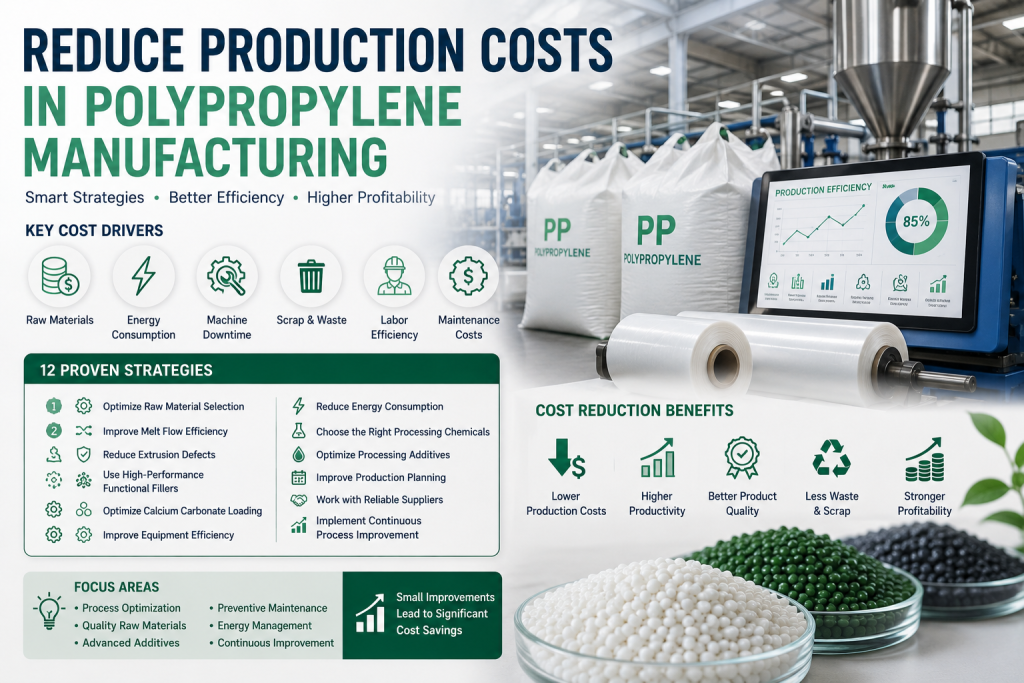
Polypropylene Costs are a major concern for plastic manufacturers seeking to improve profitability without compromising product quality. By optimizing raw material selection, improving processing efficiency, reducing waste, and controlling energy consumption, manufacturers can lower production expenses and increase operational efficiency.
What Factors Affect Polypropylene Costs?
Polypropylene Costs depend on several factors, including resin prices, material grade, energy consumption, processing conditions, production waste, labor, and equipment maintenance. Understanding these cost drivers helps manufacturers identify savings opportunities and make better purchasing and production decisions.
The most effective approach is to evaluate the total cost per kilogram of finished product rather than focusing only on the purchase price of polypropylene resin.
12 Strategies to Reduce Polypropylene Costs
1. Select the Right Polypropylene Grade
Choosing the correct polypropylene (PP) grade helps prevent unnecessary material and processing expenses. Different grades offer different melt flow rates, impact resistance, stiffness, and processing characteristics.
Manufacturers should select a grade based on the final product’s technical requirements. Using a grade with properties beyond those required can increase material costs without delivering meaningful benefits.
2. Optimize Melt Flow Rate
Melt flow rate (MFR) affects how polypropylene flows during processing. A suitable MFR can improve filling, extrusion stability, and cycle time, depending on the manufacturing process.
Review the material’s technical data sheet and validate processing performance before changing grades. For additional guidance, read our article on improving melt flow in polypropylene.
3. Reduce Extrusion Defects
Defects such as uneven thickness, surface imperfections, and unstable output can increase scrap rates and production costs.
To reduce these losses, monitor melt temperature, screw speed, die conditions, cooling, and material feeding. Standardizing process settings and recording production data can help operators identify recurring problems.
Learn more about reducing extrusion defects.
4. Use Functional Fillers Where Appropriate
Functional fillers can help reduce formulation costs or modify properties such as stiffness, dimensional stability, and surface characteristics. However, the correct filler type and loading level depend on the finished product’s specifications.
Evaluate filler cost alongside dispersion, mechanical performance, processing behavior, and final-product quality. Explore our guide to functional fillers.
5. Evaluate Calcium Carbonate Filler Masterbatch
Calcium carbonate filler masterbatch is used in selected polypropylene applications to modify material properties and manage formulation costs. Its economic value depends on the masterbatch price, dosage, polymer grade, and required performance.
Before increasing the filler concentration, test impact strength, tensile properties, surface appearance, and processing stability. See our page about calcium carbonate filler masterbatch.
6. Improve Filler Dispersion
Poor filler dispersion can cause inconsistent properties, surface defects, and rejected products. These issues may eliminate the savings expected from a lower-cost formulation.
Review mixing conditions, feeding consistency, screw configuration, and masterbatch compatibility. Conduct controlled trials to find a formulation that balances cost and performance.
Our guide to improving calcium carbonate dispersion provides additional information.
7. Reduce Energy Consumption
Electricity and heating requirements contribute to polypropylene processing expenses. Energy use can often be improved by optimizing temperature settings, minimizing unnecessary machine idle time, maintaining heaters, and checking cooling systems.
Track energy consumption per kilogram of acceptable output rather than total electricity use alone. This metric helps manufacturers compare production runs and identify inefficient operating conditions.
8. Implement Preventive Maintenance
Unplanned equipment downtime can lead to lost production, material waste, and costly repairs. Preventive maintenance helps maintain consistent output and reduce unexpected interruptions.
Inspect screws, barrels, dies, filters, heaters, motors, and cooling systems according to equipment requirements. Maintenance schedules should reflect operating conditions and manufacturer recommendations.
9. Choose Suitable Processing Additives
Processing additives may improve flow, dispersion, release, or processing stability in specific formulations. Their use should be based on a defined production problem rather than added automatically.
Compare additive costs with measurable benefits such as reduced scrap, improved throughput, or fewer defects. Review our information about plastic processing additives.
10. Standardize Processing Parameters
Frequent or uncontrolled changes to processing settings can increase variation and waste. Establish validated operating ranges for temperature, pressure, screw speed, cooling, and cycle time.
Document approved settings for each product and material grade. When adjustments are necessary, change one variable at a time where practical and record the resulting effect on quality and output.
11. Improve Production Planning
Poor production planning can increase machine changeovers, downtime, excess inventory, and material waste. Grouping compatible production orders and improving demand forecasts can help reduce these inefficiencies.
Track inventory turnover, changeover time, rejected units, and production output to identify areas where planning improvements can reduce costs.
12. Review Supplier Performance and Purchasing Terms
Resin and additive purchasing decisions influence the total cost of production. Compare suppliers based on consistent quality, technical support, delivery reliability, payment terms, and total delivered cost—not just the quoted price.
Request current technical data sheets and certificates where applicable. Test alternative suppliers before approving material changes, and maintain suitable quality controls to protect production consistency.
For available materials, visit our products page or contact AasadChimie to discuss your requirements.
How to Calculate Polypropylene Production Costs
A practical way to evaluate Polypropylene Costs is to calculate the cost per kilogram of acceptable finished product.
Cost per kilogram = Total production cost ÷ Kilograms of acceptable output
Include the relevant costs for resin, additives, energy, labor, maintenance, packaging, scrap, and other production expenses. Use a consistent accounting method when comparing different formulations or production periods.
For example, a lower-cost formulation may appear attractive based on raw material prices alone. However, if it increases scrap or slows production, the total cost per kilogram of acceptable output may rise. Always compare formulations using equivalent product specifications and production conditions.
How Can Manufacturers Reduce Costs Without Lowering Quality?
Manufacturers should begin with a baseline measurement of material consumption, energy use, scrap rate, machine downtime, and output. Next, identify the largest cost drivers and test improvements through controlled production trials.
Quality checks should cover the properties relevant to the finished product, such as tensile strength, impact resistance, stiffness, dimensional stability, and surface appearance. Applicable test methods and acceptance limits should be selected according to the product specification and relevant standards.
For technical reference, consult ASTM International, ISO standards, and the Plastics Industry Association.
Conclusion: Managing Polypropylene Costs
Reducing Polypropylene Costs requires more than buying cheaper resin. Manufacturers can improve profitability by selecting suitable grades, optimizing processing parameters, reducing scrap, evaluating fillers and additives, controlling energy consumption, and strengthening maintenance and purchasing practices.
The most reliable savings come from measuring total production costs and validating each change against product quality and process performance. A data-driven approach helps manufacturers improve efficiency while maintaining consistent finished-product specifications.
For material inquiries or technical assistance, explore AasadChimie products or contact our team.
References
- ASTM International
- International Organization for Standardization (ISO)
- Plastics Industry Association
What are the main factors affecting polypropylene costs?
The main factors include resin prices, material grade, additives, energy consumption, processing efficiency, scrap rates, maintenance, and supplier terms.
How can manufacturers reduce polypropylene production costs?
Manufacturers can optimize material selection, reduce defects, improve energy efficiency, control filler loading, and minimize downtime and production waste.
Can calcium carbonate reduce polypropylene costs?
Calcium carbonate filler masterbatch may reduce formulation costs in suitable applications. The result depends on dosage, material prices, dispersion, and the required mechanical and surface properties.
How should polypropylene production costs be measured?
Calculate total production costs per kilogram of acceptable finished output, including material, energy, labor, maintenance, scrap, and other relevant expenses.
Do lower raw material prices always mean lower production costs?
No. A cheaper material may increase defects, waste, cycle time, or quality problems. Compare total cost per kilogram while maintaining equivalent product specifications.