


Table of Contents
- What Are Plastic Manufacturing Chemicals?
- Why Are Industrial Chemicals Important in Plastic Manufacturing?
- Main Types of Plastic Manufacturing Chemicals
- Key Plastic Manufacturing Chemicals and Their Applications
- 1. Calcium Carbonate and Functional Fillers
- 2. Plastic Processing Aids
- 3. Heat Stabilizers and UV Stabilizers
- 4. Antioxidants for Polymer Processing
- 5. Plasticizers
- 6. Pigments and Colorants
- 7. Flame Retardants
- 8. Industrial Solvents for Cleaning and Preparation
- Which Chemicals Are Used for Different Plastic Products?
- How to Select the Right Plastic Manufacturing Chemicals
- Common Plastic Manufacturing Problems and Possible Solutions
- Quality Control, Safety, and Documentation
- Trends in Plastic Manufacturing Chemicals
- How AasadChimie Supports Industrial Buyers
- Conclusion
- References
- What are Plastic Manufacturing Chemicals?
- Which chemicals are commonly used in plastic manufacturing?
- How do manufacturers choose the right plastic additives?
- Why are functional fillers used in plastic manufacturing?
- How can plastic manufacturers reduce production defects?
- What documents should buyers request from a chemical supplier?
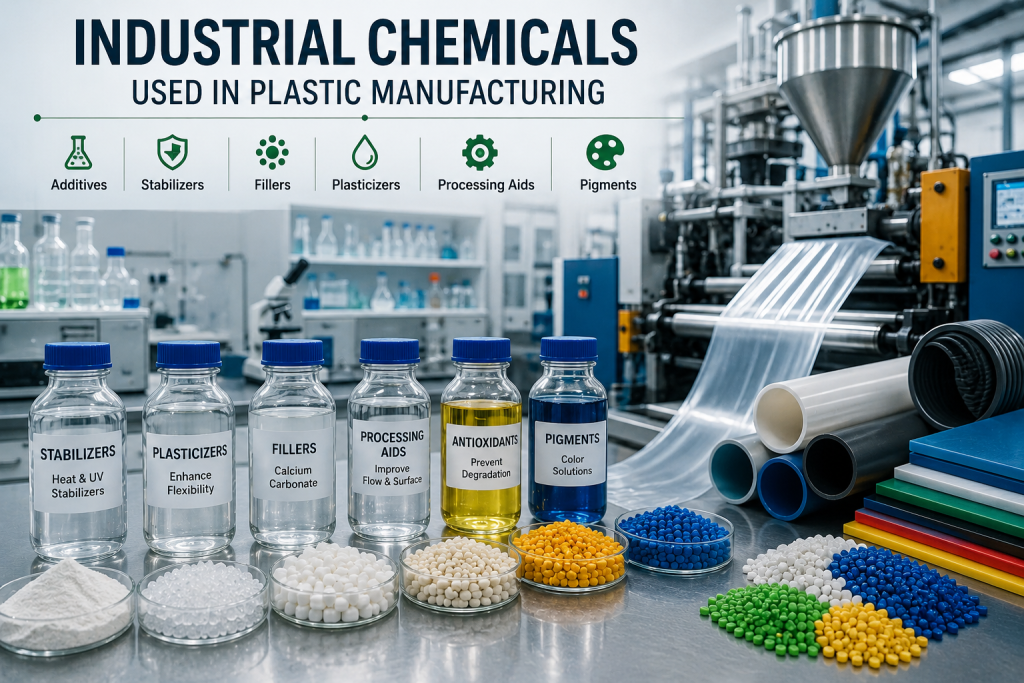
Plastic Manufacturing Chemicals are additives, processing materials, and auxiliary substances used to improve polymer processing, control product properties, and maintain consistent manufacturing quality. Common categories include functional fillers, stabilizers, plasticizers, antioxidants, pigments, processing aids, flame retardants, and selected industrial solvents. The right combination depends on the polymer, production method, end-use requirements, and applicable safety standards.
For manufacturers producing packaging, pipes, films, automotive components, construction materials, and consumer goods, selecting suitable chemicals for plastic manufacturing can improve process stability, reduce defects, and support cost-effective production. Choosing the right Plastic Manufacturing Chemicals also helps manufacturers maintain product quality, improve production efficiency, and meet the technical requirements of different plastic applications. This guide explains the main chemical categories, their applications, and the practical factors industrial buyers should evaluate before purchasing.
What Are Plastic Manufacturing Chemicals?
Plastic Manufacturing Chemicals include additives, processing materials, and auxiliary chemicals used during polymer compounding, extrusion, injection molding, blow molding, film production, and equipment maintenance. Some become part of the finished formulation, while others support cleaning or surface preparation during specific manufacturing operations.
Each category serves a different purpose. Functional fillers can adjust stiffness and material cost, stabilizers help protect polymers from heat or ultraviolet exposure, and processing aids can improve melt behavior or reduce manufacturing defects. Solvents may support approved cleaning tasks when compatible with the equipment and materials involved. Understanding how Plastic Manufacturing Chemicals interact with the base resin is essential for achieving reliable processing results and consistent finished products.
Why Are Industrial Chemicals Important in Plastic Manufacturing?
Polymer resin alone may not deliver every property required for a finished product. Manufacturers often use carefully selected plastic manufacturing additives to meet performance targets, maintain processing consistency, and balance formulation costs.
Unsuitable chemical selection, poor compatibility, or incorrect processing conditions can contribute to:
- Poor filler dispersion and inconsistent material properties
- Surface defects, die build-up, or unstable melt flow
- Color variation between production batches
- Thermal or oxidative polymer degradation
- Higher scrap rates and unplanned downtime
- Insufficient flexibility, stiffness, or outdoor durability
- Increased maintenance requirements and manufacturing costs
The correct solution starts with identifying the root cause. Adding more chemicals does not automatically improve performance; dosage, dispersion, compatibility, and processing conditions must be evaluated together.
Main Types of Plastic Manufacturing Chemicals
| Chemical category | Main function | Typical applications |
|---|---|---|
| Functional fillers | Adjust stiffness, dimensional stability, and formulation cost | Packaging, pipes, profiles, molded parts |
| Plasticizers | Increase flexibility and softness in compatible polymers | Flexible PVC, cables, flooring |
| Heat and UV stabilizers | Help protect polymers from thermal and sunlight-related degradation | Pipes, outdoor profiles, agricultural films |
| Antioxidants | Reduce oxidative degradation during processing and service | Polyolefins and engineering plastics |
| Processing aids | Support melt flow, surface quality, and processing stability | Extrusion, film production, molding |
| Pigments and colorants | Provide color and improve batch-to-batch consistency | Packaging, consumer goods, components |
| Flame retardants | Improve fire performance when correctly formulated and tested | Electrical parts, construction materials |
| Industrial solvents | Support specified cleaning or surface-preparation tasks | Selected equipment and manufacturing operations |
Key Plastic Manufacturing Chemicals and Their Applications
Different Plastic Manufacturing Chemicals address specific production challenges, from improving filler dispersion and thermal stability to controlling flexibility, color, and surface quality. Selecting the appropriate category requires an understanding of the polymer formulation, processing conditions, and intended product performance.
1. Calcium Carbonate and Functional Fillers
Calcium carbonate is widely used as a mineral filler in compatible plastic formulations. Depending on particle characteristics, surface treatment, loading level, and dispersion quality, it can adjust stiffness, dimensional behavior, and material cost. Applications include polyethylene (PE), polypropylene (PP), PVC, and other suitable polymer systems.
Before selecting a filler, manufacturers should assess particle size, moisture, surface treatment, resin compatibility, and required mechanical properties. Poor dispersion or excessive loading can reduce impact strength, create surface defects, or affect processing performance.
Read our guides to Functional Fillers, Functional Filler Powder, and Calcium Carbonate Filler Masterbatch for more information about filler selection.
2. Plastic Processing Aids
Plastic processing aids address specific challenges in extrusion, film production, compounding, and molding. Depending on their chemistry and the polymer system, these additives may improve melt behavior, reduce surface defects, support stable production, or limit build-up on processing equipment.
The most suitable option depends on the resin grade, equipment design, operating temperature, output target, and defect being investigated. Manufacturers should run controlled trials and compare melt flow, surface appearance, pressure behavior, output, and scrap rate before adopting a new additive.
Explore Plastic Processing Additives and Polymer Processing Chemicals for related technical guidance.
3. Heat Stabilizers and UV Stabilizers
Heat stabilizers help protect susceptible polymers from degradation at processing temperatures, while UV stabilizers are designed for formulations exposed to sunlight. Their chemistry must match the polymer, processing conditions, expected service environment, and regulatory requirements.
Outdoor products such as agricultural films, construction profiles, and exposed plastic components may require weathering protection. When comparing stabilizers, consider exposure intensity, product thickness, expected service life, color requirements, and compatibility with other plastic manufacturing additives.
4. Antioxidants for Polymer Processing
Antioxidants help limit oxidation that can occur during polymer processing or long-term use. They are particularly relevant when heat and oxygen exposure may affect molecular structure, color, mechanical properties, or processing stability.
Selection depends on the polymer type, processing temperature, residence time, number of thermal-processing cycles, and performance required from the finished product. Recycled polymers may need particular attention because previous processing and service history can affect degradation and additive demand.
5. Plasticizers
Plasticizers are used in compatible polymer systems to increase flexibility, softness, or workability. They are commonly associated with flexible PVC products, including cables, flooring, flexible profiles, and selected film applications.
Not every plasticizer is suitable for every application. Manufacturers should evaluate compatibility, volatility, migration behavior, temperature performance, and requirements related to food contact, medical use, or other regulated end uses.
6. Pigments and Colorants
Pigments and colorants help manufacturers achieve the required appearance and maintain color consistency. Their performance depends on dispersion, thermal stability, polymer compatibility, and the conditions used during compounding or molding.
Color matching should be assessed under consistent test conditions. Poor dispersion, contamination, or an unsuitable pigment can cause streaks, specks, color shifts, and inconsistent appearance across production batches.
7. Flame Retardants
Flame-retardant systems are used in selected plastic products when fire performance is a design requirement. Their suitability depends on the polymer, part geometry, processing method, target test standard, and restrictions that apply to the final product or market.
Adding a flame retardant does not by itself establish compliance. Finished products must be tested against relevant requirements, and manufacturers should evaluate possible effects on mechanical properties, processing behavior, color, and long-term performance.
8. Industrial Solvents for Cleaning and Preparation
Some industrial solvents support specified equipment-cleaning, residue-removal, or surface-preparation tasks. Acetone and isopropyl alcohol are examples used in certain industrial contexts, but they are not interchangeable and may damage particular plastics, coatings, seals, or machine components.
Before using a solvent, check material compatibility, equipment-manufacturer guidance, ventilation requirements, flammability hazards, and the relevant safety data sheet (SDS). Use each product only for an approved purpose and follow site-specific handling and waste procedures.
For further reading, see our Industrial Solvents, Isopropyl Alcohol, and Acetone guides.
Which Chemicals Are Used for Different Plastic Products?
The appropriate formulation depends on the product, polymer, production method, and performance requirements. This table identifies chemical categories worth evaluating; it is not a universal formulation or dosage recommendation.
| Plastic product | Chemical categories to evaluate | Primary objective |
|---|---|---|
| Plastic packaging | Fillers, processing aids, pigments, and application-specific stabilizers | Balance cost, appearance, and production consistency |
| PVC pipes and profiles | Heat stabilizers, lubricants, impact modifiers, and fillers | Support processing stability and mechanical performance |
| Automotive components | Antioxidants, UV stabilizers, impact modifiers, and colorants | Meet durability and appearance requirements |
| Plastic films | Slip agents, antiblock additives, stabilizers, and compatible processing aids | Control handling, surface behavior, and film performance |
| Electrical components | Application-specific flame retardants, stabilizers, and processing aids | Meet defined electrical, thermal, and fire-performance targets |
| Injection-molded products | Processing aids, fillers, pigments, and impact modifiers | Improve consistency, appearance, and part properties |
How to Select the Right Plastic Manufacturing Chemicals
Before purchasing a chemical or changing a formulation, manufacturers should define the technical problem and evaluate the complete processing system. The following factors can help buyers compare options and reduce the risk of unsuitable material selection.
- Polymer type: Identify whether the base resin is PE, PP, PVC, PET, ABS, or another polymer.
- Processing method: Consider extrusion, injection molding, blow molding, film production, or compounding.
- Performance targets: Define the required stiffness, flexibility, impact resistance, color, weatherability, or fire performance.
- Operating conditions: Review processing temperature, residence time, shear, throughput, and equipment limitations.
- Compatibility: Check interactions between the chemical, resin, and other formulation ingredients.
- Quality documentation: Request a technical data sheet (TDS), safety data sheet (SDS), and certificate of analysis (COA), where applicable.
- Regulatory requirements: Verify requirements for the intended market and end use, particularly in food-contact, medical, electrical, and construction applications.
- Total cost: Compare dosage, performance, scrap rate, downtime, handling needs, and supply consistency rather than price per kilogram alone.
- Supplier support: Assess product consistency, technical communication, packaging, lead times, and documentation availability.
Comparing Plastic Manufacturing Chemicals through controlled production trials helps manufacturers identify suitable grades, optimize additive consumption, and reduce avoidable manufacturing costs. Testing should reflect actual production conditions and the quality requirements of the finished product.
Common Plastic Manufacturing Problems and Possible Solutions
| Observed problem | Factors to investigate | Potential corrective approach |
|---|---|---|
| Poor filler dispersion | Particle properties, feeding, mixing, and compatibility | Review filler grade, dispersion process, and formulation |
| Surface defects or die build-up | Processing temperature, contamination, additive balance, and equipment condition | Identify the defect source and test a suitable processing aid if justified |
| Color inconsistency | Pigment dispersion, contamination, and thermal history | Standardize dosing and mixing; verify pigment compatibility |
| Thermal degradation | Temperature, residence time, oxygen exposure, and repeated processing | Optimize processing conditions and evaluate an appropriate stabilizer system |
| High production cost | Resin use, additive loading, waste, downtime, and quality losses | Evaluate total formulation cost through controlled production trials |
| Insufficient outdoor durability | UV exposure, climate, polymer type, and stabilizer package | Test a compatible weathering-protection system for the intended service life |
For extrusion-related problems, review our guides on Reducing Extrusion Defects and Improving Melt Flow in Polypropylene. Chemical changes should follow root-cause analysis and controlled trials rather than replace process troubleshooting.
Quality Control, Safety, and Documentation
Reliable selection of plastic manufacturing materials involves more than choosing a product by name. Buyers should confirm that the supplied grade matches the intended application and that the documentation corresponds to the actual product and batch.
- TDS: Provides technical properties, recommended uses, and processing guidance.
- SDS: Describes hazards, safe handling, storage, exposure controls, and emergency measures.
- COA: Reports specified test results for a particular batch, where supplied.
- Compatibility testing: Confirms that the material works with the selected polymer and production conditions.
- Application testing: Verifies that the finished product meets required mechanical, thermal, appearance, and regulatory specifications.
Use relevant test methods and applicable standards for the product and market. Supplier documentation supports purchasing decisions but does not replace validation of the finished plastic product.
Trends in Plastic Manufacturing Chemicals
Manufacturers are increasingly evaluating additives and processing materials that support productivity, product durability, and material efficiency. Areas of interest include functional fillers, additives compatible with recycled polymers, low-emission processing options, improved weathering protection, and formulations that help reduce production waste.
The most appropriate solution remains application-specific. Products marketed as sustainable or high-performance should be assessed through technical data, compatibility checks, regulatory review, and production trials. For manufacturers in India, Turkey, and the Middle East, dependable documentation and consistent supply can be as important as technical performance.
How AasadChimie Supports Industrial Buyers
AasadChimie provides industrial chemical and polymer-related product information to help manufacturers assess potential solutions for their production requirements. Buyers should confirm each product’s grade, specification, availability, and suitability for the intended process before use.
Explore the AasadChimie product range or contact our team to discuss your application and product requirements. When requesting a recommendation, include the polymer type, processing method, operating conditions, target properties, and relevant technical documentation to support a more accurate assessment.
For industrial buyers, evaluating Plastic Manufacturing Chemicals according to polymer compatibility, processing conditions, technical specifications, and supplier reliability supports better purchasing decisions. A clearly defined inquiry also helps identify products that match the intended application.
Conclusion
Plastic Manufacturing Chemicals help manufacturers control processing behavior, adjust product properties, and maintain consistent production quality. Functional fillers, stabilizers, antioxidants, plasticizers, pigments, processing aids, flame retardants, and selected solvents serve different purposes and must be chosen according to the polymer and application.
The most effective selection process begins with a clearly defined production objective, followed by compatibility checks, documentation review, controlled trials, and evaluation of total manufacturing cost. Working with a reliable supplier and validating the finished product helps manufacturers make informed purchasing decisions and maintain long-term process performance.
References
- PLASTICS Industry Association
- ASTM International
- European Chemicals Agency (ECHA)
- PubChem
- Occupational Safety and Health Administration (OSHA)
What are Plastic Manufacturing Chemicals?
Plastic Manufacturing Chemicals include fillers, stabilizers, antioxidants, plasticizers, pigments, processing aids, flame retardants, and selected solvents used to support polymer processing and improve plastic product performance.
Which chemicals are commonly used in plastic manufacturing?
Common categories include calcium carbonate fillers, heat and UV stabilizers, antioxidants, plasticizers, pigments, and processing aids. The appropriate selection depends on the polymer, production method, and required product properties.
How do manufacturers choose the right plastic additives?
Manufacturers should evaluate polymer compatibility, processing temperature, target mechanical properties, regulatory requirements, technical documentation, and total production cost. Controlled production trials help verify performance.
Why are functional fillers used in plastic manufacturing?
Functional fillers can help adjust stiffness, dimensional stability, and formulation cost. Their effectiveness depends on the filler grade, particle characteristics, loading level, and dispersion quality.
How can plastic manufacturers reduce production defects?
Manufacturers should identify the root cause of defects, review processing conditions, check raw material consistency, and evaluate compatible additives where appropriate. Controlled trials can help determine whether a formulation change improves results.
What documents should buyers request from a chemical supplier?
Depending on the product, buyers should request a Technical Data Sheet (TDS), Safety Data Sheet (SDS), and Certificate of Analysis (COA), where applicable. They should also verify application suitability and any required certifications.