


Table of Contents
- What Are Industrial Plastic Additives?
- Why Are Plastic Additives Important?
- Main Types of Industrial Plastic Additives
- Common Industrial Plastic Additives Used in Manufacturing
- 1. Functional Fillers
- 2. Calcium Carbonate Filler Masterbatch
- 3. Plasticizers
- 4. UV Stabilizers and Antioxidants
- 5. Processing Aids and Lubricants
- Industrial Applications of Plastic Additives
- How Plastic Additives Improve Manufacturing Efficiency
- How to Choose the Right Industrial Plastic Additives
- Common Manufacturing Challenges Addressed by Plastic Additives
- Future Trends in Industrial Plastic Additives
- Why Additive Quality and Supplier Selection Matter
- Explore AasadChimie Products and Contact Our Team
- Conclusion
- Related Articles
- What are Industrial Plastic Additives?
- What are the most common types of plastic additives?
- Which industries use Industrial Plastic Additives?
- How do manufacturers choose the right plastic additives?
- Can plastic additives reduce manufacturing costs?
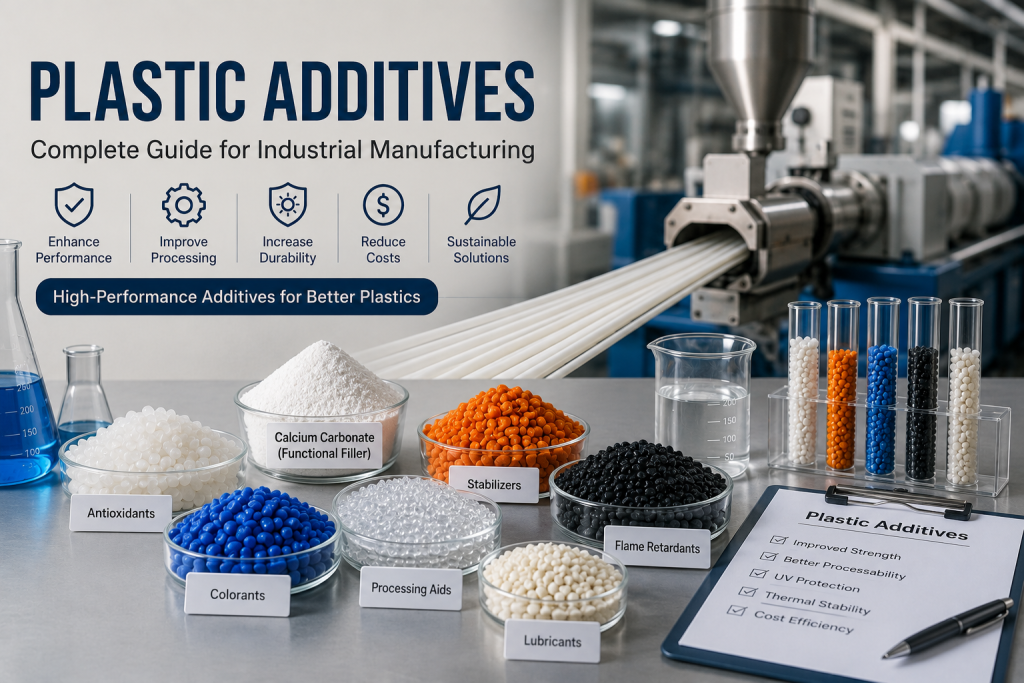
Industrial Plastic Additives are materials incorporated into polymers to improve processing, durability, mechanical properties, stability, and appearance. Manufacturers use these additives in packaging, automotive components, construction materials, electrical products, and consumer goods to achieve consistent quality and application-specific performance.
Selecting the right Industrial Plastic Additives can help manufacturers optimize production, reduce material waste, improve product lifespan, and control manufacturing costs. The appropriate additive depends on the polymer type, processing conditions, required product properties, and intended service environment.
This guide explains the main types of plastic additives, their industrial applications, their benefits, and the factors manufacturers should evaluate before choosing an additive system.
What Are Industrial Plastic Additives?
Industrial Plastic Additives are chemical substances or formulated materials added to polymers during compounding or processing. They modify selected properties without necessarily changing the base polymer. Common examples include functional fillers, plasticizers, UV stabilizers, antioxidants, lubricants, pigments, flame retardants, and processing aids.
These materials can improve melt processing, flexibility, stiffness, color consistency, resistance to environmental exposure, and other product characteristics. Their performance depends on chemical compatibility, dosage, dispersion, processing temperature, and interactions with other formulation ingredients.
Why Are Plastic Additives Important?
Without suitable plastic additives, manufacturers may experience processing difficulties, inconsistent product dimensions, premature degradation, poor surface quality, or inadequate mechanical performance. Carefully selected Industrial Plastic Additives help address these challenges while supporting reliable manufacturing operations.
The main benefits include:
- Improved mechanical properties and dimensional stability.
- Better resistance to heat, oxidation, or ultraviolet exposure.
- Enhanced processing behavior and surface quality.
- Greater flexibility in applications requiring softer materials.
- Improved color consistency and product appearance.
- Potential reductions in material costs and production waste.
- Longer service life when the additive system matches the application.
Actual results depend on the formulation and operating conditions. Manufacturers should validate expected benefits through technical evaluation and production trials rather than assuming that every additive improves every property.
Main Types of Industrial Plastic Additives
| Additive Type | Main Function | Typical Applications |
|---|---|---|
| Functional Fillers | Modify stiffness, dimensions, and formulation cost | Pipes, packaging, molded components |
| Plasticizers | Increase flexibility in compatible polymers | Flexible PVC, cables, flooring |
| UV Stabilizers | Help protect against ultraviolet degradation | Agricultural films, outdoor products |
| Antioxidants | Reduce oxidative degradation | Polyolefins and other polymer systems |
| Heat Stabilizers | Limit thermal degradation | PVC profiles and components |
| Processing Aids | Improve selected processing characteristics | Extrusion and film production |
| Lubricants | Control friction during processing | Extrusion and injection molding |
| Flame Retardants | Improve fire performance when properly formulated | Electrical and construction products |
| Pigments | Provide color and visual consistency | Packaging and consumer products |
Common Industrial Plastic Additives Used in Manufacturing
1. Functional Fillers
Functional fillers are widely used to modify stiffness, dimensional stability, density, surface characteristics, and material cost. Calcium carbonate is one example used in selected polyethylene (PE), polypropylene (PP), and other compatible formulations.
Filler performance depends on particle size, surface treatment, dispersion, loading level, and compatibility with the base resin. Poor dispersion or excessive loading may negatively affect impact strength, elongation, or surface quality.
Read our guide to Functional Fillers to learn more about their role in industrial polymer formulations.
2. Calcium Carbonate Filler Masterbatch
Calcium carbonate filler masterbatch is used in selected plastic manufacturing applications to introduce mineral filler into a polymer formulation. Depending on the grade and concentration, it can increase stiffness, influence dimensional behavior, and reduce the amount of virgin polymer required per unit of finished product.
Manufacturers should evaluate the effects on impact strength, elongation, surface appearance, processability, and finished-product specifications before adjusting the filler concentration.
For additional details, see Calcium Carbonate Filler Masterbatch.
3. Plasticizers
Plasticizers are used to increase flexibility and softness in compatible polymer systems. They are particularly important in flexible PVC applications, including flooring, cable insulation, selected tubing, and flexible products.
Choosing a plasticizer requires consideration of polymer compatibility, migration behavior, temperature resistance, durability, and any applicable safety or regulatory requirements. The correct grade depends on the intended use and product specifications.
4. UV Stabilizers and Antioxidants
UV stabilizers help reduce damage associated with sunlight exposure. They are relevant to outdoor products such as agricultural films, construction components, and other plastics expected to withstand ultraviolet radiation.
Antioxidants help protect polymer chains against oxidation during processing and service. They are particularly useful when heat and oxygen can affect material stability. In some applications, antioxidants and UV stabilizers are combined to provide complementary protection.
Selection should account for polymer type, expected exposure, processing temperature, product thickness, and required service life.
5. Processing Aids and Lubricants
Processing aids can improve selected manufacturing characteristics, including extrusion stability, melt behavior, and surface appearance. Lubricants help control friction between materials and processing equipment or within the polymer formulation.
These additives may support more consistent production, but results depend on their chemistry and compatibility with the resin. Manufacturers should also investigate equipment settings, contamination, and raw material quality when processing defects occur.
Explore our page on Plastic Processing Additives for related information.
Industrial Applications of Plastic Additives
Industrial Plastic Additives serve different purposes across manufacturing sectors. The most suitable additive package depends on the final product’s mechanical requirements, environmental exposure, processing method, and applicable standards.
| Industry | Common Additives | Typical Objective |
|---|---|---|
| Packaging | Fillers, slip agents, antioxidants | Processability, surface properties, cost control |
| Automotive | UV stabilizers, antioxidants, selected flame retardants | Durability and application-specific performance |
| Construction | Plasticizers, heat stabilizers, functional fillers | Flexibility, stability, dimensional control |
| Electrical Products | Flame retardants, stabilizers, lubricants | Processing performance and specified fire properties |
| Consumer Goods | Pigments, processing aids, fillers | Appearance, consistency, production efficiency |
| Agriculture | UV stabilizers, antioxidants | Resistance to outdoor exposure |
How Plastic Additives Improve Manufacturing Efficiency
The right additive formulation can improve product consistency and reduce selected manufacturing problems. Depending on the application, Industrial Plastic Additives may help manufacturers achieve more stable processing, reduce waste, improve surface quality, and meet defined product specifications.
Functional fillers can support formulation cost management, while processing aids can address certain extrusion issues. Stabilizers may help preserve polymer properties during processing or service. However, the economic value of an additive should be assessed against its dosage, performance benefits, possible side effects, and total production costs.
For reinforcement applications, read our article on Advanced Functional Filler Powder. It provides further information about filler technologies used in industrial polymer formulations.
How to Choose the Right Industrial Plastic Additives
Choosing the right Industrial Plastic Additives requires both technical and commercial evaluation. An additive that performs well in one resin or manufacturing process may not deliver the same results in another.
| Selection Factor | What to Evaluate |
|---|---|
| Polymer Compatibility | Compatibility with the resin and other formulation ingredients |
| Processing Conditions | Temperature, shear, residence time, and manufacturing method |
| Product Requirements | Flexibility, stiffness, durability, appearance, and service life |
| Additive Dosage | Recommended loading, dispersion, and formulation limits |
| Regulatory Requirements | Applicable safety, environmental, and product-contact requirements |
| Technical Documentation | Technical data sheet, safety data sheet, and product specifications |
| Total Cost | Material cost, waste, production time, maintenance, and quality control |
Before full-scale implementation, manufacturers should conduct controlled trials under representative production conditions. Depending on the application, testing may include melt flow, tensile properties, impact resistance, dimensional stability, surface quality, and aging performance.
Common Manufacturing Challenges Addressed by Plastic Additives
When correctly selected and used, plastic additives can help address several common manufacturing challenges:
- Inconsistent filler dispersion.
- Unwanted surface defects during extrusion.
- Thermal or oxidative degradation.
- Insufficient flexibility or stiffness.
- UV-related deterioration in outdoor products.
- Color inconsistency and appearance problems.
- Excessive material waste or inconsistent product quality.
Not all manufacturing defects originate from additive selection. Resin quality, moisture, contamination, equipment settings, and process control can also affect the final result. For extrusion-related issues, read How to Reduce Extrusion Defects.
Future Trends in Industrial Plastic Additives
Plastic manufacturing continues to evolve as producers seek better performance, improved resource efficiency, and compatibility with recycling processes. Areas of development include:
- Additives designed for recycling-compatible formulations.
- Improved filler dispersion and surface modification.
- Advanced stabilizer systems for demanding service conditions.
- Processing aids designed to improve manufacturing consistency.
- Formulations intended to reduce material use or production waste.
- Low-emission options for applications with relevant requirements.
These developments should be assessed using application-specific data. Terms such as sustainable, recyclable, or low-emission do not automatically guarantee a particular environmental outcome; the full formulation and relevant end-of-life conditions matter.
Why Additive Quality and Supplier Selection Matter
Consistent additive quality helps manufacturers maintain repeatable processing conditions and finished-product properties. Differences in composition, moisture, particle characteristics, or dispersion can affect performance and production stability.
Before purchasing, request suitable technical documentation and confirm that the grade meets your process and end-use requirements. Relevant reference resources include ASTM International, ISO standards, and the European Chemicals Agency. General chemical information can also be found through PubChem and the PLASTICS Industry Association.
These sources provide reference information, but they do not replace product-specific technical data or regulatory confirmation for a particular application.
Explore AasadChimie Products and Contact Our Team
AasadChimie provides information about industrial chemicals and functional filler solutions for manufacturing applications. Visit our Products page to explore available product information.
For product specifications, application requirements, or supply inquiries, contact the team through our Contact Us page. Confirm the suitability of each grade against your formulation, process conditions, and finished-product requirements before use.
Conclusion
Industrial Plastic Additives help manufacturers tailor plastic formulations to specific processing, mechanical, thermal, and appearance requirements. Functional fillers, plasticizers, stabilizers, antioxidants, processing aids, lubricants, and pigments each serve different purposes and should be selected according to the base polymer and intended application.
By evaluating compatibility, dosage, technical specifications, regulatory requirements, and production performance, manufacturers can make better formulation decisions and balance product quality with manufacturing costs. Reliable documentation and controlled production trials are essential for confirming the expected results.
Related Articles
- Functional Fillers
- Advanced Functional Filler Powder
- Functional Filler Powder
- Calcium Carbonate Filler Masterbatch
- Plastic Processing Additives
- How to Reduce Extrusion Defects
- Mono Ethylene Glycol
What are Industrial Plastic Additives?
Industrial Plastic Additives are materials added to polymers to improve processing, durability, mechanical properties, stability, or appearance.
What are the most common types of plastic additives?
Common types include functional fillers, plasticizers, UV stabilizers, antioxidants, heat stabilizers, processing aids, lubricants, flame retardants, and pigments.
Which industries use Industrial Plastic Additives?
Packaging, automotive, construction, electrical, agriculture, and consumer goods manufacturers use different additives according to their product requirements.
How do manufacturers choose the right plastic additives?
Manufacturers should evaluate polymer compatibility, processing conditions, required product properties, recommended dosage, technical documentation, and regulatory requirements.
Can plastic additives reduce manufacturing costs?
Suitable additives may help reduce material costs, production waste, or processing problems. The actual savings depend on the formulation, dosage, process conditions, and finished-product requirements.