


Table of Contents
- What Is Masterbatch?
- Quick Technical Overview of Masterbatch
- Why Is Masterbatch Important in Plastic Manufacturing?
- Main Types of Masterbatch
- 1. Color Masterbatch
- 2. Additive Masterbatch
- 3. Filler Masterbatch
- How Does Masterbatch Work?
- Masterbatch Applications in Different Industries
- Packaging and Plastic Film
- Injection-Molded Products
- Fibers and Woven Materials
- Agricultural and Outdoor Products
- Construction and Industrial Components
- How to Select the Right Masterbatch
- Masterbatch Dosage and Let-Down Ratio
- Masterbatch vs. Direct Ingredient Dosing
- Common Masterbatch Processing Problems
- Uneven Color or Streaking
- Visible Specks
- Changes in Mechanical Properties
- Unstable Processing
- Storage and Handling Recommendations
- Conclusion
- References
- What is masterbatch used for?
- What are the main types?
- How do manufacturers select the right grade?
- Can these formulations affect mechanical properties?
- Are all grades suitable for food-contact products?
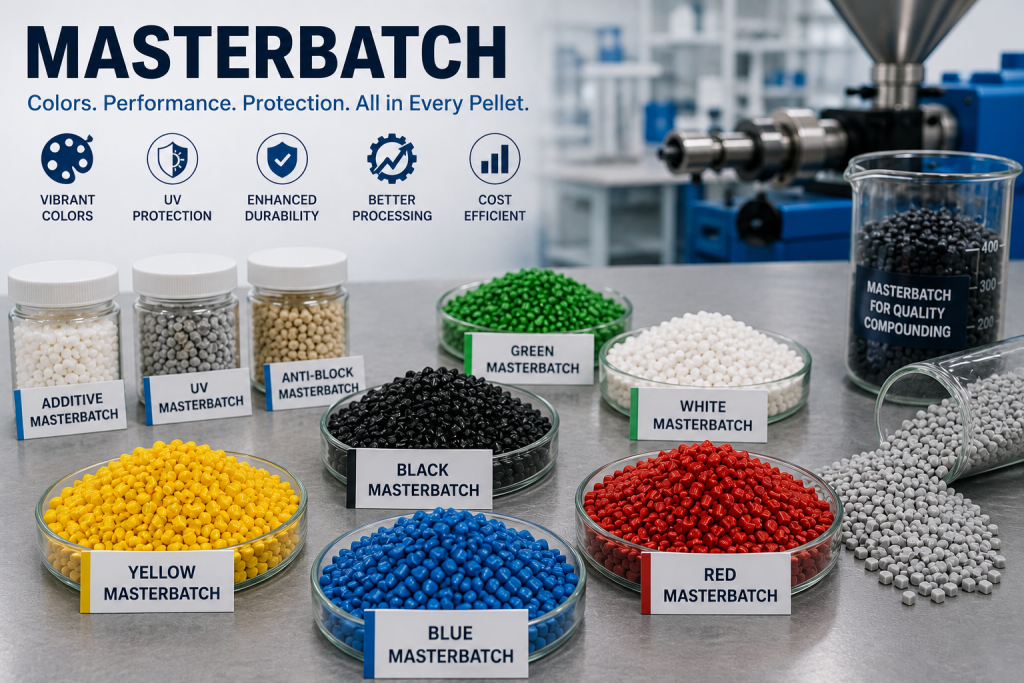
Masterbatch is a concentrated mixture of pigments, functional additives, or mineral fillers dispersed in a carrier resin. In plastic manufacturing, plastic masterbatch helps manufacturers control product color, introduce specific performance properties, and simplify ingredient handling. The right formulation depends on the base polymer, production process, and requirements of the finished product.
What Is Masterbatch?
A masterbatch is a concentrated polymer formulation, usually supplied as pellets or granules, that is blended with a base resin before or during processing. Depending on its composition, it can provide coloration, UV stabilization, oxidation protection, processing assistance, or mineral filling.
Using a suitable concentrate instead of adding certain ingredients directly as powders can simplify storage, feeding, and dosing. It can also support more consistent dispersion when the carrier resin, mixing equipment, and processing conditions are appropriate.
The performance of each grade depends on its active ingredients, concentration, compatibility with the base polymer, and recommended addition rate. The product category alone does not guarantee a specific mechanical property or service life.
Quick Technical Overview of Masterbatch
| Property | Description |
|---|---|
| Product type | Concentrated polymer formulation |
| Physical form | Usually pellets or granules |
| Main components | Pigments, functional additives, carrier resin, and optional processing aids |
| Common carrier resins | PE, PP, and other compatible polymers |
| Primary functions | Coloration, stabilization, processing modification, or mineral filling |
| Recommended dosage | Grade- and application-dependent |
| Common processing methods | Extrusion, injection molding, blow molding, and film production |
| Thermal stability | Depends on formulation and processing conditions |
There is no universal chemical formula, density, melting point, or dosage for masterbatch products. These values depend on the carrier resin and active ingredients. Consult the relevant technical data sheet (TDS) and safety data sheet (SDS) for grade-specific information.
Why Is Masterbatch Important in Plastic Manufacturing?
Masterbatch helps manufacturers introduce pigments and functional ingredients into polymers at a controlled rate. Its value comes from suitable dispersion, compatibility, dosing accuracy, and performance in the intended application.
- Consistent color: Color masterbatch can help maintain repeatable shades across production batches.
- Convenient handling: Pelletized plastic masterbatch can be easier to store and feed than some loose powders.
- Functional performance: Selected grades can provide UV protection, oxidation resistance, antistatic behavior, or other targeted effects.
- Production control: Consistent feeding can reduce variation caused by uneven ingredient distribution.
- Formulation flexibility: Manufacturers can adjust the blend ratio within the recommended operating range.
These benefits depend on the formulation and manufacturing conditions. The selected grade should be validated using the actual polymer, equipment, and finished-product specifications.
Main Types of Masterbatch
1. Color Masterbatch
Color masterbatch contains pigments or dyes dispersed in a compatible carrier resin. It helps manufacturers achieve specific shades, opacity levels, and visual effects in plastic products.
- Black masterbatch: Often uses carbon black for coloration. UV performance depends on pigment characteristics, concentration, dispersion, and the complete formulation.
- White masterbatch: Commonly contains titanium dioxide to provide whiteness and opacity.
- Custom color grades: Designed to match a required shade and color tolerance.
- Special-effect grades: May create metallic, pearlescent, fluorescent, or other decorative finishes.
When selecting a color grade, evaluate color strength, compatibility, processing temperature, dispersion, and the required appearance of the final product.
2. Additive Masterbatch
Additive masterbatch contains functional ingredients designed to modify selected processing or service properties. The appropriate formulation depends on the base polymer, exposure conditions, and intended performance.
- UV stabilizer grades: Help limit ultraviolet degradation in suitable outdoor applications.
- Antioxidant grades: Help control oxidative degradation during processing or service life.
- Slip additives: Can reduce surface friction in compatible film applications.
- Anti-block additives: Help reduce unwanted adhesion between contacting film surfaces.
- Antistatic agents: Help reduce electrostatic charge accumulation in selected products.
- Flame-retardant formulations: Can improve fire performance when the finished material meets the required test criteria.
- Processing aids: May improve specific processing characteristics, depending on the chemistry and polymer system.
Each additive grade is formulation-specific. Food-contact suitability, fire classification, outdoor durability, and other compliance requirements must be verified through appropriate documentation and testing.
3. Filler Masterbatch
Filler masterbatch contains a high proportion of mineral material dispersed in a polymer carrier. Calcium carbonate is commonly used, although other minerals may be selected for particular applications.
These formulations can modify stiffness, opacity, surface characteristics, or material cost in suitable applications. However, mineral loading and particle characteristics may also affect elongation, impact resistance, sealing behavior, and processing stability.
For more information, read the related guide to filler masterbatch, provided that the URL matches the published article.
How Does Masterbatch Work?
During production, the concentrate is blended with the base polymer at a specified ratio. Heat and mechanical mixing help distribute the active ingredients throughout the polymer melt. Proper dispersion is important because uneven distribution can cause color streaks, visible specks, or inconsistent product properties.
- Check compatibility: Match the carrier resin and formulation to the base polymer and end use.
- Determine the dosage: Follow the supplier’s recommended addition rate.
- Feed and mix: Use suitable metering and mixing equipment to achieve consistent distribution.
- Control processing: Monitor melt temperature, residence time, and other relevant production parameters.
- Test the finished product: Check appearance, processing behavior, mechanical performance, and compliance requirements.
Masterbatch Applications in Different Industries
Packaging and Plastic Film
Plastic masterbatch is used in selected packaging films, shopping bags, agricultural films, and industrial liners. Colorants, slip agents, anti-block additives, and UV stabilizers serve different functions depending on the film formulation. The selected grade must meet optical, mechanical, sealing, and regulatory requirements.
Injection-Molded Products
Masterbatch applications in injection molding include containers, caps, household products, automotive components, and industrial parts. Compatibility with the base resin, mold conditions, cycle time, and required surface finish should be confirmed before production.
Fibers and Woven Materials
Specialized grades are used in synthetic fibers, raffia, tapes, and woven sacks. Dispersion, filterability, thermal stability, and compatibility are particularly important for processes involving fine extrusion channels or spinnerets.
Agricultural and Outdoor Products
UV-stabilizing formulations may be used in greenhouse films, irrigation components, outdoor containers, and other products exposed to sunlight. The required protection depends on climate, exposure duration, polymer type, product thickness, and the overall formulation.
Construction and Industrial Components
Selected formulations are incorporated into pipes, profiles, sheets, protective components, and molded industrial products. Applications with demanding service conditions should be validated against the relevant product standards and performance tests.
How to Select the Right Masterbatch
Choosing the right masterbatch starts with the requirements of the finished product rather than price or color alone. Review the following factors before approving a grade.
- Base polymer: Confirm suitability for PE, PP, PET, ABS, or the specific resin being processed.
- Manufacturing process: Check compatibility with blown film, cast film, extrusion, injection molding, blow molding, or fiber production.
- Carrier resin: An incompatible carrier can affect dispersion, appearance, mechanical properties, and process stability.
- Active ingredient concentration: Verify pigment strength or functional ingredient concentration and the recommended dosage.
- Thermal stability: Ensure that the formulation can tolerate the processing temperature and residence time.
- End-use conditions: Consider UV exposure, friction, opacity, mechanical performance, and regulatory requirements.
- Technical documentation: Review the TDS, SDS, processing guidance, and applicable test reports.
Conduct a controlled production trial using the intended resin and equipment before moving to full-scale manufacturing. Confirm that the finished product meets its specification rather than relying only on a product description.
Masterbatch Dosage and Let-Down Ratio
The let-down ratio describes how much concentrate is blended with the base polymer. The recommended dosage depends on active ingredient concentration, target performance, polymer type, processing method, and finished-product requirements.
For example, if a 2% addition rate is defined as a percentage of the total blend, a 100 kg final batch contains 2 kg of concentrate and 98 kg of the remaining blend. If the percentage is defined relative to the base resin instead, the calculation differs. Confirm the supplier’s convention before preparing a production recipe.
Excessive dosage can increase costs and may affect mechanical properties, surface appearance, processing stability, or regulatory suitability. Insufficient dosage may fail to achieve the required color strength or functional effect. Follow grade-specific instructions and validate the formulation through testing.
Masterbatch vs. Direct Ingredient Dosing
| Factor | Concentrated formulation | Direct dosing |
|---|---|---|
| Handling | Pellet form can simplify handling and feeding | Powders or liquids may require additional controls |
| Dispersion | Can support uniform distribution when properly formulated | Depends on ingredient form and mixing equipment |
| Dosing | Supports controlled metering at the specified ratio | Requires accurate measurement and suitable feeding systems |
| Flexibility | Depends on available grades and concentrate strength | May allow direct adjustment of individual ingredients |
| Total cost | Includes concentrate price and its effect on the blend | Includes ingredient, handling, equipment, and quality-control costs |
Neither method is universally better. The appropriate approach depends on total formulation cost, safety, equipment, dispersion, consistency, and finished-product performance.
Common Masterbatch Processing Problems
Uneven Color or Streaking
Possible causes include inconsistent feeding, poor dispersion, an unsuitable carrier resin, or inadequate mixing. Check dosing accuracy, equipment settings, and compatibility before changing the formulation.
Visible Specks
Contamination, pigment agglomeration, degraded material, or inadequate equipment cleaning can cause visible defects. Inspect the feed system, screens, material handling, and processing temperatures.
Changes in Mechanical Properties
Some formulations can affect tensile strength, impact resistance, elongation, stiffness, or sealing performance. Review the recommended loading and test the finished material at the intended dosage.
Unstable Processing
Excessive temperature, long residence time, moisture, an unsuitable carrier, or incompatible ingredients may contribute to production problems. Review technical guidance and make controlled adjustments.
Storage and Handling Recommendations
Store products in sealed, clearly labeled packaging under the conditions specified by the manufacturer. Protect moisture-sensitive grades from humidity and prevent contamination from dust or incompatible materials.
Consult the product SDS for personal protective equipment, handling precautions, spill response, and disposal. Safety and storage requirements may differ between formulations.
Conclusion
Masterbatch is an important tool in plastic manufacturing, helping producers manage coloration and introduce functional ingredients into a wide range of products. Color, additive, and filler grades serve different purposes, so selection should account for polymer compatibility, processing conditions, dosage, and finished-product requirements.
For industrial applications, review the technical documentation and validate the selected grade through production trials. To explore relevant categories, visit the Products page or use the Contact Us page to discuss your application requirements.
References
- Plastics Europe — Information and resources on the plastics industry.
- ASTM International — Standards and testing methods for materials.
- ScienceDirect — Scientific literature on polymers, pigments, and additives.
What is masterbatch used for?
It introduces pigments, functional additives, or mineral fillers into polymers to achieve specific appearance, processing, or performance requirements.
What are the main types?
The main categories are color concentrates, functional additive concentrates, and mineral filler concentrates.
How do manufacturers select the right grade?
They consider the base polymer, processing method, ingredient concentration, recommended dosage, thermal stability, and end-use requirements.
Can these formulations affect mechanical properties?
Yes. Depending on composition and dosage, they may affect tensile strength, impact resistance, elongation, stiffness, and sealing performance.
Are all grades suitable for food-contact products?
No. The selected grade and finished product must meet applicable food-contact requirements, supported by appropriate documentation and testing.