


Table of Contents
- What Is Isopropyl Alcohol?
- Isopropyl Alcohol: Technical Specifications
- Why Is Isopropyl Alcohol Used in Manufacturing?
- Industrial Applications of Isopropyl Alcohol
- 1. Electronics and Electrical Manufacturing
- 2. Pharmaceutical and Laboratory Operations
- 3. Industrial Surface Preparation
- 4. Automotive and Precision Component Manufacturing
- 5. Printing, Packaging, and Coatings
- 6. Chemical Manufacturing and Formulation
- 7. Industrial Maintenance and Equipment Cleaning
- How to Choose the Right Isopropyl Alcohol Grade
- Isopropyl Alcohol Compared with Other Industrial Solvents
- Safe Handling and Storage of Isopropyl Alcohol
- Environmental Considerations and Solvent Recovery
- Industrial Purchasing and Supply Considerations
- Conclusion
- What is Isopropyl Alcohol mainly used for in industry?
- What is the CAS number of Isopropyl Alcohol?
- Is Isopropyl Alcohol soluble in water?
- How do manufacturers choose the right IPA grade?
- Is Isopropyl Alcohol flammable?
- Can used Isopropyl Alcohol be recovered and reused?
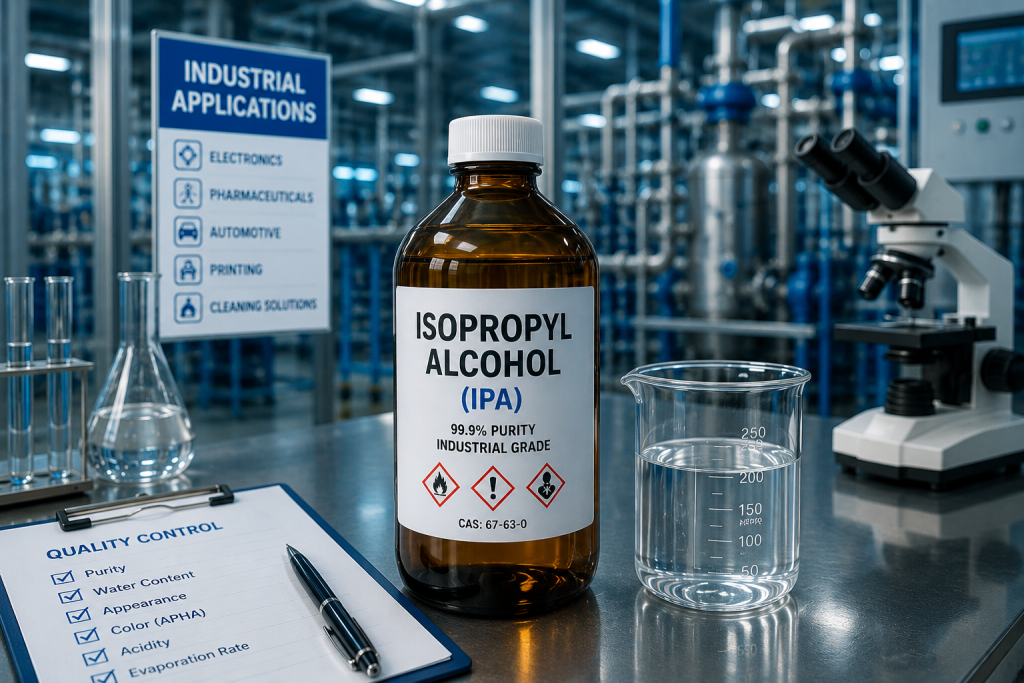
Isopropyl Alcohol (IPA), also known as isopropanol or 2-propanol, is a fast-evaporating solvent used in industrial cleaning, electronics manufacturing, pharmaceutical processing, surface preparation, and chemical production. Manufacturers select IPA based on purity, water content, contaminant profile, material compatibility, and the requirements of the cleaning or production process.
This guide explains the technical properties, industrial applications, grade selection, safety requirements, and recovery options for Isopropyl Alcohol. It is intended for industrial buyers, production engineers, procurement teams, and chemical distributors evaluating IPA for manufacturing operations.
What Is Isopropyl Alcohol?
Isopropyl Alcohol is a secondary alcohol with the molecular formula C3H8O. It is a clear, colorless, flammable liquid that mixes completely with water. Its solvency, relatively low viscosity, and rapid evaporation make it useful for removing selected oils, fingerprints, residues, and other contaminants from suitable surfaces.
Commercial IPA is commonly manufactured through the hydration of propylene. The resulting product is refined to meet the purity and quality specifications required for its intended use. Industrial, electronic-grade, pharmaceutical-grade, and other specialty grades may differ in water content, trace impurities, packaging, and quality controls.
As one of the widely used industrial solvents, Isopropyl Alcohol is valuable when a process requires effective cleaning and relatively fast drying. However, its suitability depends on the contaminant, substrate, process conditions, and required cleanliness level.
Isopropyl Alcohol: Technical Specifications
The following table summarizes representative physical and chemical properties of pure Isopropyl Alcohol. Actual commercial specifications can vary by grade, test method, and supplier; buyers should confirm the applicable technical data sheet and certificate of analysis before purchase.
| Property | Typical Value or Description |
|---|---|
| Chemical name | Propan-2-ol |
| Common names | Isopropyl Alcohol, isopropanol, IPA, 2-propanol |
| Molecular formula | C3H8O |
| CAS number | 67-63-0 |
| EC number | 200-661-7 |
| Molecular weight | 60.10 g/mol |
| Appearance | Clear, colorless liquid |
| Boiling point | Approximately 82.3°C at 101.3 kPa |
| Flash point | Approximately 12°C, closed-cup method; method-dependent |
| Density | Approximately 0.785 g/cm³ at 20–25°C |
| Water solubility | Miscible with water |
| Viscosity | Low; confirm the value at the stated temperature in the supplier’s technical data |
| Primary hazard | Highly flammable liquid and vapor |
Reference data for these properties are available from PubChem’s Isopropanol record and the NIOSH Pocket Guide. For purchasing and process design, use the specifications for the actual product grade rather than relying on generic reference values.
Why Is Isopropyl Alcohol Used in Manufacturing?
Manufacturers use Isopropyl Alcohol because it can remove many common contaminants and evaporates relatively quickly under suitable conditions. It is also miscible with water, which helps make it useful in formulations where both aqueous and organic residues need to be considered.
- Fast evaporation: Can reduce drying time between cleaning and subsequent processing steps.
- Effective cleaning: Dissolves many fingerprints, light oils, and selected process residues.
- Low residue when properly specified: Suitable grades can support cleaning procedures that require minimal nonvolatile residue.
- Flexible formulation: Available in different concentrations and purity grades for specific process requirements.
- Broad industrial use: Applied in maintenance, surface preparation, electronics, laboratories, and selected pharmaceutical operations.
IPA is not a universal cleaning solution. It may not remove every contaminant, and it can damage some plastics, coatings, adhesives, elastomers, or other sensitive materials. Manufacturers should validate compatibility and cleaning effectiveness before introducing it into a production process.
Industrial Applications of Isopropyl Alcohol
1. Electronics and Electrical Manufacturing
Isopropyl Alcohol is used in selected electronics-cleaning processes to remove fingerprints, light oils, and certain flux residues from circuit boards, connectors, sensors, and other components. Its suitability depends on the flux chemistry, component materials, cleanliness specification, and whether the assembly can tolerate the solvent.
For sensitive electronics, the grade’s water content, ionic contamination, nonvolatile residue, and trace impurities may be more important than the headline purity percentage. IPA should not be assumed compatible with every electronic component, coating, or assembly process.
2. Pharmaceutical and Laboratory Operations
Pharmaceutical manufacturers and laboratories use IPA in equipment cleaning, selected surface-disinfection procedures, analytical work, and formulation processes where the applicable grade is approved. Its role depends on the operating procedure and the relevant quality requirements.
In regulated facilities, a product’s intended use, grade documentation, concentration, microbial-control requirements, and validated procedure must all be considered. Industrial-grade Isopropyl Alcohol should not automatically be substituted for pharmaceutical or other regulated grades.
3. Industrial Surface Preparation
Before painting, bonding, printing, or coating, manufacturers may use Isopropyl Alcohol to remove fingerprints and selected light contaminants from compatible surfaces. Effective surface preparation can help reduce defects caused by contamination.
However, IPA does not remove every type of grease, silicone, wax, corrosion, or particulate matter. The cleaning procedure should specify the substrate, contaminant, wiping method, solvent concentration, drying time, and final acceptance criteria. A test on an inconspicuous area is advisable when material compatibility is uncertain.
For broader cleaning-process options, see our guide to industrial cleaning chemicals.
4. Automotive and Precision Component Manufacturing
Automotive and precision-engineering facilities may use Isopropyl Alcohol to clean selected metal, glass, and compatible component surfaces before assembly, inspection, bonding, or coating. Applications include removing handling marks and light process residues from parts that require a controlled surface condition.
Electric vehicle production and electronic control systems may also involve IPA-based cleaning steps, but the solvent must be checked against battery materials, electrical insulation, polymers, seals, and manufacturer-specific process requirements. Cleaning a component with IPA does not replace a validated contamination-control procedure.
5. Printing, Packaging, and Coatings
In printing and packaging operations, IPA may be used in selected cleaning tasks involving compatible rollers, tools, machine components, or formulation systems. Its suitability depends on the printing technology, ink chemistry, equipment design, and applicable environmental and workplace rules.
Manufacturers should also assess ventilation, flammable-vapor controls, and the potential effect of IPA emissions on workplace air quality. Alternative cleaning formulations may be more appropriate when process performance, equipment compatibility, or emissions limits require them.
6. Chemical Manufacturing and Formulation
Isopropyl Alcohol serves as a solvent, processing aid, and formulation ingredient in various chemical operations. Its properties can be useful in selected cleaning products, coatings, laboratory preparations, and specialty chemical processes.
For formulation work, engineers should evaluate IPA concentration, water content, miscibility, evaporation behavior, and interactions with other ingredients. For additional context on sourcing and selecting materials, see chemical raw materials.
7. Industrial Maintenance and Equipment Cleaning
Maintenance teams may use IPA to clean selected tools, fixtures, instrument surfaces, and equipment parts. It can be practical for small-area cleaning where rapid evaporation is beneficial and the material is compatible.
Before cleaning machinery, operators must isolate energy sources where required, follow the equipment manufacturer’s instructions, control ignition risks, and ensure the solvent cannot enter sensitive bearings, seals, electrical enclosures, or other restricted areas.
How to Choose the Right Isopropyl Alcohol Grade
The correct Isopropyl Alcohol grade depends on the application rather than purity alone. A high-purity product may be necessary for sensitive processes, while a different specification may be adequate for routine industrial cleaning. Buyers should define the required properties before comparing suppliers.
| Application | Key Selection Criteria |
|---|---|
| Routine industrial cleaning | Purity, contaminant profile, packaging, and material compatibility |
| Electronics cleaning | Water content, ionic impurities, nonvolatile residue, and process validation |
| Pharmaceutical operations | Applicable grade, documented quality controls, traceability, and approved use |
| Laboratory applications | Analytical requirements, impurity limits, and method compatibility |
| Formulation and chemical processing | Concentration, water content, miscibility, and consistency between batches |
| Bulk industrial supply | Certificate of analysis, safety data sheet, packaging, transport, and supply consistency |
When requesting a quotation, specify the required purity or concentration, intended application, packaging format, expected order volume, delivery destination, and documentation requirements. Ask for a current technical data sheet (TDS), safety data sheet (SDS), and certificate of analysis (CoA), where applicable.
Isopropyl Alcohol Compared with Other Industrial Solvents
IPA is often considered alongside acetone, ethanol, and methyl ethyl ketone (MEK). These solvents have different solvency profiles, evaporation behavior, material compatibility, and safety considerations, so they should not be treated as interchangeable.
| Solvent | Potential Advantage | Important Consideration |
|---|---|---|
| Isopropyl Alcohol (IPA) | Miscible with water; useful for many cleaning tasks | May be unsuitable for certain polymers, coatings, or residues |
| Acetone | Strong solvency for many organic materials and rapid evaporation | Can attack numerous plastics, coatings, and adhesives |
| Ethanol | Useful in selected cleaning, laboratory, and formulation processes | Grade, water content, and regulatory requirements vary by use |
| Methyl Ethyl Ketone (MEK) | Strong solvent performance in selected coatings and industrial formulations | Requires careful assessment of exposure, flammability, and substrate compatibility |
Choose a solvent by testing cleaning performance against the target contaminant, checking substrate compatibility, measuring drying time, and reviewing worker-safety and environmental requirements. Read our related guide to MEK industrial applications for a comparison point when evaluating alternative solvents.
Safe Handling and Storage of Isopropyl Alcohol
Isopropyl Alcohol is a highly flammable liquid. Its vapor can ignite when exposed to an ignition source, and vapor accumulation can create serious fire risks, particularly in poorly ventilated spaces. Exposure may also irritate the eyes and respiratory tract and can cause central nervous system effects at sufficient concentrations.
Industrial users should assess the specific product’s SDS and workplace conditions before handling IPA. Appropriate controls may include:
- Store IPA in approved, compatible, clearly labeled containers.
- Keep containers away from heat, sparks, open flames, and other ignition sources.
- Provide effective ventilation and use suitable closed-transfer systems where necessary.
- Use appropriate bonding and grounding procedures when transferring flammable liquids, as required by the risk assessment and applicable codes.
- Select gloves, eye protection, and other personal protective equipment based on the SDS and the task.
- Keep containers closed when not in use and segregate the material from incompatible substances.
- Train workers in spill response, fire prevention, exposure control, and emergency procedures.
- Dispose of IPA waste according to applicable hazardous-waste and environmental requirements.
Review the NIOSH Pocket Guide for Isopropyl Alcohol and applicable workplace regulations when developing handling procedures. Do not rely on odor alone to determine whether an atmosphere is safe.
Environmental Considerations and Solvent Recovery
Isopropyl Alcohol is a volatile organic compound (VOC), so its use can contribute to workplace and environmental emissions. Facilities should consider vapor containment, ventilation design, storage practices, waste minimization, and applicable air-emission requirements when planning an IPA-based process.
Where solvent recovery is technically and economically suitable, distillation or other approved treatment processes may allow used IPA to be recovered for reuse. The feasibility depends on the contaminant mixture, water content, required recovered-product specification, energy consumption, and process safety. Recovered solvent should not be returned to a critical application until its quality has been verified.
Learn more about the operational considerations in our guide to solvent recovery systems. Recovery does not eliminate the need for emission controls, safe waste management, or quality testing.
Industrial Purchasing and Supply Considerations
For industrial buyers, dependable Isopropyl Alcohol supply involves more than comparing the price per kilogram or liter. Product consistency, grade documentation, packaging integrity, transport conditions, lead time, and supplier communication can all affect production continuity.
Before confirming an order, procurement teams should check:
- Whether the quoted grade meets the intended process requirements.
- Whether the purity, water content, and impurity limits are documented.
- Whether batch-specific quality documents are available.
- Whether packaging and transport comply with the relevant flammable-liquid requirements.
- Whether the supplier can provide consistent specifications and communicate any product changes.
- Whether the total delivered cost includes packaging, freight, handling, and any applicable import requirements.
These checks are relevant for manufacturers and distributors operating in markets such as Iran, India, and Turkey. Availability, pricing, import conditions, and demand can vary over time, so buyers should confirm current local conditions rather than relying on generalized market forecasts.
To review available chemical products, visit the AasadChimie products page. For grade specifications, supply details, or a product inquiry, use the contact page.
Conclusion
Isopropyl Alcohol is a versatile industrial solvent used in electronics cleaning, surface preparation, selected pharmaceutical and laboratory operations, automotive manufacturing, printing, and chemical processing. Its rapid evaporation and water miscibility make it useful in many processes, but performance depends on the solvent grade, target contaminant, substrate, and operating conditions.
Manufacturers can make better purchasing and process decisions by verifying technical specifications, testing material compatibility, implementing appropriate fire and exposure controls, and evaluating solvent recovery where suitable. Selecting the right IPA grade and following documented procedures helps support consistent cleaning performance, product quality, and responsible chemical management.
What is Isopropyl Alcohol mainly used for in industry?
Isopropyl Alcohol is used for selected cleaning and processing tasks in electronics, laboratories, pharmaceutical facilities, automotive manufacturing, surface preparation, and industrial maintenance.
What is the CAS number of Isopropyl Alcohol?
The CAS number of Isopropyl Alcohol is 67-63-0.
Is Isopropyl Alcohol soluble in water?
Yes. Isopropyl Alcohol is miscible with water, meaning the two liquids can mix in all proportions.
How do manufacturers choose the right IPA grade?
They evaluate purity, water content, trace impurities, nonvolatile residue, intended application, material compatibility, and required quality documentation.
Is Isopropyl Alcohol flammable?
Yes. Isopropyl Alcohol is highly flammable. It must be stored and handled with suitable ventilation, ignition-source controls, compatible containers, and appropriate protective equipment.
Can used Isopropyl Alcohol be recovered and reused?
In suitable industrial processes, used IPA can be recovered and purified. The recovered solvent should be tested to verify that it meets the specification required for its intended reuse.