


Table of Contents
- What Are Chemical Raw Materials?
- Why Chemical Raw Materials Matter in Manufacturing
- Main Types of Chemical Raw Materials
- 1. Industrial Solvents
- 2. Acids and Alkalis
- 3. Petrochemical Derivatives
- 4. Resins and Polymers
- 5. Surfactants and Functional Additives
- 6. Specialty Chemicals
- Chemical Raw Materials in Pharmaceutical Manufacturing
- Chemical Raw Materials in Paints, Coatings, and Adhesives
- Chemical Raw Materials in Plastics and Polymer Processing
- Chemical Raw Materials in Industrial Cleaning
- How to Evaluate Chemical Specifications
- How to Choose a Reliable Supplier
- Chemical Raw Materials and Supply Chain Management
- Regional Sourcing: India, Turkey, and Iran
- India
- Turkey
- Iran
- Environmental Compliance and Safe Handling
- Solvent Recovery and Resource Efficiency
- Future Trends in Chemical Raw Materials
- Conclusion
- What are chemical raw materials?
- Which industries use chemical raw materials?
- How do manufacturers check raw material quality?
- What should buyers consider when choosing a supplier?
- How can manufacturers reduce chemical waste?
- Can one chemical grade replace another?
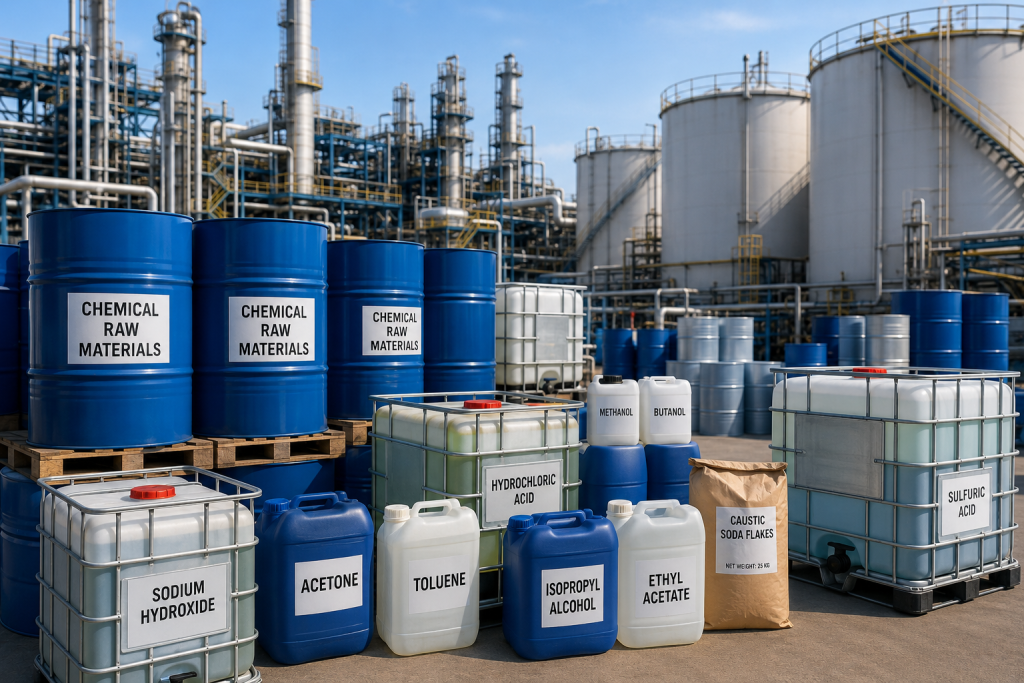
Chemical Raw Materials are essential inputs in modern manufacturing, supporting the production of pharmaceuticals, plastics, paints, coatings, adhesives, detergents, and petrochemical products. Selecting the right materials helps manufacturers maintain consistent product quality, improve process efficiency, and control operating costs.
From basic industrial solvents to advanced polymers and specialty additives, these materials perform different functions throughout the manufacturing process. Their quality, availability, and compatibility with production requirements can directly affect operational performance and finished-product specifications.
This guide explains the main types of chemical inputs, their industrial applications, material selection criteria, supplier evaluation, supply chain management, and environmental considerations for manufacturers and industrial buyers.
What Are Chemical Raw Materials?
Chemical raw materials are substances used as inputs to manufacture finished goods, intermediate compounds, and industrial formulations. Depending on the application, they may undergo chemical reactions, blending, purification, dissolution, or physical processing before becoming part of a final product.
Common examples include solvents, acids, alkalis, resins, polymers, surfactants, pigments, petrochemical derivatives, and specialty additives. Each category serves a specific function, and the appropriate grade depends on the intended application and production conditions.
For example, a coating manufacturer may require solvents and resins, while a detergent producer may need surfactants, builders, and pH-control ingredients. Understanding these differences helps purchasing teams specify the correct materials and avoid unnecessary substitutions.
Why Chemical Raw Materials Matter in Manufacturing
The selection of chemical raw materials influences product consistency, manufacturing efficiency, process reliability, and compliance with technical requirements. Even small variations in purity, moisture content, viscosity, or composition can affect certain formulations and production processes.
Manufacturers should evaluate the following factors before approving a material:
- Product quality: Consistent composition supports predictable product performance.
- Process efficiency: Suitable materials can reduce processing difficulties and unnecessary adjustments.
- Production costs: Material selection affects consumption, waste, energy use, and rejection rates.
- Operational reliability: Consistent specifications help maintain stable manufacturing conditions.
- Regulatory compliance: Appropriate documentation supports safe handling and applicable legal requirements.
- Supply continuity: Reliable sourcing helps manufacturers meet production schedules.
Evaluating the total cost of a material is more effective than comparing purchase prices alone. A cheaper product may increase overall costs if it causes inconsistent results, higher consumption, or additional quality-control requirements.
Main Types of Chemical Raw Materials
1. Industrial Solvents
Industrial solvents dissolve, dilute, extract, or remove compatible substances during manufacturing. They are widely used in paints, coatings, adhesives, printing inks, pharmaceutical processes, and industrial cleaning.
Selection depends on solvency, evaporation rate, compatibility, purity, and safety requirements. Manufacturers must also consider VOC emissions and the conditions needed for storage and handling.
Read our guide to industrial solvents to learn more about their properties and applications.
2. Acids and Alkalis
Acids and alkalis are used in chemical synthesis, pH adjustment, water treatment, metal processing, and various industrial reactions. Common examples include sulfuric acid, hydrochloric acid, phosphoric acid, sodium hydroxide, and potassium hydroxide.
Concentration, purity, compatibility, and handling requirements should be verified before purchase. The appropriate grade depends on the process, equipment, and relevant quality standards.
3. Petrochemical Derivatives
Petrochemical derivatives serve as feedstocks for producing plastics, synthetic fibers, rubber, resins, and numerous industrial intermediates. Their composition and processing characteristics determine their suitability for downstream manufacturing.
Depending on the application, manufacturers may require specific monomers, aromatic compounds, olefins, or other chemical building blocks. Technical specifications and supply consistency are important when these materials support continuous production.
4. Resins and Polymers
Resins and polymers provide structural, mechanical, adhesive, and protective properties in products ranging from packaging to automotive components and construction materials.
Manufacturers select polymer grades according to properties such as strength, flexibility, thermal resistance, chemical resistance, processability, and compatibility with additives. The right grade depends on both the manufacturing method and the final product’s intended use.
5. Surfactants and Functional Additives
Surfactants help control wetting, emulsification, foaming, and the removal of contaminants. They are commonly used in detergents, industrial cleaners, personal care formulations, and selected process applications.
Functional additives may also improve stability, color, processing behavior, durability, or resistance to environmental factors. Their effectiveness depends on formulation compatibility and the recommended dosage for the application.
6. Specialty Chemicals
Specialty chemicals are selected for specific performance requirements rather than serving only as general-purpose ingredients. Examples include corrosion inhibitors, stabilizers, dispersants, curing agents, and other functional compounds.
Because their performance can depend on precise formulation conditions, manufacturers should review technical documentation and conduct application testing before approving a new product.
Chemical Raw Materials in Pharmaceutical Manufacturing
Pharmaceutical manufacturing requires carefully controlled ingredients and processing materials. Depending on the production stage, these may include active pharmaceutical ingredients, excipients, solvents, and specialized processing aids.
Quality requirements depend on the material’s intended use and the applicable pharmaceutical standards. Manufacturers may need to verify identity, purity, impurity limits, traceability, and batch consistency before accepting a delivery.
Industrial-grade chemicals should not automatically be considered suitable for pharmaceutical production. Buyers must confirm the required grade, supporting documentation, and regulatory suitability for the specific application.
Chemical Raw Materials in Paints, Coatings, and Adhesives
Paint and coating manufacturers use combinations of resins, solvents, pigments, fillers, curing agents, and performance additives. These ingredients influence adhesion, color, gloss, viscosity, drying behavior, durability, and corrosion resistance.
Adhesive formulations may require polymers, tackifiers, crosslinking agents, and other ingredients selected for bonding strength and substrate compatibility. The appropriate formulation depends on application conditions, curing requirements, and the expected service environment.
Manufacturers should evaluate ingredient compatibility and finished-product performance through laboratory tests or controlled production trials. Environmental requirements, including restrictions on certain substances and VOC emissions, may also influence material selection.
Chemical Raw Materials in Plastics and Polymer Processing
Plastics manufacturing depends on polymer resins and functional additives that support the required mechanical, thermal, visual, and processing properties. Depending on the product, formulations may include stabilizers, pigments, impact modifiers, lubricants, and processing aids.
Material selection should account for the base polymer, processing temperature, dispersion behavior, product specifications, and intended service conditions. Manufacturers using recycled polymers may also need to address contamination, variation in material properties, and degradation during processing.
Testing helps determine whether an additive or resin grade can deliver consistent performance without creating processing problems or compromising the final product.
Chemical Raw Materials in Industrial Cleaning
Industrial cleaning formulations use selected solvents, surfactants, acids, alkalis, and other ingredients to remove grease, oils, scale, and manufacturing residues. The right combination depends on the type of contaminant, the surface being cleaned, and the cleaning method.
Inappropriate chemicals may damage equipment, leave residues, or introduce unnecessary workplace hazards. Manufacturers should assess cleaning effectiveness, surface compatibility, rinsing requirements, and waste management before changing a formulation.
Explore our related guides to industrial cleaning chemicals and industrial degreasing agents.
How to Evaluate Chemical Specifications
Before purchasing chemical raw materials, buyers should establish measurable acceptance criteria. These specifications help suppliers understand the requirement and allow quality teams to verify whether a delivered batch is suitable for use.
| Evaluation Factor | What to Verify |
|---|---|
| Identity and grade | Product name, chemical identity, grade, and CAS number where applicable |
| Purity and composition | Assay, impurity limits, and composition requirements |
| Physical properties | Relevant values such as density, viscosity, moisture, pH, or boiling range |
| Batch quality | Certificate of analysis and agreed acceptance limits |
| Safety documentation | Current safety data sheet and appropriate handling guidance |
| Storage and shelf life | Container compatibility, storage conditions, and expiry or retest requirements |
A technical data sheet describes product characteristics and typical applications, while a safety data sheet communicates hazards and protective measures. A certificate of analysis provides test results for a particular batch. These documents serve different purposes and should be reviewed together when appropriate.
How to Choose a Reliable Supplier
Supplier selection involves more than finding a product at the lowest price. A reliable supplier should provide suitable grades, consistent documentation, dependable delivery arrangements, and clear communication about quality or specification changes.
Use these criteria when comparing suppliers:
- Technical suitability: Confirm that the product meets the required specifications and application needs.
- Quality assurance: Review batch documentation and quality-control practices.
- Supply reliability: Assess stock availability, lead times, and continuity of supply.
- Packaging and transport: Verify suitable packaging and handling conditions.
- Technical support: Confirm how product questions and quality issues are addressed.
- Total delivered cost: Include transportation, storage, waste, and quality-related costs.
For critical materials, manufacturers should qualify suppliers through sample testing, document review, and controlled production trials where necessary. Substitutions should not be approved solely because two products have similar names or stated uses.
To explore available products, visit the AasadChimie Products page. For specification questions and sourcing inquiries, use the Contact Us page.
Chemical Raw Materials and Supply Chain Management
Manufacturing operations can be affected by transport delays, price fluctuations, changing availability, and disruptions in supplier networks. Effective supply chain management helps businesses identify risks and maintain adequate inventory without tying up unnecessary capital.
Practical measures include:
- Classifying materials by importance and replacement difficulty.
- Monitoring consumption rates, stock levels, and delivery lead times.
- Qualifying alternative suppliers for critical products.
- Setting inventory levels according to demand and replenishment risk.
- Tracking changes in specifications and supplier documentation.
- Checking that substitute products meet the same technical and regulatory requirements.
Multiple suppliers can reduce dependence on a single source, but alternatives should be technically approved before use. A change in purity, composition, or physical properties may affect manufacturing performance even when the product category is the same.
Regional Sourcing: India, Turkey, and Iran
Businesses sourcing chemical raw materials for India, Turkey, and Iran should evaluate supplier availability, transport routes, documentation, customs requirements, and applicable trade rules. The most suitable sourcing approach depends on the specific chemical, destination, order size, and commercial terms.
India
Manufacturers serving pharmaceutical, automotive, textile, packaging, and coatings industries should verify grade requirements and supplier quality systems. Consistent documentation and delivery planning are important for production schedules and quality assurance.
Turkey
Turkey’s manufacturing and export activities create demand for a wide range of industrial inputs. Buyers should assess product specifications, transport arrangements, customs documentation, and the requirements of the intended application.
Iran
Iran’s petrochemical and manufacturing sectors use many types of industrial chemicals and processing materials. Buyers should compare available sourcing options according to technical suitability, supply continuity, payment conditions, logistics, and applicable trade restrictions.
Market availability and commercial conditions can change. Buyers should verify current offers and applicable requirements rather than assuming that pricing, lead times, or import conditions remain constant.
Environmental Compliance and Safe Handling
Responsible management of chemical raw materials requires appropriate storage, handling, exposure controls, waste management, and compliance with relevant regulations. Requirements vary according to the chemical, quantity, application, and jurisdiction.
Manufacturers should implement procedures for:
- Reviewing safety data sheets before handling unfamiliar products.
- Providing suitable ventilation and task-specific personal protective equipment.
- Separating incompatible chemicals and controlling ignition sources where necessary.
- Preventing spills and managing waste according to applicable requirements.
- Maintaining employee training and emergency response procedures.
- Evaluating emissions and potential releases to the environment.
Useful regulatory resources include the US Environmental Protection Agency, the European Chemicals Agency, and the US Occupational Safety and Health Administration. Applicable legal requirements depend on the country and activity, so businesses should also consult relevant local authorities.
Solvent Recovery and Resource Efficiency
Some manufacturing processes generate solvent streams that can potentially be recovered and reused. The feasibility of recovery depends on the solvent composition, contamination level, process design, energy requirements, and quality standards for reuse.
Well-designed recovery systems may reduce fresh-material consumption and waste generation. However, recovered solvents should be tested against defined specifications before returning to production, particularly when purity affects product performance or regulatory compliance.
Learn more about solvent recovery systems and VOC emissions control.
Future Trends in Chemical Raw Materials
Material sourcing and formulation practices continue to evolve in response to production requirements, environmental priorities, and technological development. Adoption rates vary across industries, but several areas are receiving increasing attention.
- Bio-based feedstocks: Renewable alternatives may be suitable for selected applications when performance and lifecycle impacts are verified.
- Chemical recycling: Recovery technologies can create new routes for converting certain waste streams into useful inputs.
- Advanced specialty chemicals: Functional ingredients can improve specific performance characteristics.
- Digital procurement: Data-driven systems can support inventory planning, supplier comparison, and demand forecasting.
- Process optimization: Better monitoring and dosing can reduce material losses and improve consistency.
- Lifecycle assessment: Manufacturers can evaluate resource use and environmental impacts across a product’s lifecycle.
New materials and technologies should be assessed according to technical performance, safety, cost, and credible environmental evidence. A newer or bio-based option is not automatically suitable for every manufacturing process.
Conclusion
Chemical raw materials are fundamental to manufacturing industries, from pharmaceuticals and coatings to plastics, petrochemicals, and industrial cleaning. Their quality and suitability influence production efficiency, finished-product consistency, operating costs, and regulatory compliance.
Manufacturers can make better sourcing decisions by defining clear specifications, reviewing supplier documentation, validating performance, and planning for supply chain risks. Combining these practices with responsible handling and waste reduction supports reliable production and long-term operational performance.
What are chemical raw materials?
Chemical raw materials are substances used to manufacture finished products, intermediate compounds, and industrial formulations.
Which industries use chemical raw materials?
Pharmaceuticals, plastics, coatings, petrochemicals, automotive manufacturing, industrial cleaning, construction, and many other industries rely on these materials.
How do manufacturers check raw material quality?
They review product specifications, safety data sheets, batch-specific certificates of analysis, and application-specific test results.
What should buyers consider when choosing a supplier?
They should assess product suitability, batch consistency, documentation, delivery reliability, technical support, and total delivered cost.
How can manufacturers reduce chemical waste?
They can improve dosing, optimize processes, prevent spills, segregate waste streams, and recover suitable solvents where technically feasible.
Can one chemical grade replace another?
Not without evaluation. Differences in purity, composition, or physical properties may affect process performance, so substitutes should be tested before approval.