


Table of Contents
- What Are Industrial Solvents?
- Types of Industrial Solvents
- 1. Oxygenated Solvents
- 2. Hydrocarbon Solvents
- 3. Halogenated Solvents
- 4. Polar and Non-Polar Solvents
- Industrial Solvents: Types and Applications Compared
- Industrial Solvent Applications in Manufacturing
- Paints and Coatings
- Pharmaceutical and Fine Chemical Processing
- Petrochemical and Chemical Manufacturing
- Automotive and Metalworking
- Printing, Packaging, and Adhesives
- Industrial Solvents for Cleaning and Degreasing
- How to Select the Right Industrial Solvent
- Solvency and Material Compatibility
- Evaporation Rate and Process Conditions
- Purity and Product Grade
- Safety and Regulatory Compliance
- Total Cost of Use
- Supplier Documentation and Availability
- Environmental Impact of Industrial Solvents
- Solvent Recovery and Reuse
- Safe Handling and Storage of Industrial Solvents
- Industrial Solvent Demand in India, Turkey, and Iran
- India
- Turkey
- Iran
- Challenges in Industrial Solvent Use
- Future Trends in Industrial Solvents
- Conclusion
- What are industrial solvents used for?
- What are the main types of industrial solvents?
- How do I select the right industrial solvent?
- Are industrial solvents dangerous?
- What is industrial solvent recovery?
- What are VOC emissions?
- Are bio-based solvents always better for the environment?
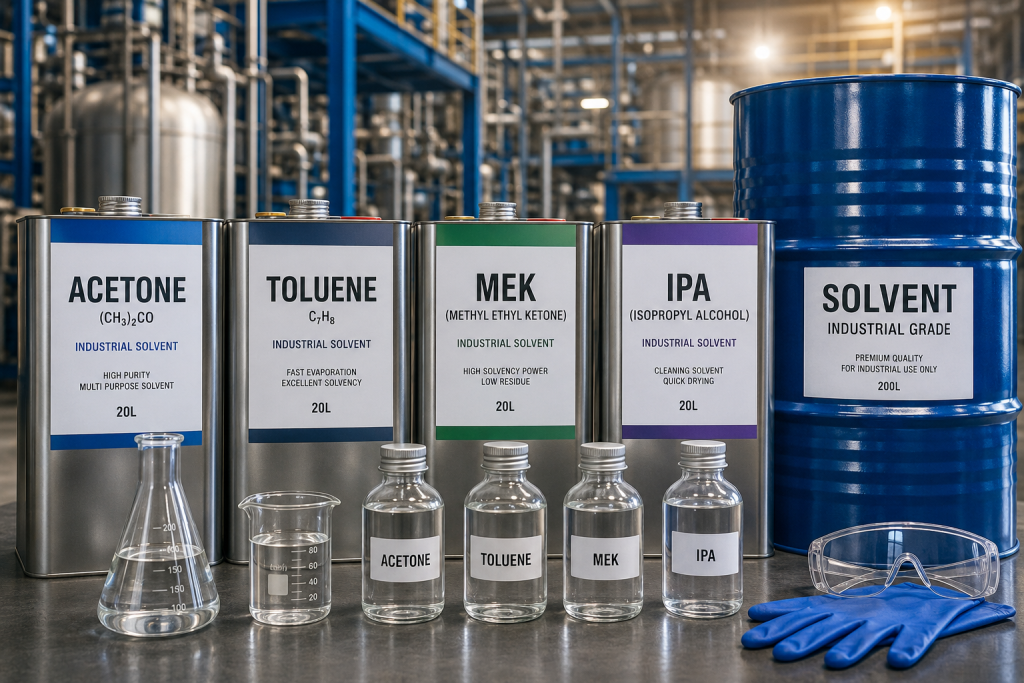
Industrial Solvents are essential chemicals used in manufacturing to dissolve materials, adjust formulation viscosity, remove contaminants, extract compounds, and support chemical processing. These solvents serve industries such as paints and coatings, pharmaceuticals, petrochemicals, automotive manufacturing, printing, adhesives, and industrial cleaning. Selecting suitable industrial solvents requires evaluating solvency, evaporation rate, material compatibility, purity, safety, and process requirements.
Manufacturers use different industrial solvents depending on the raw materials, production conditions, and required product characteristics. Understanding solvent types and their applications helps industrial buyers improve process consistency, control operating costs, and meet environmental and workplace safety requirements.
What Are Industrial Solvents?
Industrial solvents are liquids that dissolve, dilute, extract, or disperse other substances without necessarily changing their chemical identity. In manufacturing, they help prepare formulations, remove unwanted residues, facilitate chemical reactions, and separate compounds during production.
The performance of industrial solvents depends on properties such as polarity, vapor pressure, boiling point, solvency power, and compatibility with other materials. These properties influence drying time, cleaning efficiency, product quality, and solvent losses during processing.
For example, a solvent suitable for dissolving a coating resin may not be appropriate for cleaning sensitive plastic components. Manufacturers should therefore select industrial solvents according to the specific application rather than relying only on price or general chemical classification.
Types of Industrial Solvents
Industrial solvents are commonly classified by chemical structure and functional properties. The main categories include oxygenated solvents, hydrocarbon solvents, and halogenated solvents. Polarity provides another useful way to compare their behavior in different formulations.
1. Oxygenated Solvents
Oxygenated industrial solvents contain oxygen in their molecular structure. This category includes alcohols, ketones, esters, and glycol ethers. Each group offers different solvency and evaporation characteristics for manufacturing applications.
- Alcohols: Isopropyl alcohol is used in cleaning, surface preparation, and selected formulations.
- Ketones: Acetone and methyl ethyl ketone (MEK) are used in suitable coating, adhesive, cleaning, and resin-processing applications.
- Esters: Ethyl acetate and butyl acetate are common ingredients in coating, ink, and adhesive formulations.
- Glycol ethers: Selected grades provide useful solvency and controlled evaporation in industrial cleaners and coatings.
When choosing oxygenated industrial solvents, manufacturers should compare resin compatibility, water content, evaporation rate, purity, and occupational exposure requirements.
Related guides: acetone in industry and isopropyl alcohol applications.
2. Hydrocarbon Solvents
Hydrocarbon solvents consist primarily of carbon and hydrogen and are commonly derived from petroleum-based feedstocks. They include aliphatic and aromatic products, as well as formulated blends designed for specific manufacturing processes.
- Aliphatic solvents: Used in selected degreasing products, industrial cleaners, and coatings.
- Aromatic solvents: Toluene and xylene are used in certain coatings, adhesives, inks, and chemical processes.
- Hydrocarbon blends: Formulated to achieve a particular balance of solvency, volatility, and application performance.
These industrial solvents can dissolve many oils, greases, resins, and other organic materials. Their suitability depends on the contaminant, substrate, solvent composition, exposure controls, and applicable environmental regulations.
3. Halogenated Solvents
Halogenated solvents contain elements such as chlorine or fluorine. Specific compounds have been used for specialized cleaning, degreasing, and chemical synthesis. Their suitability varies considerably because toxicity, persistence, ozone-depletion potential, and regulatory restrictions differ between substances.
Before selecting halogenated industrial solvents, manufacturers should verify their current legal status, assess occupational and environmental hazards, and consider technically suitable alternatives. Product-specific safety documentation is essential because compounds within this category are not interchangeable.
4. Polar and Non-Polar Solvents
Solvent polarity helps explain how a liquid interacts with other substances. Polar industrial solvents may dissolve many polar compounds, while non-polar solvents are often more effective for oils and other non-polar materials.
- Polar solvents: Water and many alcohols interact with a range of polar substances.
- Non-polar solvents: Certain hydrocarbons are effective for dissolving oils and greases.
- Intermediate-polarity solvents: Many ketones and esters provide useful solvency for coatings, resins, and adhesives.
Polarity alone does not determine performance. Molecular structure, temperature, concentration, resin chemistry, and other formulation ingredients must also be considered when evaluating industrial solvents.
Industrial Solvents: Types and Applications Compared
| Solvent category | Examples | Common applications | Important considerations |
|---|---|---|---|
| Alcohols | Isopropyl alcohol | Cleaning and surface preparation | Purity, water compatibility, evaporation |
| Ketones | Acetone, MEK | Coatings, adhesives, selected cleaning tasks | Solvency, volatility, flammability |
| Esters | Ethyl acetate, butyl acetate | Paints, inks, coatings, adhesives | Drying profile, odor, resin compatibility |
| Hydrocarbons | Toluene, xylene, aliphatic blends | Coatings, degreasing, chemical processing | Composition, exposure, material compatibility |
| Glycol ethers | Selected glycol ether grades | Industrial cleaners and formulated products | Solvency, drying time, toxicological profile |
| Halogenated solvents | Compound-specific grades | Selected specialized processes | Regulatory status, toxicity, waste management |
This comparison provides a general starting point. Actual performance depends on the specific grade, formulation, operating conditions, and required product specification. Always review the technical data sheet (TDS) and safety data sheet (SDS) before use.
Industrial Solvent Applications in Manufacturing
Industrial solvent applications range from basic cleaning to specialized extraction and formulation processes. Manufacturers choose solvents according to the materials being processed, the required performance, and the conditions under which production takes place.
Paints and Coatings
In paint and coating production, industrial solvents dissolve or dilute resins, adjust viscosity, and influence application and film formation. Evaporation behavior can affect leveling, drying time, and surface defects.
Manufacturers should evaluate the solvent against the coating resin, application method, production temperature, ventilation system, and required finish. A suitable solvent blend can support consistent processing, but an incompatible product may cause poor film formation or other quality problems.
Pharmaceutical and Fine Chemical Processing
Pharmaceutical and fine chemical manufacturers use selected industrial solvents in extraction, synthesis, purification, and crystallization. Solvent selection depends on process efficiency, purity requirements, residual-solvent limits, and compatibility with the intended product.
These applications may require strict controls over solvent identity, impurities, and recovery. The chosen grade must meet the specifications and regulatory requirements applicable to the process.
Petrochemical and Chemical Manufacturing
Industrial solvents support extraction, separation, formulation, equipment cleaning, and other chemical production operations. Depending on the process, the solvent can influence separation efficiency, product purity, energy consumption, and downstream waste treatment.
Manufacturers should evaluate solvent losses, reuse opportunities, material compatibility, and the effect of the solvent on downstream operations when optimizing production.
Automotive and Metalworking
Selected industrial solvents remove oil, grease, and process residues from metal parts before coating, bonding, assembly, or inspection. Effective cleaning helps prepare surfaces for subsequent operations.
The cleaning process must remove contaminants without damaging the substrate, seals, coatings, or other components. Manufacturers should also assess flammability, ventilation, waste handling, and the possibility of using a lower-hazard alternative.
Printing, Packaging, and Adhesives
Solvents are used in some printing inks, laminating systems, and adhesive formulations to dissolve ingredients and control application properties. Their evaporation behavior can influence drying speed and production throughput.
Manufacturers should consider substrate compatibility, residual solvent, emissions, worker exposure, and the technical requirements of the final product when selecting industrial solvents for printing and packaging operations.
Industrial Solvents for Cleaning and Degreasing
Cleaning and degreasing are major uses of industrial solvents in machinery production, metal fabrication, equipment maintenance, and other manufacturing environments. Appropriate solvents can remove oil, grease, adhesive residues, and process contaminants that interfere with product quality.
Choosing the correct cleaner begins with identifying the contaminant, substrate, cleaning method, and required cleanliness level. Immersion, wiping, spraying, and enclosed cleaning systems may require different formulations and operating controls.
Solvent selection should also account for drying time, flammability, worker exposure, waste treatment, and recovery potential. A solvent that removes contamination effectively but damages the substrate or creates excessive exposure risks may not be suitable for the process.
Explore our related guides to industrial cleaning chemicals and industrial degreasing agents.
How to Select the Right Industrial Solvent
Selecting industrial solvents requires balancing technical performance, safety, compliance, and total operating cost. A structured evaluation helps manufacturers avoid compatibility issues and unnecessary material consumption.
Solvency and Material Compatibility
Confirm that the solvent dissolves the target material or removes the contaminant effectively. Check its compatibility with plastics, elastomers, coatings, metals, seals, and other materials that may contact it. Preliminary testing can help identify swelling, cracking, discoloration, or unwanted residue.
Evaporation Rate and Process Conditions
Vapor pressure, boiling point, and evaporation rate affect drying time, solvent losses, ventilation requirements, and process efficiency. Consider the operating temperature, application method, equipment design, and required contact time before choosing a product.
Purity and Product Grade
Different applications require different purity levels and impurity limits. Review the product specification, water content, batch consistency, packaging, and certificate of analysis where applicable. Regulated or high-precision operations may require more stringent quality controls than general-purpose cleaning.
Safety and Regulatory Compliance
Review the SDS for flammability, toxicity, exposure controls, incompatible materials, storage conditions, and spill response. Verify that the chosen industrial solvent complies with relevant chemical restrictions, air-emission requirements, transport rules, and industry-specific standards.
Total Cost of Use
The purchase price is only one part of the cost. Consider consumption rate, process efficiency, drying time, ventilation, protective equipment, recovery yield, waste treatment, storage, and transport. A more expensive solvent may provide a lower overall cost if it improves productivity or reduces losses.
Supplier Documentation and Availability
Reliable sourcing requires clear product specifications, consistent batches, appropriate packaging, and accessible technical documentation. Confirm the grade and intended application before placing an order, particularly when a solvent will be used in a controlled or regulated process.
Review the AasadChimie products page or contact our team to discuss product specifications and sourcing requirements.
Environmental Impact of Industrial Solvents
Some industrial solvents release volatile organic compounds (VOCs) during storage, transfer, application, drying, and waste handling. Depending on their chemical composition and environmental conditions, VOC emissions can contribute to ground-level ozone formation and create workplace exposure concerns.
Emission management measures may include closed transfer systems, suitable ventilation, vapor capture, leak prevention, process optimization, and appropriate abatement technology. Low-VOC or water-based alternatives can be useful in some applications, but their technical performance and overall environmental impact should be assessed before substitution.
Manufacturers should evaluate emissions against applicable local requirements and relevant technical guidance. The US Environmental Protection Agency provides information on air pollution and emissions management, while the European Chemicals Agency publishes chemical safety and regulatory information.
Related reading: VOC emissions control.
Solvent Recovery and Reuse
Solvent recovery involves collecting used solvent, separating contaminants, and processing the material for reuse when its quality meets the intended application requirements. Depending on the composition, recovery may involve distillation, condensation, filtration, or other separation methods.
Recovering industrial solvents can reduce virgin material consumption and waste generation. However, feasibility depends on the solvent mixture, contamination level, required purity, energy demand, equipment costs, and applicable waste regulations.
Before installing a recovery system, assess material balances, expected recovery yield, fire and explosion risks, operating costs, and the management of residual waste. Recovered material should be tested against the specifications required for its intended reuse.
Learn more in our guide to industrial solvent recovery systems.
Safe Handling and Storage of Industrial Solvents
Industrial solvents have different hazard profiles. Many organic solvents are flammable, while some can cause irritation, central nervous system effects, or other health problems following exposure. Certain chemicals also present chronic health or environmental hazards.
- Storage: Use compatible, labeled containers and follow the product SDS and applicable fire codes.
- Ventilation: Prevent harmful vapor accumulation through appropriate ventilation or enclosed processes.
- Ignition control: Keep flammable solvents away from ignition sources and use suitable equipment where required.
- Personal protective equipment: Select gloves, eye protection, and other PPE based on the specific chemical and exposure assessment.
- Spill response: Maintain appropriate spill procedures and compatible cleanup materials.
- Transportation: Follow the applicable chemical classification, packaging, labeling, and transport requirements.
Always consult the current SDS for the exact product. The Occupational Safety and Health Administration (OSHA) provides resources on workplace safety, hazard communication, and chemical exposure.
Industrial Solvent Demand in India, Turkey, and Iran
Purchasing requirements for industrial solvents vary by market, chemical category, end-use sector, feedstock availability, trade conditions, and environmental regulations. Regional demand should be evaluated using current data for the specific solvent rather than assuming that all categories follow the same growth pattern.
India
Pharmaceuticals, coatings, adhesives, automotive manufacturing, printing, and chemical processing are relevant sectors for solvent procurement. Buyers may compare local supply with imported grades, while considering product consistency, delivery reliability, technical documentation, and applicable requirements.
Turkey
Coatings, textiles, automotive supply chains, packaging, and chemical processing create a range of industrial requirements. Solvent buyers should assess grade availability, delivered cost, supplier documentation, and compliance with relevant product and environmental standards.
Iran
Petrochemical production and downstream manufacturing are relevant to the production and consumption of various solvents. Procurement decisions can depend on domestic production capacity, feedstock access, product quality, logistics, and the technical needs of individual applications.
For companies sourcing industrial solvents across these markets, useful comparison criteria include grade, purity, available volume, delivery conditions, documentation, and total delivered cost. Claims about market size or growth should be supported by recent, credible data specific to the solvent category.
Challenges in Industrial Solvent Use
Although industrial solvents are important manufacturing materials, their use can create technical, environmental, and operational challenges.
- VOC emissions: Evaporation may increase air emissions and require control systems.
- Worker exposure: Inhalation or skin contact can create health risks, depending on the chemical.
- Fire hazards: Flammable vapors require suitable storage, ventilation, and ignition controls.
- Material incompatibility: Unsuitable solvents may damage substrates, seals, coatings, or equipment.
- Waste management: Used solvent mixtures may require recovery, treatment, or regulated disposal.
- Supply consistency: Differences in grade, impurities, or availability can affect manufacturing quality.
A documented solvent-management program can address these challenges through purchasing specifications, employee training, exposure control, inventory management, and suitable waste-handling procedures.
Future Trends in Industrial Solvents
Solvent selection and technology continue to evolve in response to performance needs, environmental requirements, and operating costs. Important areas of development include:
- Low-emission formulations: Products designed to reduce VOC emissions where technically suitable.
- Bio-based solvents: Products derived partly or entirely from renewable feedstocks, assessed for performance and lifecycle impact.
- Solvent recycling: Improved recovery methods that reduce virgin material consumption.
- Process automation: Monitoring and control systems that improve solvent dosing, handling, and consistency.
- Safer chemical substitution: Evaluation of alternatives with lower hazards while maintaining technical performance.
No single solvent is ideal for every application. Manufacturers should compare performance, safety, energy demand, emissions, and lifecycle impacts before changing an established process.
Conclusion
Industrial solvents support manufacturing operations across coatings, cleaning, chemical processing, pharmaceuticals, printing, adhesives, and metalworking. Their effectiveness depends on choosing the correct chemical and grade for the intended process while considering compatibility, purity, evaporation, safety, emissions, and cost.
For industrial buyers, an effective selection process combines technical data, supplier documentation, compliance checks, and practical testing. Where technically and economically feasible, emission controls and solvent recovery can reduce losses and improve resource efficiency.
Explore the AasadChimie product range or contact AasadChimie to discuss chemical specifications and industrial sourcing requirements.
What are industrial solvents used for?
Industrial solvents are used to dissolve or dilute materials, remove contaminants, extract compounds, and support manufacturing processes such as coating, cleaning, and chemical production.
What are the main types of industrial solvents?
The main categories include oxygenated solvents, hydrocarbon solvents, and halogenated solvents. Solvents can also be compared according to polarity and evaporation behavior.
How do I select the right industrial solvent?
Compare solvency, material compatibility, evaporation rate, purity, safety profile, regulatory requirements, and total operating cost for the intended application.
Are industrial solvents dangerous?
Some are flammable, irritating, toxic, or environmentally hazardous. The risks depend on the chemical, exposure route, concentration, and conditions of use.
What is industrial solvent recovery?
It is the collection and treatment of used solvent so that it can be reused when the recovered material meets the specifications of its intended application.
What are VOC emissions?
VOC emissions occur when volatile organic compounds enter the air. Depending on the compound and conditions, these emissions may contribute to air pollution or create workplace exposure concerns.
Are bio-based solvents always better for the environment?
Not necessarily. Their suitability depends on toxicity, performance, production methods, energy use, and lifecycle impacts.
Thank you for sharing this valuable information. It helped me better understand the role of specialty chemicals in improving product performance.