


Table of Contents
- What Is Acetone?
- Quick Technical Specifications
- Why Manufacturers Use Acetone
- Major Industrial Applications
- 1. Paints and Coatings
- 2. Adhesives and Sealants
- 3. Pharmaceutical and Fine Chemical Processing
- 4. Plastics, Resins, and Chemical Production
- 5. Industrial Cleaning
- 6. Metal Surface Preparation
- How to Select the Right Grade
- Safety, Storage, and Handling
- Storage Requirements
- Worker Protection
- Environmental Impact and VOC Management
- Solvent Recovery and Recycling
- Market and Sourcing Considerations in India, Turkey, and Iran
- India
- Turkey
- Iran
- Future Trends in Industrial Solvent Management
- Conclusion
- What is acetone mainly used for in industry?
- What is the chemical formula of acetone?
- Is acetone flammable?
- Can acetone be recovered and reused?
- How should industrial buyers select a grade?
- Can acetone be used on all plastics and coatings?
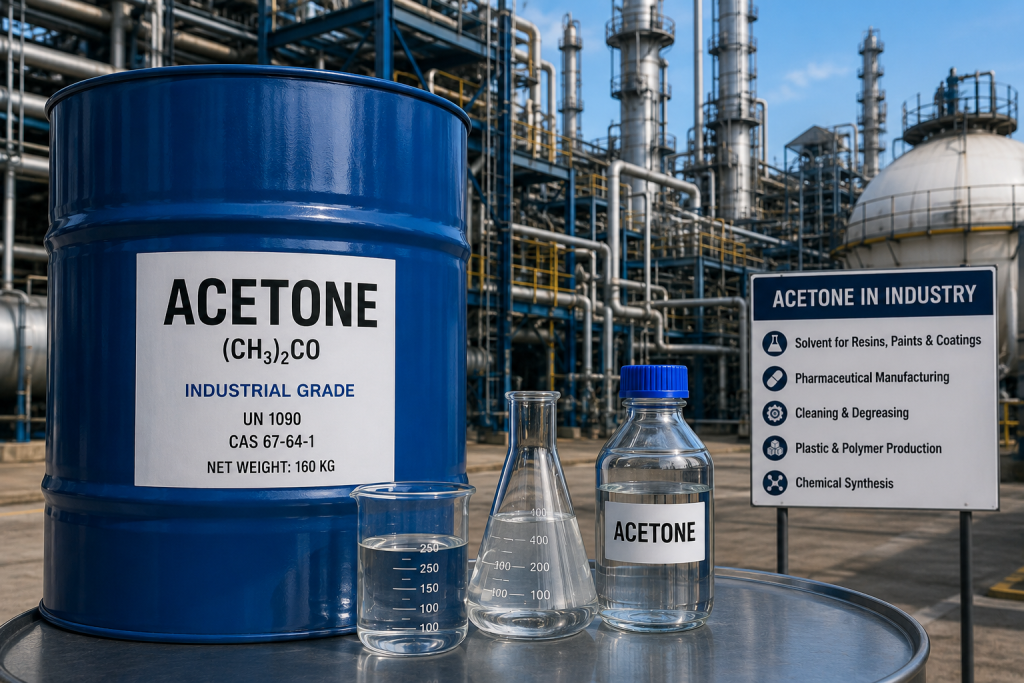
Acetone is a fast-evaporating organic solvent used in chemical manufacturing, coatings, adhesives, industrial cleaning, and selected pharmaceutical processes. Its ability to dissolve many organic substances makes it valuable in applications that require effective cleaning, formulation, extraction, or solvent processing.
For industrial buyers, selecting the right grade involves more than comparing prices. Purity, application requirements, material compatibility, fire safety, supply reliability, and environmental controls all influence purchasing decisions.
This guide covers the technical properties, major applications, benefits, handling requirements, recovery options, and sourcing considerations associated with acetone in manufacturing.
What Is Acetone?
Acetone, also known as propanone, is a colorless, volatile liquid belonging to the ketone family. Its chemical formula is C3H6O. It is miscible with water and many common organic solvents, making it useful in a wide range of industrial processes.
The compound is manufactured through established chemical production routes, including processes associated with phenol production and other industrial synthesis methods. Its origin, purity, and specification depend on the manufacturing route and commercial grade.
As part of the wider industrial solvents category, it is used both as a processing aid and as an ingredient in selected formulations.
Quick Technical Specifications
The following table provides representative properties of acetone. Buyers should confirm the exact specifications and test methods against the supplier’s technical data sheet and certificate of analysis.
| Property | Typical Value or Description |
|---|---|
| Chemical name | Acetone |
| Alternative name | Propanone, dimethyl ketone |
| Molecular formula | C3H6O |
| Molecular weight | 58.08 g/mol |
| CAS number | 67-64-1 |
| EC number | 200-662-2 |
| Appearance | Clear, colorless liquid |
| Boiling point | Approximately 56°C at atmospheric pressure |
| Flash point | Approximately −20°C; test method dependent |
| Density | Approximately 0.79 g/cm³ at 20°C |
| Water solubility | Miscible with water |
| Main hazards | Highly flammable liquid and vapor; eye irritation and exposure-related effects may occur |
These values are general reference data rather than guaranteed purchasing specifications. Industrial, analytical, and pharmaceutical applications may have different purity and impurity requirements.
Why Manufacturers Use Acetone
Manufacturers select this solvent for several practical reasons. Its relatively low boiling point supports rapid evaporation, while its solvent properties make it suitable for removing certain contaminants and dissolving compatible organic compounds.
- Solvent performance: Dissolves many resins, oils, and other compatible organic substances.
- Rapid evaporation: Can reduce drying time in suitable cleaning and processing applications.
- Water compatibility: Mixes completely with water, which can be useful in selected formulations and process systems.
- Process versatility: Serves as a cleaning agent, extraction solvent, and chemical processing medium.
- Commercial availability: Sold in multiple grades for different industrial and laboratory requirements.
These benefits do not make it suitable for every process. Its fast evaporation can create handling challenges, and it may damage certain plastics, coatings, or other sensitive materials. Compatibility testing is important before implementation.
Major Industrial Applications
1. Paints and Coatings
In selected coatings and surface-finishing operations, acetone can dissolve compatible resins, adjust formulation properties, or clean equipment between production runs. Its evaporation profile may be useful where quick solvent removal is required.
However, it is not universally suitable for coating formulations. Rapid evaporation can affect leveling, film formation, and application time. Formulators should evaluate resin compatibility, drying behavior, surface quality, and VOC requirements before choosing a solvent system.
2. Adhesives and Sealants
Some adhesive manufacturing processes use this chemical to dissolve compatible polymer components, adjust formulation viscosity, or clean production equipment. After application, evaporation may help a solvent-based formulation develop its intended bond, depending on the adhesive chemistry.
Performance depends on the polymer, substrate, formulation, and curing mechanism. Manufacturers should not assume that faster evaporation automatically improves bonding strength or finished-product quality.
3. Pharmaceutical and Fine Chemical Processing
Acetone can be used as a process solvent in selected pharmaceutical and fine chemical operations, including extraction, purification, crystallization, and synthesis. Its suitability depends on the process design, residual-solvent requirements, and applicable quality standards.
Manufacturers must distinguish between general industrial grades and grades approved for a specific pharmaceutical process. Purity, trace impurities, documentation, and residual-solvent controls should be evaluated according to the intended use.
India’s pharmaceutical manufacturing sector is one example of an industrial market where solvent selection and consistent chemical quality can be important purchasing considerations. Specific demand depends on individual production processes and current market conditions.
4. Plastics, Resins, and Chemical Production
The chemical is used in selected resin-processing and chemical manufacturing operations as a solvent, cleaning agent, or process aid. It is also associated with the manufacture of certain chemical intermediates, including processes involving methyl methacrylate and bisphenol A, depending on the production route.
It is important to distinguish between direct use as a processing solvent and use as a chemical feedstock. The required grade, process controls, and purchasing specifications can differ considerably between these applications.
5. Industrial Cleaning
Cleaning operations may use acetone to remove compatible oils, adhesive residues, some coatings, and other organic contaminants from tools, equipment, or selected surfaces. Its rapid evaporation can reduce the time required for solvent removal.
Before use, manufacturers should check whether the solvent could soften plastics, damage painted surfaces, affect elastomers, or create a fire hazard. They should also evaluate ventilation, ignition control, residue requirements, and waste handling.
Related information is available in our guides to industrial cleaning chemicals and industrial degreasing agents.
6. Metal Surface Preparation
In certain metal fabrication and finishing operations, the solvent can remove compatible machining oils and organic residues before subsequent processing. Surface cleanliness may be important before painting, bonding, or applying selected finishes.
It is not a universal degreasing solution, and it should not replace a validated cleaning procedure without testing. Manufacturers should confirm substrate compatibility, required surface cleanliness, workplace exposure controls, and the suitability of the method for the next production stage.
How to Select the Right Grade
The best grade depends on the process, required purity, applicable standards, and the potential effect of impurities on the finished product. A general-purpose industrial grade may be appropriate for some cleaning tasks but unsuitable for a tightly controlled formulation.
| Selection Factor | What Buyers Should Check |
|---|---|
| Intended application | Confirm whether the product will be used for cleaning, formulation, extraction, or chemical processing. |
| Purity | Review the assay and specified impurity limits. |
| Moisture content | Check water limits where moisture could affect the process. |
| Quality documentation | Request a current technical data sheet, safety data sheet, and batch certificate of analysis as applicable. |
| Material compatibility | Test the effect on substrates, seals, equipment, and formulation ingredients. |
| Packaging and storage | Verify container suitability, storage conditions, and transport requirements. |
| Regulatory suitability | Confirm that the grade meets requirements for its specific intended use. |
When evaluating suppliers, compare documented specifications rather than relying on product names alone. A change in grade or supplier should be assessed before the material is introduced into an established production process.
To explore available chemical products, visit the AasadChimie Products page or contact the team through the Contact Us page.
Safety, Storage, and Handling
Acetone is highly flammable, and its vapor can form ignitable mixtures with air. Exposure may irritate the eyes and cause effects such as headache, dizziness, or drowsiness, particularly at elevated concentrations.
Industrial facilities should follow the current safety data sheet, applicable regulations, and site-specific risk assessment when storing or using this chemical.
Storage Requirements
- Store in suitable, tightly closed containers designed for the product.
- Keep away from heat, sparks, flames, and other ignition sources.
- Provide appropriate ventilation in storage and handling areas.
- Use suitable electrical and process equipment where flammable vapor may be present.
- Separate the material from incompatible substances according to the SDS.
- Follow applicable requirements for flammable-liquid storage and transport.
Worker Protection
- Use suitable eye protection and chemical-resistant gloves selected according to the task and exposure assessment.
- Provide adequate ventilation or local exhaust where necessary.
- Use respiratory protection only as part of an appropriate protection program when required.
- Train employees in spill response, fire prevention, and safe transfer procedures.
- Prevent discharge into drains and waterways.
For further guidance, consult the Occupational Safety and Health Administration (OSHA) and the relevant local workplace safety authority. Always follow the product-specific SDS for emergency measures and protective equipment.
Environmental Impact and VOC Management
Acetone is volatile and can be released into workplace or outdoor air during storage, transfer, use, and waste handling. Environmental requirements depend on the jurisdiction and the specific industrial activity. Its regulatory treatment may differ from that of other VOCs, so businesses should verify the rules applicable to their facility.
Manufacturers can improve solvent management through closed transfer systems, leak prevention, suitable ventilation, careful inventory control, and appropriate vapor management where required.
Alternative solvents may be considered where they reduce overall risk or improve process performance. Any substitution should be assessed for technical suitability, worker safety, emissions, waste generation, and lifecycle impacts.
For related information, see our article on VOC emissions control. Regulatory information is also available from the US Environmental Protection Agency and the European Chemicals Agency.
Solvent Recovery and Recycling
Some manufacturing facilities recover used solvent streams to reduce waste and lower fresh-material consumption. Recovery may involve distillation or other separation methods selected according to the composition of the collected stream and the purity required for reuse.
Recovery is not automatically feasible for every application. Water, dissolved contaminants, mixed solvents, and process residues can affect separation efficiency and recovered-product quality.
Before reusing recovered material, manufacturers should define acceptance criteria and verify that the purified solvent meets the requirements of the intended process. They should also assess energy consumption, fire protection, operating costs, and waste disposal requirements.
Learn more about industrial solvent recovery systems.
Market and Sourcing Considerations in India, Turkey, and Iran
Industrial demand varies by application, local production capacity, imports, pricing, and manufacturing activity. Buyers in India, Turkey, and Iran should evaluate current supplier offers and logistics rather than relying on generalized market-growth claims.
India
Pharmaceuticals, chemical processing, coatings, adhesives, and other manufacturing activities can create demand for suitable solvent grades. Buyers should verify purity requirements, supplier documentation, delivery schedules, and the grade’s suitability for the intended process.
Turkey
Manufacturing sectors such as coatings, automotive supply chains, adhesives, and industrial processing may use acetone in selected operations. Procurement decisions should consider product availability, transport arrangements, technical specifications, and applicable import requirements.
Iran
Chemical processing, manufacturing, maintenance, and cleaning applications may require different grades and quantities. Buyers should assess local availability and alternative supply routes while checking current commercial terms, logistics, and applicable trade requirements.
For all three markets, reliable procurement involves more than securing the lowest price. Consistent quality, suitable documentation, safe transportation, and continuity of supply are important factors in total purchasing cost.
Future Trends in Industrial Solvent Management
Industrial solvent use is influenced by process efficiency, workplace safety, environmental requirements, and changing formulation needs. Several developments are relevant to manufacturers evaluating their future solvent strategies.
- Improved recovery systems: Better separation and process monitoring may help suitable facilities reuse solvents.
- More efficient handling: Closed transfer and leak-prevention measures can reduce losses and unnecessary exposure.
- Formulation optimization: Manufacturers can evaluate solvent blends and alternative processes to meet technical requirements.
- Digital inventory management: Improved tracking can help monitor consumption, stock levels, and replenishment needs.
- Stronger process controls: Monitoring and documented procedures can support consistent product quality and safer operations.
The most appropriate strategy depends on the application, economics, and applicable regulations. Any change should be validated before full-scale implementation.
Conclusion
Acetone is an important industrial solvent used in cleaning, coatings, adhesives, chemical processing, and selected pharmaceutical and resin applications. Its rapid evaporation and solvent properties can offer practical advantages, but its flammability, material compatibility, and grade-specific requirements must be carefully managed.
Manufacturers can make better procurement decisions by verifying technical specifications, selecting a suitable grade, assessing supplier reliability, and following appropriate safety procedures. Where feasible, solvent recovery and improved handling can also help reduce material losses and support more efficient operations.
What is acetone mainly used for in industry?
It is used in selected cleaning, coating, adhesive, chemical processing, extraction, and pharmaceutical manufacturing applications.
What is the chemical formula of acetone?
Its chemical formula is C₃H₆O, and its molecular weight is approximately 58.08 g/mol.
Is acetone flammable?
Yes. It is a highly flammable liquid, so suitable ventilation, ignition control, storage, and handling procedures are essential.
Can acetone be recovered and reused?
Yes. Suitable solvent streams can sometimes be purified through separation processes, provided the recovered material meets the specifications required for reuse.
How should industrial buyers select a grade?
Buyers should assess purity, impurities, moisture content, application requirements, technical documentation, packaging, and regulatory suitability.
Can acetone be used on all plastics and coatings?
No. It can damage or dissolve certain plastics, finishes, and elastomers. Compatibility testing is recommended before use.