


Table of Contents
- Quick Answer: What Is Filler Masterbatch?
- Technical Specifications of Calcium Carbonate Filler Masterbatch
- Why Do Manufacturers Use Filler Masterbatch?
- How Calcium Carbonate Filler Masterbatch Works
- Main Components of Filler Masterbatch
- 1. Calcium Carbonate (CaCO₃)
- 2. Carrier Resin
- 3. Processing and Dispersion Additives
- Key Benefits of Calcium Carbonate Filler Masterbatch
- 1. Potential Reduction in Material Costs
- 2. Increased Stiffness
- 3. Dimensional Stability
- 4. Surface and Appearance Control
- 5. Processing Optimization
- Types of Filler Masterbatch
- Industrial Applications of Filler Masterbatch
- 1. Blown-Film Manufacturing
- 2. Injection Molding
- 3. Pipe and Profile Extrusion
- 4. Blow Molding
- 5. Woven Bags and Raffia Products
- How to Calculate the Cost Impact of Filler Masterbatch
- How to Choose the Right Filler Masterbatch
- Common Mistakes When Using Filler Masterbatch
- Filler Masterbatch and Recycled Plastics
- Industry Trends in Filler Masterbatch
- Conclusion
- Related Articles
- References and Further Reading
- Explore Filler Masterbatch Solutions with AasadChimie
- What is filler masterbatch?
- What is calcium carbonate filler masterbatch used for?
- Does filler masterbatch reduce plastic manufacturing costs?
- Can filler masterbatch increase stiffness?
- Can calcium carbonate filler masterbatch be used with recycled plastics?
- How do I choose the right filler masterbatch?
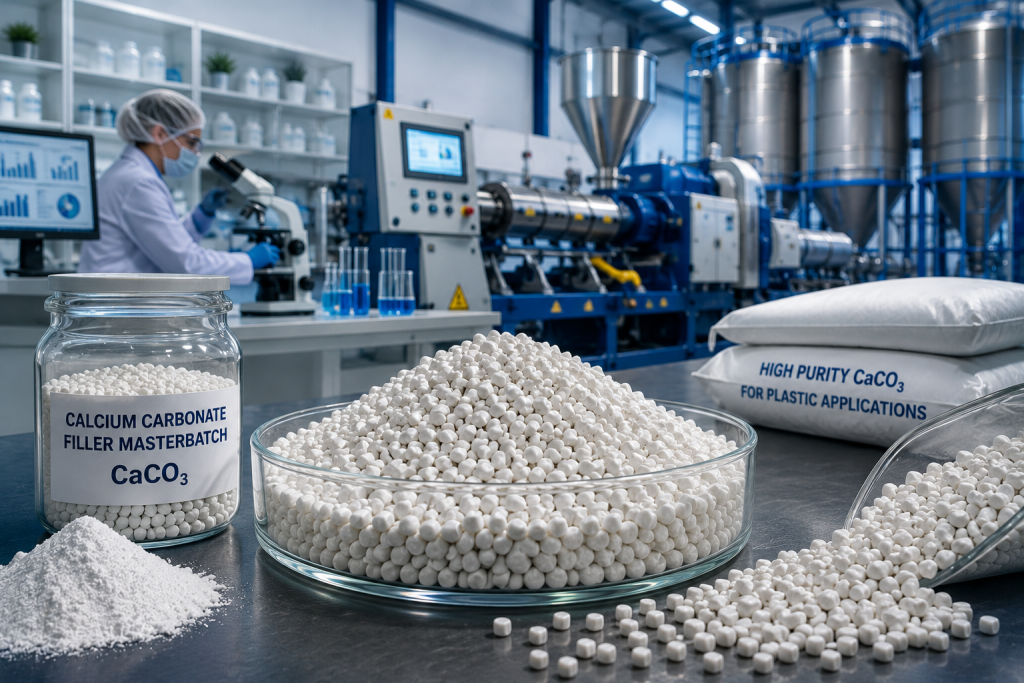
Filler masterbatch is a concentrated mixture of mineral fillers, carrier resin, and selected processing additives used in plastic manufacturing. Calcium carbonate filler masterbatch is widely used to help control material costs and modify properties such as stiffness, dimensional stability, and surface appearance in suitable plastic products.
Manufacturers use filler masterbatch in applications including packaging films, shopping bags, woven polypropylene products, injection-molded parts, and selected construction products. The right formulation and loading level depend on the base polymer, manufacturing process, and performance requirements of the finished product.
Quick Answer: What Is Filler Masterbatch?
Filler masterbatch is a concentrated additive compound that introduces mineral particles into a polymer during extrusion or molding. In calcium carbonate filler masterbatch, the principal mineral is calcium carbonate (CaCO₃), dispersed in a compatible carrier resin.
Depending on the application, adding this material can reduce the amount of base polymer required per unit of finished product and improve stiffness or dimensional stability. However, excessive or unsuitable loading may reduce impact strength, elongation, flexibility, or other properties. Manufacturers should validate the formulation through testing rather than assuming that every filler grade delivers the same results.
Technical Specifications of Calcium Carbonate Filler Masterbatch
Filler masterbatch is a formulated compound rather than a single chemical substance. Its composition and physical properties vary by manufacturer and grade. The following table summarizes key information about its main mineral component and the properties buyers should confirm in the product technical data sheet.
| Parameter | Details |
|---|---|
| Product type | Mineral-filled polymer masterbatch |
| Common mineral | Calcium carbonate |
| Chemical formula | CaCO₃ |
| CAS number of calcium carbonate | 471-34-1 |
| Carrier resin | Typically PE or PP, depending on the application |
| Physical appearance | Usually pellets or granules |
| Calcium carbonate content | Grade-specific; confirm with the supplier |
| Particle size | Depends on the mineral grade and formulation |
| Moisture content | Product-specific; check the technical data sheet |
| Bulk density | Product-specific; confirm the measurement method and units |
| Recommended processing temperature | Depends on the carrier resin, base polymer, and process |
When comparing suppliers, request the technical data sheet (TDS), safety data sheet (SDS), mineral loading, carrier resin, particle-size information, and recommended processing conditions for the exact grade under consideration.
Why Do Manufacturers Use Filler Masterbatch?
Polymer resin is a major cost component in many plastic products. Filler masterbatch gives manufacturers a way to modify a formulation by incorporating mineral content, potentially reducing material costs while targeting specific product properties.
Common reasons for using calcium carbonate filler masterbatch include:
- Reducing the amount of base polymer required in suitable formulations.
- Increasing stiffness in applications where greater rigidity is desirable.
- Adjusting dimensional stability and shrinkage behavior.
- Modifying surface appearance and opacity.
- Supporting process optimization when dispersion and formulation are appropriate.
- Meeting cost and performance targets for high-volume production.
These benefits are formulation-dependent. Mineral addition does not automatically improve every mechanical property, and the final result must be evaluated against the finished product’s specifications.
How Calcium Carbonate Filler Masterbatch Works
During extrusion or molding, the filler masterbatch is combined with the base polymer at a defined let-down ratio. The carrier resin melts and helps distribute the calcium carbonate particles throughout the polymer matrix.
When dispersion is adequate, the mineral can modify the stiffness, shrinkage behavior, opacity, and surface characteristics of the finished product. The magnitude of these changes depends on the mineral concentration, particle size, surface treatment, carrier compatibility, and processing conditions.
Manufacturers commonly introduce filler masterbatch using gravimetric or volumetric dosing equipment. Accurate dosing and effective mixing help maintain consistent filler concentration across production runs.
Main Components of Filler Masterbatch
1. Calcium Carbonate (CaCO₃)
Calcium carbonate is a mineral filler used in many polymer formulations. It is typically supplied as finely ground mineral particles, with particle size, purity, whiteness, and surface treatment selected according to the target application.
Important characteristics include:
- Particle-size distribution: Influences dispersion, surface finish, and the performance of the filled polymer.
- Mineral purity: Helps determine consistency and suitability for the intended product.
- Whiteness: Matters when appearance or color is important.
- Surface treatment: Certain treated grades can improve compatibility and dispersion in particular polymer systems.
- Moisture control: Helps prevent processing issues associated with excessive moisture.
2. Carrier Resin
The carrier resin helps deliver the mineral into the base polymer. Polyethylene-based carriers are commonly used for compatible PE applications, while polypropylene-based carriers may be selected for suitable PP applications.
Carrier selection matters because incompatibility can affect dispersion, mechanical properties, surface quality, and processing stability. For multilayer structures or specialized products, confirm compatibility with the complete polymer formulation.
3. Processing and Dispersion Additives
Depending on the formulation, a masterbatch may contain dispersing agents, lubricants, or other processing additives. These ingredients can help improve mineral distribution and processing behavior, but the exact composition varies between products.
Ask the supplier for grade-specific technical documentation instead of assuming that all filler masterbatches use the same additive package.
Key Benefits of Calcium Carbonate Filler Masterbatch
1. Potential Reduction in Material Costs
Replacing part of the base polymer with a mineral-filled masterbatch can reduce the raw-material cost per kilogram of compound when the masterbatch is economically priced and the resulting product meets its performance requirements.
However, the cost benefit should be calculated using the complete formulation. Additional effects on cycle time, scrap, energy consumption, product weight, and quality can change the overall result.
2. Increased Stiffness
Calcium carbonate can increase the stiffness of many polymer compounds. This may be beneficial for products that need to retain their shape under normal service conditions.
The effect depends on the polymer, mineral loading, particle characteristics, and interfacial compatibility. Greater stiffness does not necessarily mean greater impact resistance or toughness.
3. Dimensional Stability
Mineral fillers can change the shrinkage and dimensional behavior of molded or extruded products. In suitable formulations, this can help manufacturers achieve more consistent dimensions.
Actual shrinkage behavior depends on mold design, cooling conditions, polymer orientation, and the complete formulation. Production trials are necessary before setting final process parameters.
4. Surface and Appearance Control
Calcium carbonate filler masterbatch can influence opacity, color, gloss, and surface texture. These changes may be useful in products where a particular appearance is required.
For applications that require high transparency, a mineral-filled formulation may not be appropriate. Manufacturers should test color, gloss, surface quality, and any other relevant optical properties.
5. Processing Optimization
A well-dispersed formulation can support stable production when it is matched to the extrusion or molding process. Poor dispersion, incompatible carrier resin, or excessive loading can instead cause surface defects, inconsistent output, or reduced mechanical performance.
Types of Filler Masterbatch
Filler masterbatch grades differ according to their mineral content, carrier resin, particle characteristics, and intended manufacturing process.
- PE filler masterbatch: Used in compatible polyethylene applications, including selected films and bags.
- PP filler masterbatch: Designed for suitable polypropylene applications, including selected woven products and molded parts.
- Blown-film filler masterbatch: Formulated for specific film extrusion conditions and film-performance requirements.
- Injection-molding filler masterbatch: Selected for compatible molding compounds, dimensional requirements, and mechanical properties.
- Blow-molding filler masterbatch: Considered only when the formulation meets the product’s strength, wall-thickness, and process requirements.
- Woven-bag and raffia grades: Used in selected PP-based woven applications, subject to tensile and elongation requirements.
These categories are not interchangeable. Always confirm the recommended polymer, process, and application with the supplier before purchasing or changing a grade.
Industrial Applications of Filler Masterbatch
1. Blown-Film Manufacturing
Film manufacturers may use calcium carbonate filler masterbatch in selected polyethylene film formulations to manage material costs and adjust stiffness, opacity, and processing characteristics.
Potential applications include:
- Shopping bags
- Garbage bags
- General-purpose packaging films
- Selected agricultural films
- Industrial liners and wrapping films
Suitability depends on film thickness, tear resistance, elongation, sealing performance, and optical requirements. Filler loading should be validated through film testing and production trials.
2. Injection Molding
In injection molding, mineral-filled compounds can be used where cost, rigidity, and dimensional performance need to be balanced.
Examples may include:
- Selected household products
- Storage containers
- Utility components
- Industrial molded parts
- Non-critical interior components
For impact-sensitive or load-bearing components, assess impact strength, tensile behavior, weld-line performance, and long-term durability before increasing filler content.
3. Pipe and Profile Extrusion
Filler masterbatch may be suitable for certain non-pressure profiles, conduits, or other extruded products when the formulation meets the relevant mechanical and dimensional requirements.
It should not be assumed that a general-purpose calcium carbonate grade is suitable for pressure pipes or regulated piping systems. These applications may have strict requirements for long-term hydrostatic strength, impact resistance, and material compliance. Verify the applicable product standard and formulation approval before use.
4. Blow Molding
Blow-molded products require adequate melt strength, uniform wall thickness, and resistance to impact or deformation. A filler-containing formulation should be evaluated carefully because mineral addition can affect these properties.
Potential uses should be limited to applications where testing confirms suitability. Containers for chemicals, pressure-related service, or demanding transport conditions require particular attention to durability and compatibility.
5. Woven Bags and Raffia Products
Selected polypropylene woven products may incorporate filler masterbatch to manage formulation cost and adjust stiffness. Applications can include certain sacks, woven sheets, and packaging products.
Because woven products rely on tensile strength and elongation, manufacturers should evaluate tape properties, weaving performance, seam strength, and finished-bag durability before increasing filler loading.
How to Calculate the Cost Impact of Filler Masterbatch
The economic benefit depends on the price of the base resin, the price and loading of the masterbatch, and whether the finished product continues to meet its quality requirements.
For an initial comparison, calculate the weighted raw-material cost per kilogram of the compound:
Compound cost per kg = (resin fraction × resin price) + (masterbatch fraction × masterbatch price)
For example, consider a hypothetical formulation containing 90% base resin at $1.50/kg and 10% filler masterbatch at $0.80/kg:
- Base resin contribution: 0.90 × $1.50 = $1.35/kg
- Masterbatch contribution: 0.10 × $0.80 = $0.08/kg
- Total raw-material cost: $1.43/kg of compound
Compared with a formulation made entirely from resin at $1.50/kg, this represents a raw-material saving of $0.07/kg of compound, or approximately 4.7%, before processing, scrap, and quality costs are considered.
This is an illustrative calculation, not a guaranteed saving. The actual result depends on local prices, the precise formulation, product density, output requirements, and production performance.
How to Choose the Right Filler Masterbatch
Selecting the right grade requires more than comparing the price per kilogram. Review the following factors before making a purchasing decision:
- Base polymer: Confirm compatibility with PE, PP, or the specific resin blend.
- Manufacturing process: Match the grade to blown film, cast film, injection molding, extrusion, or another process.
- Mineral content: Check the stated calcium carbonate loading and the test method used.
- Particle size and treatment: Review their suitability for the required dispersion and surface finish.
- Mechanical properties: Set minimum requirements for tensile strength, elongation, impact resistance, and stiffness as applicable.
- Appearance: Evaluate whiteness, color, opacity, gloss, and surface texture.
- Moisture and dispersion: Check product handling recommendations and consistency.
- Regulatory requirements: Confirm any applicable food-contact, construction, or other sector-specific requirements.
- Total cost: Compare the full formulation cost and finished-product performance, not only the masterbatch purchase price.
Request a technical data sheet, safety data sheet, sample, and recommended dosage range. Run a controlled trial using the intended polymer and production settings before adopting the grade at scale.
Common Mistakes When Using Filler Masterbatch
Incorrect selection or dosing can undermine the benefits of a mineral-filled formulation. Common mistakes include:
- Increasing filler loading without testing mechanical properties.
- Selecting a carrier resin that is poorly matched to the base polymer.
- Choosing a product based only on price or advertised mineral content.
- Ignoring dispersion, moisture, or feeding consistency.
- Using a film grade in a molding application without confirming suitability.
- Failing to check the impact on sealing, flexibility, impact strength, or product appearance.
- Assuming a formulation suitable for non-critical products will also meet pressure-pipe or food-contact requirements.
Document trial conditions and compare the results against a control formulation. This helps identify the best balance between cost, process stability, and product quality.
Filler Masterbatch and Recycled Plastics
Calcium carbonate filler masterbatch may be considered in some recycled-polymer formulations, but compatibility and performance must be evaluated for the specific recycled resin. Recycled materials can vary in melt flow, contamination, thermal history, and mechanical properties.
Adding mineral filler does not automatically improve recycled-polymer quality. Manufacturers should measure relevant properties, assess dispersion, and verify that the finished product meets its required specifications.
Industry Trends in Filler Masterbatch
Developments in filler masterbatch focus on improving mineral dispersion, controlling particle characteristics, increasing formulation consistency, and supporting the use of recycled polymers in suitable applications.
Manufacturers are also evaluating higher-loading formulations where technically feasible. However, higher mineral content is not always better: the optimal loading is the one that meets product requirements at the lowest overall manufacturing cost.
Conclusion
Filler masterbatch is an important formulation tool for plastic manufacturers seeking to manage material costs and adjust properties such as stiffness, dimensional stability, and appearance. Calcium carbonate filler masterbatch can be useful in selected films, bags, woven products, and molded components when the grade is matched to the application.
Successful use depends on carrier compatibility, mineral characteristics, dispersion, loading level, and the performance requirements of the finished product. Technical documentation, controlled production trials, and total-cost calculations help manufacturers select a formulation that balances economic and technical needs.
Related Articles
- Masterbatch Explained: Types and Applications
- Plastic Additives Explained
- Plastic Raw Materials Guide
- How to Improve Plastic Product Quality
- Plastic Manufacturing Defects and Solutions
References and Further Reading
- Plastics Europe — Plastics industry information and resources.
- ASTM International — Standards and test methods for materials and products.
- ScienceDirect — Scientific literature on polymer materials and mineral fillers.
- Society of Plastics Engineers — Plastics processing and materials resources.
Explore Filler Masterbatch Solutions with AasadChimie
When evaluating a filler masterbatch for your manufacturing process, consider the base polymer, mineral content, dispersion quality, and finished-product specifications together. Visit the AasadChimie products page to explore available product information, or contact the AasadChimie team to discuss your application requirements and technical specifications.
What is filler masterbatch?
Filler masterbatch is a concentrated mixture of mineral filler, carrier resin, and, in some formulations, processing additives. It is incorporated into polymers to modify material properties and potentially reduce formulation costs.
What is calcium carbonate filler masterbatch used for?
It is used in selected plastic films, bags, woven products, and molded components to adjust cost, stiffness, dimensional behavior, and appearance.
Does filler masterbatch reduce plastic manufacturing costs?
It can reduce raw-material costs when the masterbatch is economically priced and the finished product meets its performance requirements. Total savings depend on formulation, processing, scrap, and quality costs.
Can filler masterbatch increase stiffness?
Calcium carbonate can increase stiffness in many polymer formulations. The effect depends on mineral loading, particle characteristics, polymer type, and dispersion. Other mechanical properties may change as well.
Can calcium carbonate filler masterbatch be used with recycled plastics?
It may be suitable for selected recycled polymers, but compatibility and finished-product performance should be verified through testing.
How do I choose the right filler masterbatch?
Compare carrier compatibility, calcium carbonate content, particle characteristics, processing conditions, mechanical requirements, and total formulation cost. Confirm the grade's suitability with the supplier's technical documentation and production trials.