


Table of Contents
- What Is Calcium Carbonate Dispersion?
- Why Is Calcium Carbonate Dispersion Important?
- Common Problems Caused by Poor Filler Dispersion
- 10 Ways to Improve Calcium Carbonate Dispersion
- 1. Select the Right Calcium Carbonate Grade
- 2. Use Surface-Treated Calcium Carbonate When Appropriate
- 3. Optimize Twin-Screw Extrusion Conditions
- 4. Choose Compatible Processing Additives
- 5. Stabilize Polymer Melt Flow
- 6. Control Calcium Carbonate Loading
- 7. Maintain Consistent Feeding and Mixing
- 8. Prevent Moisture and Material Contamination
- 9. Identify Extrusion Defects Early
- 10. Monitor Dispersion and Finished-Product Quality
- Applications That Benefit from Good Calcium Carbonate Dispersion
- How to Troubleshoot Calcium Carbonate Dispersion Problems
- Explore Polymer Processing Solutions from AasadChimie
- Conclusion
- Related Articles
- References
- Why is calcium carbonate dispersion important?
- What causes poor calcium carbonate dispersion?
- Can processing additives improve calcium carbonate dispersion?
- Does coated calcium carbonate improve dispersion in polypropylene?
- How can manufacturers test calcium carbonate dispersion?
- Can excessive calcium carbonate loading cause processing problems?
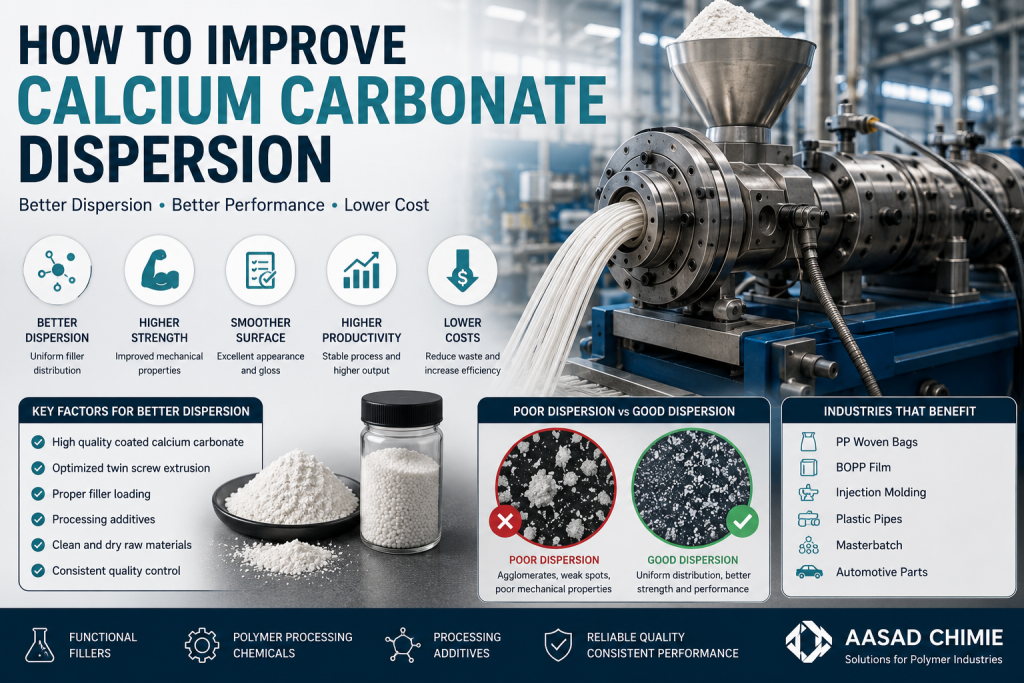
Calcium carbonate dispersion is a key factor in the quality and processing performance of polypropylene compounds, masterbatch, films, and molded plastic products. Poor dispersion can cause visible white spots, surface defects, inconsistent mechanical properties, and unstable extrusion.
Manufacturers can improve filler distribution by selecting suitable calcium carbonate, optimizing mixing and extrusion conditions, controlling filler loading, and using compatible processing additives. The best approach depends on the polymer grade, product requirements, equipment, and formulation.
What Is Calcium Carbonate Dispersion?
Calcium carbonate dispersion describes how evenly calcium carbonate particles are distributed throughout a polymer matrix. Good dispersion requires breaking down particle agglomerates and distributing the resulting particles consistently during compounding.
Dispersion is not the same as particle size. Fine particles may still form agglomerates if surface treatment, feeding, mixing, or polymer compatibility is inadequate.
Why Is Calcium Carbonate Dispersion Important?
Uniform filler distribution can improve product consistency, surface appearance, and the reliability of mechanical performance. It can also help manufacturers maintain stable production when the formulation and processing conditions are properly optimized.
- More consistent surface appearance
- Better control of mechanical properties
- More uniform filler distribution
- Fewer defects caused by agglomerates
- Improved process consistency
- Better control of production waste
The actual benefits depend on filler loading, particle characteristics, polymer type, and the finished product’s performance requirements.
Common Problems Caused by Poor Filler Dispersion
| Observed Problem | Possible Cause | Recommended Check |
|---|---|---|
| White spots | Large agglomerates or uneven filler distribution | Inspect the compound and filler feeding system |
| Rough surface | Agglomeration or unsuitable particle characteristics | Review filler grade and mixing conditions |
| Inconsistent mechanical properties | Uneven filler distribution or excessive loading | Test samples and review the formulation |
| Unstable extrusion | Variation in feed rate, melt conditions, or formulation | Monitor pressure, temperature, and throughput |
| Black specks | Contamination or degraded material | Inspect raw materials, equipment, and purge residue |
10 Ways to Improve Calcium Carbonate Dispersion
1. Select the Right Calcium Carbonate Grade
Choose a grade that matches the polymer, target filler loading, and end-use requirements. Particle size distribution, particle shape, surface characteristics, and purity can all influence processing and final product performance.
Do not select a filler based on fineness alone. Evaluate the supplier’s technical data and test the material under actual production conditions.
2. Use Surface-Treated Calcium Carbonate When Appropriate
Surface-treated calcium carbonate, commonly coated with suitable treatment agents, may improve compatibility with nonpolar polymers such as polypropylene. The effectiveness depends on the coating chemistry, filler grade, polymer formulation, and processing conditions.
Compare treated and untreated grades through controlled trials before changing a production formulation.
3. Optimize Twin-Screw Extrusion Conditions
Twin-screw compounding can provide effective distributive and dispersive mixing when the screw design and operating conditions are suitable. Screw configuration, rotational speed, feed rate, and residence time all influence filler distribution.
Adjust one process variable at a time and monitor melt pressure, torque, throughput, and product quality. Excessive shear or temperature can introduce other processing problems.
4. Choose Compatible Processing Additives
Some plastic processing additives can improve lubrication, melt flow, or interfacial behavior. These effects may support more consistent filler distribution, but not every additive improves dispersion in every formulation.
Review additive compatibility, recommended dosage, and processing guidance before use. See our guide to Plastic Processing Additives for more information.
5. Stabilize Polymer Melt Flow
Consistent melt behavior helps maintain repeatable mixing and extrusion conditions. Variations in polymer grade, temperature, feed rate, or residence time can affect the way calcium carbonate is distributed.
Review the melt flow characteristics of the selected polymer and maintain stable processing conditions. Read our article on Improving Melt Flow in Polypropylene for related guidance.
6. Control Calcium Carbonate Loading
Increasing filler content can reduce the amount of polymer used, but excessive loading may make uniform distribution more difficult and change impact strength, elongation, surface quality, or processability.
Determine the appropriate loading through formulation trials that measure both processing performance and finished-product properties. For related information, see Calcium Carbonate Filler Masterbatch.
7. Maintain Consistent Feeding and Mixing
Uneven feeding can create local variations in filler concentration. Check feeder calibration, material flow, feeding sequence, and the consistency of the polymer and filler supply.
Where necessary, review the mixing sequence and equipment configuration with the compounding equipment supplier. Consistent feeding supports repeatable mixing and product quality.
8. Prevent Moisture and Material Contamination
Contamination can introduce defects that are mistaken for poor dispersion. Dust, foreign particles, degraded polymer, and inconsistent raw materials should be investigated when product quality changes unexpectedly.
- Store raw materials in clean, suitable conditions.
- Keep containers and conveying systems properly closed.
- Inspect incoming materials and supplier documentation.
- Clean hoppers, feeders, and processing equipment regularly.
- Investigate unexpected changes in material appearance or performance.
Check the moisture specifications of each raw material rather than assuming that every calcium carbonate grade requires the same drying procedure.
9. Identify Extrusion Defects Early
Unstable pressure, surface defects, die deposits, and inconsistent output may indicate a processing issue. These symptoms do not always originate from poor filler dispersion, so investigate the complete process before changing the formulation.
Our guide on Reducing Extrusion Defects covers related production issues. You can also review Functional Fillers when evaluating filler options for polymer applications.
10. Monitor Dispersion and Finished-Product Quality
Use a consistent quality-control plan to detect changes before they affect large production batches. The appropriate tests depend on the final application and the manufacturer’s quality requirements.
- Microscopic examination of filler distribution
- Visual inspection for agglomerates and surface defects
- Melt flow testing where relevant
- Tensile, impact, or elongation testing as required
- Monitoring extrusion pressure, torque, and output
- Recording formulation and process changes between batches
Use the results to identify the cause of a defect rather than relying on visual inspection alone.
Applications That Benefit from Good Calcium Carbonate Dispersion
| Application | Key Quality Consideration |
|---|---|
| PP woven bags | Tensile performance and consistent tape quality |
| BOPP films | Surface appearance and film processability |
| Injection-molded parts | Dimensional consistency and mechanical properties |
| Masterbatch | Uniform filler concentration |
| Plastic pipes and profiles | Consistent processing and product specifications |
| Automotive components | Application-specific mechanical and surface requirements |
The required dispersion quality varies by application. Film, packaging, injection molding, and structural components may need different filler grades and processing strategies.
How to Troubleshoot Calcium Carbonate Dispersion Problems
When dispersion quality deteriorates, start by identifying when the defect appeared and whether it affects all products or only a specific formulation.
- Check the calcium carbonate grade, batch consistency, and technical data.
- Inspect feeder calibration and material flow.
- Review screw configuration, temperature settings, speed, and throughput.
- Check for contamination, agglomerates, or unexpected raw material changes.
- Compare samples using suitable laboratory and production tests.
- Change one variable at a time and document the result.
This systematic approach helps distinguish filler-related problems from equipment, contamination, or polymer-processing issues.
Explore Polymer Processing Solutions from AasadChimie
AasadChimie provides information about functional fillers and polymer processing chemicals for industrial applications. Explore our Products page to review available solutions, or contact our team to discuss your application and technical requirements.
You can also learn more about Functional Filler Powder, Advanced Functional Filler Powder, and Polymer Processing Chemicals.
Conclusion
Improving calcium carbonate dispersion requires the right combination of filler selection, formulation design, feeding consistency, mixing performance, and process control. Surface treatment and processing additives may help in suitable formulations, but their benefits should be confirmed through controlled trials.
By monitoring both processing conditions and finished-product properties, manufacturers can identify dispersion problems more accurately, reduce avoidable defects, and maintain consistent polymer production.
Related Articles
- Improve Melt Flow in Polypropylene
- Reduce Production Costs in Polypropylene Manufacturing
- Reduce Extrusion Defects
- Functional Fillers
- Functional Filler Powder
- Advanced Functional Filler Powder
- Calcium Carbonate Filler Masterbatch
- Plastic Processing Additives
- Polymer Processing Chemicals
References
Why is calcium carbonate dispersion important?
Uniform calcium carbonate dispersion helps improve product consistency, surface appearance, and control over mechanical properties. It can also reduce defects associated with filler agglomeration.
What causes poor calcium carbonate dispersion?
Common causes include filler agglomeration, unsuitable particle characteristics, inconsistent feeding, inadequate mixing, excessive filler loading, and incompatible formulation components.
Can processing additives improve calcium carbonate dispersion?
Some processing additives can improve lubrication or melt behavior and may support more consistent filler distribution. Their effectiveness depends on the polymer, additive chemistry, formulation, and processing conditions.
Does coated calcium carbonate improve dispersion in polypropylene?
Surface-treated calcium carbonate may improve compatibility with polypropylene, depending on the treatment and formulation. Testing is necessary to confirm its effect on dispersion and final product properties.
How can manufacturers test calcium carbonate dispersion?
Manufacturers can use microscopic examination, visual defect analysis, and relevant mechanical and processing tests. The most suitable methods depend on the product and quality requirements.
Can excessive calcium carbonate loading cause processing problems?
Yes. Excessive loading can make uniform distribution more difficult and may affect mechanical properties, surface quality, and processability. The optimal loading should be established through formulation trials.