


Table of Contents
- Quick Technical Specifications
- What Is This Aromatic Solvent Used For?
- 1. Paints and Protective Coatings
- 2. Adhesives and Sealants
- 3. Printing Inks
- 4. Industrial Cleaning and Surface Preparation
- 5. Rubber and Polymer Processing
- 6. Petrochemical Feedstock and Chemical Production
- Understanding the Three Isomers
- How to Select the Right Grade
- Comparison With Toluene and Acetone
- Safety, Storage, and Handling
- Environmental Considerations and Solvent Recovery
- Purchasing Considerations for Industrial Buyers
- Conclusion
- What is xylene mainly used for?
- What is the difference between mixed xylenes and para-xylene?
- Is xylene soluble in water?
- Is xylene flammable?
- Can xylene replace toluene in industrial formulations?
- What should buyers check before purchasing this solvent?
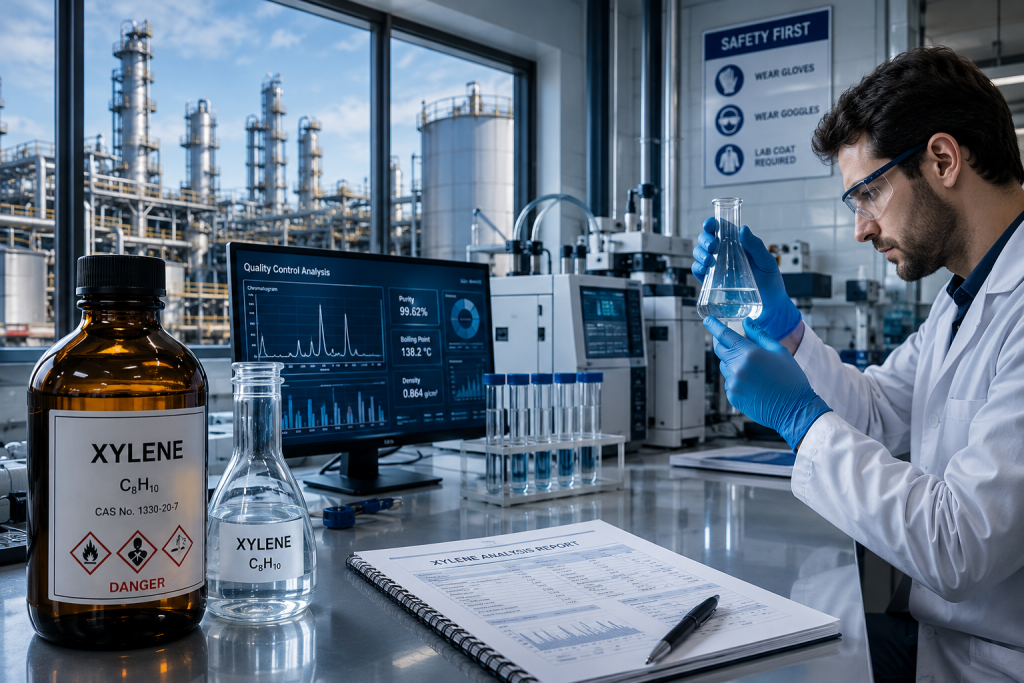
Xylene is an aromatic hydrocarbon solvent used in coatings, printing inks, adhesives, industrial cleaning, and petrochemical manufacturing. Its solvency, evaporation behavior, and compatibility with different formulations make it useful in processes where a balance between performance and drying time is required.
Quick Technical Specifications
The following values describe commercial mixed xylenes. Actual specifications may vary by supplier, isomer composition, grade, and test method.
| Property | Typical Information |
|---|---|
| Chemical name | Xylene (dimethylbenzene) |
| Common synonyms | Dimethylbenzene, mixed xylenes |
| Molecular formula | C8H10 |
| Molecular weight | 106.17 g/mol |
| CAS number | 1330-20-7 for mixed isomers |
| EC number | 215-535-7 for mixed xylenes |
| Appearance | Clear, colorless liquid |
| Boiling range | Approximately 137–144°C for many mixed grades |
| Flash point | Often approximately 25–32°C, depending on composition and test method |
| Density | Approximately 0.86–0.88 g/cm³ near 20°C |
| Water solubility | Low; slightly soluble in water |
| Main hazards | Flammable liquid and harmful vapor exposure |
For purchasing and process design, consult the supplier’s current technical data sheet (TDS) and safety data sheet (SDS). These documents provide grade-specific limits, handling requirements, and quality parameters.
What Is This Aromatic Solvent Used For?
Manufacturers select this material based on its ability to dissolve compatible resins, control formulation viscosity, and support the required drying profile. Its suitability depends on the formulation, production equipment, ventilation, and applicable environmental requirements.
1. Paints and Protective Coatings
In industrial paints and coatings, the solvent can help dissolve compatible resins and adjust viscosity for application. It may be used in metal coatings, machinery finishes, maintenance coatings, and selected protective formulations.
Formulators should assess resin compatibility, film formation, evaporation rate, and the effect on the final coating. The appropriate concentration depends on the formulation rather than a universal dosage.
2. Adhesives and Sealants
Some solvent-based adhesive systems use aromatic hydrocarbons to dissolve or disperse compatible polymer components. These materials can influence application viscosity, wetting, and drying behavior.
Before use, manufacturers should confirm compatibility with the adhesive polymer, substrate, and intended end-use requirements. Solvent choice must also account for workplace exposure and restrictions that may apply to the finished product.
3. Printing Inks
Selected industrial ink formulations use aromatic solvents to support resin dissolution and viscosity control. Performance depends on the printing process, ink chemistry, substrate, and required drying conditions.
Because solvent emissions can affect workplace air quality and regulatory compliance, manufacturers should review ventilation, emission controls, and the potential for lower-VOC alternatives.
4. Industrial Cleaning and Surface Preparation
This chemical may be considered for certain industrial cleaning tasks involving compatible oily residues, coatings, or other organic contaminants. However, it is not suitable for every surface or cleaning operation.
Before implementation, test the solvent on the target material and evaluate residue, surface damage, fire risk, and vapor exposure. For related approaches, see our guide to industrial cleaning chemicals in manufacturing and our overview of industrial degreasing agents.
5. Rubber and Polymer Processing
Some rubber, resin, and polymer operations use aromatic solvents during formulation or processing when the material is chemically compatible with the system. The choice depends on polymer type, process temperature, solvent removal requirements, and product specifications.
Manufacturers should validate the process at laboratory or pilot scale before introducing a solvent into full-scale production. Residual solvent limits and worker protection requirements must be considered where relevant.
6. Petrochemical Feedstock and Chemical Production
Individual dimethylbenzene isomers are important intermediates in petrochemical manufacturing. Para-xylene is used in the production chain for purified terephthalic acid (PTA) and polyester, while ortho-xylene is a feedstock for phthalic anhydride. Meta-xylene is used in the manufacture of isophthalic acid and other specialty intermediates.
These feedstock applications generally require specifications and separation processes that differ from those used for mixed-solvent grades.
Understanding the Three Isomers
The term refers to three structural isomers with the same molecular formula but different arrangements of the two methyl groups on the benzene ring. Their chemical identities and industrial uses are not interchangeable.
| Isomer | CAS Number | Representative Industrial Use |
|---|---|---|
| Ortho-xylene (o-xylene) | 95-47-6 | Production of phthalic anhydride |
| Meta-xylene (m-xylene) | 108-38-3 | Production of isophthalic acid and specialty intermediates |
| Para-xylene (p-xylene) | 106-42-3 | Production of PTA and polyester-related materials |
| Mixed xylenes | 1330-20-7 | Solvent applications and petrochemical separation feedstock |
Always verify the CAS number and isomer composition on the product documentation. A mixed-solvent grade should not be assumed to meet the purity requirements of a specific-isomer process.
How to Select the Right Grade
The correct grade depends on the intended process, required purity, and the performance specifications of the finished product. Buyers should compare supplier documentation rather than relying on the chemical name alone.
| Selection Factor | What to Check |
|---|---|
| Intended application | Confirm whether the requirement is for a solvent, a process intermediate, or a purified isomer. |
| Purity and composition | Review assay, isomer distribution, and specified impurities. |
| Evaporation behavior | Compare boiling range and drying requirements with the production process. |
| Formulation compatibility | Conduct compatibility and performance tests with the resin, polymer, or substrate. |
| Quality consistency | Check batch specifications, certificates of analysis, and supplier quality controls. |
| Safety and compliance | Review the SDS, applicable exposure limits, fire controls, and local regulations. |
For broader guidance on evaluating chemical inputs, read our article on industrial chemical raw materials. You can also explore our product range when comparing materials for manufacturing requirements.
Comparison With Toluene and Acetone
Although these chemicals can all serve as industrial solvents, their properties and suitability differ. Substitution should be based on technical testing rather than price or chemical category alone.
| Characteristic | Mixed Xylenes | Toluene | Acetone |
|---|---|---|---|
| Chemical family | Aromatic hydrocarbon | Aromatic hydrocarbon | Ketone |
| Typical boiling point or range | About 137–144°C | About 111°C | About 56°C |
| Evaporation behavior | Generally slower than toluene and acetone | Generally intermediate | Fast |
| Common consideration | Useful where a higher boiling range is required | Often selected for aromatic solvency and intermediate evaporation | Often selected where rapid evaporation is needed |
These are general comparisons; actual performance depends on formulation and operating conditions. Review our related guides to toluene in industrial applications and acetone in industry before considering a substitution.
Safety, Storage, and Handling
Mixed xylenes are flammable and can produce vapors that are harmful when inhaled. Exposure may cause irritation, dizziness, headache, and other nervous-system effects. Repeated or excessive exposure can present additional health risks.
- Ventilation: Use suitable local exhaust ventilation and follow workplace exposure-control requirements.
- Fire prevention: Keep away from heat, sparks, open flames, and other ignition sources. Use appropriate equipment for flammable-liquid areas.
- Personal protective equipment: Select chemical-resistant gloves, eye protection, and other PPE based on the current SDS and task-specific risk assessment.
- Storage: Keep containers tightly closed in a cool, well-ventilated area designated for flammable liquids.
- Spill response: Follow the site emergency procedure, control ignition sources where safe, and prevent releases to drains or waterways.
Do not rely on odor to assess exposure or determine whether an area is safe. Consult the current SDS and applicable occupational-safety guidance, including the NIOSH resources and the chemical information available through PubChem.
Environmental Considerations and Solvent Recovery
As a volatile organic compound (VOC), this solvent can contribute to workplace and atmospheric emissions. The scale of the impact depends on the quantity used, process design, emission controls, and release conditions.
Manufacturers can evaluate closed transfer systems, effective ventilation, suitable vapor-control equipment, leak prevention, and solvent recovery where technically and economically feasible. Recovery systems must be designed for the solvent mixture and operating conditions involved.
Review our resources on VOC emissions control and industrial solvent recovery systems for further process considerations. Lower-VOC or non-solvent alternatives may be appropriate in some applications, but compatibility and finished-product performance must be verified.
Purchasing Considerations for Industrial Buyers
Before placing an order, buyers should confirm the intended grade, required quantity, packaging, delivery conditions, and documentation. Specifications should match the application, particularly when the material is used in a controlled formulation or petrochemical process.
- Request a current TDS and SDS.
- Confirm CAS number, assay, and isomer composition where relevant.
- Review the certificate of analysis and agreed acceptance limits.
- Check packaging integrity, storage conditions, and transport requirements.
- Assess supply consistency and compatibility with existing production equipment.
For product information or application-related inquiries, visit the AasadChimie products page or contact the team through the Contact Us page.
Conclusion
Xylene-based materials support a range of industrial processes, from coatings and selected cleaning formulations to petrochemical production. The best choice depends on the required solvency, evaporation profile, purity, isomer composition, and applicable safety and environmental controls. Checking technical documentation and validating performance under actual operating conditions helps manufacturers select a suitable grade and maintain consistent production quality.
What is xylene mainly used for?
It is used in selected paints, coatings, adhesives, printing inks, industrial cleaning formulations, and petrochemical processes.
What is the difference between mixed xylenes and para-xylene?
Mixed xylenes contain a combination of isomers, while para-xylene is a specific isomer used mainly as a feedstock for producing PTA and polyester-related materials.
Is xylene soluble in water?
It has low water solubility and is much more compatible with many organic materials than with water.
Is xylene flammable?
Yes. Commercial grades are flammable liquids and should be stored and handled according to their safety data sheets.
Can xylene replace toluene in industrial formulations?
Not automatically. Their boiling ranges, evaporation rates, solvency, and effects on the final formulation differ. Testing is necessary before substitution.
What should buyers check before purchasing this solvent?
They should verify grade, purity, isomer composition, technical specifications, safety documentation, packaging, and consistency between batches.