


Table of Contents
- What Are Industrial Cleaning Solvents?
- Where Are Industrial Cleaning Solvents Used?
- Common Types of Industrial Cleaning Solvents
- Acetone
- Isopropyl Alcohol (IPA)
- Methyl Ethyl Ketone (MEK)
- Toluene and Xylene
- How to Choose the Right Industrial Cleaning Solvent
- Industrial Cleaning Solvents and Production Efficiency
- Safety and Environmental Considerations
- Lower-Emission Alternatives for Industrial Cleaning
- Source Industrial Cleaning Solvents from Aasad Chimie
- What are industrial cleaning solvents used for?
- Which solvent is best for industrial cleaning?
- Can acetone be used for industrial cleaning?
- What is the difference between IPA and acetone for cleaning?
- How can manufacturers reduce the environmental impact of solvent cleaning?
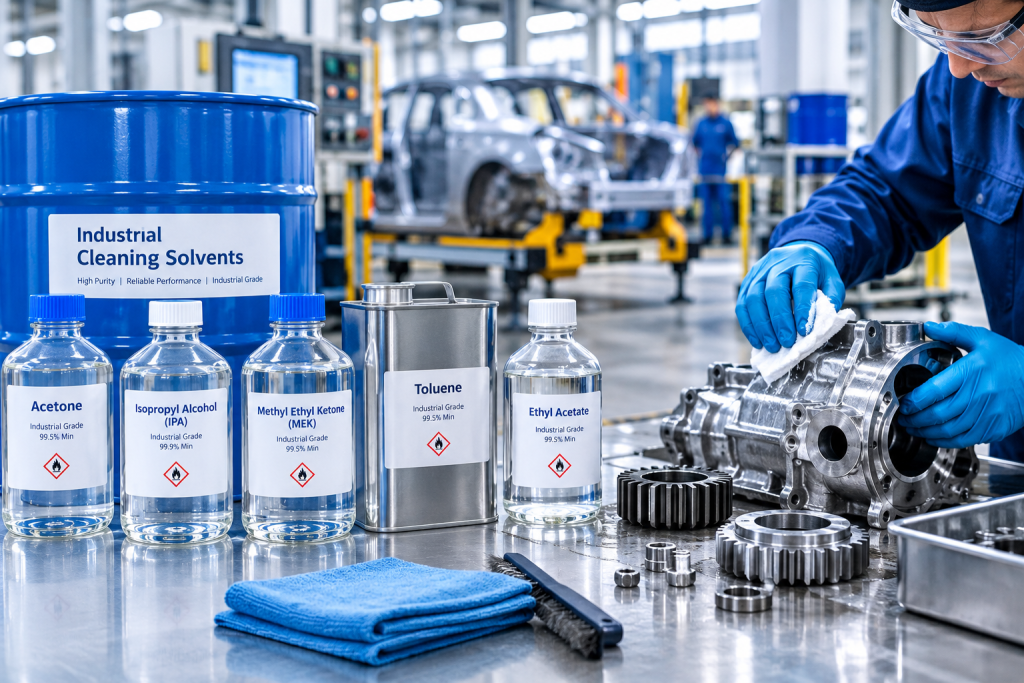
Industrial Cleaning Solvents help manufacturers remove oil, grease, adhesive residues, uncured coatings, and other contaminants from machinery, metal components, and production surfaces. Selecting the right industrial cleaning solvent improves cleaning efficiency, prepares surfaces for subsequent processing, and helps protect sensitive materials from chemical damage.
What Are Industrial Cleaning Solvents?
Industrial cleaning solvents are chemical liquids used to dissolve, loosen, or remove contaminants from equipment, components, and manufacturing surfaces. Unlike general-purpose cleaners, industrial cleaning solvents are selected according to the contaminant, substrate, cleaning method, and required surface condition.
Common solvent families include ketones, alcohols, esters, and hydrocarbon solvents. Each family has different solvency characteristics, evaporation behavior, and material compatibility. The objective is to remove unwanted substances effectively without leaving unacceptable residues or damaging the cleaned surface.
Where Are Industrial Cleaning Solvents Used?
Industrial cleaning solvents support maintenance, manufacturing, and surface preparation across multiple industries.
- Metalworking and fabrication: Removing machining oils, grease, and processing residues before welding, coating, painting, or assembly. The cleaning process must be compatible with the metal and the next manufacturing step.
- Automotive manufacturing: Cleaning selected metal components, tools, and production equipment to support consistent assembly and surface preparation.
- Electronics manufacturing: Removing compatible contaminants from selected components and equipment. Electronic assemblies require particular care because some solvents can damage plastics, coatings, labels, or sensitive materials.
- Paint and coating preparation: Removing residues before applying primers, paints, adhesives, or protective coatings. The surface must be compatible with both the cleaning solvent and the coating system.
- Machinery maintenance: Removing grease, lubricants, and accumulated deposits from suitable mechanical parts and equipment.
- Chemical manufacturing: Cleaning compatible process equipment and components according to validated procedures and material requirements.
Common Types of Industrial Cleaning Solvents
The most suitable industrial cleaning solvent depends on the type of contamination, the material being cleaned, and the required drying time. The following chemicals have different properties and should not be treated as interchangeable.
Acetone
Acetone is a fast-evaporating solvent that can remove certain organic residues, adhesives, and compatible coating materials. Its rapid evaporation can reduce drying time, but it may damage some plastics, paints, and elastomers. Compatibility testing is essential before use.
Isopropyl Alcohol (IPA)
Isopropyl alcohol (IPA) is used for selected surface-cleaning and preparation tasks where its solvency and evaporation profile are appropriate. Its suitability depends on the contaminant, material, and required cleanliness level. IPA should not automatically be assumed suitable for every electronic component or precision-cleaning process.
Methyl Ethyl Ketone (MEK)
Methyl ethyl ketone (MEK) provides strong solvency for certain resins, adhesives, and coatings. It may be used in selected industrial cleaning applications, but its flammability, exposure hazards, and compatibility with the substrate must be assessed.
Toluene and Xylene
Toluene and xylene can dissolve certain oils, resins, and organic contaminants. These aromatic solvents may be appropriate for specific industrial processes, but their occupational health and environmental considerations require careful evaluation. Less hazardous alternatives should be assessed where technically feasible.
For a broader overview of solvent chemistry and applications, see our guide to industrial solvents.
How to Choose the Right Industrial Cleaning Solvent
Selecting industrial cleaning solvents requires more than identifying a chemical with strong solvency. Manufacturers should evaluate the contamination, surface material, cleaning method, and requirements of the next production stage.
- Contaminant type: Identify whether the residue consists of oil, grease, adhesive, ink, resin, or another substance. Different contaminants may require different cleaning approaches.
- Substrate compatibility: Confirm that the solvent will not damage metal finishes, plastics, rubber, seals, coatings, or electronic components.
- Evaporation rate: Fast evaporation may reduce drying time, while a slower solvent can provide longer contact time. The correct profile depends on the process and residue.
- Residue and surface quality: Determine whether the cleaning process leaves a surface suitable for painting, bonding, coating, or assembly.
- Cleaning method: Consider wiping, immersion, spraying, or automated cleaning equipment. Not every solvent is suitable for every method.
- Safety and compliance: Assess flammability, workplace exposure, ventilation, waste handling, and applicable VOC requirements.
- Total operating cost: Compare solvent consumption, cleaning time, equipment needs, waste management, and process consistency rather than purchase price alone.
Before introducing a new solvent, conduct a compatibility test on the actual substrate and validate the cleaning process under representative production conditions.
Industrial Cleaning Solvents and Production Efficiency
Effective solvent cleaning can improve production consistency by removing contaminants that interfere with coating adhesion, bonding, assembly, or surface finishing. A suitable solvent may also reduce manual cleaning effort and help maintain equipment in appropriate operating condition.
However, stronger solvency does not automatically mean better cleaning. A solvent that removes a contaminant quickly may also attack the substrate, damage a protective finish, or create additional handling requirements. The best choice balances cleaning performance, material compatibility, drying behavior, safety, and operating cost.
For sensitive components or high-purity applications, manufacturers should establish acceptance criteria for surface cleanliness and verify that the selected process meets those requirements.
Safety and Environmental Considerations
Many industrial cleaning solvents are flammable, and some can cause harmful exposure through inhalation or skin contact. Facilities should review the relevant Safety Data Sheet (SDS), provide appropriate ventilation, control ignition sources, and use suitable personal protective equipment.
Solvents should be stored in compatible, properly labelled containers. Used solvents and contaminated wipes must be managed according to applicable waste requirements. Workers should also follow established spill-response procedures and avoid mixing chemicals unless the process has been specifically evaluated.
The United Nations Globally Harmonized System (GHS) provides a framework for chemical hazard classification and communication. Applicable local regulations and workplace requirements must also be followed.
Lower-Emission Alternatives for Industrial Cleaning
Manufacturers seeking to reduce solvent emissions may evaluate aqueous cleaning systems, optimized solvent blends, or other alternatives designed for the specific contaminant and substrate. These options can involve trade-offs in drying time, equipment requirements, waste treatment, cleaning performance, and operating cost.
Lower VOC content alone does not guarantee that a cleaning product is safer or more effective. A complete assessment should consider the chemical hazards, actual cleaning performance, and environmental requirements. Read our guide to low-VOC solvents for more information about lower-emission solvent technologies.
Source Industrial Cleaning Solvents from Aasad Chimie
Industrial Cleaning Solvents play an important role in manufacturing maintenance, degreasing, and surface preparation. The most suitable option depends on the contaminant, substrate, cleaning process, drying requirements, and safety conditions.
Manufacturers should compare solvent properties, confirm material compatibility, and validate cleaning performance before changing an established process. To explore available chemical materials, visit the Aasad Chimie product directory. For sourcing enquiries and application requirements, contact Aasad Chimie.
What are industrial cleaning solvents used for?
Industrial cleaning solvents are used to remove oils, grease, adhesives, selected coatings, and other contaminants from compatible equipment, components, and manufacturing surfaces.
Which solvent is best for industrial cleaning?
There is no single best solvent for every application. The correct choice depends on the contaminant, substrate compatibility, cleaning method, drying requirements, and workplace safety conditions.
Can acetone be used for industrial cleaning?
Yes. Acetone can remove certain organic contaminants and residues, but it may damage some plastics, coatings, and elastomers. Compatibility testing is necessary before use.
What is the difference between IPA and acetone for cleaning?
IPA and acetone have different solvency and evaporation characteristics. Their suitability depends on the material being cleaned, the type of residue, and the required surface condition.
How can manufacturers reduce the environmental impact of solvent cleaning?
They can evaluate solvent recovery, optimized cleaning processes, aqueous systems, and suitable lower-emission alternatives while verifying cleaning performance, chemical hazards, and regulatory compliance.