


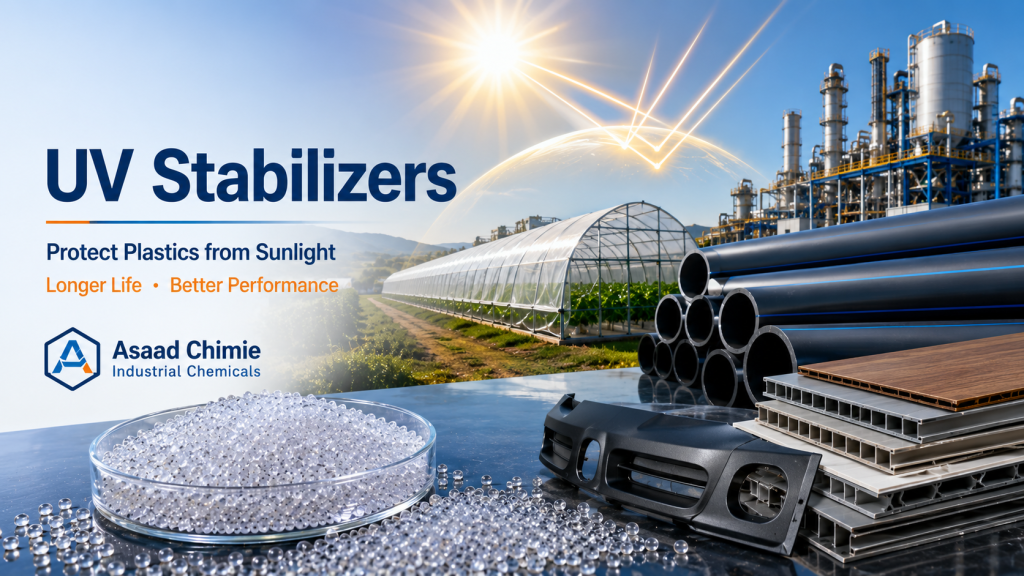
Table of Contents
- What Are UV Stabilizers for Plastics?
- Why UV Stabilizers for Plastics Are Important
- How Do UV Stabilizers for Plastics Work?
- Main Types of UV Stabilizers for Plastics
- 1. HALS UV Stabilizers
- 2. UV Absorbers for Plastics
- 3. UV Quenchers
- 4. Combined UV Stabilizer Systems
- Benefits of UV Stabilizers for Plastics
- Industrial Applications of UV Stabilizers for Plastics
- Agricultural Films
- Automotive Components
- Construction Materials
- Outdoor Furniture and Consumer Products
- Pipes, Tanks, and Infrastructure
- Cables and Electrical Components
- Solar and Energy Applications
- How to Choose the Right UV Stabilizers for Plastics
- 1. Identify the Polymer Type
- 2. Define the Exposure Conditions
- 3. Evaluate Product Color and Transparency
- 4. Review Processing Conditions
- 5. Check Compatibility with Other Additives
- 6. Confirm Regulatory and Performance Requirements
- HALS vs. UV Absorbers for Plastics
- UV Stabilizers for Recycled Plastics
- Future Trends in UV Stabilization Technology
- Common Mistakes When Selecting UV Stabilizers for Plastics
- Conclusion: Selecting UV Stabilizers for Plastics
- Related Articles
- External References
- Frequently Asked Questions
- What are UV stabilizers for plastics?
- Which polymers use UV stabilizers?
- What is the difference between HALS and UV absorbers?
- Can UV stabilizers improve the lifespan of outdoor plastics?
- Can UV stabilizers be used in recycled plastics?
- Contact AasadChimie
- What are UV stabilizers for plastics?
- Which polymers use UV stabilizers?
- What is the difference between HALS and UV absorbers?
- Can UV stabilizers improve the lifespan of outdoor plastics?
- Can UV stabilizers be used in recycled plastics?
UV Stabilizers for Plastics are specialty additives that protect polymer materials from degradation caused by prolonged ultraviolet radiation. They help reduce discoloration, surface cracking, brittleness, and loss of mechanical properties in plastic products exposed to sunlight. Manufacturers use UV stabilizers in agricultural films, automotive components, construction materials, outdoor furniture, pipes, and other applications that require long-term weather resistance.
Choosing the right UV stabilizers for plastics depends on polymer type, exposure conditions, processing temperature, product color, and expected service life. HALS, UV absorbers, and combined stabilization systems offer different protection mechanisms for polyethylene, polypropylene, PVC, ABS, polycarbonate, and other polymers.
What Are UV Stabilizers for Plastics?
UV Stabilizers for Plastics are additives designed to reduce the damaging effects of ultraviolet radiation on polymer materials. UV exposure can initiate photochemical reactions that generate free radicals, accelerate oxidation, and damage polymer chains. Over time, these reactions may reduce product durability and change its appearance.
Without suitable UV protection, plastic products exposed to sunlight may develop:
- Surface cracking and brittleness
- Yellowing and discoloration
- Loss of gloss and surface quality
- Reduced tensile strength and impact resistance
- Surface chalking and embrittlement
- Premature aging and shorter service life
For manufacturers producing outdoor plastic components, UV stabilization is an important part of formulation design. The appropriate UV stabilizers for plastics help maintain product performance under intended exposure conditions, although actual service life also depends on the resin, product design, climate, and other additives.
Why UV Stabilizers for Plastics Are Important
Ultraviolet radiation can trigger chemical reactions within susceptible polymers. These reactions may cause chain scission, crosslinking, and photo-oxidation, depending on the polymer structure and environmental conditions. The resulting changes can affect flexibility, strength, color, and surface appearance.
Heat, oxygen, moisture, pollutants, and repeated temperature changes can further influence outdoor degradation. Consequently, selecting UV stabilizers for plastics requires consideration of the complete service environment rather than UV exposure alone.
Effective stabilization can help manufacturers reduce premature product deterioration, improve weatherability, and maintain more consistent product quality. For long-life applications, UV stabilizers may need to be combined with antioxidants and other compatible additives.
For additional information about polymer degradation and materials testing, consult ASTM International, which publishes technical standards used to evaluate material properties and performance.
How Do UV Stabilizers for Plastics Work?
UV stabilizers protect polymers through several mechanisms. Some absorb harmful ultraviolet radiation before it can trigger degradation. Others interrupt radical reactions that occur during photo-oxidation, while certain additives deactivate excited molecular states involved in photochemical reactions.
The main stabilization mechanisms include:
- UV absorption: UV absorbers absorb selected wavelengths of ultraviolet radiation and dissipate the energy through non-destructive pathways, commonly as heat.
- Radical control: Hindered amine light stabilizers (HALS) help interrupt radical-driven degradation cycles.
- Excited-state quenching: Quenchers deactivate excited molecular states in selected polymer systems.
- Combined protection: Compatible UV stabilizers and antioxidants can provide complementary protection against light-induced and oxidative degradation.
The performance of UV stabilizers for plastics depends on additive chemistry, concentration, dispersion, polymer compatibility, product thickness, pigmentation, and environmental exposure. Formulation trials are important when long-term outdoor performance is required.
Main Types of UV Stabilizers for Plastics
Different UV stabilizers for plastics are suited to different resins and applications. Understanding their mechanisms helps manufacturers select additives that meet weatherability, appearance, and durability requirements.
1. HALS UV Stabilizers
Hindered amine light stabilizers, commonly called HALS, are widely used to protect many polymers against light-induced degradation. Rather than functioning primarily as UV absorbers, HALS help control free-radical reactions associated with photo-oxidation.
HALS UV stabilizers are commonly considered for outdoor polyolefin applications, including agricultural films, polypropylene components, outdoor furniture, and selected construction products.
Important selection factors include:
- Compatibility with the polymer and other additives
- Required outdoor exposure duration
- Potential interaction with acidic ingredients or pigments
- Processing conditions and additive retention
- Product thickness, color, and intended use
Not every HALS grade performs equally in every formulation. Manufacturers should verify compatibility and weathering performance under application-relevant conditions.
2. UV Absorbers for Plastics
UV absorbers capture selected ultraviolet wavelengths and dissipate the absorbed energy through pathways that reduce damage to the polymer. They are used in various plastic materials, coatings, and applications where UV transmission, appearance, or surface durability matters.
Depending on the chemistry, UV absorbers may be suitable for transparent or colored engineering plastics, molded components, sheets, and other products. Their suitability depends on the polymer, required optical properties, processing temperature, and exposure conditions.
When selecting UV absorbers for plastics, manufacturers should evaluate absorption characteristics, thermal stability, compatibility, migration potential, and applicable regulatory requirements.
3. UV Quenchers
UV quenchers deactivate excited molecular states that can contribute to photochemical degradation. They are used in selected specialty formulations where the polymer chemistry and application benefit from this stabilization mechanism.
Quenchers are not universal replacements for HALS or UV absorbers. Their effectiveness depends on the material system, the relevant degradation pathway, and compatibility with the complete formulation.
4. Combined UV Stabilizer Systems
Some demanding outdoor applications require more than one stabilization mechanism. Formulators may combine HALS, UV absorbers, and antioxidants to address light-induced degradation and oxidation under heat and oxygen exposure.
For example, an agricultural film may require a HALS-based system, while a transparent engineering plastic may need a UV absorber selected for its optical and thermal requirements. The final combination should be determined through formulation testing.
Benefits of UV Stabilizers for Plastics
When correctly selected and incorporated, UV stabilizers for plastics can help manufacturers improve outdoor durability and maintain product quality. Benefits vary according to the polymer, additive package, product design, and exposure environment.
| Benefit | Industrial Value |
|---|---|
| Improved weatherability | Helps products withstand outdoor exposure |
| Color retention | Helps limit UV-related discoloration |
| Mechanical-property retention | Helps reduce loss of strength and impact resistance |
| Longer service life | May reduce premature replacement needs |
| Surface protection | Helps limit cracking, chalking, and embrittlement |
| More consistent product quality | Supports durability targets across production batches |
UV stabilization does not guarantee a specific service life. Performance should be verified against the intended application, using suitable weathering tests and real-world exposure data where available.
Industrial Applications of UV Stabilizers for Plastics
UV stabilizers for plastics are used across industries that require polymer products to maintain their properties during sunlight exposure. The best additive system depends on the polymer grade, product design, climate, and performance requirements.
Agricultural Films
Polyethylene agricultural films are exposed to sunlight, heat, and changing environmental conditions. Suitable UV stabilizers help maintain film integrity and reduce premature embrittlement. Agricultural formulations may also need to account for contact with agrochemicals, sulfur-containing compounds, or other substances that can affect stabilizer performance.
Automotive Components
Exterior automotive trim, molded parts, and selected polymer components may require resistance to sunlight, heat, and changing weather conditions. UV stabilizers can help preserve appearance and mechanical properties when selected for the specific resin and exposure profile.
Construction Materials
Plastic roofing components, profiles, outdoor panels, and other construction materials may experience prolonged UV exposure. UV stabilizers for plastics can help reduce light-induced degradation and support long-term performance. Formulations should also account for temperature cycling, moisture, and the mechanical demands of the application.
Outdoor Furniture and Consumer Products
Outdoor chairs, tables, storage products, and garden equipment often require color retention and resistance to surface deterioration. UV stabilization helps address sunlight-related damage, while pigments and other additives may also influence the final weathering performance.
Pipes, Tanks, and Infrastructure
Plastic pipes, water storage tanks, and infrastructure products may be exposed to sunlight during storage, installation, or service. The appropriate UV stabilization system depends on the resin, exposure duration, product design, and applicable industry requirements.
Cables and Electrical Components
Selected cable jackets, conduits, enclosures, and electrical components require resistance to environmental aging. UV stabilizers may be used alongside antioxidants and other additives to support the specified material performance. Electrical, flame-retardancy, and regulatory requirements must also be considered.
Solar and Energy Applications
Some polymer components used in solar and energy systems face long-term outdoor exposure. Stabilizer selection must consider the specific component, temperature range, optical requirements, and relevant qualification standards rather than relying on a general-purpose additive recommendation.
How to Choose the Right UV Stabilizers for Plastics
Selecting the right UV stabilizers for plastics requires an assessment of the polymer, processing conditions, exposure environment, and target product performance. An additive suitable for one resin or application may not be suitable for another.
1. Identify the Polymer Type
Start by confirming whether the material is polyethylene (PE), polypropylene (PP), PVC, ABS, polycarbonate (PC), PET, polyamide (PA), or another polymer. Resin chemistry influences stabilizer compatibility, migration behavior, and performance.
2. Define the Exposure Conditions
Consider geographic location, UV intensity, temperature, humidity, product orientation, and expected exposure duration. Agricultural films and automotive exterior parts, for example, may require different stabilization strategies.
3. Evaluate Product Color and Transparency
Transparent products may require UV absorbers with suitable optical characteristics. Pigmented products need a formulation that accounts for pigment interactions, color stability, and the potential contribution of pigments to UV protection.
4. Review Processing Conditions
Extrusion, injection molding, film blowing, and other processes expose additives to different thermal and mechanical conditions. Check whether the selected stabilizer can withstand the processing temperature and residence time without unacceptable degradation or loss.
5. Check Compatibility with Other Additives
Antioxidants, pigments, fillers, flame retardants, processing aids, and other ingredients may influence stabilizer performance. For example, some HALS grades can be affected by acidic components. A complete formulation review helps identify potential interactions.
For additional formulation guidance, see our related articles on plastic processing aids and plastic additives for different polymers.
6. Confirm Regulatory and Performance Requirements
Food-contact, automotive, construction, electrical, and other applications may have specific regulatory or qualification requirements. Verify compliance for the target market and test the formulation using relevant methods, such as accelerated weathering and mechanical-property evaluation.
ASTM International provides standards that may be relevant when choosing test methods for weathering and material performance. Always select the specific standard that matches the polymer and intended application.
HALS vs. UV Absorbers for Plastics
HALS and UV absorbers both contribute to UV protection, but they work through different mechanisms. The appropriate choice depends on the polymer, application, optical requirements, and exposure conditions.
| Feature | HALS | UV Absorbers |
|---|---|---|
| Primary mechanism | Helps interrupt radical-driven degradation | Absorbs selected UV wavelengths |
| Common applications | Outdoor polyolefins and selected molded parts | Selected transparent plastics, coatings, and engineering polymers |
| Selection considerations | Compatibility, acidic ingredients, exposure, and resin type | Absorption profile, transparency, thermal stability, and compatibility |
| Combined use | May be combined with UV absorbers and antioxidants | May complement HALS in suitable formulations |
Neither technology is universally superior. In some formulations, HALS may provide effective long-term protection, while other applications benefit from UV absorbers or a combined stabilization system. Testing under representative exposure conditions is the best way to compare alternatives.
UV Stabilizers for Recycled Plastics
Recycled plastics may have experienced previous exposure to sunlight, heat, oxygen, and repeated melt processing. These factors can change polymer properties and influence the performance of newly added stabilizers.
UV stabilizers for plastics can help protect recycled materials against further light-induced degradation when the selected chemistry is compatible with the recycled resin. However, UV stabilizers do not reverse damage that has already occurred during earlier use or processing.
Before selecting a stabilization package for recycled PE or PP, manufacturers should assess:
- Polymer identity and recycled-content percentage
- Previous service and processing history, where known
- Contamination and compatibility risks
- Color and mechanical-property requirements
- Outdoor exposure and expected service life
- Interactions with antioxidants, pigments, and other additives
Where oxidative degradation is also a concern, an antioxidant system may complement UV stabilization. For background on oxidation control, see our article on antioxidants for polymers.
Future Trends in UV Stabilization Technology
UV stabilization continues to evolve as manufacturers seek durable products, improved formulation efficiency, and compatibility with recycled materials. New formulations are being developed for specific polymers and demanding exposure environments.
Important development areas include:
- High-performance HALS for demanding outdoor applications
- Stabilization systems designed for recycled polymers
- Low-migration solutions for applications with specific regulatory requirements
- Formulations for agricultural films with demanding service conditions
- Stabilizers compatible with selected bio-based polymers
- More efficient additive combinations that balance durability and cost
These developments do not eliminate the need for application-specific testing. Manufacturers should assess performance, compatibility, regulatory compliance, and total formulation cost before adopting a new UV stabilization technology.
For broader information on plastics and polymer applications, consult Plastics Europe. Scientific literature on polymer weathering and light stabilization can also be explored through ScienceDirect.
Common Mistakes When Selecting UV Stabilizers for Plastics
- Choosing by price alone: A lower-cost additive may not provide the required weathering performance or compatibility.
- Ignoring polymer chemistry: Stabilizer performance varies between resins and formulations.
- Overlooking pigment interactions: Some pigments can influence UV protection or interact with the stabilization package.
- Assuming all outdoor applications are alike: Agricultural films, automotive parts, and construction profiles face different exposure conditions.
- Ignoring antioxidants: UV stabilization and oxidative stabilization address related but distinct degradation mechanisms.
- Skipping weathering tests: Laboratory evaluation helps determine whether a formulation meets its target performance.
Conclusion: Selecting UV Stabilizers for Plastics
UV Stabilizers for Plastics help protect polymer materials from sunlight-related degradation, maintain appearance, and support mechanical-property retention in outdoor applications. HALS, UV absorbers, quenchers, and combined stabilization systems offer different approaches to improving polymer weatherability.
The right solution depends on resin chemistry, UV exposure, processing conditions, product design, and regulatory requirements. Manufacturers should evaluate compatibility and validate performance through appropriate testing before finalizing a formulation.
To explore suitable polymer additive options, visit our products page or contact our team to discuss your application and technical requirements.
Related Articles
- Plastic Processing Aids: Types, Benefits & Industrial Applications
- Slip Additives for Plastic Films
- Anti-Block Additives for Plastic Films
- Impact Modifiers for Polypropylene
- Antioxidants for Polymers: Types and Applications
External References
Frequently Asked Questions
What are UV stabilizers for plastics?
UV stabilizers are additives that help protect polymers from ultraviolet radiation and reduce light-induced degradation, discoloration, cracking, and loss of mechanical properties.
Which polymers use UV stabilizers?
Polyethylene, polypropylene, PVC, ABS, polycarbonate, PET, polyamide, and other polymers may require UV stabilization depending on their exposure and application.
What is the difference between HALS and UV absorbers?
HALS help interrupt radical-driven degradation reactions, while UV absorbers absorb selected wavelengths of ultraviolet radiation. Some formulations use both technologies.
Can UV stabilizers improve the lifespan of outdoor plastics?
Suitable UV stabilizers can help extend service life by reducing UV-related degradation, but actual performance depends on the resin, formulation, product design, and exposure conditions.
Can UV stabilizers be used in recycled plastics?
Yes. Compatible UV stabilizers can help protect recycled polymers against further UV-related degradation, although they cannot reverse damage that has already occurred.
Contact AasadChimie
Looking for suitable UV stabilizers for your plastic formulation? Visit our products page or contact our team to discuss your polymer type, processing conditions, and outdoor performance requirements.
What are UV stabilizers for plastics?
UV stabilizers are additives that help protect polymers from ultraviolet radiation and reduce light-induced degradation, discoloration, cracking, and loss of mechanical properties.
Which polymers use UV stabilizers?
Polyethylene, polypropylene, PVC, ABS, polycarbonate, PET, polyamide, and other polymers may require UV stabilization depending on their exposure and application.
What is the difference between HALS and UV absorbers?
HALS help interrupt radical-driven degradation reactions, while UV absorbers absorb selected wavelengths of ultraviolet radiation. Some formulations use both technologies.
Can UV stabilizers improve the lifespan of outdoor plastics?
Suitable UV stabilizers can help extend service life by reducing UV-related degradation, but actual performance depends on the resin, formulation, product design, and exposure conditions.
Can UV stabilizers be used in recycled plastics?
Yes. Compatible UV stabilizers can help protect recycled polymers against further UV-related degradation, although they cannot reverse damage that has already occurred.