


Table of Contents
- What Are Slip Additives?
- Why Slip Additives Matter in Plastic Film Production
- How Do Slip Additives Work?
- Main Types of Slip Additives
- 1. Oleamide Slip Additives
- 2. Erucamide Slip Additives
- 3. Stearamide Slip Additives
- 4. Specialty and Low-Migration Slip Additives
- Benefits of Slip Additives for Plastic Films
- Industrial Applications of Slip Additives
- Polyethylene Packaging Films
- BOPP and CPP Films
- Food Packaging Films
- Agricultural Films
- Industrial Liners and Bags
- Multilayer Films
- How to Choose the Right Slip Additives
- 1. Identify the Polymer and Film Structure
- 2. Define the Required COF
- 3. Evaluate Migration and Conditioning Time
- 4. Consider Printing, Lamination, and Sealing
- 5. Check Food-Contact and Other Regulatory Requirements
- 6. Assess Compatibility with Anti-Block Additives
- Slip Additives vs. Anti-Block Additives
- Emerging Trends in Slip Additive Technology
- Common Mistakes When Using Slip Additives
- Conclusion: Selecting Slip Additives for Plastic Films
- Related Articles
- External References
- Frequently Asked Questions
- What are slip additives?
- Which polymers commonly use slip additives?
- Can slip additives be combined with anti-block additives?
- Do slip additives affect printing and lamination?
- Why are slip additives important in automated packaging?
- Contact AasadChimie
- What are slip additives in plastic films?
- How do slip additives work in plastic film production?
- What are the most common types of slip additives?
- What is the difference between slip additives and anti-block additives?
- Which slip additive is suitable for polyethylene films?
- Do slip additives affect printing and heat sealing?
- How can manufacturers select the right slip additive?
- Can slip additives be used in food packaging films?
- How do slip additives affect the coefficient of friction (COF)?
- Can slip additives be combined with anti-block additives?
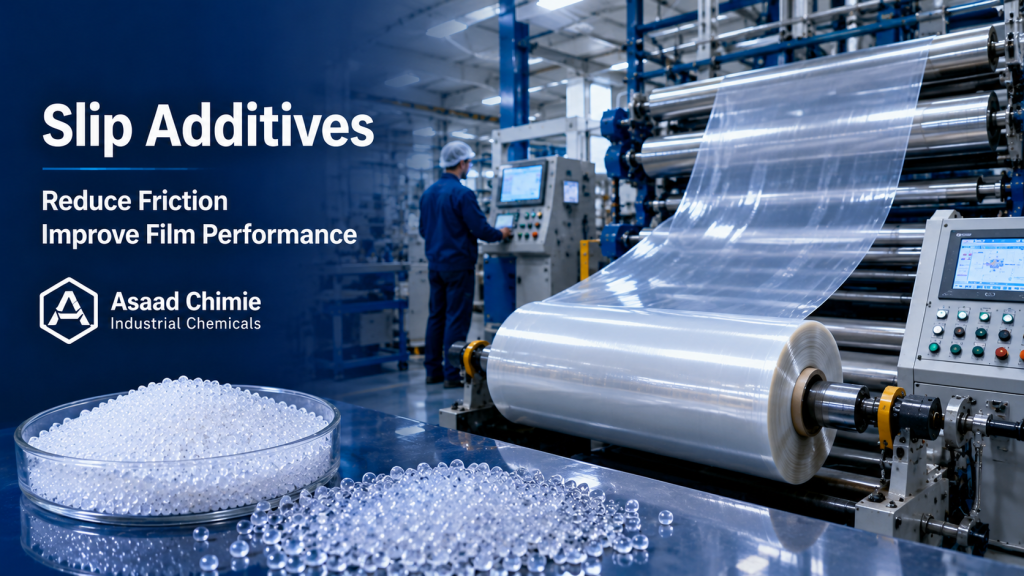
Slip Additives are functional additives used to reduce surface friction in plastic films and improve handling during manufacturing, converting, and packaging. By lowering the coefficient of friction (COF), slip additives help polyethylene (PE), polypropylene (PP), BOPP, and CPP films move more smoothly through winding, printing, lamination, and automated packaging equipment.
Choosing the right slip additives depends on the polymer type, required COF, additive migration, processing conditions, storage time, and end-use requirements. The correct formulation can improve film handling and production consistency while helping manufacturers meet packaging performance specifications.
What Are Slip Additives?
Slip Additives are specialty materials incorporated into polymer formulations to reduce friction between film surfaces or between a film and processing equipment. They are widely used in flexible packaging because surface friction affects film feeding, roll handling, converting efficiency, and packaging-line performance.
Many conventional slip additives migrate gradually from the polymer bulk toward the film surface after processing. This process, known as blooming or surface migration, can create a lubricating layer that lowers friction. The speed and extent of migration depend on additive chemistry, resin type, temperature, film thickness, and formulation.
Some advanced slip technologies use different mechanisms or are designed to reduce migration. Therefore, not all slip additives behave in the same way, and the best choice depends on the performance requirements of the finished film.
Why Slip Additives Matter in Plastic Film Production
Surface friction has a direct impact on the performance of plastic films during production and converting. If friction is too high, film layers may resist sliding against each other or against equipment surfaces. This can lead to handling problems, reduced line speed, and inconsistent packaging operations.
Appropriately selected slip additives can help address problems such as:
- Unstable film feeding and unwinding
- Excessive friction between film layers
- Difficulty controlling film tension
- Film handling problems on converting lines
- Inconsistent performance during automated packaging
- Scratches or surface damage caused by handling
- Production interruptions associated with poor film movement
The objective is not to achieve the lowest possible friction in every case. Manufacturers need a controlled coefficient of friction that supports reliable processing without compromising printing, lamination, sealing, or downstream handling.
How Do Slip Additives Work?
Many conventional slip additives move gradually through the polymer matrix and accumulate at the film surface after extrusion. Once sufficient additive reaches the surface, it can reduce resistance between contacting surfaces and improve film movement.
This process is influenced by several factors:
- Additive chemistry: Different slip agents have different migration rates and surface behavior.
- Polymer type: Resin chemistry and crystallinity affect additive compatibility and mobility.
- Processing conditions: Melt temperature, cooling, and extrusion conditions can influence the final additive distribution.
- Storage time and temperature: The surface concentration may change after production.
- Film thickness and formulation: The amount of additive available to migrate depends on the overall material structure and composition.
Because surface migration can continue after production, the coefficient of friction may change over time. Manufacturers should test slip additives at relevant intervals, especially when films are printed, laminated, sealed, or stored before use.
Main Types of Slip Additives
Several types of slip additives are used in flexible packaging. Their selection depends on the desired friction level, migration profile, processing requirements, and compatibility with the polymer.
1. Oleamide Slip Additives
Oleamide is a fatty acid amide commonly used as a slip additive in polyethylene films and other suitable polymer formulations. It can migrate relatively quickly toward the film surface, helping reduce friction after processing.
Oleamide may be suitable when manufacturers require relatively rapid slip development. However, its migration can affect surface properties over time, so printing, lamination, and storage requirements should be considered during formulation development.
2. Erucamide Slip Additives
Erucamide is another widely used fatty acid amide slip additive. Compared with oleamide, it often develops slip more gradually, although actual performance depends on the resin, formulation, and processing conditions.
Erucamide is used in many polyethylene and polypropylene film applications where a controlled friction profile is required. It may be considered for packaging films that need a balance between processing performance and surface stability.
3. Stearamide Slip Additives
Stearamide can provide slip and lubrication effects in selected polymer formulations. Its behavior differs from oleamide and erucamide, so it should be evaluated according to the target resin, required COF, and end-use performance.
Manufacturers should compare surface friction, compatibility, and any effect on downstream operations before choosing stearamide for a particular film application.
4. Specialty and Low-Migration Slip Additives
Specialty slip additives include silicone-based systems, polymeric technologies, and formulations designed for specific surface-performance requirements. Depending on their chemistry, these materials may provide different friction behavior or reduce reliance on conventional migrating amides.
Low-migration or non-migratory systems may be considered when surface deposits, printing performance, lamination, or other downstream requirements limit the use of conventional slip agents. Their suitability must be confirmed through testing because performance varies between technologies.
Benefits of Slip Additives for Plastic Films
Correctly selected slip additives can improve film handling and help manufacturers achieve consistent performance during production and packaging. The results depend on the polymer, additive dosage, equipment, and required surface characteristics.
| Benefit | Industrial Value |
|---|---|
| Reduced coefficient of friction | Supports smoother film movement |
| Improved roll handling | Helps with winding and unwinding |
| More consistent film feeding | Supports reliable converting operations |
| Packaging-line performance | Helps maintain stable film movement on suitable equipment |
| Controlled surface properties | Supports film-handling specifications |
| Process optimization | May reduce friction-related interruptions and waste |
Slip additives do not automatically increase production speed or eliminate all downtime. Their contribution should be assessed alongside equipment settings, film design, tension control, and other process variables.
Industrial Applications of Slip Additives
Slip Additives are widely used in plastic film applications where controlled surface friction is important. The suitable additive depends on the resin, film structure, conversion process, and final use.
Polyethylene Packaging Films
LDPE and LLDPE films are commonly used in bags, liners, wrapping films, and flexible packaging. Slip additives can improve film-to-film movement and support winding and unwinding operations.
The required slip profile depends on film thickness, winding conditions, storage time, and whether the film will be printed, laminated, or heat-sealed.
BOPP and CPP Films
Biaxially oriented polypropylene (BOPP) and cast polypropylene (CPP) films are used in packaging and converting applications. Slip additives may help control surface friction during roll handling and downstream processing.
For these films, manufacturers should consider the orientation or casting process, surface treatment, optical requirements, and compatibility with printing and lamination.
Food Packaging Films
Flexible food packaging often requires consistent handling on high-speed packaging equipment. Slip additives can help achieve the required friction profile, but the complete formulation must comply with applicable food-contact requirements.
Regulatory compliance depends on the additive grade, concentration, polymer, food type, temperature, and target market. Manufacturers should verify documentation and applicable limits before using a slip additive in food-contact materials.
Agricultural Films
Agricultural films require suitable handling during extrusion, winding, installation, and use. Slip additives may support processing and film movement, although the complete formulation must also meet requirements for UV stability, mechanical performance, and environmental exposure.
Industrial Liners and Bags
Industrial liners, shipping bags, and heavy-duty flexible packaging may benefit from controlled friction during converting and filling. The selected slip additive should support handling without creating unwanted changes in surface properties during storage or use.
Multilayer Films
Multilayer films combine different polymers or functional layers to achieve barrier, sealing, mechanical, or optical performance. Slip additives must be selected carefully because migration, interlayer contact, and surface treatment can affect the performance of the overall structure.
How to Choose the Right Slip Additives
Selecting the right slip additives requires more than choosing an additive with a low-friction claim. Manufacturers should define the target coefficient of friction and consider how the film will be processed, stored, printed, laminated, sealed, and used.
1. Identify the Polymer and Film Structure
Confirm whether the film is made from LDPE, LLDPE, HDPE, PP, BOPP, CPP, or a multilayer combination. Polymer chemistry and film structure influence additive compatibility, migration, and final surface properties.
2. Define the Required COF
The coefficient of friction measures the resistance between contacting surfaces. The required value depends on the packaging machine, film construction, and intended operation. Both static and dynamic COF may be relevant, so manufacturers should use an appropriate test method and clearly define the surfaces being tested.
3. Evaluate Migration and Conditioning Time
Conventional amide slip additives may require time to migrate to the surface. If a film is converted immediately after extrusion, its friction behavior may differ from that of the same film after storage. Test the film at the time points that reflect actual manufacturing and customer use.
4. Consider Printing, Lamination, and Sealing
Excessive surface migration or deposits can interfere with some downstream processes. Evaluate print adhesion, lamination bond strength, surface treatment, and heat-sealing performance when these operations are part of the production process.
5. Check Food-Contact and Other Regulatory Requirements
Food packaging and other regulated applications may require specific additive grades and supporting documentation. Confirm compliance for the relevant jurisdiction and intended conditions of use instead of assuming that every grade of a particular chemical is suitable.
6. Assess Compatibility with Anti-Block Additives
Slip additives and anti-block additives are often used together, but their functions differ. Their combined effects on friction, film clarity, surface quality, and processing should be tested as part of the complete formulation.
Read our related guide to anti-block additives for plastic films for more information about film separation and blocking control.
Slip Additives vs. Anti-Block Additives
Slip additives and anti-block additives are frequently combined in flexible packaging formulations because they address related but different film-handling problems. Slip additives reduce friction, while anti-block additives help prevent adjacent film surfaces from sticking together.
| Feature | Slip Additives | Anti-Block Additives |
|---|---|---|
| Main purpose | Reduce surface friction | Reduce blocking between film layers |
| Typical mechanism | Often form a lubricating surface layer through migration | Often create microscopic surface irregularities that reduce contact area |
| Main benefit | Smoother sliding and film movement | Easier separation of contacting film surfaces |
| Important evaluation factors | COF, migration, printing, and sealing | Blocking, clarity, surface finish, and film handling |
Combining these additives may improve overall film handling, but the formulation must be optimized. An anti-block additive can affect optical properties, while a slip additive can change friction over time as it migrates to the surface.
Emerging Trends in Slip Additive Technology
Flexible packaging continues to evolve as manufacturers seek reliable high-speed processing, improved recyclability, and more controlled surface performance. These demands are influencing the development of slip additives and related polymer technologies.
Important development areas include:
- Low-migration slip systems for selected applications
- Technologies designed to reduce unwanted surface deposits
- Specialty additives for high-performance BOPP and CPP films
- Formulations compatible with recyclable mono-material packaging
- Improved control of friction throughout storage and converting
- Additive systems developed for specific regulatory requirements
Newer technologies still require application-specific testing. Manufacturers should compare COF stability, processability, surface quality, regulatory compliance, and total formulation cost before making a change.
Common Mistakes When Using Slip Additives
- Choosing only by initial COF: Surface friction can change as conventional slip additives migrate over time.
- Ignoring downstream converting: Printing, lamination, and sealing requirements may limit the suitable additive and dosage.
- Using excessive additive: Higher concentrations do not always improve performance and may cause deposits or other surface issues.
- Ignoring polymer compatibility: Additive behavior depends on the resin and overall formulation.
- Overlooking anti-block performance: Reducing friction does not necessarily prevent film layers from sticking together.
- Skipping storage tests: Film performance should be evaluated after realistic conditioning and storage periods.
Conclusion: Selecting Slip Additives for Plastic Films
Slip Additives play an important role in controlling surface friction in plastic films. They can improve film handling, support winding and converting, and help manufacturers achieve consistent performance in flexible packaging applications.
The right solution depends on the polymer, required coefficient of friction, migration profile, storage conditions, downstream processing, and regulatory requirements. Testing the complete formulation under realistic production conditions helps confirm that the selected slip additives meet the required specifications.
To explore polymer additive options, visit our products page or contact our team to discuss your film structure, processing conditions, and performance requirements.
Related Articles
- Anti-Block Additives for Plastic Films
- Plastic Processing Aids
- Impact Modifiers for Polypropylene
- UV Stabilizers for Plastics
External References
- ASTM International – Standards information relevant to material testing and performance evaluation.
- Plastics Europe – Information about plastics, polymer applications, and the plastics industry.
- ScienceDirect – Scientific literature on polymer additives, film properties, and friction behavior.
- American Chemistry Council – Information about the chemistry industry and plastic materials.
Frequently Asked Questions
What are slip additives?
Slip additives are materials incorporated into plastic formulations to reduce surface friction and improve film movement during manufacturing, converting, and packaging.
Which polymers commonly use slip additives?
Slip additives are commonly used in polyethylene and polypropylene films, including LDPE, LLDPE, HDPE, BOPP, CPP, and selected multilayer packaging structures.
Can slip additives be combined with anti-block additives?
Yes. They are often combined because slip additives reduce friction, while anti-block additives help prevent film surfaces from sticking together.
Do slip additives affect printing and lamination?
They can affect downstream surface performance, particularly if migration or surface deposits interfere with adhesion. The additive grade and concentration should be tested with the intended printing and lamination processes.
Why are slip additives important in automated packaging?
They help control film friction and support consistent movement through packaging equipment, provided the film formulation and friction level match the machine requirements.
Contact AasadChimie
Looking for suitable slip additives for polyethylene, polypropylene, or multilayer packaging films? Visit our products page or contact our team to discuss your formulation and film-processing requirements.
What are slip additives in plastic films?
Slip additives are materials added to plastic films to reduce surface friction and improve handling during converting, packaging, and transportation.
How do slip additives work in plastic film production?
Slip additives migrate gradually toward the film surface, forming a lubricating layer that reduces the coefficient of friction (COF). The effectiveness depends on the additive type, polymer formulation, and conditioning time.
What are the most common types of slip additives?
Common types include oleamide, erucamide, and stearamide. The appropriate choice depends on the polymer, required friction level, processing conditions, and end-use requirements.
What is the difference between slip additives and anti-block additives?
Slip additives reduce friction between film surfaces and processing equipment, while anti-block additives help prevent film layers from sticking together. Both may be used in the same formulation to improve film handling.
Which slip additive is suitable for polyethylene films?
Oleamide and erucamide are commonly used in polyethylene films. The best option depends on the required COF, film thickness, storage conditions, printing or lamination needs, and packaging application.
Do slip additives affect printing and heat sealing?
Yes. Excessive surface migration can reduce ink adhesion, interfere with lamination, or affect heat-sealing performance. Formulations should be tested under actual production conditions.
How can manufacturers select the right slip additive?
Manufacturers should evaluate the polymer type, target COF, migration rate, processing temperature, storage time, regulatory requirements, and compatibility with other additives.
Can slip additives be used in food packaging films?
Yes, provided the selected additive and its concentration comply with the applicable food-contact regulations for the target market. Compliance should be confirmed using the supplier’s technical and regulatory documentation.
How do slip additives affect the coefficient of friction (COF)?
They generally lower the COF, helping films move more smoothly through converting and packaging equipment. The final COF depends on formulation, surface migration, testing method, and conditioning time.
Can slip additives be combined with anti-block additives?
Yes. Combining them can improve film separation and handling. However, the formulation should be optimized to avoid unwanted effects on transparency, surface quality, printing, and sealing performance.