


Table of Contents
- What Are Polymer Processing Chemicals?
- Why Are Polymer Processing Chemicals Important?
- Main Types of Polymer Processing Chemicals
- 1. Polymer Processing Aids
- 2. Functional Fillers in Polymer Manufacturing
- 3. Calcium Carbonate Filler Masterbatch
- 4. Lubricants for Polymer Processing
- 5. Heat Stabilizers and Antioxidants
- 6. Dispersing Agents
- Industrial Applications of Polymer Processing Chemicals
- How These Chemicals Improve Manufacturing Efficiency
- How to Choose the Right Polymer Processing Chemicals
- Identify the Main Processing Challenge
- Validate the Formulation Before Scale-Up
- Common Polymer Processing Problems and Possible Solutions
- Quality Control and Performance Testing
- Emerging Trends in Polymer Processing Chemicals
- Related Industrial Chemicals and Resources
- Working with a Reliable Chemical Supplier
- Conclusion
- References and Technical Resources
- What are Polymer Processing Chemicals?
- Why are Polymer Processing Chemicals important?
- Which industries use Polymer Processing Chemicals?
- How do I select the right Polymer Processing Chemicals?
- Can Polymer Processing Chemicals reduce production costs?
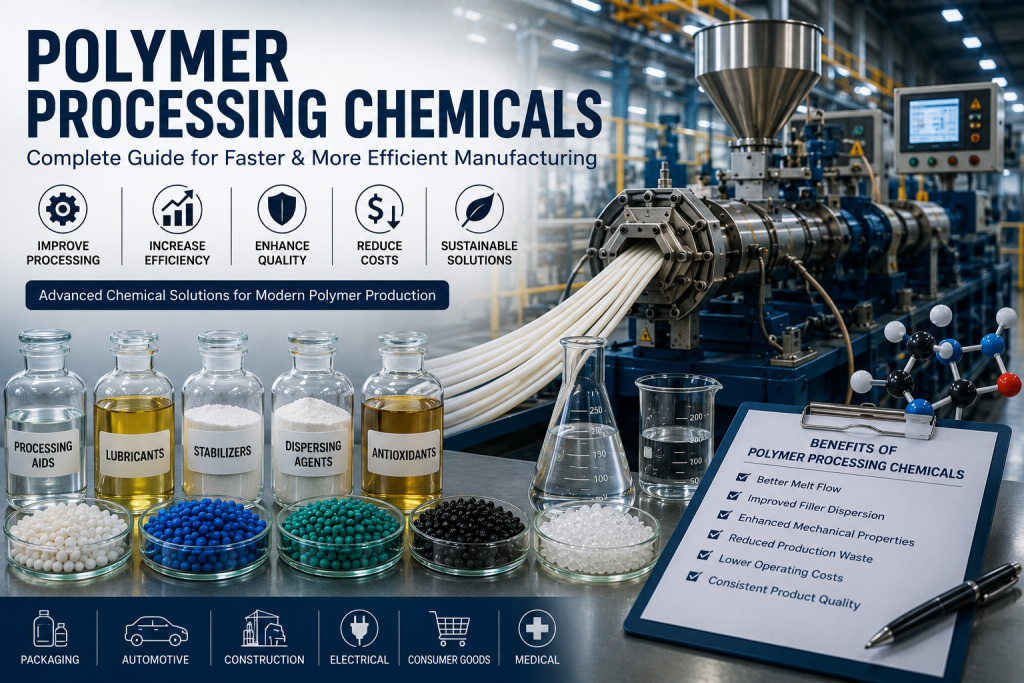
Polymer Processing Chemicals are essential materials used to improve plastic manufacturing efficiency, processing stability, and finished-product quality. Depending on their formulation, these chemicals help manufacturers improve melt flow, disperse fillers, control friction, reduce selected extrusion defects, and protect polymers against thermal or oxidative degradation.
Choosing the right polymer processing chemicals depends on the resin type, manufacturing method, processing temperature, equipment, and required product properties. Understanding the main chemical categories and their functions helps manufacturers develop more reliable formulations for extrusion, injection molding, compounding, and masterbatch production.
What Are Polymer Processing Chemicals?
Polymer processing chemicals are additives and processing materials used during polymer conversion to improve manufacturing behavior or achieve specific material properties. They may be incorporated into the polymer formulation or used to address particular challenges during production.
Common examples include processing aids, functional fillers, lubricants, heat stabilizers, antioxidants, and dispersing agents. Each category performs a different function, and not every additive is suitable for every polymer or production process.
These materials are used in the processing of polypropylene (PP), polyethylene (PE), PVC, and other thermoplastics. Their selection should consider resin compatibility, the required performance of the finished product, regulatory requirements, and the manufacturer’s operating conditions.
Why Are Polymer Processing Chemicals Important?
Plastic manufacturers must balance production speed, product consistency, material performance, and operating costs. Properly selected polymer processing chemicals can help address specific production challenges and improve process control.
- Improved processability: Suitable additives can help control friction, melt behavior, and material flow.
- Better filler dispersion: Compatible dispersing agents and filler systems can improve the distribution of mineral particles in a polymer matrix.
- Reduced processing defects: The right formulation may help control selected surface defects, die buildup, or inconsistent extrusion behavior.
- Improved thermal stability: Appropriate stabilizers and antioxidants can help protect susceptible polymers during processing.
- Consistent product quality: Controlled formulations can support repeatable processing and more predictable product properties.
- Cost optimization: Better process stability and reduced material waste may lower total production costs when verified through trials.
The actual benefits depend on the polymer grade, additive dosage, equipment, and operating conditions. Manufacturers should validate any formulation changes through controlled laboratory or production testing.
Main Types of Polymer Processing Chemicals
| Chemical Type | Primary Function | Typical Applications |
|---|---|---|
| Processing aids | Improve selected processing and flow characteristics | Film extrusion, profiles, pipes |
| Functional fillers | Modify stiffness, dimensional stability, or formulation cost | Compounds and masterbatches |
| Lubricants | Control friction and material release | Extrusion and injection molding |
| Heat stabilizers | Help reduce heat-related degradation | Heat-sensitive polymer formulations |
| Antioxidants | Help limit oxidative degradation | Polyolefins and engineering plastics |
| Dispersing agents | Improve filler and pigment distribution | Compounding and masterbatch production |
| Impact modifiers | Improve impact resistance in compatible systems | Automotive and consumer products |
| UV stabilizers | Help protect polymers from ultraviolet exposure | Outdoor plastic products |
1. Polymer Processing Aids
Processing aids are used to address specific manufacturing challenges, including certain melt-flow problems, surface imperfections, and instability during extrusion. Depending on the chemistry and polymer system, a processing aid may help reduce melt fracture or die buildup and support more consistent production.
The appropriate product depends on the resin, equipment, processing temperature, and type of defect. Manufacturers should review technical data sheets and test the recommended dosage before implementing a formulation change.
For more information, explore plastic processing additives and practical approaches to reducing extrusion defects.
2. Functional Fillers in Polymer Manufacturing
Functional fillers are used to modify selected properties of plastic compounds and optimize formulation costs. Calcium carbonate is a widely used mineral filler, while other filler materials may be selected for specific mechanical, thermal, or dimensional requirements.
Filler performance depends on particle size, surface treatment, moisture content, loading level, dispersion quality, and compatibility with the polymer. Poor dispersion or excessive filler loading may reduce impact strength, weaken the material, or create surface defects.
Learn more about functional fillers, functional filler powder, and advanced functional filler powder.
3. Calcium Carbonate Filler Masterbatch
Calcium carbonate filler masterbatch is a concentrated mixture of mineral filler and a polymer carrier. It allows manufacturers to introduce calcium carbonate into compatible plastic formulations during compounding or product manufacturing.
When selecting a masterbatch, evaluate its filler content, carrier compatibility, dispersion quality, moisture level, and effect on the final product. Tensile strength, impact resistance, surface finish, processability, and dimensional stability should be considered together rather than evaluated in isolation.
The optimum addition rate varies by application and product specifications. Controlled trials at different loading levels can help determine the balance between material cost and finished-product performance.
Read more about calcium carbonate filler masterbatch and methods to improve calcium carbonate dispersion.
4. Lubricants for Polymer Processing
Polymer lubricants help control friction within a formulation or between the material and processing equipment. Depending on their chemistry, internal and external lubricants can influence melt behavior, material release, surface quality, and equipment buildup.
However, excessive lubricant or poor compatibility may cause plate-out, weak printing or bonding performance, or surface defects. Manufacturers should select lubricants according to the resin and process, follow supplier recommendations, and verify results through production trials.
5. Heat Stabilizers and Antioxidants
Heat stabilizers and antioxidants help protect susceptible polymers from degradation under specific processing or service conditions. Heat stabilizers are particularly relevant to formulations that require protection against thermal damage, while antioxidants help limit oxidation caused by exposure to oxygen and elevated temperatures.
The correct stabilization system depends on the polymer, temperature profile, residence time, expected service environment, and applicable regulations. Testing should examine color stability, mechanical properties, compatibility, and long-term performance where relevant.
6. Dispersing Agents
Dispersing agents help distribute fillers, pigments, and other ingredients throughout a polymer formulation. Effective dispersion can improve consistency, appearance, and the reliability of the finished compound.
Chemical selection is only one part of the process. Mixing equipment, shear conditions, temperature, ingredient sequence, and material compatibility also affect dispersion. Manufacturers should assess the complete formulation and processing method when investigating dispersion problems.
Industrial Applications of Polymer Processing Chemicals
| Industry | Typical Products | Important Requirements |
|---|---|---|
| Packaging | Films, containers, caps, flexible packaging | Consistent processing and required mechanical properties |
| Automotive | Molded components and polymer compounds | Durability and application-specific performance |
| Construction | Pipes, profiles, panels, cable compounds | Dimensional stability and weather resistance |
| Electrical | Cable insulation and plastic housings | Electrical properties and thermal stability |
| Consumer goods | Household products and storage items | Surface quality and consistent production |
| Industrial manufacturing | Sheets, technical components, extruded profiles | Process reliability and specification control |
How These Chemicals Improve Manufacturing Efficiency
The main purpose of using polymer processing chemicals is to address defined manufacturing requirements. When the formulation is compatible with the resin and equipment, suitable additives may help manufacturers:
- Improve processing consistency and control selected flow-related issues.
- Reduce certain surface defects and material losses.
- Achieve more uniform filler distribution in filled compounds.
- Protect susceptible polymers against thermal or oxidative degradation.
- Maintain more consistent product properties across production batches.
- Optimize total manufacturing costs by reducing waste or improving productivity.
To measure the results, compare the revised formulation with a baseline using production throughput, scrap rate, energy consumption, cycle time, and finished-product test results. No additive should be assumed to improve all these measures in every application.
How to Choose the Right Polymer Processing Chemicals
Choosing a suitable product starts with identifying the production problem and defining the required outcome. A chemical that works well in one resin or process may be unsuitable for another.
| Selection Factor | What to Check |
|---|---|
| Polymer compatibility | Compatibility with PP, PE, PVC, or the specified resin grade |
| Processing conditions | Temperature, shear, residence time, pressure, and equipment |
| Target properties | Strength, flexibility, impact resistance, appearance, and stability |
| Dosage and dispersion | Recommended concentration and mixing requirements |
| Regulatory compliance | Applicable food-contact, electrical, construction, or other requirements |
| Total production cost | Material cost, waste, productivity, and quality losses |
| Supplier support | Technical documentation, batch consistency, availability, and guidance |
Identify the Main Processing Challenge
Determine whether the problem relates to melt flow, filler dispersion, thermal degradation, friction, surface defects, or finished-product performance. A clear diagnosis helps prevent unnecessary additive use and reduces the risk of introducing new formulation problems.
Validate the Formulation Before Scale-Up
Begin with laboratory evaluation or a controlled production trial. Record the additive concentration, processing settings, product quality, and observed defects. Compare the results with the existing formulation and confirm that the revised system meets all required specifications before scaling up.
Common Polymer Processing Problems and Possible Solutions
| Problem | Possible Causes | Potential Response |
|---|---|---|
| Poor filler dispersion | Inadequate mixing, moisture, or incompatibility | Review filler treatment, dispersing agents, and mixing conditions |
| Extrusion surface defects | Unstable flow, unsuitable temperature, or die buildup | Review operating conditions and compatible processing aids |
| Thermal degradation | Excessive temperature, long residence time, or insufficient stabilization | Review the temperature profile and stabilization system |
| Inconsistent mechanical properties | Variable raw materials, dispersion problems, or incorrect loading | Standardize inputs and verify formulation controls |
| High production costs | Scrap, inefficient processing, or unsuitable formulation | Compare total cost and finished-product performance |
These are potential causes rather than definitive diagnoses. Equipment inspection, raw-material checks, and process data should be used to identify the underlying issue before making formulation changes.
Quality Control and Performance Testing
Quality control helps verify whether a formulation meets the requirements of the manufacturing process and finished product. Depending on the polymer and application, useful tests may include:
- Melt flow rate or melt volume rate, where applicable.
- Tensile, impact, and flexural testing according to product requirements.
- Visual inspection for surface defects, color variation, and dispersion quality.
- Thermal stability or aging tests for products exposed to heat or outdoor conditions.
- Dimensional checks and relevant application-specific compliance tests.
Use documented acceptance criteria and appropriate test methods. ASTM International and ISO standards provide resources for identifying relevant testing procedures.
Emerging Trends in Polymer Processing Chemicals
Manufacturers continue to evaluate new formulations to improve productivity, support material circularity, and meet changing technical and environmental requirements.
- Recycling-compatible formulations: Additives developed for selected recycled polymer systems.
- Lower-emission materials: Formulations designed to meet applicable volatile-emission requirements.
- Advanced filler technology: Improved filler treatment and dispersion approaches.
- Process optimization: Products designed to address specific manufacturing limitations.
- Application-specific solutions: Formulations tailored to resin grades, equipment, and end-use performance targets.
New technologies must still be assessed for compatibility, safety, performance, and regulatory compliance before use in production.
Related Industrial Chemicals and Resources
Some manufacturing operations also require supporting chemicals for cleaning, surface preparation, or other industrial processes. These materials have different functions from polymer additives and should be selected according to the intended application and relevant safety instructions.
Working with a Reliable Chemical Supplier
A dependable supplier can help manufacturers review product specifications, obtain technical documents, assess compatibility, and maintain consistent raw-material quality. Before purchasing, request the relevant technical data sheet (TDS), safety data sheet (SDS), handling guidance, and product-specific quality information.
Evaluate suppliers based on product consistency, technical support, documentation, availability, and suitability for the intended application—not price alone.
For product information or industrial chemical inquiries, visit the AasadChimie products page or contact the team through the contact page.
Conclusion
Polymer Processing Chemicals help manufacturers manage processing behavior, improve filler dispersion, support polymer stability, and achieve consistent product quality. The right choice depends on the resin, processing method, production challenge, and finished-product requirements.
By reviewing technical specifications, selecting compatible additives, and validating formulations through controlled trials, manufacturers can make informed decisions about processing aids, functional fillers, lubricants, stabilizers, and dispersing agents. A systematic approach helps balance manufacturing efficiency, product performance, and total production cost.
References and Technical Resources
- ASTM International – Standards and Test Methods
- ISO – International Standards
- European Chemicals Agency (ECHA)
- PubChem – Chemical Information
- Plastics Industry Association
What are Polymer Processing Chemicals?
Polymer processing chemicals are additives and processing materials used to improve polymer processability, filler dispersion, stability, and selected properties of finished plastic products.
Why are Polymer Processing Chemicals important?
They can help manufacturers control processing behavior, reduce certain production defects, improve formulation consistency, and optimize manufacturing costs.
Which industries use Polymer Processing Chemicals?
They are used in packaging, automotive, construction, electrical products, consumer goods, and industrial plastic manufacturing.
How do I select the right Polymer Processing Chemicals?
Selection depends on polymer compatibility, processing conditions, target product properties, recommended dosage, regulatory requirements, and total production cost.
Can Polymer Processing Chemicals reduce production costs?
They may reduce total costs by improving process stability, reducing scrap, or optimizing material use. Results should be confirmed through controlled trials.