


Table of Contents
- What Are Polymer Additives?
- Why Polymer Additives Matter in Manufacturing
- Complete Polymer Additives List: 25 Essential Types
- 1. Antioxidants
- 2. UV Stabilizers
- 3. Heat Stabilizers
- 4. Slip Additives
- 5. Anti-Block Additives
- 6. Processing Aids
- 7. Impact Modifiers
- 8. Chain Extenders
- 9. Flame Retardants
- 10. Antistatic Additives
- 11. Nucleating Agents
- 12. Clarifying Agents
- 13. Optical Brighteners
- 14. Color Masterbatch
- 15. White Masterbatch
- 16. Black Masterbatch
- 17. Lubricants
- 18. Compatibilizers
- 19. Coupling Agents
- 20. Blowing Agents
- 21. Foaming Regulators
- 22. Plasticizers
- 23. Anti-Fog Additives
- 24. Antimicrobial Additives
- 25. Odor Absorbers
- Polymer Additives List by Resin Type
- How to Choose the Right Polymer Additives
- 1. Identify the Polymer and Grade
- 2. Define the Performance Target
- 3. Match the Additive to the Process
- 4. Check Compatibility and Interactions
- 5. Review Regulatory and Safety Requirements
- 6. Conduct Controlled Trials
- 7. Compare Total Cost
- Common Mistakes When Selecting Polymer Additives
- Polymer Additives and Recycled Plastics
- Future Trends in Polymer Additives
- Benefits of Using a Structured Polymer Additives List
- Conclusion
- Related Articles
- References
- What are polymer additives?
- What are the most common types of polymer additives?
- Why are antioxidants used in plastic manufacturing?
- Which polymer additives are used for recycled plastics?
- Can the same additive be used in every polymer?
- How do manufacturers choose the right polymer additive?
- What is the difference between a polymer additive and a masterbatch?
- Do polymer additives reduce manufacturing costs?
Polymer Additives are functional ingredients added to plastics to improve processing, stability, mechanical performance, appearance, and service life. Common types include antioxidants, UV stabilizers, impact modifiers, processing aids, lubricants, and compatibilizers. The right additive depends on the polymer, manufacturing process, product requirements, and operating environment.
In modern plastic manufacturing, the base resin is only one part of the formulation. Polyethylene film may require antioxidants, slip additives, and anti-block agents, while an automotive component may need impact modifiers, heat stabilizers, or flame retardants. Understanding the function of each additive helps manufacturers improve consistency, reduce defects, and make better material-selection decisions.
What Are Polymer Additives?
Polymer Additives are chemicals, functional materials, or formulated ingredients incorporated into polymer systems to achieve specific performance targets. Depending on the product, they can improve thermal stability, UV resistance, flexibility, impact strength, color, surface properties, or processing behavior.
Additives are commonly supplied as powders, liquids, pellets, or concentrated masterbatches. Their dosage and method of incorporation depend on the chemistry, polymer grade, equipment, and required properties of the finished product.
Manufacturers use additives in applications such as:
- Flexible packaging films and plastic bags
- Automotive components and interior parts
- PVC pipes, profiles, and construction products
- Electrical and electronic components
- Food and consumer packaging
- Agricultural films and outdoor products
- Recycled plastic compounds
- Engineering plastics and technical components
Why Polymer Additives Matter in Manufacturing
Plastic products must meet requirements for processing, appearance, durability, safety, and cost. A resin that performs well under one set of conditions may require modification for a different application.
A suitable additive package can help manufacturers:
- Protect polymers against thermal and oxidative degradation.
- Improve resistance to sunlight and environmental exposure.
- Control friction and film blocking.
- Improve toughness and reduce brittleness.
- Support stable extrusion and molding.
- Adjust color, opacity, and optical properties.
- Improve compatibility between selected materials.
- Reduce scrap when formulation and process conditions are optimized.
However, additives must be selected as part of a balanced formulation. Incompatible combinations, excessive dosage, or unsuitable processing conditions may reduce performance or create problems during printing, sealing, recycling, or final use.
Complete Polymer Additives List: 25 Essential Types
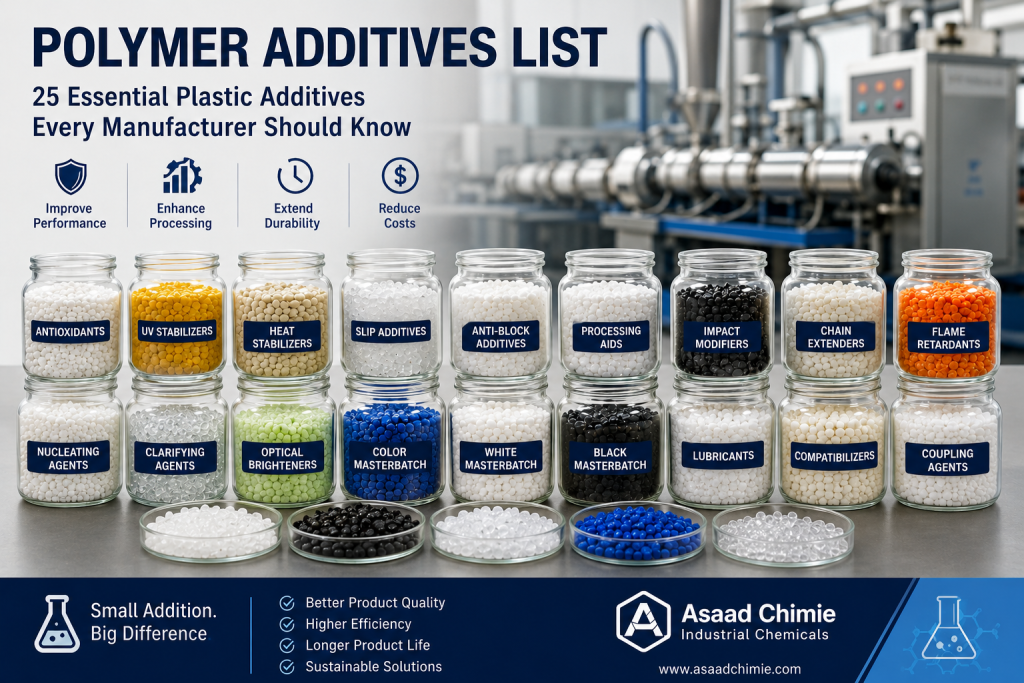
This Polymer Additives List covers 25 major additive categories used across plastics manufacturing. The categories have different functions, and some products may serve more than one purpose depending on their composition and application.
1. Antioxidants
Antioxidants help protect polymers against oxidative degradation during processing and, where appropriate, long-term use. They are particularly important for polyolefins such as polyethylene (PE) and polypropylene (PP), which can be affected by heat and oxygen during melt processing.
Primary and secondary antioxidants may be combined to provide complementary protection. The appropriate system depends on processing temperature, residence time, polymer history, and service conditions.
Typical applications: PE and PP films, molded components, recycled polyolefins, and polymer compounds requiring improved thermal stability.
2. UV Stabilizers
UV stabilizers help reduce polymer degradation caused by ultraviolet radiation. Depending on the chemistry, they may absorb UV radiation or interrupt degradation reactions associated with light exposure.
These additives are relevant to products exposed to sunlight, although the required protection depends on polymer type, product thickness, exposure intensity, pigments, and intended service life.
Typical applications: Agricultural films, outdoor packaging, pipes, construction profiles, and exterior automotive components.
3. Heat Stabilizers
Heat stabilizers help prevent or slow thermal degradation during processing and service. They are particularly important in PVC formulations, where processing heat can cause degradation and discoloration if stabilization is inadequate.
Different polymer systems require different stabilizer chemistries. A product designed for PVC should not automatically be assumed suitable for polyolefins or engineering plastics.
Typical applications: PVC pipes, window profiles, cable insulation, and selected heat-sensitive polymer formulations.
4. Slip Additives
Slip additives reduce the coefficient of friction between plastic surfaces. In flexible packaging, they can help film move through rollers and automated packaging equipment more smoothly.
The formulation must balance friction reduction with sealing, printing, lamination, and surface requirements. Excessive slip can be undesirable in applications that depend on controlled friction.
Typical applications: PE films, selected PP films, bags, liners, and flexible packaging.
5. Anti-Block Additives
Anti-block additives help prevent adjacent film layers from sticking together during winding, storage, and handling. They commonly work by modifying the film surface to reduce the area of close contact between layers.
Selection depends on the required separation performance, film clarity, gloss, thickness, and processing conditions.
Typical applications: Polyethylene films, flexible packaging, industrial liners, and selected polypropylene films.
6. Processing Aids
Processing aids are used to address specific manufacturing problems and improve processing behavior. Depending on the chemistry, they may reduce melt-fracture defects, improve surface quality, or help control deposits in suitable extrusion systems.
Processing aids are not universal solutions. Manufacturers should first identify the root cause of a defect and confirm compatibility with the resin, equipment, and downstream operations.
Typical applications: Blown-film extrusion, selected extrusion processes, and polymer formulations with specific processing challenges.
7. Impact Modifiers
Impact modifiers improve toughness and help reduce brittle failure under impact. Their effectiveness depends on polymer compatibility, modifier chemistry, particle morphology, concentration, and processing conditions.
In some formulations, improved impact strength may involve trade-offs with stiffness, heat resistance, transparency, or cost.
Typical applications: PP compounds, PVC products, selected engineering plastics, automotive components, and durable consumer goods.
8. Chain Extenders
Chain extenders are reactive additives used in suitable polymer systems to increase molecular weight or modify polymer-chain structure. They can be useful when processing certain degraded or recycled polymers, but the result depends on the resin chemistry and reaction conditions.
For recycled PET, an appropriate chain-extender system may help improve intrinsic viscosity or melt strength when the material and process are suitable. Results should be confirmed through testing rather than assumed from additive selection alone.
Typical applications: Selected recycled PET processes, polyester systems, and compatible polymer recycling applications.
9. Flame Retardants
Flame retardants are used to reduce flammability or modify fire behavior in polymer products. Performance depends on the additive chemistry, polymer, loading level, product geometry, and test method.
Meeting a fire classification requires testing the finished product against the applicable standard. The presence of a flame retardant alone does not establish compliance.
Typical applications: Electrical housings, cables, building materials, transportation components, and selected technical plastics.
10. Antistatic Additives
Antistatic additives help reduce the accumulation of static charge on plastic surfaces. Depending on the technology, their performance can be influenced by humidity, surface conditions, formulation, and the time allowed for the effect to develop.
Typical applications: Packaging films, trays, containers, and plastic components requiring improved static control.
11. Nucleating Agents
Nucleating agents promote the formation of polymer crystals during cooling in suitable semicrystalline polymers. They can influence crystallization behavior, stiffness, dimensional stability, and molding cycle time.
The resulting properties depend on the polymer grade, additive type, processing conditions, and formulation. Improved transparency is possible with certain specialized nucleating systems but is not a universal effect.
Typical applications: Polypropylene molded parts, containers, household products, and selected thin-wall components.
12. Clarifying Agents
Clarifying agents are specialized additives designed to improve the transparency of certain semicrystalline polymers, particularly polypropylene. They modify crystallization behavior to reduce light scattering within the material.
Typical applications: Transparent PP containers, food packaging, storage products, and consumer packaging.
13. Optical Brighteners
Optical brighteners absorb ultraviolet light and emit visible light, which can make compatible materials appear brighter or visually whiter. Their effect depends on the polymer, color formulation, light source, and product application.
Typical applications: Selected white or light-colored plastic products, packaging, fibers, and consumer goods.
14. Color Masterbatch
Color masterbatch is a concentrated mixture of pigments or dyes, carrier resin, and sometimes additional functional ingredients. It allows manufacturers to introduce color into a polymer while supporting consistent dispersion and production control.
Manufacturers should check carrier compatibility, color consistency, thermal stability, dispersion, and any applicable regulatory requirements.
Typical applications: Packaging, household products, automotive plastics, films, pipes, and molded components.
15. White Masterbatch
White masterbatch typically uses titanium dioxide or another suitable pigment system to provide whiteness and opacity. Performance depends on pigment concentration, dispersion, carrier resin, and the optical requirements of the final product.
Typical applications: White films, containers, sheets, packaging, and consumer products.
16. Black Masterbatch
Black masterbatch commonly uses carbon black dispersed in a polymer carrier. It provides black coloration and, in suitably formulated products, may contribute to UV protection or electrical conductivity.
These functions depend on the carbon-black grade, concentration, dispersion, and final formulation. Not every black masterbatch provides conductivity or the same level of UV protection.
Typical applications: Pipes, films, automotive parts, outdoor products, and selected industrial components.
17. Lubricants
Lubricants help control friction within a polymer formulation or at the interface between the melt and processing equipment. Depending on their chemistry, they may influence flow, mold release, surface finish, and processing stability.
Excessive or unsuitable lubrication can affect adhesion, printing, sealing, or mechanical performance, so the type and dosage should be matched to the process.
Typical applications: PVC processing, extrusion, injection molding, and selected compounding operations.
18. Compatibilizers
Compatibilizers help improve the interaction between otherwise poorly compatible polymers or between polymer matrices and selected materials. In recycled plastics, they may help improve the performance of certain mixed-polymer blends.
The correct compatibilizer depends on the polymers involved, their proportions, contamination, processing conditions, and the target properties.
Typical applications: Polymer blends, multilayer material recycling, mixed-plastic compounds, and selected recycled-polymer applications.
19. Coupling Agents
Coupling agents improve interfacial interaction between a polymer and selected fillers or reinforcing materials. They may help transfer stress between the polymer matrix and a compatible filler when the formulation is properly designed.
Typical applications: Glass-fiber-reinforced plastics, mineral-filled compounds, wood-plastic composites, and selected technical materials.
20. Blowing Agents
Blowing agents generate gas during processing to create a cellular structure in a polymer. Depending on the system, they may be chemical or physical blowing agents.
The resulting foam density, cell structure, insulation performance, and mechanical properties depend on the polymer, processing equipment, and formulation.
Typical applications: Foam packaging, insulation products, lightweight components, and selected cushioning materials.
21. Foaming Regulators
Foaming regulators help control the structure and consistency of cellular plastics. Depending on the formulation, they may influence cell formation, melt strength, surface quality, or dimensional stability.
They should be selected alongside the blowing-agent system and the processing method rather than treated as a universal additive category.
Typical applications: Foamed PVC, selected polyolefin foams, insulation products, and lightweight packaging.
22. Plasticizers
Plasticizers increase flexibility or softness in compatible polymers by modifying interactions within the material. They are especially important in flexible PVC, although the suitable chemistry depends on the required properties and regulatory conditions.
Plasticizer selection should consider migration, volatility, compatibility, durability, and the intended end use.
Typical applications: Flexible PVC, cable insulation, flooring, flexible profiles, and selected specialty polymer products.
23. Anti-Fog Additives
Anti-fog additives modify the interaction between water and a plastic surface to reduce visible condensation under suitable conditions. They are used when maintaining visibility through transparent film is important.
Performance depends on temperature, humidity, formulation, film structure, and storage conditions. Anti-fog additives do not replace appropriate food-safety or temperature-control practices.
Typical applications: Selected food packaging films, fresh-produce packaging, and compatible agricultural films.
24. Antimicrobial Additives
Antimicrobial additives are designed to inhibit or reduce the growth of specified microorganisms on or within certain materials. Their effectiveness depends on the active ingredient, target organism, concentration, exposure conditions, and test method.
Claims about antimicrobial performance should be supported by appropriate testing and must comply with the regulations applicable to the intended market and product category. Antimicrobial additives do not automatically make a product sterile or suitable for medical use.
Typical applications: Selected healthcare-related surfaces, consumer products, and specialty plastic applications where the intended use and regulatory framework permit them.
25. Odor Absorbers
Odor absorbers and odor-control additives help reduce unwanted smells in compatible polymer formulations. They can be useful in selected recycled plastics, where previous use, contamination, or processing history may contribute to odor.
The best solution depends on the odor source. Absorbers cannot reliably compensate for every type of contamination, and recycled feedstock may require sorting, washing, drying, or other treatment before compounding.
Typical applications: Selected recycled-polymer compounds, household products, automotive components, and plastic products with defined odor requirements.
Polymer Additives List by Resin Type
Different polymers have different processing characteristics and performance requirements. The table below provides a starting point for identifying additive categories that may be relevant to common resin families.
| Polymer | Potentially Relevant Additives | Primary Objective |
|---|---|---|
| Polyethylene (PE) | Antioxidants, slip additives, anti-block additives, UV stabilizers, processing aids | Processing stability, film handling, and outdoor durability |
| Polypropylene (PP) | Antioxidants, impact modifiers, nucleating agents, clarifying agents, UV stabilizers | Thermal stability, impact performance, and controlled crystallization |
| PVC | Heat stabilizers, lubricants, impact modifiers, plasticizers, processing aids | Thermal stability, processability, and flexibility or toughness |
| PET | Chain extenders for suitable systems, stabilizers, colorants | Molecular-weight management and product-specific performance |
| ABS | Antioxidants, UV stabilizers, flame retardants, color masterbatch | Stability, appearance, and application-specific fire performance |
| Engineering plastics | Heat stabilizers, impact modifiers, coupling agents, flame retardants | Performance under demanding mechanical, thermal, or electrical conditions |
| Recycled polyolefins | Antioxidants, compatibilizers, selected odor-control additives, processing aids | Addressing degradation, variability, odor, or processing challenges |
This table is a selection guide, not a formulation recipe. The right additive depends on the resin grade, product specification, processing conditions, additive compatibility, and intended market.
How to Choose the Right Polymer Additives
Selecting Polymer Additives should begin with the required product properties and the manufacturing problem to be solved. Adding more ingredients does not automatically improve performance; an effective formulation balances compatibility, processing, durability, and cost.
1. Identify the Polymer and Grade
Confirm whether the base resin is PE, PP, PVC, PET, ABS, or another polymer. Check the grade, melt-flow characteristics where applicable, stabilizer package, and any restrictions specified by the resin supplier.
2. Define the Performance Target
Specify the property that needs improvement. Examples include impact strength, UV resistance, transparency, coefficient of friction, heat stability, flexibility, or odor control. Define measurable acceptance criteria before selecting an additive.
3. Match the Additive to the Process
Injection molding, extrusion, blow molding, film production, and compounding expose materials to different temperature profiles, shear conditions, and residence times. Confirm that the selected additive is suitable for the intended manufacturing process.
4. Check Compatibility and Interactions
Additives can interact with each other and with the polymer. A slip additive may affect printing or sealing, a lubricant may influence adhesion, and a colorant may alter light or heat absorption. Review the complete formulation rather than evaluating each ingredient in isolation.
5. Review Regulatory and Safety Requirements
Food-contact packaging, electrical products, construction materials, and other regulated applications may require specific documentation or testing. Verify the requirements for the actual product and target market. A technical data sheet alone does not establish regulatory approval for every application.
6. Conduct Controlled Trials
Test the proposed additive at appropriate concentrations and under representative processing conditions. Compare the results with a control formulation and evaluate relevant properties, production stability, and downstream performance.
7. Compare Total Cost
Compare additive price alongside dosage, throughput, scrap, downtime, product consistency, and any additional testing requirements. The most economical solution is the one that meets the product specification reliably at an acceptable total production cost.
Common Mistakes When Selecting Polymer Additives
Formulation errors can lead to quality problems, unstable processing, and unnecessary costs. Common mistakes include:
- Selecting an additive based only on its price per kilogram.
- Using the same formulation for different polymers without validation.
- Ignoring the effects of additives on printing, sealing, or adhesion.
- Assuming UV stabilizers are necessary for every plastic product.
- Using chain extenders without confirming polymer compatibility and reaction conditions.
- Applying flame-retardant additives without testing the finished product to the required standard.
- Using recycled feedstock without assessing contamination and degradation.
- Overlooking food-contact requirements or other market-specific regulations.
- Changing several formulation variables at once, making trial results difficult to interpret.
A structured selection and testing process is generally more reliable than correcting formulation problems after full-scale production begins.
Polymer Additives and Recycled Plastics
Recycled polymers may have different processing and performance characteristics from virgin resin because of previous heat exposure, oxidation, contamination, mixed materials, and variations in feedstock quality.
Depending on the polymer and the identified problem, manufacturers may evaluate antioxidants, chain extenders, compatibilizers, processing aids, or odor-control technologies. Each additive addresses a different issue and should not be treated as a universal recycling solution.
For example, a suitable chain extender may help modify molecular weight in certain recycled PET systems, while antioxidants may be considered for recycled polyolefins that experience oxidative degradation. Compatibilizers may help selected mixed-polymer blends, but results depend on the polymers and their proportions.
Before selecting an additive, assess the feedstock, processing history, contamination, and target product properties. Validate the formulation using appropriate laboratory and production-scale tests.
Future Trends in Polymer Additives
The development of Polymer Additives is increasingly influenced by recycled-content targets, product durability, regulatory requirements, and manufacturing efficiency. Areas of development include:
- Stabilization systems for suitable recycled polymers.
- Compatibilizers for selected polymer blends and recycling streams.
- Processing technologies designed to improve extrusion stability.
- Low-migration formulations for applications with relevant requirements.
- PFAS-free alternatives for selected processing applications.
- Multifunctional additive systems that address several compatible performance targets.
- Formulation-development tools that improve testing and material-selection efficiency.
New technologies should be evaluated using application-specific performance data, compatibility assessments, regulatory documentation, and appropriate testing. No additive should be assumed sustainable, recyclable, or compliant solely because of its category or marketing description.
Benefits of Using a Structured Polymer Additives List
A well-organized Polymer Additives List helps manufacturers compare functional categories and identify possible solutions before conducting detailed formulation trials.
- Clarifies the function of each additive category.
- Supports polymer-specific material selection.
- Helps identify potential solutions to processing problems.
- Improves communication between production, quality, and purchasing teams.
- Supports more structured formulation trials.
- Helps manufacturers evaluate technical performance alongside total cost.
- Encourages documentation and regulatory checks before commercial use.
For practical selection, compare the additive’s technical specifications, recommended dosage, polymer compatibility, processing conditions, and documented performance. The category name alone is not enough to determine suitability.
Conclusion
Polymer Additives play an important role in modern plastic manufacturing by modifying processing behavior, stability, mechanical properties, appearance, and service performance. The 25 categories in this guide cover a wide range of functions, from antioxidants and UV stabilizers to impact modifiers, compatibilizers, and odor-control technologies.
The right additive package depends on the base polymer, production process, required product properties, and applicable regulations. By identifying the actual performance target, checking compatibility, reviewing technical documentation, and conducting controlled trials, manufacturers can make more informed formulation decisions.
Explore the AasadChimie product categories for relevant industrial chemical information. For product availability, technical documentation, or application-related questions, visit the Contact Us page.
Related Articles
- Antioxidants for Polymers
- UV Stabilizers for Plastics
- Plastic Processing Aids
- Slip Additives
- Anti-Block Additives
- Plastic Additives for Different Polymers
- Plastic Additives for Packaging
References
- Plastics Europe — Plastics industry information and sustainability resources.
- ASTM International — Material standards and testing methods.
- ScienceDirect — Research literature on polymers, additives, and processing.
- American Chemistry Council — Chemistry and plastics industry resources.
- Polymer Database — Reference information on polymer materials.
What are polymer additives?
Polymer additives are functional ingredients incorporated into plastic formulations to modify processing behavior, stability, mechanical properties, appearance, or other application-specific characteristics.
What are the most common types of polymer additives?
Common categories include antioxidants, UV stabilizers, heat stabilizers, slip additives, anti-block additives, processing aids, impact modifiers, lubricants, compatibilizers, and color masterbatches.
Why are antioxidants used in plastic manufacturing?
Antioxidants help reduce oxidative degradation during polymer processing and, where appropriate, subsequent use. The required system depends on the polymer, processing conditions, and performance targets.
Which polymer additives are used for recycled plastics?
Depending on the polymer and the problem, manufacturers may evaluate antioxidants, chain extenders, compatibilizers, processing aids, and odor-control additives. Selection should be based on feedstock quality and testing.
Can the same additive be used in every polymer?
No. Additive compatibility and performance depend on polymer chemistry, processing conditions, formulation, and the intended application.
How do manufacturers choose the right polymer additive?
Manufacturers should define the required performance, identify the polymer and processing method, check compatibility and regulatory requirements, and validate the formulation through controlled trials.
What is the difference between a polymer additive and a masterbatch?
A polymer additive is a functional ingredient or additive product. A masterbatch is a concentrated formulation, typically containing pigments or functional ingredients dispersed in a carrier resin for incorporation into a larger quantity of polymer.
Do polymer additives reduce manufacturing costs?
They can reduce total production costs when they improve process stability, decrease scrap, or help a product meet its performance requirements. Results depend on dosage, compatibility, production conditions, and the cost of the finished product.