


Table of Contents
- What Are Plastic Processing Additives?
- Types of Plastic Processing Additives
- 1. Lubricants and Processing Aids
- 2. Thermal Stabilizers
- 3. Antioxidants
- 4. Slip and Antiblocking Agents
- 5. Dispersing Agents and Functional Fillers
- 6. Impact Modifiers and Other Functional Additives
- How Plastic Processing Additives Improve Manufacturing Efficiency
- Industrial Applications of Plastic Processing Additives
- Extrusion
- Injection Molding
- Film and Packaging Production
- Polymer Compounding and Masterbatch Production
- How to Select the Right Plastic Processing Additives
- Compatibility Testing and Quality Control
- Common Mistakes When Using Processing Additives
- Conclusion
- What are plastic processing additives?
- Which additives are commonly used in plastic manufacturing?
- Can plastic processing additives reduce manufacturing defects?
- How do manufacturers choose the right additive?
- Do processing additives affect finished plastic properties?
- How can manufacturers measure additive performance?
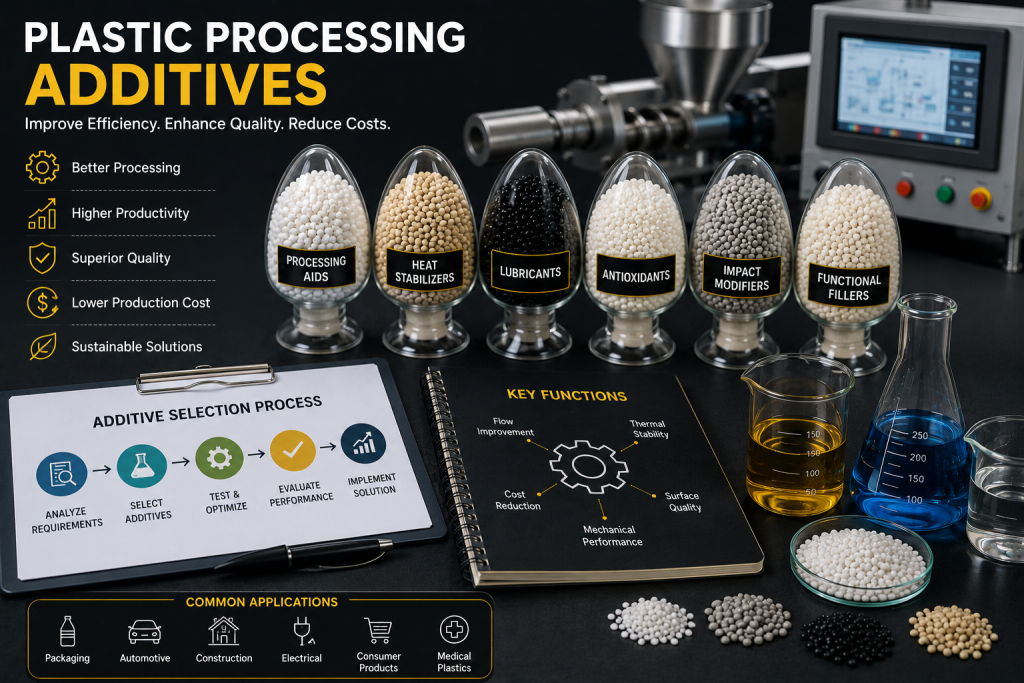
Plastic processing additives are specialized ingredients used to improve polymer processability, production efficiency, and finished-product quality. They help manufacturers manage friction, melt flow, thermal stability, and material dispersion during extrusion, injection molding, film production, and polymer compounding.
The right plastic processing additives depend on the base resin, manufacturing method, operating conditions, and required product properties. Selecting a compatible formulation can help reduce processing defects, improve production consistency, and optimize material use without compromising product performance.
What Are Plastic Processing Additives?
Plastic processing additives are functional materials incorporated into polymer formulations to improve specific manufacturing or performance characteristics. Unlike the base resin, which forms the main structure of a plastic product, these ingredients address particular processing challenges or enhance selected properties.
Depending on their chemistry, additives can improve lubrication, protect polymers against heat and oxidation, support the dispersion of fillers, reduce surface friction, or modify impact resistance. Their effectiveness depends on compatibility with the polymer and the conditions under which the material is processed.
Manufacturers should evaluate the available AasadChimie products according to their formulation requirements, technical specifications, and intended industrial application.
Types of Plastic Processing Additives
1. Lubricants and Processing Aids
Lubricants help control friction within polymer formulations and between molten plastic and processing equipment. Depending on the formulation, they may improve material flow, reduce sticking, support mold release, and improve processing stability.
These ingredients are used in applications such as PVC processing, extrusion, injection molding, and polymer compounding. Manufacturers must select a suitable type and concentration because excessive lubrication can affect printing, adhesion, welding, and surface finish.
2. Thermal Stabilizers
Thermal stabilizers help protect heat-sensitive polymers from degradation during processing. Exposure to elevated temperatures can cause discoloration, changes in mechanical properties, and deterioration of the polymer structure.
The appropriate stabilizer depends on the resin, processing temperature, residence time, and applicable safety or regulatory requirements. Testing under representative production conditions helps confirm whether the selected system provides sufficient protection.
3. Antioxidants
Antioxidants help limit oxidative degradation caused by heat and oxygen. They are used in polymer processing and compounding to preserve material properties during manufacturing and, where required, during the service life of the finished product.
Antioxidant selection should consider polymer compatibility, processing conditions, the expected service environment, and interactions with other ingredients in the formulation.
4. Slip and Antiblocking Agents
Slip agents reduce friction between plastic surfaces, helping films move more easily during winding, converting, packaging, and handling. Antiblocking agents reduce the tendency of adjacent film layers to stick together during storage or processing.
These additives are particularly relevant to polyethylene and polypropylene films. Selection should account for coefficient of friction, transparency, surface appearance, sealing performance, and downstream printing requirements.
5. Dispersing Agents and Functional Fillers
Dispersing agents help distribute pigments, mineral fillers, and other solid ingredients more uniformly throughout a polymer matrix. Effective dispersion can improve formulation consistency and support predictable processing and product properties.
Functional fillers can also modify stiffness, dimensional stability, cost, and other characteristics. Their performance depends on particle size, surface treatment, loading level, polymer compatibility, and mixing conditions.
For more information, explore the AasadChimie guides on functional fillers, calcium carbonate filler masterbatch, and improving calcium carbonate dispersion.
6. Impact Modifiers and Other Functional Additives
Impact modifiers are used to improve toughness or impact resistance in selected polymer formulations. Other functional ingredients may help provide UV resistance, antistatic properties, flame resistance, or compatibility between different polymers.
These materials serve different purposes and should not be treated as interchangeable. Manufacturers should assess the intended benefit alongside mechanical performance, surface appearance, processing stability, and relevant regulatory requirements.
How Plastic Processing Additives Improve Manufacturing Efficiency
Plastic processing additives can help manufacturers address problems that increase production time, material waste, or product rejection. Depending on the formulation, they may support more stable melt flow, better thermal protection, improved dispersion, and reduced friction during processing.
- Improved processability: Suitable processing aids can support smoother material movement through manufacturing equipment.
- Consistent product quality: Appropriate stabilizers and dispersing agents can help control variation in selected product properties.
- Defect reduction: Correct additive selection may help address sticking, unstable extrusion, surface imperfections, or poor filler dispersion.
- Production stability: A validated formulation can help manufacturers maintain more consistent processing conditions.
- Potential cost savings: Lower waste and more efficient production may reduce total manufacturing costs when improvements are confirmed by testing.
The results depend on the polymer grade, equipment design, additive concentration, and operating conditions. Manufacturers should measure improvements through controlled trials instead of assuming that an additive will automatically increase production output.
Industrial Applications of Plastic Processing Additives
Extrusion
During extrusion, additives may improve melt stability, control friction, support filler dispersion, and help maintain surface quality. The required formulation depends on whether the production line manufactures pipes, profiles, sheets, films, or other extruded products.
For troubleshooting advice, read how to reduce extrusion defects and how to improve melt flow in polypropylene.
Injection Molding
Injection molding formulations may contain lubricants, stabilizers, processing aids, and impact modifiers to address filling behavior, dimensional stability, surface finish, and mechanical performance. The selected additive must be compatible with the resin, mold design, cycle conditions, and final product specifications.
Film and Packaging Production
Film manufacturers use slip agents, antiblocking agents, antioxidants, and other ingredients to achieve suitable handling, optical properties, sealing behavior, and resistance to degradation. The formulation should be assessed against the requirements of the complete packaging process, including printing, winding, and converting.
Polymer Compounding and Masterbatch Production
Compounding combines polymers with fillers, pigments, and functional ingredients. Appropriate processing aids and dispersing agents can support mixing efficiency and formulation consistency. In mineral-filled systems, filler particle characteristics, surface treatment, and dispersion quality can be as important as additive concentration.
How to Select the Right Plastic Processing Additives
Choosing plastic processing additives requires a systematic assessment of the polymer, production process, and target performance. Manufacturers should evaluate the following factors before introducing a new ingredient.
- Identify the base polymer: Confirm whether the formulation uses polypropylene (PP), polyethylene (PE), polyvinyl chloride (PVC), polyethylene terephthalate (PET), or another resin.
- Define the processing objective: Determine whether the goal is to improve flow, reduce friction, protect against heat, enhance dispersion, or address a specific defect.
- Review operating conditions: Consider processing temperature, residence time, production speed, screw configuration, and equipment limitations.
- Check technical documentation: Review the technical data sheet, safety data sheet, recommended conditions of use, and applicable regulatory information.
- Validate the dosage: Follow supplier guidance and determine a suitable concentration through laboratory or production trials.
- Measure the results: Compare throughput, defect rates, material waste, process stability, and finished-product properties against a documented baseline.
Manufacturers should evaluate the total cost of production rather than purchase price alone. A suitable additive may offer value by improving consistency or reducing waste, but its benefits should be confirmed under representative manufacturing conditions.
Compatibility Testing and Quality Control
Compatibility testing is essential before changing a polymer formulation. An additive that improves one property may negatively affect another, including mechanical strength, color, surface appearance, adhesion, sealing performance, or recyclability.
Effective quality control should document the polymer grade, additive concentration, processing temperature, machine settings, and test results. Depending on the application, manufacturers may assess melt flow, tensile behavior, impact performance, thermal stability, or other relevant properties.
Technical test methods and industry guidance are available through ASTM International and the International Organization for Standardization (ISO). For chemical safety and regulatory considerations, consult the European Chemicals Agency (ECHA) and the applicable regulations for the intended market.
Common Mistakes When Using Processing Additives
- Selecting an incompatible product: An additive designed for one polymer or process may not perform well in another.
- Using an excessive concentration: Increasing the dosage does not necessarily improve performance and may negatively affect finished-product properties.
- Ignoring ingredient interactions: Additives can interact with stabilizers, pigments, fillers, and other formulation components.
- Changing multiple variables simultaneously: Making several changes at once makes it difficult to identify the cause of a result.
- Skipping production trials: Laboratory results should be verified under realistic manufacturing conditions before full-scale implementation.
Conclusion
Plastic processing additives are important tools for improving polymer processability, manufacturing consistency, and selected finished-product properties. Lubricants, thermal stabilizers, antioxidants, slip agents, dispersing agents, and impact modifiers each address different production requirements.
The best solution depends on the polymer, processing method, operating conditions, and target performance. By reviewing technical documentation, testing compatibility, and measuring results through controlled trials, manufacturers can select suitable additives while protecting product quality.
To explore available materials, visit the AasadChimie products page. For product specifications or assistance with a specific manufacturing requirement, contact AasadChimie.
What are plastic processing additives?
Plastic processing additives are ingredients incorporated into polymer formulations to improve processability, thermal stability, friction control, dispersion, or selected finished-product properties.
Which additives are commonly used in plastic manufacturing?
Common types include lubricants, processing aids, thermal stabilizers, antioxidants, slip agents, antiblocking agents, dispersing agents, and impact modifiers.
Can plastic processing additives reduce manufacturing defects?
They may help address problems such as unstable material flow, sticking, and poor dispersion. Results depend on the additive, polymer, equipment, and processing conditions.
How do manufacturers choose the right additive?
They should identify the processing challenge, confirm polymer compatibility, review technical documentation, test suitable concentrations, and validate results under actual production conditions.
Do processing additives affect finished plastic properties?
Yes. Depending on the additive and dosage, they may affect surface appearance, friction, mechanical performance, adhesion, thermal stability, and other properties.
How can manufacturers measure additive performance?
Performance can be evaluated by comparing process stability, production throughput, defect rates, material waste, and relevant finished-product test results.