


Table of Contents
- What Are Kaolin Fillers?
- How Do Kaolin Fillers Work in Polymer Compounds?
- Why Are Kaolin Fillers Used in Plastics?
- Improved Dimensional Stability
- Enhanced Surface Quality
- Better Processing Performance
- Cost Optimization
- Kaolin Fillers Compared with Other Mineral Fillers
- Factors Affecting Kaolin Filler Performance
- Particle Size
- Purity Level
- Surface Treatment
- Types of Kaolin Fillers Used in Polymer Applications
- Natural Kaolin Fillers
- Calcined Kaolin Fillers
- Surface Modified Kaolin Fillers
- Benefits of Kaolin Fillers in Polymer Compounds
- Improved Mechanical Performance
- Enhanced Thermal Resistance
- Better Electrical Properties
- Improved Product Appearance
- Industrial Applications of Kaolin Fillers in Plastics
- PVC Industry
- Packaging Industry
- Automotive Plastic Components
- Electrical Components
- How to Select the Right Kaolin Filler?
- Conclusion
- What are kaolin fillers used for in plastics?
- Are kaolin fillers suitable for PVC compounds?
- What is the difference between natural and calcined kaolin?
- Can kaolin fillers be used in polypropylene?
- How do kaolin fillers compare with calcium carbonate?
- How do you select the right kaolin filler?
The development of high-performance plastic materials requires advanced solutions that improve mechanical properties, processing efficiency, and product durability. One of the important materials used in polymer modification is Kaolin Fillers.
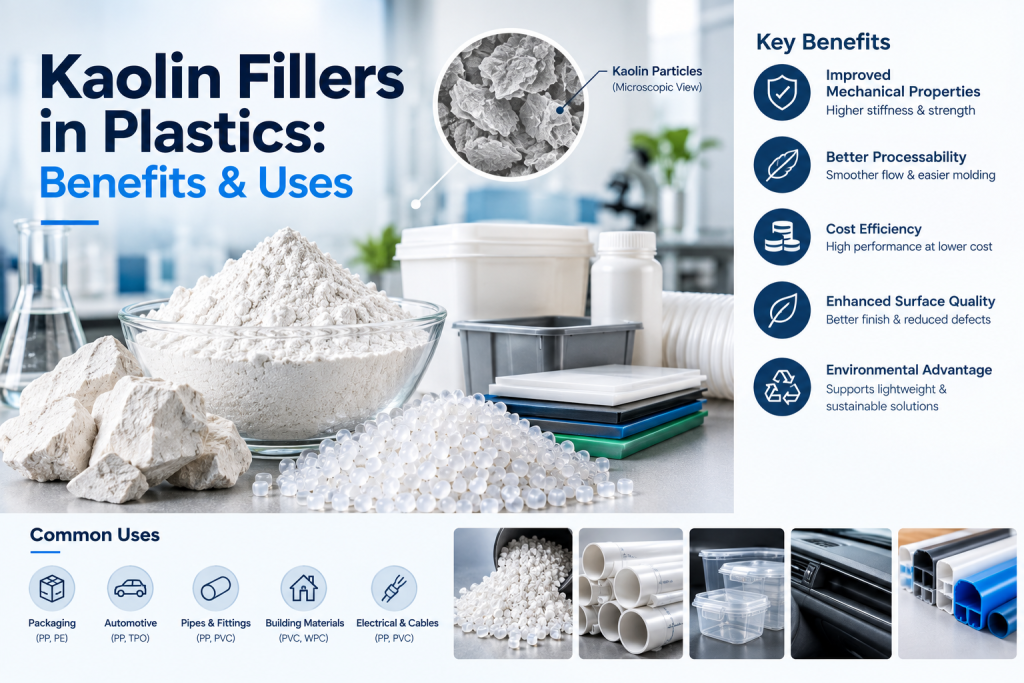
Kaolin fillers are mineral-based materials that enhance the performance of plastic compounds by improving dimensional stability, surface quality, processing behavior, and specific functional properties. Due to their unique structure and chemical composition, kaolin materials are widely used in different polymer applications.
From PVC products and packaging materials to automotive components and electrical applications, Kaolin Fillers help manufacturers develop reliable and cost-effective polymer solutions.
Understanding the properties, types, and industrial applications of kaolin fillers allows plastic manufacturers to select suitable materials for their specific production requirements.
What Are Kaolin Fillers?
Kaolin Fillers are mineral fillers primarily composed of kaolinite, a hydrated aluminum silicate material. They are added to polymer compounds to modify physical properties and improve material performance.
Unlike some reinforcement fillers that mainly increase stiffness, kaolin provides a combination of benefits including improved surface characteristics, dimensional stability, and processing performance.
Kaolin materials are commonly used in:
- PVC compounds
- Polypropylene systems
- Engineering plastics
- Rubber and polymer composites
The effectiveness of kaolin fillers depends on factors such as particle size, purity, processing method, surface treatment, and compatibility with the polymer matrix.
How Do Kaolin Fillers Work in Polymer Compounds?
When incorporated into polymer systems, kaolin particles interact with the polymer matrix and influence the structure and behavior of the final material.
These mineral particles can contribute to:
- Improved dimensional stability
- Enhanced surface properties
- Better processing characteristics
- Increased material consistency
- Optimized production costs
Proper dispersion is essential because uniform distribution of filler particles helps manufacturers achieve consistent performance in finished plastic products.
Why Are Kaolin Fillers Used in Plastics?
Kaolin Fillers are selected by plastic manufacturers because they provide a balance between performance improvement and economic advantages.
Improved Dimensional Stability
One of the important advantages of kaolin fillers is their ability to reduce dimensional changes during plastic processing.
By controlling shrinkage and improving structural stability, kaolin helps manufacturers produce more accurate and consistent plastic components.
Enhanced Surface Quality
Kaolin fillers can improve the surface appearance of plastic products by providing smoother finishes and better material consistency.
This property is especially valuable in applications where visual quality and surface performance are important.
Better Processing Performance
Properly selected kaolin materials can improve processing behavior during extrusion and injection molding.
They help manufacturers achieve more stable production conditions and consistent product quality.
Cost Optimization
Similar to other mineral fillers, kaolin can partially replace polymer resin and help reduce material costs while maintaining required performance levels.
Kaolin Fillers Compared with Other Mineral Fillers
Kaolin, talc, and calcium carbonate are all important mineral fillers used in polymer manufacturing. However, each material provides different advantages depending on the application.
| Property | Kaolin Fillers | Talc Fillers | Calcium Carbonate Fillers |
|---|---|---|---|
| Main Advantage | Surface quality and stability | High stiffness and thermal resistance | Cost efficiency and general reinforcement |
| Surface Performance | High | Medium | Good |
| Stiffness Improvement | Good | High | Moderate |
| Cost Level | Medium | Medium | Low |
Factors Affecting Kaolin Filler Performance
The final performance of kaolin-filled polymer compounds depends on several technical factors.
Particle Size
Particle size affects dispersion, surface quality, and interaction between the filler and polymer matrix. Fine particles usually provide better distribution and improved performance.
Purity Level
High-purity kaolin provides more consistent properties and is preferred for applications requiring reliable material performance.
Surface Treatment
Surface modification can improve compatibility between kaolin particles and polymer systems, resulting in better processing and final product properties.
Types of Kaolin Fillers Used in Polymer Applications
Different polymer applications require different levels of performance, which is why manufacturers use various grades of Kaolin Fillers. The selection depends on factors such as purity, particle structure, processing method, and final product requirements.
Natural Kaolin Fillers
Natural kaolin is obtained from mineral deposits and processed to achieve suitable particle size and purity for industrial applications.
This type of kaolin is commonly used where manufacturers need improved processing performance, dimensional stability, and cost optimization.
Common applications include:
- PVC compounds
- General plastic products
- Polymer composites
- Industrial plastic components
Calcined Kaolin Fillers
Calcined kaolin is produced by heating natural kaolin at controlled temperatures. This process changes its structure and improves certain performance characteristics.
Advantages of calcined kaolin include:
- Improved thermal stability
- Better reinforcement performance
- Enhanced electrical properties
- Higher durability in demanding applications
Calcined kaolin is often selected for advanced polymer systems where higher performance is required.
Surface Modified Kaolin Fillers
Surface-modified kaolin is treated to improve interaction between mineral particles and polymer matrices.
Surface modification can provide:
- Better dispersion inside polymers
- Improved compatibility
- Enhanced mechanical properties
- More stable processing conditions
Benefits of Kaolin Fillers in Polymer Compounds
The use of Kaolin Fillers provides several technical advantages that help manufacturers improve the performance of plastic products.
Improved Mechanical Performance
Kaolin particles can reinforce polymer structures and improve resistance to deformation. This makes plastic compounds more stable under mechanical stress.
Enhanced Thermal Resistance
Certain grades of kaolin improve the ability of polymer materials to maintain their properties under elevated temperatures.
This makes them suitable for applications where thermal stability is important.
Better Electrical Properties
Kaolin materials can contribute to improved electrical insulation characteristics, making them useful in specific electrical and electronic applications.
Improved Product Appearance
Due to their fine particle structure, kaolin fillers can improve surface smoothness and visual consistency in finished plastic products.
Industrial Applications of Kaolin Fillers in Plastics
Kaolin Fillers are used across multiple industries because they provide a combination of performance improvement and cost efficiency.
PVC Industry
The PVC industry is one of the major users of kaolin-based mineral fillers. Kaolin improves processing behavior, dimensional stability, and surface properties in PVC products.
Applications include:
- PVC pipes
- Profiles
- Sheets
- Construction plastic products
Packaging Industry
Packaging manufacturers use kaolin-containing polymer compounds to improve rigidity, processing consistency, and product quality.
Applications include:
- Plastic containers
- Packaging films
- Industrial packaging materials
Automotive Plastic Components
Automotive manufacturers require lightweight materials with stable performance. Kaolin fillers help improve dimensional accuracy and surface characteristics in plastic components.
Applications include:
- Interior components
- Trim parts
- Technical plastic assemblies
Electrical Components
Kaolin is used in selected electrical polymer applications due to its stability and ability to improve insulation-related properties.
Common applications include:
- Electrical housings
- Protective components
- Insulating plastic parts
How to Select the Right Kaolin Filler?
Choosing the correct kaolin grade depends on polymer type, production method, and required final properties.
Important selection factors include:
- Particle Size: Fine particles generally provide better dispersion and improved surface quality.
- Purity: High-purity materials provide more consistent performance.
- Calcination Level: Heat-treated grades may provide enhanced thermal and electrical properties.
- Surface Treatment: Modified surfaces improve compatibility with polymer systems.
- Application Requirements: Manufacturers should consider stiffness, stability, appearance, and cost targets.
Conclusion
Kaolin Fillers are valuable mineral materials used in plastic manufacturing to improve dimensional stability, surface quality, processing efficiency, and product reliability.
From PVC products and packaging materials to automotive and electrical applications, kaolin provides manufacturers with a versatile solution for optimizing polymer performance.
Selecting the appropriate kaolin grade, particle characteristics, and surface treatment allows manufacturers to achieve the desired balance between quality, performance, and cost efficiency.
Aasad Chimie provides advanced polymer additive solutions and industrial chemical materials designed to support manufacturers in developing high-performance plastic compounds.
For technical consultation and polymer material solutions, visit our
contact page.
For additional technical information about plastics and polymer materials, explore resources from
Plastics Europe
and scientific research available through
ScienceDirect.
What are kaolin fillers used for in plastics?
Kaolin fillers are used to modify surface characteristics, dimensional stability, and selected functional properties of plastic compounds.
Are kaolin fillers suitable for PVC compounds?
Yes, selected kaolin grades can be used in PVC compounds to support specific surface, processing, and dimensional requirements.
What is the difference between natural and calcined kaolin?
Natural kaolin is processed from mined material, while calcined kaolin is heat-treated to change its structure and certain functional properties.
Can kaolin fillers be used in polypropylene?
Yes, kaolin fillers can be incorporated into selected polypropylene formulations, depending on compatibility, dispersion, and performance requirements.
How do kaolin fillers compare with calcium carbonate?
Kaolin and calcium carbonate differ in particle characteristics and their effects on polymer performance. The best choice depends on the application, formulation, and cost targets.
How do you select the right kaolin filler?
Consider particle size, purity, moisture content, surface treatment, polymer compatibility, processing conditions, and the required properties of the finished product.