


Table of Contents
- Quick Answer: What Is Isopropyl Alcohol?
- Isopropyl Alcohol: Chemical and Physical Properties
- How Is Isopropyl Alcohol Produced?
- 1. Direct Hydration
- 2. Indirect Hydration
- Why Is Isopropyl Alcohol Used in Industry?
- Isopropyl Alcohol 70% vs. 99%: What Is the Difference?
- Industrial Applications of Isopropyl Alcohol
- 1. Electronics and Electrical Manufacturing
- 2. Pharmaceutical and Healthcare Manufacturing
- 3. Paints, Coatings, and Inks
- 4. Printing and Packaging
- 5. Cosmetics and Personal Care Formulations
- 6. Automotive and Industrial Maintenance
- Choosing the Right Industrial Isopropyl Alcohol Grade
- Is Isopropyl Alcohol Compatible with Plastics and Metals?
- Safety, Storage, and Handling Requirements
- How to Evaluate an Isopropyl Alcohol Supplier
- Isopropyl Alcohol Market and Industrial Demand
- Isopropyl Alcohol Compared with Other Industrial Solvents
- Conclusion
- Related Articles
- References
- What is Isopropyl Alcohol mainly used for?
- What is the difference between IPA 70% and IPA 99%?
- What is the chemical formula and CAS number of Isopropyl Alcohol?
- Is Isopropyl Alcohol flammable?
- Can Isopropyl Alcohol damage plastic materials?
- How should manufacturers select an IPA grade?
- What documents should an Isopropyl Alcohol supplier provide?
- What is the boiling point of Isopropyl Alcohol?
Isopropyl Alcohol (IPA), also known as isopropanol or 2-propanol, is a colorless, flammable solvent widely used for industrial cleaning, degreasing, surface preparation, and chemical formulation. Its ability to dissolve many oils and residues, mix completely with water, and evaporate relatively quickly makes it useful across electronics, pharmaceutical manufacturing, printing, coatings, and laboratory operations.
Choosing the right Isopropyl Alcohol grade depends on purity, water content, residue limits, material compatibility, and the requirements of the final application. This guide covers its technical properties, manufacturing process, industrial applications, grade selection, and essential handling precautions.
Quick Answer: What Is Isopropyl Alcohol?
Isopropyl Alcohol is a secondary alcohol with the chemical formula C3H8O. It is also called IPA, isopropanol, and 2-propanol. Industrial buyers commonly select it as a solvent for removing oils, fingerprints, and other contaminants, while specific aqueous formulations are used for disinfection where the product and application are approved for that purpose.
IPA is completely miscible with water, but its cleaning performance, drying time, and suitability for a process depend on concentration, contaminants, surface material, and operating conditions. It is highly flammable and must be handled with appropriate fire prevention and ventilation controls.
Isopropyl Alcohol: Chemical and Physical Properties
| Property | Typical Value |
|---|---|
| Chemical name | Propan-2-ol |
| Common names | Isopropyl alcohol, isopropanol, IPA, 2-propanol |
| Chemical formula | C3H8O |
| CAS number | 67-63-0 |
| EC number | 200-661-7 |
| Molecular weight | 60.10 g/mol |
| Appearance | Clear, colorless liquid |
| Odor | Characteristic alcohol odor |
| Boiling point | Approximately 82.3°C at 101.3 kPa |
| Melting point | Approximately -89.5°C |
| Density | Approximately 0.785 g/cm³ at 20°C |
| Flash point | Approximately 12°C, closed cup |
| Water solubility | Completely miscible |
| Vapor density | Approximately 2.1 relative to air |
These values are typical reference data for isopropanol and may vary slightly with measurement method, temperature, and product specification. Commercial grades should be evaluated against the supplier’s current Certificate of Analysis (CoA) and Safety Data Sheet (SDS).
How Is Isopropyl Alcohol Produced?
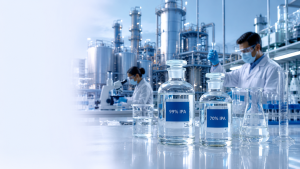
Commercial Isopropyl Alcohol is generally manufactured from propylene through a hydration process. Propylene is a petrochemical feedstock obtained from refining and other hydrocarbon-processing operations.
1. Direct Hydration
In direct hydration, propylene reacts with water in the presence of a suitable catalyst under controlled pressure and temperature. The resulting mixture is separated and purified, commonly through distillation, to achieve the required commercial specification. This route is used in modern industrial production.
2. Indirect Hydration
In indirect hydration, propylene first reacts with sulfuric acid to form sulfate intermediates. Subsequent hydrolysis produces isopropanol, which is then separated and purified. The use of this route depends on the facility, process economics, and production requirements.
After synthesis, purification and quality-control steps determine the final product’s water content and impurity profile. Buyers should not assume that a label such as 99% IPA automatically guarantees electronic, pharmaceutical, or reagent-grade quality; each application may require additional specifications.
Why Is Isopropyl Alcohol Used in Industry?
Isopropyl Alcohol is valued for its combination of solvent performance, water miscibility, and relatively rapid evaporation. It can dissolve many common oils, greases, and organic residues, although no single solvent is suitable for every contaminant or surface.
- Effective cleaning: Helps remove fingerprints, oils, and selected process residues.
- Fast evaporation: Can reduce drying time compared with slower-evaporating cleaning systems.
- Water miscibility: Can be blended with water for applications that require a specific concentration.
- Formulation flexibility: Used as a solvent or processing aid in selected chemical products.
- Multiple commercial grades: Available in different purity levels and formulations for distinct process requirements.
- Broad industrial use: Supports cleaning and formulation processes in many manufacturing sectors.
However, IPA is not universally residue-free under all conditions. Dissolved contaminants can remain after evaporation, and unsuitable grades may introduce trace impurities. Surface compatibility and cleaning effectiveness should be validated before production-scale use.
Isopropyl Alcohol 70% vs. 99%: What Is the Difference?
One of the most important purchasing decisions is selecting the appropriate IPA concentration. A 70% aqueous solution contains more water than a 99% grade, which changes evaporation behavior and may influence performance in particular cleaning or disinfection applications.
| Factor | IPA 70% | IPA 99% |
|---|---|---|
| Composition | Approximately 70% IPA with water making up most of the balance; confirm whether the percentage is by volume or mass | Approximately 99% IPA, with a small amount of other components depending on specification |
| Evaporation | Generally slower because of the higher water content | Generally faster under comparable conditions |
| Disinfection | Commonly used in approved formulations for selected disinfection purposes | Not automatically more effective for disinfection |
| Precision cleaning | May be unsuitable when low water content is required | Often considered when low water content is important |
| Process considerations | Water content can affect drying and surface compatibility | Purity, trace contaminants, and material compatibility still require verification |
The best concentration depends on the intended process rather than the percentage alone. For disinfection, follow the relevant product instructions and applicable standards. For electronics or precision manufacturing, check residue limits, water content, ionic contamination requirements, and the equipment manufacturer’s guidance.
Industrial Applications of Isopropyl Alcohol
Industrial buyers use Isopropyl Alcohol in cleaning, surface preparation, and formulation processes. The required grade varies by sector, and applications involving sensitive equipment or regulated products need documented quality specifications.
1. Electronics and Electrical Manufacturing
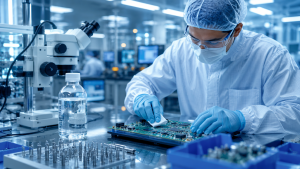
IPA is used in selected electronics-cleaning operations to help remove fingerprints, light oils, and certain flux residues. Potential applications include circuit-board maintenance, component preparation, and cleaning of compatible equipment.
- Confirm compatibility with plastics, coatings, adhesives, and elastomers.
- Use the grade specified by the equipment or process manufacturer.
- Follow electrical isolation procedures and allow complete drying before re-energizing equipment.
- Use suitable ventilation and ignition controls because IPA vapors are flammable.
IPA should not be assumed suitable for every electronic assembly. Some flux residues require specialized cleaners, and some components or surface finishes can be damaged by solvents.
2. Pharmaceutical and Healthcare Manufacturing
In pharmaceutical and healthcare environments, suitable IPA formulations may be used for surface disinfection, equipment cleaning, and selected sanitation procedures. The product must meet the applicable purity, quality, and regulatory requirements for its intended use.
Industrial solvent-grade IPA should not automatically be treated as a pharmaceutical, medical, or disinfectant-grade product. Buyers should verify the relevant monograph, formulation, validation requirements, and documentation before use.
3. Paints, Coatings, and Inks
IPA can serve as a solvent or formulation component in selected coatings, inks, and surface-treatment products. Its inclusion may affect viscosity, drying behavior, flow, and compatibility with other ingredients.
Formulators should test the solvent within the complete formulation rather than assuming that it will improve every coating system. Resin chemistry, application method, ventilation, and applicable emissions requirements all influence solvent selection.
4. Printing and Packaging
Printing and packaging operations may use IPA in selected cleaning tasks and formulations. Its volatility can help reduce drying time, but the appropriate grade and concentration depend on the equipment, printing process, and applicable workplace and environmental requirements.
5. Cosmetics and Personal Care Formulations
Isopropyl Alcohol can be used as a solvent or formulation ingredient in certain personal-care and cosmetic products. The permitted concentration and quality requirements depend on the finished product, its intended use, and the regulations of the target market.
6. Automotive and Industrial Maintenance
Maintenance teams may use IPA for selected degreasing and surface-preparation tasks on compatible components. Before applying it to sensors, painted surfaces, plastics, rubber parts, or protective coatings, verify material compatibility and follow the component manufacturer’s instructions.
Choosing the Right Industrial Isopropyl Alcohol Grade
Concentration is only one part of grade selection. Industrial purchasers should compare the complete product specification with their process requirements.
| Application | Key Selection Criteria |
|---|---|
| General industrial cleaning | Purity, water content, contaminant profile, and cleaning performance |
| Electronics cleaning | Purity, residue limits, water content, and compatibility with components |
| Pharmaceutical manufacturing | Applicable grade, approved specification, traceability, and required documentation |
| Disinfection | Validated concentration, approved formulation, contact time, and intended use |
| Laboratory work | Reagent specification, impurity limits, and analytical requirements |
| Coatings and inks | Solvency, formulation compatibility, evaporation behavior, and regulatory limits |
Before placing an order, request a current CoA, SDS, technical data sheet, and batch identification details. Confirm the concentration basis, packaging type, shelf life, storage conditions, and any application-specific impurity limits. For regulated uses, verify whether additional certifications or manufacturing controls are required.
Is Isopropyl Alcohol Compatible with Plastics and Metals?
IPA is compatible with many metals and selected plastics under appropriate conditions, but compatibility cannot be assumed for every material. Certain plastics, elastomers, adhesives, paints, and coatings may soften, crack, discolor, swell, or lose performance after contact with a solvent.
Compatibility depends on the material formulation, IPA concentration, temperature, contact duration, mechanical stress, and the presence of other chemicals. Test the intended grade on a representative sample and consult the component or material supplier before introducing IPA into a critical production process.
Safety, Storage, and Handling Requirements
Isopropyl Alcohol is highly flammable. Its flash point is approximately 12°C in a closed-cup test, so vapors can ignite at ordinary workplace temperatures. Vapors are also heavier than air and may accumulate in low or poorly ventilated areas.
- Store containers tightly closed in a cool, well-ventilated area designated for flammable liquids.
- Keep away from open flames, hot surfaces, sparks, and other ignition sources.
- Use appropriate ventilation and equipment suitable for the site’s flammable-vapor risk.
- Follow grounding and bonding procedures where required during bulk transfer.
- Wear PPE selected according to the SDS and the specific exposure risk.
- Avoid breathing concentrated vapors and prevent eye contact or prolonged skin exposure.
- Keep containers clearly labeled and segregate them according to applicable chemical-storage rules.
- Follow local regulations for spill response, fire protection, and waste disposal.
Always review the supplier’s Safety Data Sheet before handling the material. The workplace risk assessment should account for concentration, quantity, process temperature, ventilation, transfer method, and the potential for vapor accumulation.
How to Evaluate an Isopropyl Alcohol Supplier
For manufacturers, consistent supply and verified quality can be as important as price. A supplier evaluation should cover technical compliance, documentation, packaging, and logistics.
- Product specification: Confirm purity, water content, and relevant impurity limits.
- Batch documentation: Request a Certificate of Analysis and Safety Data Sheet.
- Traceability: Check lot identification and the supplier’s quality-control procedures.
- Packaging: Match container material and size to storage, handling, and transport requirements.
- Logistics: Confirm lead time, transport conditions, and compliance with dangerous-goods requirements where applicable.
- Technical support: Make sure the supplier can clarify specifications and provide documentation for the intended use.
Compare offers on an equivalent specification basis. A lower price may not represent better value if the grade fails to meet the process requirements or requires additional testing and handling.
Isopropyl Alcohol Market and Industrial Demand
Demand for IPA is linked to its use in cleaning products, chemical formulations, healthcare-related applications, and electronics manufacturing. Purchasing requirements vary by industry and region, particularly where manufacturers need tighter impurity controls or documented quality systems.
For buyers in markets such as India, Turkey, and the Middle East, supply planning should consider local regulations, import and transport requirements, delivery lead times, packaging availability, and consistency between batches. Before selecting a supplier, evaluate current commercial offers and product documentation rather than relying on general market claims.
Isopropyl Alcohol Compared with Other Industrial Solvents
| Solvent | Key Characteristics | Selection Consideration |
|---|---|---|
| Isopropyl Alcohol (IPA) | Water-miscible, effective for many oils and residues, relatively volatile | Useful for selected cleaning and formulation tasks; flammability and material compatibility must be assessed |
| Acetone | Highly volatile solvent with strong solvency for many organic materials | May attack plastics, coatings, and adhesives that tolerate IPA |
| Methyl Acetate | Volatile ester solvent used in selected coatings and formulation systems | Evaluate resin compatibility, evaporation profile, and process requirements |
| Propylene Carbonate | Polar solvent with a much higher boiling point and slower evaporation than IPA | Consider when low volatility or different solvency characteristics are required |
These solvents are not interchangeable in every application. Selection should be based on contaminant type, material compatibility, evaporation rate, process conditions, worker safety, and regulatory requirements.
Conclusion
Isopropyl Alcohol is an important industrial solvent used in cleaning, surface preparation, and chemical formulation. Its water miscibility, solvent performance, and relatively rapid evaporation make it useful across electronics, pharmaceutical manufacturing, printing, coatings, laboratories, and industrial maintenance.
The most suitable grade depends on more than concentration alone. Buyers should confirm purity, water content, impurity limits, material compatibility, documentation, and safe handling requirements before use. Comparing suppliers against a defined technical specification helps manufacturers maintain process consistency and control purchasing risk.
To explore available chemical products, visit the AasadChimie Products page. For product specifications, availability, or purchasing enquiries, use the Contact Us page.
Related Articles
- Industrial Solvents Guide
- Methyl Acetate Applications
- Propylene Carbonate Guide
- Mono Ethylene Glycol (MEG)
- Choosing the Right Industrial Solvent
References
- PubChem: Isopropyl Alcohol
- CDC/NIOSH: Isopropyl Alcohol Safety and Physical Properties
- NIST Chemistry WebBook: 2-Propanol
What is Isopropyl Alcohol mainly used for?
Isopropyl Alcohol is used for industrial cleaning, degreasing, surface preparation, and selected chemical formulations. Applications include electronics, pharmaceutical manufacturing, printing, coatings, laboratories, and maintenance.
What is the difference between IPA 70% and IPA 99%?
IPA 70% contains more water and is commonly used in certain approved disinfection formulations. IPA 99% has a lower water content and is often selected for processes requiring faster evaporation or reduced moisture. The correct grade depends on the intended application.
What is the chemical formula and CAS number of Isopropyl Alcohol?
The chemical formula of Isopropyl Alcohol is C₃H₈O, and its CAS number is 67-63-0. It is also known as isopropanol or 2-propanol.
Is Isopropyl Alcohol flammable?
Yes. Isopropyl Alcohol is highly flammable and can release vapors that ignite in the presence of an ignition source. It requires suitable ventilation, controlled storage, and strict fire-prevention measures.
Can Isopropyl Alcohol damage plastic materials?
Yes, some plastics, elastomers, adhesives, and coatings can be damaged by IPA. Compatibility depends on the material formulation, concentration, temperature, and exposure time. Testing is recommended before production use.
How should manufacturers select an IPA grade?
Manufacturers should assess purity, water content, impurity limits, material compatibility, and the requirements of the intended process. They should also request a current Certificate of Analysis and Safety Data Sheet.
What documents should an Isopropyl Alcohol supplier provide?
Depending on the application, buyers should request a Certificate of Analysis, Safety Data Sheet, technical data sheet, batch traceability details, and any additional quality or regulatory documentation required by their industry.
What is the boiling point of Isopropyl Alcohol?
The boiling point of pure Isopropyl Alcohol is approximately 82.3°C at standard atmospheric pressure. Commercial mixtures may have different boiling behavior depending on their composition.