


Table of Contents
- Isopropyl Alcohol: Technical Specifications
- What Makes Isopropyl Alcohol Useful?
- Where Is Isopropyl Alcohol Used in Industry?
- 1. Industrial Surface Cleaning
- 2. Electronics and Precision Manufacturing
- 3. Coatings, Inks, and Formulations
- 4. Chemical and Pharmaceutical Processing
- 5. Equipment Maintenance and Degreasing
- How to Select the Right Grade
- Safety, Storage, and Handling
- Conclusion
- What is isopropyl alcohol mainly used for in industry?
- What is the chemical formula of isopropyl alcohol?
- Does isopropyl alcohol mix with water?
- Why is isopropyl alcohol used for industrial cleaning?
- Is isopropyl alcohol flammable?
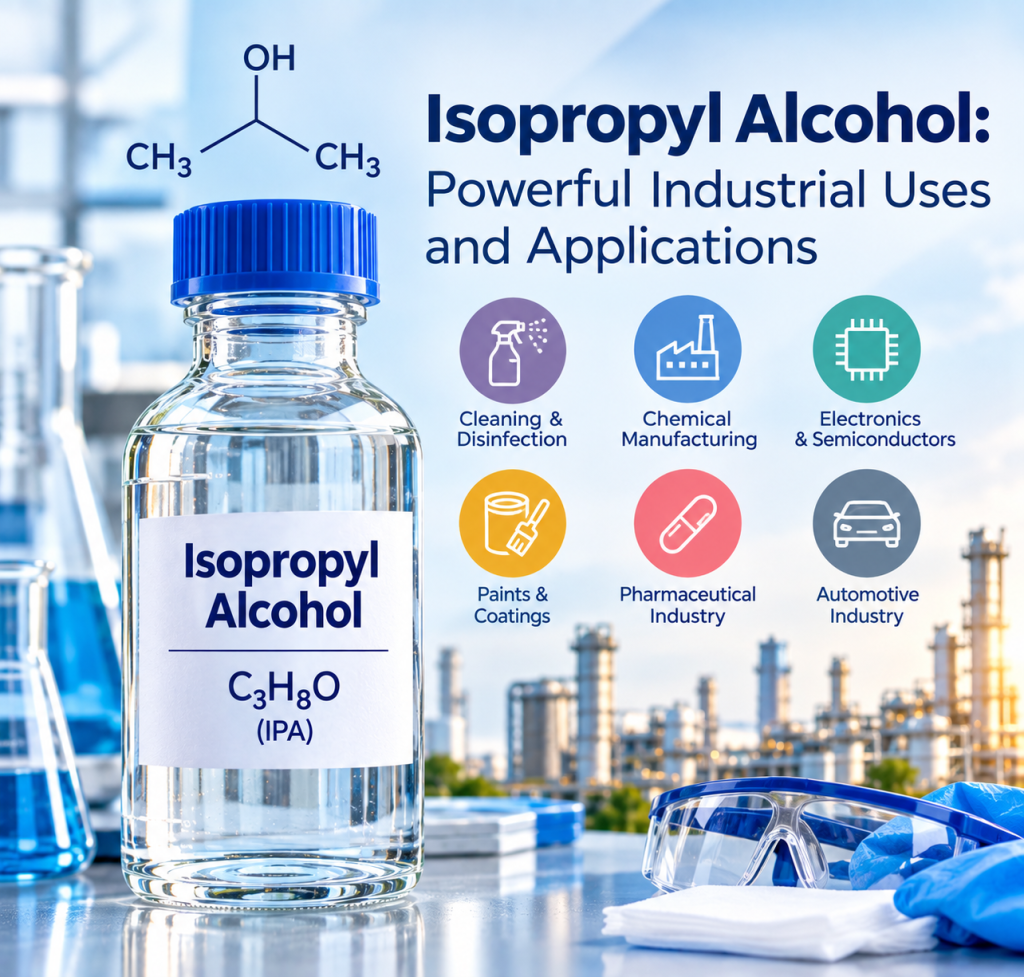
Isopropyl Alcohol, also known as isopropanol or IPA, is a fast-evaporating industrial solvent used in surface cleaning, electronics manufacturing, coatings, and chemical processing. Its ability to dissolve many oils and organic residues makes it useful for cleaning compatible surfaces and supporting manufacturing operations.
With the molecular formula C3H8O and CAS number 67-63-0, isopropyl alcohol is a clear, colorless, flammable liquid. Available grades differ in purity and water content, so buyers should match product specifications to the intended application.
Isopropyl Alcohol: Technical Specifications
| Property | Typical Reference Value |
|---|---|
| Chemical name | Isopropyl Alcohol |
| Synonyms | Isopropanol, 2-Propanol, IPA |
| Molecular formula | C3H8O |
| CAS number | 67-63-0 |
| EC number | 200-661-7 |
| Molecular weight | 60.10 g/mol |
| Appearance | Clear, colorless liquid |
| Melting point | Approximately -89°C |
| Boiling point | Approximately 82.5°C at atmospheric pressure |
| Flash point | Approximately 12°C, closed-cup reference value; method-dependent |
| Density | Approximately 0.785 g/cm³ at 20°C |
| Dynamic viscosity | Approximately 2.4 mPa·s at 20°C |
| Water solubility | Miscible with water |
Note: Values are approximate reference data for relatively pure isopropyl alcohol. Commercial grades can differ in purity and water content. Confirm the applicable specifications using the supplier’s Technical Data Sheet (TDS) and Certificate of Analysis (CoA).
What Makes Isopropyl Alcohol Useful?
Isopropyl alcohol is a secondary alcohol with good solvency for many organic substances. Its relatively low boiling point allows it to evaporate quickly under normal conditions, which can help reduce drying time after cleaning.
It also mixes readily with water, allowing manufacturers to use different concentrations for specific processes. However, water content can affect cleaning performance, material compatibility, and drying behavior. Additional chemical information is available in the PubChem Isopropyl Alcohol reference.
Where Is Isopropyl Alcohol Used in Industry?
1. Industrial Surface Cleaning
One of the main applications is removing fingerprints, oils, grease, and other compatible contaminants from equipment and surfaces. Its relatively rapid evaporation can be beneficial when cleaning processes require short drying times and minimal residue.
Before use, manufacturers should verify compatibility with plastics, coatings, seals, and other materials. Isopropyl alcohol can damage certain surfaces, so testing a small area or consulting the equipment manufacturer’s guidance is advisable.
2. Electronics and Precision Manufacturing
Selected grades are used to clean compatible electronic components, tools, and manufacturing surfaces. In these applications, purity and contamination control are important because unwanted residues can interfere with sensitive production processes.
Not every electronic component is suitable for alcohol cleaning. Buyers should check the equipment manufacturer’s recommendations and select a grade that meets the required purity and moisture specifications.
3. Coatings, Inks, and Formulations
Some coatings, inks, and specialty formulations use isopropyl alcohol as a solvent or co-solvent. It can help dissolve compatible ingredients and influence the drying rate of the finished formulation.
Its suitability depends on the resin, other solvents, substrate, and required application performance. Formulators should evaluate solvency, evaporation rate, and compatibility before changing the solvent composition.
4. Chemical and Pharmaceutical Processing
Isopropyl alcohol can serve as a processing solvent in chemical manufacturing and selected pharmaceutical operations. Depending on the process, it may be used for cleaning, extraction, or other manufacturing steps.
The required grade depends on the process specification and relevant regulatory requirements. Material intended for a sensitive application should not be substituted with a general industrial grade without verifying its suitability.
5. Equipment Maintenance and Degreasing
Maintenance teams may use IPA to remove certain residues from compatible tools and equipment. Its ability to evaporate relatively quickly can be useful when equipment needs to dry before the next production step.
For heavy grease or specialized contamination, another cleaning agent may be more effective. The selection should account for contaminant type, surface material, ventilation, and fire safety.
How to Select the Right Grade
Industrial buyers should review the following factors before ordering isopropyl alcohol:
- Purity: Confirm the assay and permitted impurity levels.
- Water content: Check moisture limits where drying performance or process quality is critical.
- Material compatibility: Verify that the solvent will not damage the surface or equipment being cleaned.
- Intended use: Distinguish general industrial cleaning from electronics or regulated manufacturing applications.
- Documentation: Request a current CoA, TDS when available, and Safety Data Sheet (SDS).
- Packaging and consistency: Confirm container compatibility, batch traceability, and supply requirements.
The highest-purity grade is not automatically necessary for every task. The correct choice is the grade that meets the technical and regulatory requirements of the intended process.
Safety, Storage, and Handling
Isopropyl alcohol is highly flammable. Its vapor can ignite when exposed to flames, sparks, hot surfaces, or other ignition sources. Use it with suitable ventilation and keep it away from smoking areas and sources of ignition.
Store the material in compatible, tightly closed, clearly labeled containers. Follow the supplier’s SDS, use appropriate personal protective equipment, and implement procedures for spill control and fire prevention. Avoid contact with eyes and prolonged skin exposure.
Industrial facilities should follow applicable requirements for flammable-liquid storage, handling, and transportation. More chemical safety information is available from the NIOSH Pocket Guide to Chemical Hazards.
Conclusion
Isopropyl alcohol is an important industrial solvent for surface cleaning, electronics manufacturing, selected coatings, and chemical processing. Its solvency and relatively rapid evaporation make it suitable for many applications, provided that the selected grade is compatible with the process and materials involved.
Before purchasing, compare purity, water content, documentation, and application requirements. Explore the Aasad Chimie product directory or contact Aasad Chimie to discuss your industrial solvent sourcing needs.
What is isopropyl alcohol mainly used for in industry?
It is commonly used for surface cleaning, electronics maintenance, selected coatings, and chemical processing.
What is the chemical formula of isopropyl alcohol?
Its molecular formula is C₃H₈O, and its CAS number is 67-63-0.
Does isopropyl alcohol mix with water?
Yes. Isopropyl alcohol is miscible with water, although the concentration affects the properties of the resulting mixture.
Why is isopropyl alcohol used for industrial cleaning?
It dissolves many organic contaminants and evaporates relatively quickly, which can help reduce drying time on compatible surfaces.
Is isopropyl alcohol flammable?
Yes. It is highly flammable and must be handled and stored away from ignition sources with suitable ventilation.