


Table of Contents
- What Are High-Solids Coatings?
- Why VOC Reduction Matters
- Key Advantages of High-Solids Coating Systems
- Resin Technologies Used in High-Solids Coatings
- Industrial Applications
- Application and Processing Considerations
- Comparison with Waterborne and Conventional Solvent-Based Coatings
- Role in Sustainable Industrial Coating Strategies
- Future Trends in High-Solids Coatings
- Conclusion
- References
High-solids coatings have emerged as an effective solution for industries seeking to reduce volatile organic compound (VOC) emissions without sacrificing coating performance. By increasing the proportion of solid components and minimizing solvent content, these coatings offer enhanced efficiency, durability, and environmental compliance.
What Are High-Solids Coatings?
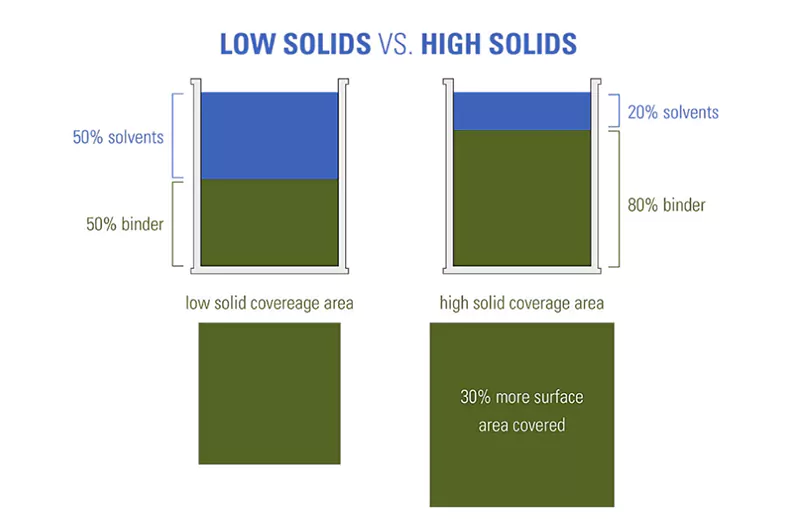
High-solids coatings are formulated with a higher percentage of resins, pigments, and functional additives compared to conventional solvent-based systems. Typically containing more than 65% solid content by volume, these coatings achieve desired film thickness with fewer application passes, resulting in lower solvent evaporation.
Why VOC Reduction Matters
VOC emissions contribute to air pollution, regulatory non-compliance, and health risks in industrial environments. Environmental regulations worldwide increasingly restrict VOC levels in coatings used for automotive, construction, and industrial maintenance. High-solids coatings directly address these concerns by significantly lowering solvent release during application and curing.
Key Advantages of High-Solids Coating Systems
- Reduced VOC emissions and improved environmental compliance
- Thicker film build per coat
- Lower material consumption and application costs
- Improved chemical and abrasion resistance
- Shorter drying and curing cycles
Resin Technologies Used in High-Solids Coatings
Advancements in polymer chemistry have enabled the development of low-viscosity, high-molecular-weight resins suitable for high-solids formulations. Common resin systems include acrylics, polyurethanes, epoxies, and alkyd-modified polymers. These resins provide excellent flow, leveling, and film formation despite reduced solvent content.
Industrial Applications
High-solids coatings are widely used in sectors where durability and regulatory compliance are critical. Typical applications include protective coatings for steel structures, pipelines, machinery, automotive components, and marine equipment. Their ability to form robust films makes them ideal for harsh operating environments.
Application and Processing Considerations
Due to higher viscosity, high-solids coatings require precise formulation and application control. Advanced spray equipment, temperature management, and rheology modifiers are commonly used to ensure smooth application and uniform coverage. Proper surface preparation remains essential for optimal adhesion and long-term performance.
Comparison with Waterborne and Conventional Solvent-Based Coatings
While waterborne coatings offer excellent environmental benefits, they may face limitations in humidity sensitivity and substrate compatibility. Conventional solvent-based coatings, although easy to apply, often exceed VOC limits. High-solids coatings provide a balanced solution by maintaining solvent-based performance while achieving significant VOC reduction.
Role in Sustainable Industrial Coating Strategies
High-solids coatings support sustainability goals by reducing emissions, minimizing waste, and improving coating efficiency. When combined with energy-efficient curing methods and optimized application techniques, these systems contribute to greener manufacturing processes and long-term operational savings.
Future Trends in High-Solids Coatings
Ongoing research focuses on further lowering viscosity, enhancing bio-based resin content, and improving curing technologies. Innovations in catalyst systems, reactive diluents, and hybrid polymer structures are expected to expand the adoption of high-solids coatings across more demanding industrial applications.
Conclusion
High-solids coatings represent a practical and effective approach to reducing VOC emissions without compromising industrial performance. Their combination of environmental compliance, durability, and application efficiency positions them as a key technology in modern coating systems.
One of the most important benefits of high-solids coatings is their ability to achieve thicker film builds in a single application. Because a greater proportion of the applied material remains on the surface after curing, manufacturers can reduce the number of coating layers required. This not only saves material costs but also shortens application time and minimizes downtime in industrial production lines.
From an operational perspective, high-solids coatings contribute to improved productivity and lower overall lifecycle costs. Reduced solvent evaporation leads to less material loss, while enhanced mechanical properties such as abrasion resistance, chemical stability, and corrosion protection extend the service life of coated components. These advantages are especially valuable in industries such as oil and gas, infrastructure, marine, and heavy machinery, where long-term durability is critical.
Another key factor driving adoption is regulatory compliance. As environmental regulations continue to tighten worldwide, manufacturers are under increasing pressure to lower VOC emissions and improve workplace safety. High-solids coatings help companies meet these standards without requiring a complete shift to alternative technologies, making them an attractive transitional and long-term solution for sustainable manufacturing.
Advancements in resin chemistry and formulation technology are further expanding the capabilities of high-solids systems. The development of low-viscosity, high-performance polymers and reactive diluents allows formulators to maintain excellent flow, leveling, and adhesion even at elevated solid contents. As innovation continues, high-solids coatings are expected to play an increasingly important role in balancing environmental responsibility with high-performance industrial requirements.