


Table of Contents
- Ethylene Glycol: Technical Specifications
- What Is Ethylene Glycol?
- Major Industrial Applications
- 1. Antifreeze and Engine Coolants
- 2. Industrial Heat-Transfer Systems
- 3. Polyester and PET Manufacturing
- 4. Chemical Intermediates and Manufacturing
- How to Choose the Right Grade
- Safety, Storage, and Handling
- Conclusion
- What is ethylene glycol mainly used for?
- What is the chemical formula of ethylene glycol?
- Is ethylene glycol soluble in water?
- Why is ethylene glycol used in PET production?
- Is ethylene glycol hazardous?
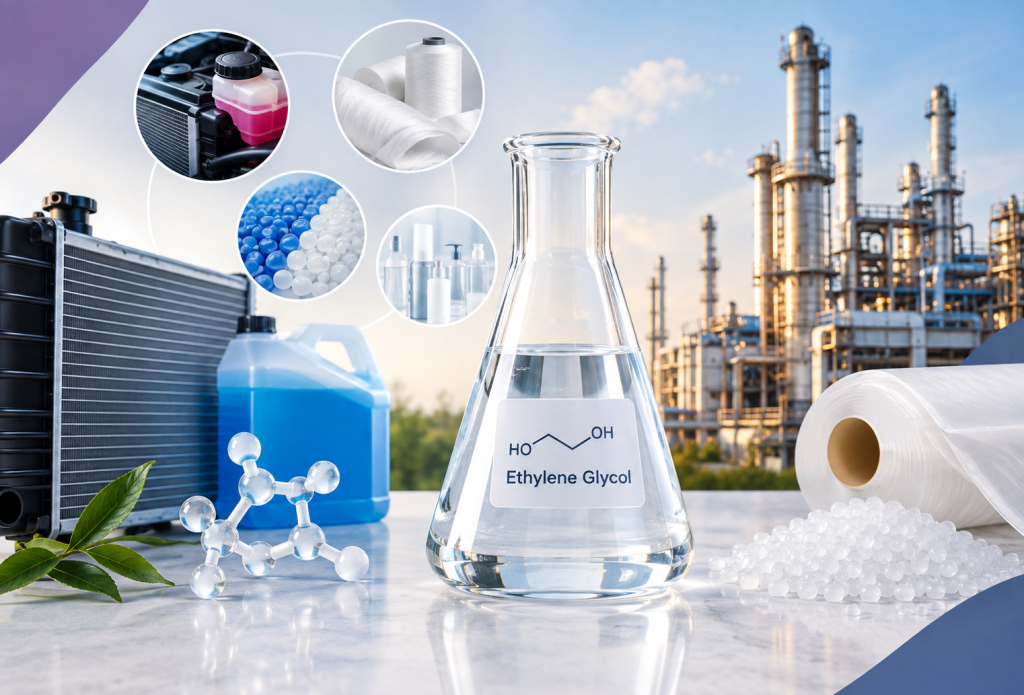
Ethylene Glycol is an industrial chemical used in antifreeze and coolant formulations, heat-transfer systems, polyester manufacturing, and polyethylene terephthalate (PET) production. Its low freezing point, water miscibility, and role as a chemical feedstock make it valuable to automotive, packaging, textile, and chemical manufacturing industries.
Also known as monoethylene glycol (MEG) or ethane-1,2-diol, this colorless liquid is supplied in different commercial grades. Buyers should select a grade based on the required purity, application, and supplier specifications.
Ethylene Glycol: Technical Specifications
| Property | Typical Reference Value |
|---|---|
| Chemical name | Ethylene Glycol |
| Synonyms | Monoethylene Glycol (MEG), Ethane-1,2-diol, 1,2-Ethanediol |
| Molecular formula | C2H6O2 |
| CAS number | 107-21-1 |
| EC number | 203-473-3 |
| Molecular weight | 62.07 g/mol |
| Appearance | Clear, colorless liquid |
| Melting point | Approximately -13°C |
| Boiling point | Approximately 197–198°C at atmospheric pressure |
| Flash point | Approximately 111°C, closed-cup reference value; method-dependent |
| Density | Approximately 1.11 g/cm³ at 20–25°C |
| Dynamic viscosity | Approximately 16–17 mPa·s at 20°C |
| Water solubility | Miscible with water |
Note: These are reference values for relatively pure ethylene glycol. Commercial specifications and measured properties may vary by grade, purity, temperature, and test method. Consult the supplier’s Technical Data Sheet (TDS) and Certificate of Analysis (CoA) for purchasing decisions.
What Is Ethylene Glycol?
This compound is a diol, meaning its molecular structure contains two hydroxyl groups. It is manufactured at industrial scale and serves two main functions: acting as a component in temperature-control fluids and providing a raw material for chemical synthesis.
Its ability to mix with water and influence the freezing point of aqueous solutions supports coolant applications. Its chemical reactivity also makes it a key input for producing polyester materials. More chemical information is available in the PubChem Ethylene Glycol reference.
Major Industrial Applications
1. Antifreeze and Engine Coolants
One of the best-known uses is in antifreeze and engine coolant formulations. When blended with water in suitable proportions, it lowers the freezing point of the mixture and helps protect cooling systems against freezing. The final formulation may also contain corrosion inhibitors and other additives to protect system components.
Manufacturers must select the appropriate concentration and formulation for the operating temperature, equipment materials, and system requirements. Pure glycol should not automatically be treated as a ready-to-use coolant.
2. Industrial Heat-Transfer Systems
Glycol-based fluids are used in selected heating and cooling systems where controlled heat transfer is required. Applications may include industrial process cooling and closed-loop temperature-management equipment.
Performance depends on the complete formulation, including glycol concentration, viscosity, corrosion protection, and operating temperature. Buyers should assess the finished fluid requirements rather than selecting a raw material based on one property alone.
3. Polyester and PET Manufacturing
Polyester production is a major application for this chemical. It reacts with terephthalic acid or related intermediates during the manufacture of polyester polymers. These materials are used in textile fibers, films, packaging, and engineering applications.
It is also an essential feedstock for polyethylene terephthalate (PET), which is widely used in beverage bottles, food packaging, films, and synthetic fibers. Consistent purity and controlled water content can be important for reliable polymerization and product quality.
For related product information, visit the Monoethylene Glycol product page.
4. Chemical Intermediates and Manufacturing
Beyond coolants and polymers, the material participates in the production of selected chemical intermediates and industrial formulations. Its use depends on the reaction pathway, process conditions, and required final-product specifications.
Manufacturers should confirm that the selected grade meets the technical requirements of their process and is compatible with other raw materials.
How to Choose the Right Grade
Industrial buyers should evaluate several factors before purchasing:
- Purity: Confirm the assay and impurity limits required for the application.
- Water content: Check moisture specifications where water can affect processing or product quality.
- Application requirements: Distinguish between feedstock for PET production and material intended for coolant formulations.
- Documentation: Request a current CoA and Safety Data Sheet (SDS), along with a TDS when available.
- Supply consistency: Review batch specifications, packaging options, and delivery requirements.
The most suitable grade is the one that meets the process specification and relevant industry requirements, not necessarily the one with the highest stated purity.
Safety, Storage, and Handling
Ethylene glycol is harmful if swallowed and can cause serious health effects, including kidney damage. Because it may have little or no noticeable odor, workers should not rely on smell to detect exposure. Accidental ingestion must be treated as a medical emergency.
Use appropriate personal protective equipment, prevent contact with food and drinking water, and keep containers clearly labeled and securely closed. Follow the supplier’s SDS and applicable workplace procedures. Additional hazard information is available in the NIOSH Pocket Guide to Chemical Hazards.
Store the material in compatible, properly labeled containers under the supplier’s recommended conditions. Prevent spills from entering drains or waterways, and follow local requirements for storage, transport, and waste management.
Conclusion
Ethylene glycol is an important raw material for antifreeze, heat-transfer fluids, polyester, and PET manufacturing. Its physical properties support temperature-control applications, while its chemical structure makes it valuable in polymer production.
For industrial procurement, verify grade, purity, water content, documentation, and application suitability before placing an order. To explore available chemicals, visit the Aasad Chimie product directory or contact the Aasad Chimie team to discuss your sourcing requirements.
What is ethylene glycol mainly used for?
It is mainly used in antifreeze and coolant formulations, heat-transfer fluids, polyester production, and PET manufacturing.
What is the chemical formula of ethylene glycol?
Its chemical formula is C₂H₆O₂, and its CAS number is 107-21-1.
Is ethylene glycol soluble in water?
Yes. Ethylene glycol is miscible with water, meaning it can mix with water in all proportions.
Why is ethylene glycol used in PET production?
It reacts with terephthalic acid or related intermediates to produce the polyester polymer used in PET materials.
Is ethylene glycol hazardous?
Yes. It is harmful if swallowed and can cause serious health effects. Appropriate handling procedures and protective equipment are essential.