


Table of Contents
- What Do Antioxidants for Plastics Do?
- Why Are Antioxidants Important in Plastic Processing?
- Types of Antioxidants for Plastics
- Antioxidants for Plastics in Polypropylene
- Antioxidants for Plastics in Polyethylene
- Benefits of Antioxidants for Plastics
- Antioxidants for Plastics in Compounding and Recycling
- Antioxidants vs. UV Stabilizers
- How to Choose Antioxidants for Plastics
- Quality Control and Performance Testing
- Conclusion
- What are antioxidants for plastics used for?
- Which types of antioxidants are used in plastics?
- Why are antioxidants used in polypropylene?
- Can antioxidants improve recycled plastic quality?
- Are antioxidants and UV stabilizers the same?
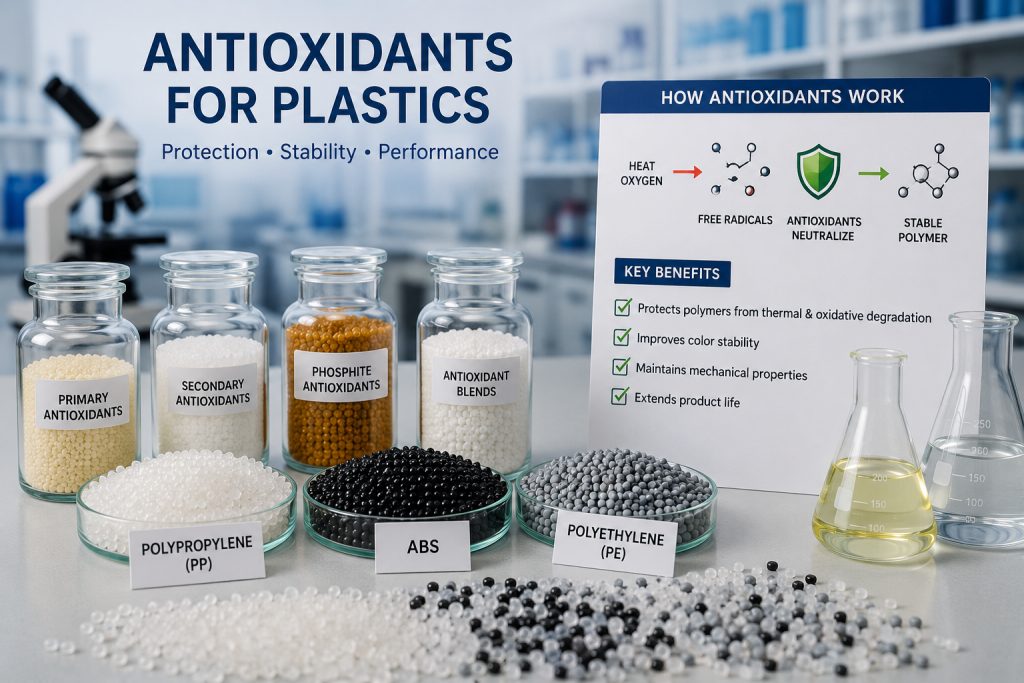
Antioxidants for Plastics are polymer additives that help slow oxidation caused by heat, oxygen, and processing stress. They support polymer stability during extrusion, injection molding, compounding, and product use, helping manufacturers preserve material properties and improve processing consistency.
Selecting the right antioxidant depends on the polymer type, processing conditions, formulation, and intended service life. These additives are particularly important in polypropylene (PP), polyethylene (PE), and other thermoplastics that may undergo thermal or oxidative degradation.
What Do Antioxidants for Plastics Do?
During polymer processing, heat and mechanical shear can initiate chemical reactions that generate free radicals. In the presence of oxygen, these reactions may produce hydroperoxides and other reactive species that damage polymer chains. The resulting degradation can cause discoloration, reduced molecular weight, changes in melt flow, brittleness, and lower mechanical performance.
Antioxidants for Plastics help interrupt or slow these reactions through different stabilization mechanisms. Their effectiveness depends on the polymer chemistry, additive concentration, processing history, and exposure conditions.
Why Are Antioxidants Important in Plastic Processing?
Extrusion, injection molding, blow molding, and melt compounding expose polymers to elevated temperatures and mechanical forces. Some materials are also processed more than once, increasing the risk of oxidation and changes in material properties.
Using suitable antioxidant additives can help manufacturers maintain more consistent processing behavior, reduce heat-related degradation, and preserve product quality. However, antioxidants do not eliminate all forms of polymer degradation; temperature control, residence time, equipment conditions, and appropriate formulation remain essential.
Types of Antioxidants for Plastics
| Antioxidant Type | Primary Function | Typical Role |
|---|---|---|
| Primary antioxidants | Interrupt free-radical chain reactions | Help limit oxidation during processing and service |
| Secondary antioxidants | Decompose polymer hydroperoxides | Reduce the accumulation of oxidation-promoting intermediates |
| Combined antioxidant systems | Use complementary stabilization mechanisms | Provide balanced protection for specific formulations |
Hindered phenolic antioxidants are common examples of primary antioxidants, while phosphites and certain thioesters are used as secondary antioxidants. Their suitability varies by polymer, processing temperature, regulatory requirements, and compatibility with other ingredients.
Combining primary and secondary antioxidants can provide complementary protection. The formulation must still be optimized and tested because the same combination may not perform equally well in every resin or application.
Antioxidants for Plastics in Polypropylene
Polypropylene is widely used in automotive components, packaging, household products, fibers, and industrial molded parts. During melt processing, polypropylene can undergo chain scission and oxidative degradation, potentially changing its melt flow and mechanical properties.
Antioxidants for Plastics used in polypropylene formulations can help limit these changes during extrusion, injection molding, and compounding. The required stabilization depends on the PP grade, processing temperature, residence time, filler content, and whether the material will be reprocessed.
Learn more about polymer additives and review related information about plastic additives and their applications.
Antioxidants for Plastics in Polyethylene
Polyethylene is used in films, pipes, bottles, drums, cable insulation, and industrial packaging. Depending on the grade and application, polyethylene may experience oxidation during melt processing or prolonged exposure to heat and oxygen.
Appropriate stabilization can help maintain processing consistency and material performance. Requirements differ between LDPE, LLDPE, and HDPE, as well as between thin films, thick molded products, pipes, and other end uses. For long-service applications, manufacturers should consider both processing stability and the expected operating environment.
Benefits of Antioxidants for Plastics
When correctly selected and formulated, antioxidants can provide several benefits:
- Improved thermal processing stability: Help reduce oxidation during exposure to processing temperatures.
- Better color retention: Limit some oxidation-related discoloration.
- Preservation of mechanical properties: Help slow the degradation that can reduce strength, elongation, or impact performance.
- More consistent processing: Help control unwanted changes in melt behavior caused by polymer degradation.
- Support for repeated processing: May help reduce additional oxidation during recycling or reprocessing, depending on the polymer’s previous history.
These benefits are not automatic guarantees. Results depend on the additive package, dosage, dispersion, resin condition, processing conditions, and application-specific testing.
Antioxidants for Plastics in Compounding and Recycling
Plastic compounding combines a base resin with additives, fillers, pigments, and modifiers. During melt mixing, the polymer may experience heat and high shear, making oxidation control an important formulation consideration.
Recycled and repeatedly processed plastics may require special evaluation because their previous exposure to heat, oxygen, contaminants, and other materials can affect their remaining stability. An antioxidant package may improve processing behavior, but it cannot fully restore polymer chains that have already been severely degraded.
Explore our guide to polymer additives for an overview of the technologies used to modify and stabilize plastics.
Antioxidants vs. UV Stabilizers
Antioxidants primarily target oxidation associated with heat, oxygen, and processing. UV stabilizers are designed to reduce damage associated with ultraviolet radiation. Because outdoor plastic products may experience both thermal oxidation and sunlight exposure, some formulations use both types of additives.
The required combination depends on the polymer, product design, exposure conditions, color, expected service life, and regulatory requirements. Compatibility and performance should be verified through formulation trials and suitable aging tests.
How to Choose Antioxidants for Plastics
Choosing Antioxidants for Plastics requires evaluating the complete formulation rather than selecting an additive based on polymer name alone. Important considerations include:
- Polymer type and grade: PP, PE, ABS, and engineering plastics may require different stabilization approaches.
- Processing conditions: Temperature, residence time, oxygen exposure, and shear influence oxidation risk.
- End-use environment: Heat, sunlight, contact with chemicals, and expected service duration affect requirements.
- Formulation compatibility: Fillers, pigments, flame retardants, and other additives may influence performance.
- Regulatory requirements: Food-contact, medical, electrical, and other regulated applications may have specific restrictions.
- Testing and dosage: Supplier recommendations should be validated through trials at appropriate concentrations.
Consult the additive supplier’s technical data sheet and safety data sheet before use. Laboratory and production-scale testing can help establish whether the selected stabilization package meets the required performance criteria.
Quality Control and Performance Testing
Manufacturers can evaluate antioxidant performance using tests selected for the material and end-use requirements. Relevant measurements may include melt flow rate, color change, tensile properties, impact strength, oxidation induction time, and accelerated thermal aging.
Methods such as oxidation induction time testing can help compare the oxidative stability of suitable polyolefin samples under defined test conditions. Results should be interpreted alongside processing data and real-world service requirements; no single test predicts every aspect of long-term durability.
For relevant polymer testing methods, consult ISO standards and the technical documentation for the selected resin and additive.
Conclusion
Antioxidants for Plastics help manufacturers manage oxidation and thermal degradation during polymer processing and product use. Depending on the formulation, they can support processing stability, color retention, and preservation of mechanical properties in polypropylene, polyethylene, and other thermoplastics.
The most suitable system depends on the resin grade, processing conditions, additive compatibility, regulatory requirements, and expected service environment. Careful formulation and performance testing are essential for reliable results.
Explore available materials on the Aasad Chimie products page, or contact Aasad Chimie to discuss your industrial chemical and formulation requirements.
What are antioxidants for plastics used for?
They help slow oxidative degradation caused by heat and oxygen, supporting polymer stability during processing and service.
Which types of antioxidants are used in plastics?
Common categories include primary antioxidants, such as hindered phenols, and secondary antioxidants, such as phosphites. Some formulations combine both types.
Why are antioxidants used in polypropylene?
They can help reduce oxidation during melt processing and preserve material properties, depending on the polypropylene grade and processing conditions.
Can antioxidants improve recycled plastic quality?
They may help stabilize recycled plastics during further processing, but they cannot fully reverse damage that has already occurred in degraded polymer chains.
Are antioxidants and UV stabilizers the same?
No. Antioxidants primarily address oxidation, while UV stabilizers target degradation associated with ultraviolet exposure. Some outdoor applications require both.