


Table of Contents
- What Are Anti-Block Additives?
- Why Does Plastic Film Blocking Occur?
- How Anti-Block Additives Work
- Main Components of Anti-Block Masterbatches
- 1. Mineral-Based Active Ingredients
- 2. Carrier Resin
- 3. Dispersing and Supporting Ingredients
- Types of Anti-Block Additives
- Natural Silica-Based Formulations
- Synthetic Silica-Based Formulations
- Talc and Other Mineral Formulations
- Anti-Block Additives vs. Slip Additives
- Key Benefits of Anti-Block Additives
- Industrial Applications of Anti-Block Additives
- 1. Flexible Packaging Films
- 2. Agricultural Films
- 3. Bags and Industrial Liners
- 4. Polyethylene and Polypropylene Films
- 5. Medical and Pharmaceutical Packaging
- How to Select the Right Anti-Block Additives
- Common Problems and Troubleshooting
- Recommended Testing Before Full-Scale Production
- Anti-Block Technology and Sustainable Packaging
- Conclusion
- Related Articles
- References and Further Reading
- Explore Plastic Additive Solutions with AasadChimie
- What are anti-block additives?
- Which polymers use anti-block additives?
- What is the difference between anti-block and slip additives?
- Can anti-block additives affect film transparency?
- How do manufacturers select an anti-block grade?
- Are anti-block additives suitable for food packaging?
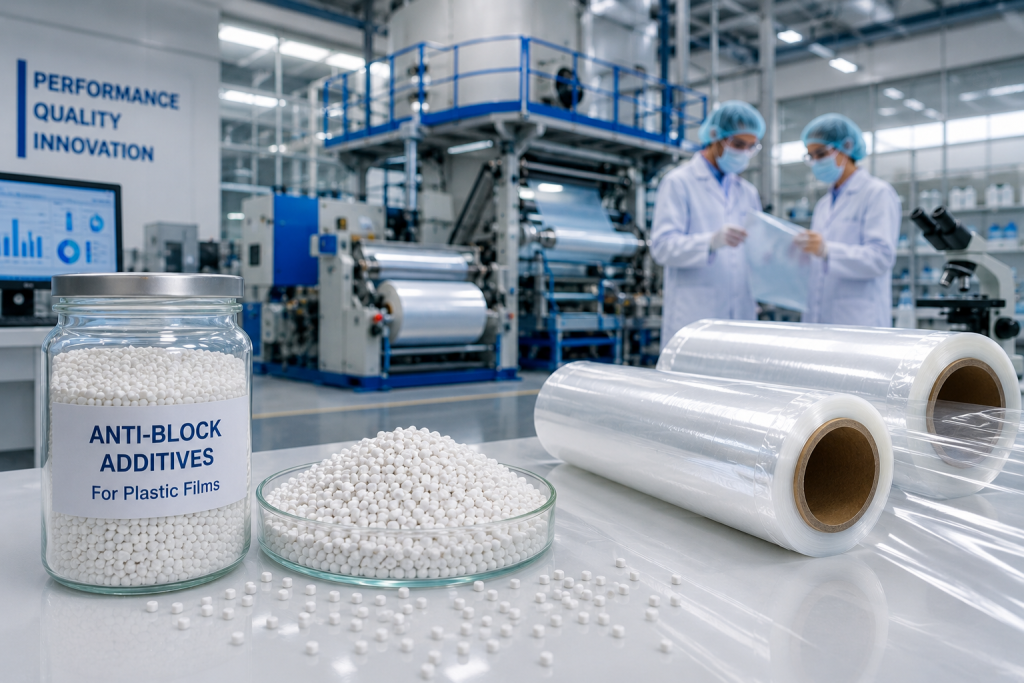
Anti-block additives help prevent adjacent layers of plastic film from sticking together during winding, storage, transportation, and converting. By reducing direct surface contact, these additives improve film separation and handling in polyethylene (PE), polypropylene (PP), and other flexible film applications.
Choosing the right anti-block formulation requires balancing blocking resistance with optical clarity, coefficient of friction, sealing performance, and the requirements of the final application. This guide explains how anti-block technology works, which materials are commonly used, and how manufacturers can select a suitable solution.
What Are Anti-Block Additives?
Anti-block additives are functional materials incorporated into plastic films to reduce blocking, which occurs when adjacent film surfaces adhere to one another. Blocking can make rolls difficult to unwind, prevent bags from opening easily, and interrupt automated packaging operations.
These additives commonly contain finely divided mineral particles or other materials that modify the film surface. They are often supplied as concentrated masterbatches, allowing film manufacturers to introduce the active ingredient into a polymer during extrusion.
Typical applications include PE packaging films, polypropylene films, agricultural films, liners, bags, and selected industrial packaging products. The appropriate formulation depends on the polymer, film thickness, required transparency, processing conditions, and end-use requirements.
Why Does Plastic Film Blocking Occur?
Blocking develops when two film surfaces make close contact and adhere to each other. Surface smoothness, polymer characteristics, winding pressure, temperature, and storage conditions can all influence the severity of the problem.
Common contributing factors include:
- High winding pressure: Tight rolls increase contact between adjacent layers.
- Elevated temperatures: Warm storage conditions can increase surface adhesion.
- Smooth film surfaces: Greater surface contact may increase blocking.
- Polymer formulation: Resin grade and other additives affect surface behavior.
- Storage duration: Prolonged contact under pressure may make separation more difficult.
Humidity may also influence performance in certain materials and storage environments, but its effect depends on the complete film formulation. Identifying the main cause of blocking helps manufacturers determine whether an additive adjustment, process change, or combination of both is needed.
How Anti-Block Additives Work
Most mineral-based anti-block additives work by creating microscopic separation between adjacent film surfaces. Small particles near the film surface reduce the effective area of direct contact, making the layers easier to separate.
During film extrusion, the additive is dispersed within the molten polymer. As the film cools, suitable particles influence its surface topography. The resulting reduction in surface contact can improve roll release, bag opening, and handling during converting.
The result depends on particle size, particle shape, concentration, dispersion quality, film thickness, and polymer characteristics. Excessive loading or poorly selected particles may increase haze, reduce gloss, affect surface appearance, or interfere with other film properties.
Main Components of Anti-Block Masterbatches
1. Mineral-Based Active Ingredients
The active ingredient provides the surface modification responsible for reducing blocking. Common mineral choices include:
- Natural silica: Used in selected film formulations where cost and anti-blocking performance are important.
- Synthetic silica: Available in controlled particle grades for applications requiring a particular balance of anti-blocking efficiency and optical performance.
- Talc: Used in selected polymer formulations, depending on particle characteristics and performance requirements.
- Diatomaceous earth: Used in some formulations where its particle structure and surface characteristics are suitable.
These materials are not interchangeable in every application. Their suitability must be assessed using the target film’s optical, mechanical, and processing specifications.
2. Carrier Resin
In a masterbatch, the carrier resin transports the active ingredient into the base polymer and supports dispersion during processing. Common carriers include LDPE, LLDPE, HDPE, and PP, depending on the intended application.
A compatible carrier helps maintain uniform additive distribution and reduces the risk of processing problems. Manufacturers should check carrier compatibility with the base resin, extrusion temperature, and final film structure.
3. Dispersing and Supporting Ingredients
Some formulations contain additional ingredients to support dispersion, handling, or processing. Their presence and function vary by product. An anti-block masterbatch should therefore be evaluated using its technical data sheet rather than assuming that all products contain the same components.
Types of Anti-Block Additives
Natural Silica-Based Formulations
Natural silica grades are used in selected general-purpose films, bags, and agricultural applications. Their performance depends on mineral purity, particle-size distribution, loading, and dispersion. They may be appropriate where the required optical quality and surface properties can be achieved economically.
Synthetic Silica-Based Formulations
Synthetic silica grades can offer more controlled particle characteristics. Depending on the grade and formulation, they may help manufacturers balance blocking resistance with film clarity and surface quality.
They can be considered for packaging films where optical appearance is important, but high transparency is not guaranteed by the use of synthetic silica alone. Film thickness, resin selection, particle concentration, and processing conditions also influence haze and clarity.
Talc and Other Mineral Formulations
Talc and other selected minerals may be used in particular film formulations. Their suitability depends on particle characteristics, polymer compatibility, and the performance targets of the finished product. Testing is necessary before replacing one mineral system with another.
Anti-Block Additives vs. Slip Additives
Anti-block and slip additives address related but different problems. Anti-block technology reduces adhesion between adjacent film layers, while slip additives primarily reduce friction between surfaces.
| Property | Anti-Block Additives | Slip Additives |
|---|---|---|
| Primary function | Reduce film blocking | Reduce surface friction |
| Typical mechanism | Modify surface contact | Change surface lubricity |
| Key performance measure | Blocking force or separation behavior | Coefficient of friction (COF) |
| Common benefit | Easier separation and unwinding | Improved sliding and machine handling |
| Potential trade-off | Changes in haze, gloss, or sealing | Changes in friction over time or sealing behavior |
Both technologies may be used in the same film. However, the combination should be tested because additive interactions, migration, and surface conditions can affect the final performance.
Key Benefits of Anti-Block Additives
- Easier film separation: Helps adjacent layers release more consistently.
- Improved roll handling: Can support more reliable unwinding during converting.
- More efficient bag opening: Helps reduce sticking during automated bag-making and packaging operations.
- Reduced production interruptions: Lower blocking can reduce handling problems and associated downtime.
- Better process consistency: A suitable formulation can help maintain more consistent film handling across production runs.
- Application-specific performance: Different grades allow manufacturers to balance blocking resistance with optical and surface requirements.
Actual results depend on the film formulation and operating conditions. Anti-block additives do not independently guarantee higher line speeds, lower scrap rates, or improved mechanical strength.
Industrial Applications of Anti-Block Additives
1. Flexible Packaging Films
Flexible packaging manufacturers use anti-block formulations when film layers need to separate reliably during unwinding, bag conversion, or packaging. Potential applications include bakery bags, produce bags, liners, and selected food packaging structures.
For food-contact applications, the complete formulation must meet the applicable regulations for the intended market and conditions of use. Food-contact suitability should be confirmed through supplier documentation and compliance testing.
2. Agricultural Films
Greenhouse films, mulch films, and other agricultural films may require anti-block performance to facilitate roll handling, installation, and storage. Manufacturers should assess the additive alongside UV stabilizers, optical requirements, film thickness, and the expected service environment.
Anti-block additives and UV stabilizers perform different functions. A formulation intended for outdoor use must be evaluated for compatibility with the film’s full stabilization package.
3. Bags and Industrial Liners
Shopping bags, industrial liners, and packaging sacks may stick together when stored in stacks or rolls. A suitable anti-block formulation can improve separation and support consistent bag opening during converting and packing.
4. Polyethylene and Polypropylene Films
PE and PP films have different processing and surface characteristics, so a formulation designed for one polymer should not automatically be assumed suitable for the other. The carrier resin, mineral type, concentration, and extrusion conditions should be selected for the target polymer and film structure.
5. Medical and Pharmaceutical Packaging
Selected medical and pharmaceutical packaging films may require controlled surface behavior and consistent opening performance. Additives for these applications need careful assessment of purity, traceability, regulatory compliance, and compatibility with the packaging design. A general-purpose anti-block grade should not be treated as suitable for medical use without appropriate documentation.
How to Select the Right Anti-Block Additives
Choosing an appropriate formulation requires a clear understanding of the film’s end use and production process. Consider the following factors before selecting a grade:
- Base polymer: Identify whether the film uses LDPE, LLDPE, HDPE, PP, or a multilayer structure.
- Film thickness: Thin films may respond differently to particle size and additive loading than thicker films.
- Optical requirements: Establish acceptable limits for haze, clarity, and gloss.
- Blocking performance: Define the required separation behavior under expected storage and winding conditions.
- Friction requirements: Set COF targets if the film also needs controlled sliding behavior.
- Sealing performance: Check whether the additive affects seal initiation, seal strength, or the sealing window.
- Processing method: Consider blown-film or cast-film extrusion and the relevant processing conditions.
- Regulatory requirements: Verify suitability for food contact or other regulated applications where applicable.
Review the product technical data sheet and conduct trials on the actual production line. A formulation that works in one resin grade or film thickness may require adjustment in another.
Common Problems and Troubleshooting
| Observed Problem | Possible Cause | Recommended Check |
|---|---|---|
| Film layers still stick together | Insufficient anti-block performance, poor dispersion, or high winding pressure | Review additive concentration, dispersion, roll tension, and storage conditions. |
| Excessive haze | Particle characteristics or loading are unsuitable for the clarity target | Compare alternative grades and measure haze under consistent test conditions. |
| Inconsistent film separation | Uneven additive distribution or inconsistent process conditions | Check masterbatch feeding, mixing, extrusion stability, and film uniformity. |
| Unwanted friction changes | Interaction with slip additives or changes in surface behavior | Measure COF over time and test the combined additive system. |
| Reduced sealing performance | Surface effects or formulation interactions | Evaluate seal strength, seal initiation temperature, and the processing window. |
Change one variable at a time where practical and compare trial results against a documented baseline. This makes it easier to identify the cause of a performance change.
Recommended Testing Before Full-Scale Production
Before adopting a new anti-block formulation, manufacturers should evaluate the finished film under representative production and storage conditions. Relevant tests may include:
- Blocking or film-separation force
- Haze and optical clarity
- Coefficient of friction (COF)
- Film tensile properties where relevant
- Heat-seal strength and seal initiation behavior
- Roll unwinding and bag-opening performance
- Stability after storage or conditioning
Use suitable standardized methods and consistent conditioning procedures where applicable. Testing should reflect the intended application rather than relying solely on the additive’s nominal concentration or mineral type.
Anti-Block Technology and Sustainable Packaging
Packaging manufacturers are increasingly evaluating additive systems alongside recyclability, material reduction, and resource efficiency goals. In recyclable mono-material films, the complete additive package should be assessed for its effect on film performance and compatibility with the intended recycling stream.
Smaller particle sizes or higher additive concentrations do not automatically make a formulation more sustainable or improve every performance characteristic. Manufacturers should use technical data, processing trials, and relevant recycling guidance to evaluate the full system.
Conclusion
Anti-block additives are important functional materials for plastic film manufacturing because they help reduce blocking and improve the separation of adjacent film layers. Their performance depends on the active mineral, carrier resin, dispersion quality, polymer type, film thickness, and processing conditions.
For reliable results, manufacturers should balance blocking resistance with optical clarity, friction, sealing performance, and regulatory requirements. Technical data review and production-scale testing help identify the most suitable formulation for each application.
Related Articles
- Masterbatch Explained: Types and Applications
- Calcium Carbonate Filler Masterbatch Guide
- Plastic Additives Explained
- How UV Stabilizers Protect Plastic Products
- Plastic Manufacturing Defects and Solutions
References and Further Reading
- Plastics Europe — Plastics industry information and resources.
- ASTM International — Standards and test methods for materials and products.
- Society of Plastics Engineers — Plastics processing and materials resources.
- ScienceDirect — Scientific literature on polymer films and additives.
Explore Plastic Additive Solutions with AasadChimie
Manufacturers evaluating anti-block formulations should consider polymer compatibility, film clarity, blocking performance, and processing requirements together. Visit the AasadChimie products page to explore available product information, or contact the AasadChimie team to discuss your application requirements and technical specifications.
What are anti-block additives?
Anti-block additives are materials incorporated into plastic films to reduce adhesion between adjacent layers and improve film separation during storage, unwinding, and converting.
Which polymers use anti-block additives?
They are commonly used in polyethylene (PE) and polypropylene (PP) films. The suitable grade depends on the polymer, film structure, processing method, and end-use requirements.
What is the difference between anti-block and slip additives?
Anti-block additives reduce adhesion between film layers, while slip additives primarily reduce friction. Both may be used together, subject to compatibility and performance testing.
Can anti-block additives affect film transparency?
Yes. Mineral type, particle size, concentration, and film thickness can affect haze, gloss, and clarity. The formulation should be tested against the film's optical requirements.
How do manufacturers select an anti-block grade?
They should evaluate polymer compatibility, blocking resistance, transparency, friction, sealing performance, processing conditions, and any applicable regulatory requirements.
Are anti-block additives suitable for food packaging?
Some formulations may be suitable, but food-contact compliance must be verified for the specific product, formulation, intended use, and target market.