


Table of Contents
- Ethyl Acetate: Quick Technical Specifications
- What Are the Main Ethyl Acetate Industrial Applications?
- 1. Paints and Industrial Coatings
- 2. Printing Inks and Flexible Packaging
- 3. Adhesives and Lamination
- 4. Chemical Processing and Specialty Formulations
- Why Is Ethyl Acetate Used as an Industrial Solvent?
- Ethyl Acetate vs. Methyl Acetate vs. n-Butyl Acetate
- How to Select the Right Ethyl Acetate Grade
- Ethyl Acetate Supply for Iran, India, and Turkey
- Safety, Handling, and Storage Requirements
- Technical Reference for Ethyl Acetate
- Conclusion: Choosing Ethyl Acetate for Industrial Use
- What are the main industrial applications of ethyl acetate?
- Why is ethyl acetate commonly used in printing inks?
- How do ethyl acetate and n-butyl acetate differ?
- What should buyers check before purchasing industrial ethyl acetate?
- Is ethyl acetate safe to handle in industrial facilities?
Ethyl Acetate Industrial Applications include paints and coatings, printing inks, adhesives, flexible packaging, and selected chemical processing operations. Ethyl acetate is a volatile ester solvent valued for its solvency, relatively fast evaporation, and compatibility with many industrial formulations. Manufacturers should evaluate purity, moisture content, evaporation behavior, safety requirements, and process specifications before selecting a suitable grade.
Ethyl Acetate: Quick Technical Specifications
Understanding the properties relevant to Ethyl Acetate Industrial Applications helps manufacturers compare solvent performance and determine whether the material fits their process requirements. The following values are typical reference figures; actual specifications can vary by supplier, grade, purity, and test method. Always check the current Technical Data Sheet (TDS), Certificate of Analysis (CoA), and Safety Data Sheet (SDS).
| Property | Typical Value |
|---|---|
| Chemical name | Ethyl acetate |
| Synonyms | Ethyl ethanoate, acetic acid ethyl ester |
| Chemical formula | C4H8O2 |
| CAS number | 141-78-6 |
| EC number | 205-500-4 |
| Molecular weight | 88.11 g/mol |
| Appearance | Clear, colorless liquid |
| Boiling point | Approximately 77°C at 101.3 kPa |
| Flash point | Approximately -4°C; method-dependent |
| Density | Approximately 0.90 g/cm³ at 20°C |
| Dynamic viscosity | Approximately 0.45 mPa·s at 20°C |
| Water solubility | Approximately 80 g/L near 20°C |
What Are the Main Ethyl Acetate Industrial Applications?
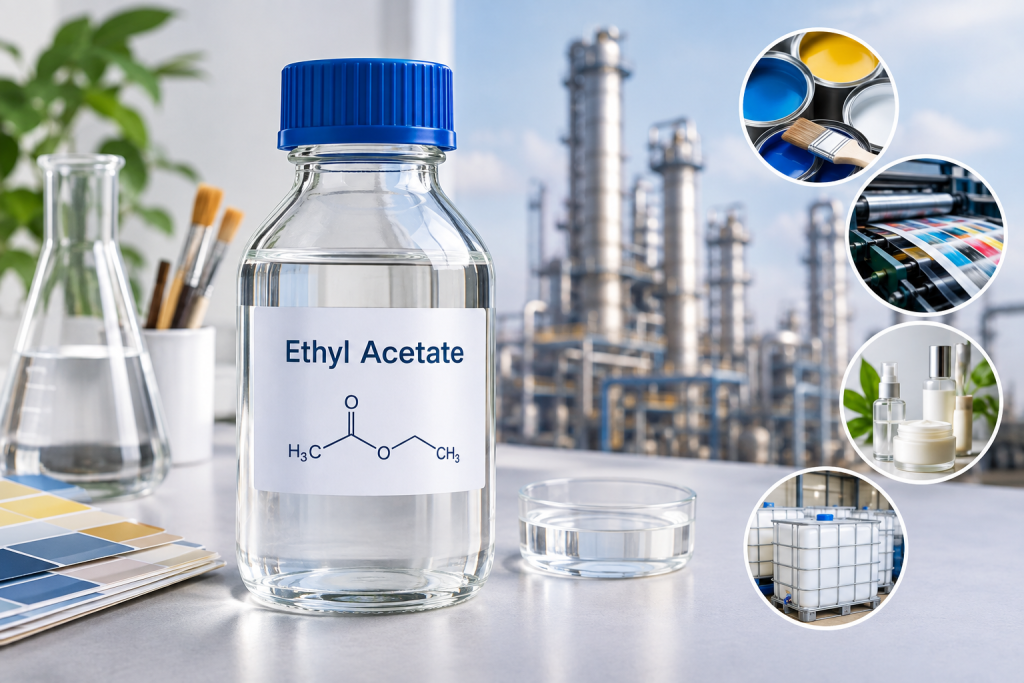
The main Ethyl Acetate Industrial Applications involve dissolving or diluting compatible resins, polymers, binders, and other formulation ingredients. Its relatively low boiling point supports fast evaporation under typical conditions, which can help manufacturers control drying in selected production processes. Actual performance depends on formulation chemistry, operating conditions, and compatibility with other ingredients.
1. Paints and Industrial Coatings
Ethyl acetate is used as a solvent in selected paints, lacquers, clear coatings, and protective coating formulations. It helps dissolve compatible resins and adjust application viscosity. Its evaporation profile can support film formation and drying, although the result depends on resin chemistry, film thickness, ambient temperature, and airflow.
For coating manufacturers, solvent selection should consider resin compatibility, required open time, surface appearance, drying speed, and applicable volatile organic compound (VOC) regulations. Excessively fast evaporation can cause application defects under certain conditions, so formulation trials are important before changing solvent ratios.
In these Ethyl Acetate Industrial Applications, manufacturers should evaluate coating thickness, ambient temperature, airflow, resin compatibility, and drying performance before finalizing a solvent blend. The best balance depends on the coating system and the finish required by the end user.
2. Printing Inks and Flexible Packaging
Another important area among Ethyl Acetate Industrial Applications is printing ink production, including selected gravure and flexographic ink systems. Ethyl acetate can dissolve compatible binders and help control ink viscosity and drying behavior. These properties can be useful in high-speed printing processes where consistent transfer and solvent release are essential.
Packaging converters should verify compatibility with the ink’s resin system, printing equipment, substrate, and drying unit. Residual-solvent requirements, food-contact packaging rules, and local regulatory obligations must also be evaluated where applicable. A solvent suitable for one ink formulation may not be suitable for another.
For printing-related Ethyl Acetate Industrial Applications, consistent solvent quality and controlled drying are important considerations. Buyers should also verify substrate compatibility, residual-solvent limits, and the technical requirements of the finished packaging.
3. Adhesives and Lamination
Ethyl acetate can serve as a solvent in selected adhesive formulations, including certain solvent-based systems used for bonding and lamination. It supports the dissolution of compatible polymeric ingredients and influences viscosity, application, and drying behavior.
For industrial adhesive applications, manufacturers should assess bond strength, substrate compatibility, drying time, residual solvent, and the effect of production conditions. In flexible packaging lamination, the adhesive supplier’s formulation guidance and curing requirements should take priority over assumptions based only on solvent properties.
Successful Ethyl Acetate Industrial Applications in adhesive production depend on the polymer system, bonding requirements, application method, and acceptable residual-solvent levels. Production trials should confirm that the selected solvent performs as expected in the complete adhesive formulation.
4. Chemical Processing and Specialty Formulations
Ethyl acetate is also used as a process solvent in selected extraction, separation, and specialty chemical operations. Its usefulness depends on the solubility of the target material, the behavior of other components, and the feasibility of solvent recovery. Process designers should assess solvent losses, recovery energy, material compatibility, and waste management requirements before selecting it.
Not every chemical process benefits from ethyl acetate. Water content, reaction conditions, flammability, and interactions with other substances may limit its suitability. Laboratory or pilot-scale validation can help confirm performance before full-scale implementation.
Why Is Ethyl Acetate Used as an Industrial Solvent?
Ethyl acetate offers a combination of useful solvent properties. It can dissolve a range of compatible organic materials, evaporates relatively quickly under typical ambient conditions, and has a recognizable solvent profile that formulators can evaluate against process requirements.
- Solvency: It dissolves many compatible resins and organic compounds, although performance depends on the material.
- Evaporation: Its boiling point near 77°C supports relatively fast evaporation compared with many higher-boiling solvents.
- Formulation flexibility: It can be blended with other solvents when the complete system remains compatible.
- Process suitability: It may support efficient drying in applications designed around its evaporation profile.
- Supply options: Industrial grades may be available in different purity levels and packaging formats, depending on the supplier.
These advantages do not make ethyl acetate a universal solvent. The best choice depends on performance testing, worker exposure controls, environmental requirements, and the total cost of using and recovering the solvent.
Ethyl Acetate vs. Methyl Acetate vs. n-Butyl Acetate
Comparing related ester solvents can help manufacturers identify a suitable option for a specific formulation. The following comparison is a starting point rather than a substitute for application testing.
| Characteristic | Ethyl Acetate | Methyl Acetate | n-Butyl Acetate |
|---|---|---|---|
| Typical boiling point | About 77°C | About 57°C | About 126°C |
| Relative evaporation | Fast | Very fast | Slower |
| Common industrial roles | Inks, coatings, adhesives | Selected fast-drying solvent systems | Coatings, inks, and resin systems |
| Main selection consideration | Balance of solvency and drying | Very rapid evaporation and compatibility | Longer evaporation time and formulation needs |
Actual evaporation rates depend on test conditions, temperature, airflow, and formulation composition. Review product specifications and test each candidate in the intended process before replacing one solvent with another.
Explore the related products: Methyl Acetate and Normal Butyl Acetate.
How to Select the Right Ethyl Acetate Grade
Choosing a suitable grade for Ethyl Acetate Industrial Applications requires more than checking the product name. Buyers should match the supplier’s specifications to the technical requirements of their process.
- Purity: Confirm the required assay and any limits on impurities.
- Moisture content: Check water limits where moisture can affect the formulation or process.
- Acidity: Verify acidity specifications when they are important to resin stability or product quality.
- Appearance: Confirm clarity and color requirements stated in the specification.
- Evaporation behavior: Evaluate drying performance under actual production conditions.
- Documentation: Request a current TDS, SDS, and batch-specific CoA.
- Packaging: Select packaging that is compatible with the solvent and suitable for storage and transport.
Before approving a grade for Ethyl Acetate Industrial Applications, compare the product’s purity, moisture content, acidity, and batch consistency with your manufacturing specification. There is no single purity grade or consumption rate that applies to every application; requirements depend on the formulation, equipment, and process conditions.
Ethyl Acetate Supply for Iran, India, and Turkey
Manufacturers and distributors sourcing ethyl acetate in Iran, India, or Turkey should compare technical compliance, shipment terms, packaging, lead time, and supplier documentation. The most competitive quotation is not necessarily the best option if the supplied grade does not meet production requirements.
When sourcing material for Ethyl Acetate Industrial Applications in Iran, India, or Turkey, confirm the grade, packaging, documentation, delivery terms, and current availability directly with the supplier.
Before confirming an order, buyers should clarify the following points:
- Required grade, purity, and specification limits.
- Available package sizes and bulk supply options.
- Batch traceability and the availability of a Certificate of Analysis.
- Delivery location, lead time, and agreed shipping terms.
- Safety documentation and applicable import or transport requirements.
For product information, visit the Ethyl Acetate product page or browse the complete Aasad Chimie product range. Contact the supplier to confirm current availability, specifications, packaging, and quotation details.
Safety, Handling, and Storage Requirements
Ethyl acetate is a highly flammable liquid and vapor. Its low flash point means that ignition can occur at ordinary working temperatures if suitable controls are not in place. Industrial facilities must follow the current SDS, local regulations, and site-specific risk assessments.
- Keep the material away from heat, sparks, flames, and other ignition sources.
- Use suitable ventilation and equipment designed for the relevant flammable-solvent environment.
- Control static electricity during transfer and follow approved grounding and bonding procedures where required.
- Wear PPE selected through the site’s chemical risk assessment, including suitable eye and skin protection.
- Store the product in compatible, tightly closed containers in a cool, appropriately ventilated area.
- Follow the SDS for spill response, fire response, first aid, and waste disposal.
Do not rely on generic handling advice alone. Review the supplier’s latest Safety Data Sheet and ensure that workers receive appropriate training before handling or transferring ethyl acetate.
Technical Reference for Ethyl Acetate
For chemical identity and additional physical-property information, consult the PubChem Ethyl Acetate reference. For procurement and process decisions, compare reference data with the supplier’s current TDS, SDS, and CoA because test methods and commercial specifications may differ.
Conclusion: Choosing Ethyl Acetate for Industrial Use
Ethyl Acetate Industrial Applications span coatings, printing inks, adhesives, flexible packaging, and selected chemical processes. Its solvency and relatively fast evaporation make it a useful option for many formulations, but performance depends on grade, compatibility, process conditions, and safety controls.
Choosing the right grade for Ethyl Acetate Industrial Applications can help manufacturers maintain consistent production quality while meeting process, safety, and regulatory requirements. Before purchasing, confirm the required specification, review technical and safety documents, and assess the material under actual application conditions.
To discuss product specifications or supply requirements, visit the Ethyl Acetate product page or contact Aasad Chimie for further information.
What are the main industrial applications of ethyl acetate?
Ethyl acetate is used in selected paints and coatings, printing inks, adhesives, flexible packaging, and chemical processing operations. Its suitability depends on resin compatibility, evaporation requirements, product specifications, and process conditions. Manufacturers should confirm application performance through technical documentation and appropriate testing.
Why is ethyl acetate commonly used in printing inks?
Ethyl acetate can dissolve compatible ink binders and help control viscosity and drying behavior. These properties can be useful in selected gravure and flexographic printing systems. The correct solvent choice depends on the ink formulation, printing equipment, substrate, residual-solvent requirements, and applicable regulations.
How do ethyl acetate and n-butyl acetate differ?
Ethyl acetate has a lower boiling point and generally evaporates faster than n-butyl acetate. This difference can influence drying time, film formation, and application performance. Neither solvent is universally better; manufacturers should compare solvency, formulation compatibility, operating conditions, and required finish.
What should buyers check before purchasing industrial ethyl acetate?
Buyers should verify purity, moisture content, acidity where relevant, packaging, batch consistency, and availability of a current Technical Data Sheet, Safety Data Sheet, and Certificate of Analysis. Delivery terms and applicable transport requirements should also be confirmed before placing a bulk order.
Is ethyl acetate safe to handle in industrial facilities?
Ethyl acetate is highly flammable and requires appropriate ventilation, ignition-source control, compatible storage, and suitable personal protective equipment. Facilities should follow the supplier's current Safety Data Sheet, local regulations, and site-specific risk assessments. Workers should be trained in safe handling and spill response.