

Table of Contents
- Diethylene Glycol Quick Specifications
- What Is Diethylene Glycol? Formula and Structure
- Diethylene Glycol Molecular Weight and Key Properties
- Is Diethylene Glycol Soluble in Water? Solubility Explained
- Industrial Uses of Diethylene Glycol
- 1. Unsaturated polyester resins and polyester polyols
- 2. Polyurethane polyols
- 3. Natural gas dehydration
- 4. Antifreeze, coolant and heat-transfer blends
- 5. Solvent, humectant and lubricant uses
- Diethylene Glycol vs Monoethylene Glycol (MEG)
- How to Choose Diethylene Glycol Grade and Purity
- Diethylene Glycol Safety, Handling and Contamination Risks
- Diethylene Glycol Packaging and Supply
- Request Diethylene Glycol Price, Datasheet or COA
- What is the molecular weight and formula of diethylene glycol?
- Is diethylene glycol soluble in water?
- What is the boiling point and flash point of diethylene glycol?
- What is diethylene glycol used for?
- Is diethylene glycol toxic, and can it be used in food or medicine?
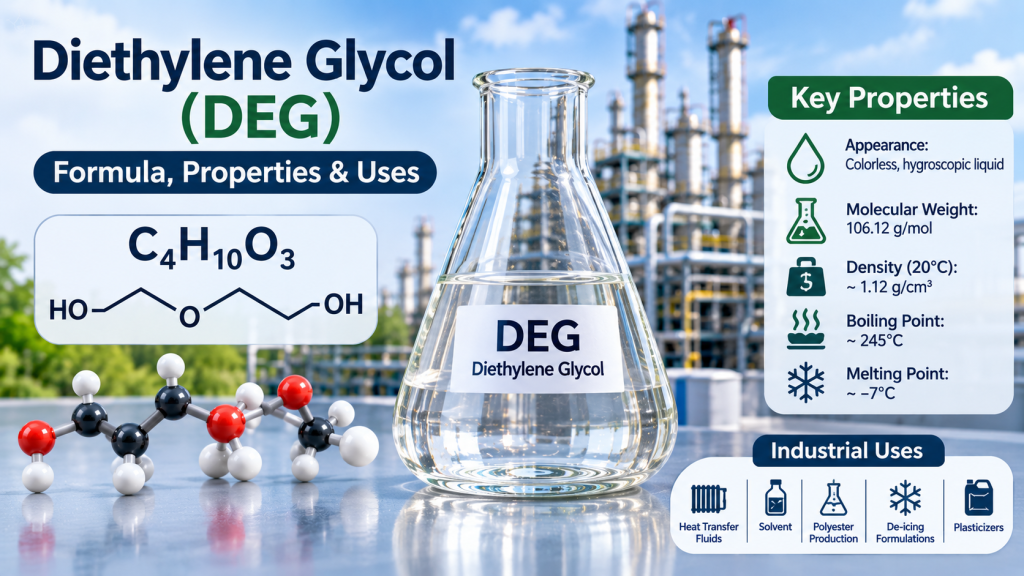
Diethylene glycol (DEG) is a clear, colourless, hygroscopic liquid with the formula C4H10O3 (CAS 111-46-6) and a molecular weight of 106.12 g/mol. It is used mainly to make unsaturated polyester resins and polyurethane polyols, and also in natural gas dehydration, antifreeze blends and as a solvent and humectant. This guide gives formulators, resin producers and buyers verified data, grade guidance and the safety points that matter when buying diethylene glycol.
Diethylene Glycol Quick Specifications
| Property | Value (conditions) |
|---|---|
| Chemical name / synonyms | Diethylene glycol, DEG, 2,2′-oxydiethanol, bis(2-hydroxyethyl) ether, diglycol; دیاتیلن گلایکول (Persian); dietilen glikol (Turkish) |
| Molecular formula | C4H10O3; structural: (HOCH2CH2)2O |
| CAS number | 111-46-6 |
| EC number | 203-872-2 |
| Molecular weight | 106.12 g/mol |
| Appearance | Clear, colourless, viscous, hygroscopic liquid |
| Boiling point | 245 °C (at 760 mmHg) |
| Melting point | −10 °C |
| Flash point | 138–143 °C (closed cup; depends on method) |
| Density | 1.115–1.117 g/mL (at 20 °C) |
| Viscosity | 13.65 cSt (at 40 °C) |
| Vapour pressure | 0.01–0.04 mmHg (at 20 °C) |
| Refractive index | 1.4476 (at 20 °C) |
| Solubility | Completely miscible with water and many organic liquids |
| Autoignition temperature | about 228 °C (442 °F) |
| HS code | 2909 41 00 |
What Is Diethylene Glycol? Formula and Structure
Diethylene glycol is an ether-alcohol: two ethylene glycol units joined by an ether bond, with a hydroxyl group at each end. That gives the structural formula (HOCH2CH2)2O and the molecular formula C4H10O3.
It is produced as a co-product of monoethylene glycol manufacture, so supply of diethylene glycol follows MEG output. If you also buy monoethylene glycol (MEG) for industrial use, our guide to MEG properties and uses explains how the two relate.

Diethylene Glycol Molecular Weight and Key Properties
These properties decide how diethylene glycol behaves in storage and in your process:
- Molecular weight 106.12 g/mol (formula C4H10O3).
- Boiling point 245 °C. This is far higher than MEG (197.3 °C), so DEG is much less volatile, with a vapour pressure of only 0.01–0.04 mmHg at 20 °C.
- Flash point 138–143 °C. It is a combustible liquid, not a highly flammable one like light solvents, but it can burn once heated.
- Density about 1.116 g/mL at 20 °C. It is heavier than water.
- Viscosity 13.65 cSt at 40 °C. It is moderately viscous, and it is hygroscopic, meaning it absorbs moisture from air.
Is Diethylene Glycol Soluble in Water? Solubility Explained
Yes. Diethylene glycol is completely miscible with water and with many organic liquids. Its two hydroxyl groups and ether oxygen form hydrogen bonds with water, so it mixes in any proportion. This miscibility is why it works as a humectant, a dehydrating agent and a coupling solvent. It is also why containers must stay closed: absorbed moisture raises the water content, which matters in resin and polyurethane synthesis.
Industrial Uses of Diethylene Glycol
1. Unsaturated polyester resins and polyester polyols
Role: glycol building block that reacts with acids and anhydrides to form the polyester backbone; this is one of the largest uses of diethylene glycol. Suitable grade: technical or high-purity DEG with low colour, low MEG and TEG content, and low acidity and water.
2. Polyurethane polyols
Role: intermediate for polyols used in polyurethane systems. Suitable grade: technical grade with low water and acidity, and controlled iron and colour.
3. Natural gas dehydration
Role: hygroscopic liquid that absorbs water from gas streams. Suitable grade: technical grade with consistent purity and water content. For a related glycol, see triethylene glycol (TEG) supply.
4. Antifreeze, coolant and heat-transfer blends
Role: freeze-point depressant used with MEG in antifreeze, deicing and heat-transfer fluids. Suitable grade: technical grade compatible with your MEG blend.
5. Solvent, humectant and lubricant uses
Role: low-volatility solvent in printing inks, cleaners, adhesives and textile dyeing; humectant and lubricant for fibres, paper and cork; plasticizer and hydraulic-fluid component. Suitable grade: technical grade with a stated DEG assay. The right dosage depends on your formulation, so set it in trials with your own system.
Diethylene Glycol vs Monoethylene Glycol (MEG)
| Property | Monoethylene glycol (MEG) | Diethylene glycol (DEG) |
|---|---|---|
| Boiling point | 197.3 °C | 245 °C |
| Melting point | −12.9 °C | −10 °C |
| Flash point | 111 °C (closed cup) | 138–143 °C |
| Density | 1.1132 g/cm³ | 1.115–1.117 g/mL (20 °C) |
| GHS hazard statements | H302, H373 | H302 |
Choose diethylene glycol when you need lower volatility and a higher boiling point, and MEG when your formulation or standard calls for the lighter glycol. Many resin and antifreeze producers use both, which is why they are often sourced together from the Aasad Chemie product range. For an overview of the whole family, read 5 Types of Glycols and Their Industrial Uses.
How to Choose Diethylene Glycol Grade and Purity
- Assay: a producer technical data sheet lists DEG content of 99.8 wt% or higher for industrial grade, and analytical standards reach 99.5% (GC) or higher. Read the diethylene glycol technical data sheet from PTT Global Chemical to see typical specification limits.
- For polyester resins: ask for low colour, low MEG and TEG content, and low acidity and water.
- For polyurethane polyols: low water and acidity, plus controlled iron and colour.
- For gas dehydration: purity, water content and consistent supply.
- Documents: request the SDS, a COA for each lot with DEG assay and water content, and the technical datasheet.
Diethylene Glycol Safety, Handling and Contamination Risks
| GHS hazard class | Hazard statement |
|---|---|
| Acute toxicity (oral), Category 4 | H302: Harmful if swallowed |
Diethylene glycol is stored as a combustible liquid. One producer data sheet lists it as non-dangerous under IMDG, but always confirm transport classification on your supplier’s SDS. The harmonised classification and precautionary statements are shown on the Sigma-Aldrich product and safety page for diethylene glycol. Wear gloves, work in a ventilated area and keep containers tightly closed because the liquid is hygroscopic.
Contamination warning: diethylene glycol is an industrial chemical and must never enter food, drug or cosmetic supply chains. Contamination of ingredients such as glycerin and propylene glycol has caused fatal poisonings, and the FDA guidance on testing high-risk drug components for diethylene glycol and ethylene glycol recommends testing them before use. Keep drums and tanks clearly labelled, segregated from food and pharmaceutical materials, and never repack without original labels.
Diethylene Glycol Packaging and Supply
Industrial glycols are commonly supplied in drums, IBCs and ISO tanks. Confirm available packaging, minimum order quantity and delivery terms with our team. For customs documents, diethylene glycol is commonly declared under HS code 2909 41 00, and every shipment should include an SDS and COA.
See the diethylene glycol product specifications and supply page, or browse all industrial chemicals and solvents.
Request Diethylene Glycol Price, Datasheet or COA
Tell us the grade, quantity, packaging and delivery destination (Iran, India, Turkey or elsewhere), and we will send a quotation with the datasheet and COA. Contact the Aasad Chemie team to request a price.
Reviewed by the Aasad Chemie technical team. Last updated: November 2, 2026.
What is the molecular weight and formula of diethylene glycol?
Diethylene glycol has the molecular formula C4H10O3 and a molecular weight of 106.12 g/mol. Its structural formula is (HOCH2CH2)2O, and its CAS number is 111-46-6. It is also called 2,2′-oxydiethanol or diglycol. These identifiers appear on every COA and SDS, so use them to confirm you are buying the right glycol.
Is diethylene glycol soluble in water?
Yes. Diethylene glycol is completely miscible with water and with many organic liquids, thanks to its two hydroxyl groups and ether oxygen. It is also hygroscopic, so it absorbs moisture from air. Keep containers tightly closed, because absorbed water changes the water content on the COA and can affect resin and polyurethane reactions.
What is the boiling point and flash point of diethylene glycol?
Diethylene glycol boils at about 245 °C at 760 mmHg and melts at about −10 °C. Its flash point is roughly 138–143 °C depending on the test method, so it is a combustible liquid rather than a highly flammable one. Density is about 1.116 g/mL at 20 °C, making it heavier than water.
What is diethylene glycol used for?
The main uses are unsaturated polyester resins and polyurethane polyols. It is also used for natural gas dehydration, antifreeze and coolant blends, and as a solvent, humectant or lubricant in inks, textiles, cleaners and adhesives. Required purity depends on the use, so tell your supplier the application before ordering.
Is diethylene glycol toxic, and can it be used in food or medicine?
Diethylene glycol is classified as harmful if swallowed (H302). Industrial grade must never be used in food, drugs or cosmetics, because contamination of ingredients such as glycerin and propylene glycol has caused fatal poisonings. FDA guidance recommends testing high-risk components for it before use. Handle with gloves and ventilation and follow the SDS.