

Table of Contents
- What Is PVC?
- PVC: Key Technical Specifications
- 1. Construction and Infrastructure
- Important Selection Factors
- 2. Electrical Insulation and Cable Protection
- 3. Healthcare and Medical Products
- 4. Packaging and Protective Films
- Packaging Factors to Evaluate
- 5. Automotive and Transportation Components
- Key Properties That Influence PVC Performance
- How to Choose the Right PVC Grade
- Environmental and Safety Considerations
- Conclusion
- References
- What is PVC used for in industry?
- What is the difference between rigid and flexible PVC?
- Is PVC resistant to chemicals?
- Is every PVC grade suitable for medical applications?
- Can PVC be recycled?
- How should manufacturers select a PVC grade?
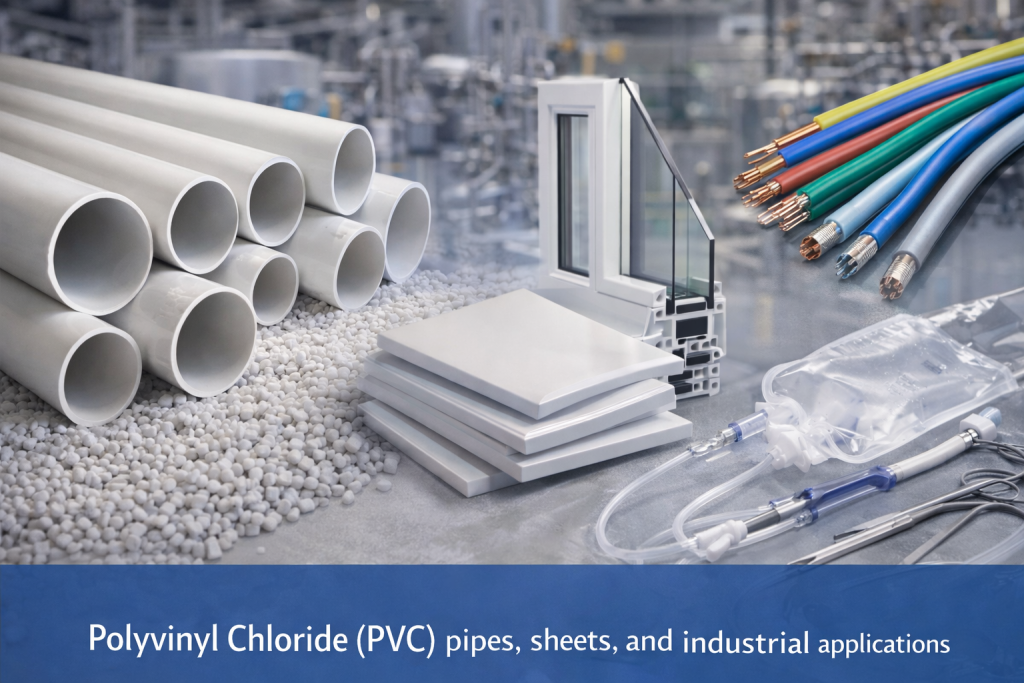
PVC (polyvinyl chloride) is a versatile thermoplastic used in construction, electrical insulation, healthcare, packaging, and automotive manufacturing. Its combination of durability, chemical resistance, electrical insulation, and formulation flexibility makes it suitable for both rigid and flexible products. The right PVC grade depends on the application, processing method, required service life, and additive package.
What Is PVC?
Polyvinyl chloride is a synthetic polymer produced by polymerizing vinyl chloride monomer. Manufacturers use additives such as heat stabilizers, impact modifiers, processing aids, pigments, and plasticizers to achieve the properties required for a particular product.
Rigid PVC, often called uPVC in building applications, is commonly used for pipes, fittings, and window profiles. Flexible PVC contains plasticizers that improve softness and flexibility, making it suitable for cables, flooring, hoses, and selected medical products. These formulations are not interchangeable: each must be designed and tested for its intended use.
For a broader technical overview of PVC applications and end-of-life management, see this scientific review of polyvinyl chloride applications and recycling.
PVC: Key Technical Specifications
| Property | Typical Information |
|---|---|
| Chemical name | Polyvinyl chloride |
| Abbreviation | PVC |
| CAS number | 9002-86-2 |
| Repeat-unit formula | (C₂H₃Cl)n |
| Appearance | Typically supplied as white resin powder; compounded grades may be pellets or granules |
| Molecular weight | Variable; depends on polymer chain length and resin grade |
| Available forms | Rigid and flexible compounds, resin powders, pellets, sheets, and profiles |
| Common processing methods | Extrusion, injection molding, calendering, and selected coating processes |
These are general identification details rather than a complete product specification. Bulk density, K-value or viscosity characteristics, thermal stability, and processing requirements vary by grade. Consult the relevant technical data sheet before selecting a resin for production.
1. Construction and Infrastructure
Construction is one of the most established application areas for PVC. Rigid PVC is used in water and drainage pipes, fittings, cable conduits, window frames, door profiles, wall panels, and other building components.
Its corrosion resistance, relatively low maintenance requirements, and ease of fabrication make it useful in infrastructure projects. PVC piping systems can offer long service life when the resin formulation, wall thickness, joint design, installation method, and operating conditions are appropriate.
Important Selection Factors
- Pressure and temperature: Select a pipe grade and pressure rating suited to the operating conditions.
- Chemical exposure: Check compatibility with the transported fluid, including its concentration and temperature.
- Outdoor durability: Evaluate UV resistance and weathering performance for exposed components.
- Mechanical performance: Consider impact resistance, stiffness, and applicable product standards.
2. Electrical Insulation and Cable Protection
PVC compounds are widely used to insulate electrical wires and provide protective cable sheaths. Electrical grades can combine dielectric performance, flexibility, abrasion resistance, and processability, depending on the formulation.
Flexible PVC is particularly useful where cables must bend during installation or service. For industrial and infrastructure applications, manufacturers should evaluate voltage rating, conductor temperature, flexibility at low temperatures, flame performance, and resistance to oils or other chemicals where relevant.
Fire performance should never be assumed from the word PVC alone. The behavior of a finished cable depends on the complete compound, cable construction, installation conditions, and test standard used. Choose materials that meet the electrical and fire-safety requirements of the intended market.
3. Healthcare and Medical Products
Specially formulated PVC is used in selected medical tubing, fluid-handling components, bags, and other healthcare products. Its transparency in certain formulations, flexibility, and ability to be processed into thin-walled components make it useful for applications where controlled fluid movement and visual inspection are important.
Medical use requires more than choosing a flexible resin. The complete formulation and finished device must meet applicable requirements for biocompatibility, extractables and leachables, sterilization compatibility, mechanical integrity, and intended clinical use.
Not every PVC grade is suitable for medical contact. Plasticizer selection and other additives require particular attention, and a material’s suitability must be established for the specific device and regulatory market. Manufacturers should use qualified medical-grade materials and documented validation procedures.
4. Packaging and Protective Films
PVC has applications in selected packaging formats, including blister packaging, films, sheets, and certain containers. Its formability and potential for transparency can support product presentation and protective packaging requirements.
However, packaging suitability depends on the packaged product, storage conditions, migration limits, mechanical requirements, and local regulations. PVC is not automatically the preferred option for every food, pharmaceutical, or consumer product. Alternative materials may be more suitable when recycling infrastructure, barrier properties, or specific regulatory requirements are decisive.
Packaging Factors to Evaluate
- Required transparency, stiffness, and forming performance.
- Compatibility with the contents and expected storage conditions.
- Applicable food-contact or pharmaceutical packaging requirements.
- Seal integrity, shelf-life requirements, and end-of-life options.
5. Automotive and Transportation Components
PVC compounds are used in selected automotive applications, including wire insulation, interior trim, protective films, flooring, seals, and flexible coverings. The ability to adjust hardness, flexibility, color, and surface finish helps manufacturers design materials for different component functions.
Automotive formulations must be selected against the performance demands of the component. Relevant criteria can include heat aging, low-temperature flexibility, abrasion resistance, odor and emissions requirements, resistance to cleaning agents, and compatibility with adjacent materials.
For under-the-hood or other high-temperature applications, the temperature rating of the specific PVC compound is especially important. A general-purpose grade should not be substituted for a qualified automotive material without appropriate testing and approval.
Key Properties That Influence PVC Performance
The performance of PVC depends on both the base resin and the additives used in the compound. The following characteristics are important when comparing grades:
| Property | Why It Matters |
|---|---|
| Chemical resistance | Supports use in selected pipes, fittings, linings, and protective components; compatibility must be checked for each chemical and condition. |
| Electrical insulation | Makes suitable PVC compounds useful for wire and cable insulation. |
| Rigidity or flexibility | Can be adjusted through formulation, including the use of plasticizers in flexible grades. |
| Thermal stability | Influences processing behavior and performance during service. |
| Weathering resistance | Depends on the formulation, exposure, pigmentation, and stabilizer package. |
| Impact strength | May be improved through appropriate impact modifiers and compound design. |
How to Choose the Right PVC Grade
Industrial buyers should begin with the finished product’s requirements rather than selecting a resin based only on price or a general description. A practical evaluation should include:
- Define the application: Identify whether the product is a pipe, cable, profile, film, medical component, or automotive part.
- Specify the operating environment: Document temperature, chemical contact, UV exposure, mechanical loads, and expected service life.
- Match the processing method: Confirm that the resin and compound are suitable for extrusion, injection molding, calendering, or the intended manufacturing process.
- Review additives and compliance: Check stabilizers, plasticizers, pigments, and other ingredients against performance and regulatory requirements.
- Verify technical documentation: Review the technical data sheet, safety data sheet, relevant certifications, and test results before production approval.
For industrial material sourcing, compare the specification of each offered grade with the actual application requirements. Visit the AasadChimie products page for product information, or contact the team to discuss a material inquiry.
Environmental and Safety Considerations
PVC’s environmental profile depends on its production, additives, service life, collection, and end-of-life treatment. Mechanical recycling is possible for suitable, properly sorted PVC waste, but mixed polymers, contamination, legacy additives, and material degradation can complicate recovery. Chemical recycling methods are also being investigated to recover useful chemicals and improve resource efficiency. Practical recycling options depend on waste composition, available technology, and local infrastructure.
For a technical review of PVC waste recovery methods and their limitations, see this scientific review of waste PVC recycling technologies.
Durability can reduce the need for frequent replacement in some applications, but it does not by itself establish that a product has a lower overall environmental impact. Life-cycle assessment and realistic end-of-life scenarios provide a more reliable basis for comparison.
During manufacturing, processors should follow the resin and compound supplier’s handling instructions, control dust where relevant, and prevent overheating. Thermal decomposition can release hazardous fumes, including hydrogen chloride. Appropriate ventilation, temperature control, and workplace safety procedures are essential.
Conclusion
PVC remains an important industrial polymer because it can be formulated for a broad range of rigid and flexible applications. Its five key uses include construction, electrical insulation, healthcare, packaging, and automotive components. The best results depend on selecting a suitable grade, validating the complete formulation, and confirming that the finished product meets its technical, safety, and regulatory requirements.
References
- Polyvinyl chloride applications along with methods for managing its end-of-life items: A review
- An overview on the recycling of waste poly(vinyl chloride)
Technical review: AasadChimie Technical Team
Last updated: October 2026
What is PVC used for in industry?
PVC is used in construction products, electrical cable insulation, selected medical devices, packaging materials, and automotive components.
What is the difference between rigid and flexible PVC?
Rigid PVC is designed for stiffness and dimensional stability, while flexible PVC uses plasticizers or other formulation methods to improve flexibility.
Is PVC resistant to chemicals?
PVC resists many acids, alkalis, and other substances, but compatibility depends on the chemical, its concentration, temperature, exposure duration, and the specific formulation.
Is every PVC grade suitable for medical applications?
No. Medical applications require specifically selected materials and validation for the intended device, contact conditions, and applicable regulations.
Can PVC be recycled?
Some PVC products can be mechanically recycled when suitable collection, sorting, and processing systems are available. Recycling feasibility depends on product composition, contamination, and local infrastructure.
How should manufacturers select a PVC grade?
They should assess the application, processing method, operating conditions, required properties, additive package, and applicable standards before approving a grade.