

Table of Contents
- n-Octane Quick Specifications
- What Is n-Octane? Formula, Structure and Classification
- n-Octane Properties: Boiling Point, Flash Point and Density
- n-Octane vs Iso-Octane: Why “Octane Rating” Is a Different Topic
- Industrial Uses of n-Octane
- 1. Non-polar solvent and extraction medium
- 2. Cleaning and degreasing
- 3. Analytical and reference standard
- 4. Synthesis and reaction medium
- n-Octane vs Other Solvents: How to Choose
- How to Choose n-Octane Grade and Purity
- n-Octane Safety, Handling and Storage
- n-Octane Packaging and Supply
- Request a Quote, Datasheet or COA
- What is the chemical formula of n-octane?
- Is octane a hydrocarbon?
- What are the boiling point and density of octane?
- What is the difference between n-octane and iso-octane?
- Which grade of n-octane should I request, and what documents come with it?
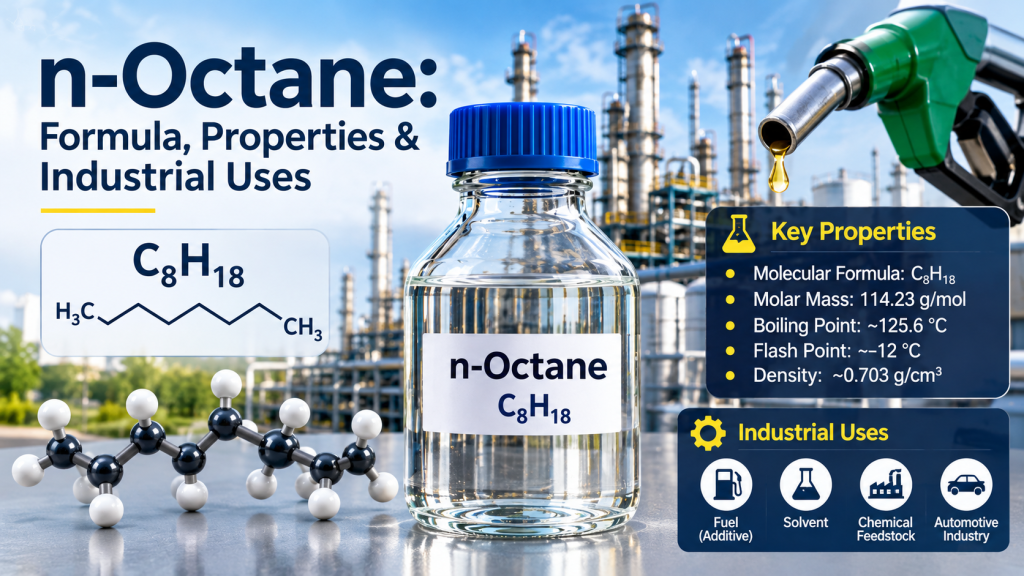
n-Octane is a straight-chain hydrocarbon with the formula C8H18 (CAS 111-65-9): a clear, colourless, highly flammable liquid that boils at about 125–126 °C. Its main uses are as a non-polar solvent, a cleaning and extraction medium, and an analytical reference standard. This guide gives buyers, formulators and lab managers verified data, grade selection advice and supply information.
n-Octane Quick Specifications
| Property | Value (conditions) |
|---|---|
| Chemical name / synonyms | n-Octane, normal octane, octane; oktan (Turkish); اکتان نرمال (Persian) |
| Molecular formula | C8H18; structural: CH3(CH2)6CH3 |
| CAS number | 111-65-9 |
| EC number | 203-892-1 |
| Molecular weight | 114.23 g/mol |
| Appearance | Clear, colourless liquid, gasoline-like odour |
| Boiling point | 125–126 °C (at 1013 hPa) |
| Melting point | −57 °C |
| Flash point | 13 °C (closed cup) |
| Density | 0.70 g/cm³ (at 20 °C) |
| Viscosity | 0.55 mPa·s (at 20 °C) |
| Vapour pressure | 14 hPa (at 20 °C) |
| Solubility in water | 0.0007 g/L (at 20 °C); soluble in ethanol and acetone |
| Explosive limits in air | 0.8–6.5 vol% |
| HS code | 2901 10 00 |
What Is n-Octane? Formula, Structure and Classification
n-Octane (normal octane) is an unbranched alkane with the molecular formula C8H18. It is a saturated hydrocarbon: it contains only carbon and hydrogen, joined by single bonds. So, yes, octane is a hydrocarbon, and a non-polar one.
The name “octane” can refer to any of the C8H18 isomers, so the CAS number 111-65-9 is what identifies the straight-chain form in purchase orders and customs paperwork. The full compound record, including the structure, is available in the PubChem record for octane (CID 356).

n-Octane Properties: Boiling Point, Flash Point and Density
Three numbers decide how n-octane behaves in a plant or warehouse:
- Boiling point 125–126 °C. It evaporates much more slowly than light alkanes such as n-pentane (about 36 °C), which gives better control in processes where drying speed matters.
- Flash point 13 °C (closed cup). This is below normal room temperature, so vapour can ignite without any heating. It is classified as a Category 2 flammable liquid.
- Density 0.70 g/cm³ and water solubility of only 0.0007 g/L. It floats on water and does not mix with it, so spills spread across the water surface instead of dissolving.
Its vapour is about 3.9 times heavier than air, and the explosive range is 0.8–6.5 vol% in air. Vapour can therefore travel along floors to a distant ignition source, which is why ventilation and ignition control are part of every handling procedure.
n-Octane vs Iso-Octane: Why “Octane Rating” Is a Different Topic
Many searches for “octane” are about fuel. The octane rating scale is anchored by iso-octane (2,2,4-trimethylpentane), which defines the 100 point, and n-heptane, which defines zero. You can compare the two isomers in the PubChem record for iso-octane (CID 10907).
n-Octane is the straight-chain isomer: CAS 111-65-9, boiling point about 125 °C, against about 99 °C for iso-octane. It is selected for its solvent behaviour and consistent composition, not as a fuel-rating reference. Treat any supplier claim of a “high octane rating” for n-octane with caution and confirm the CAS number.
Industrial Uses of n-Octane
1. Non-polar solvent and extraction medium
Role: dissolves non-polar organic materials such as oils, waxes and greases, and serves as a medium for extraction and purification. Suitable grade: commercial grades of about 98.5–99% (GC). The dosage depends on your formulation or process, so set it in trials with your own system.
2. Cleaning and degreasing
Role: cleaning solvent for non-polar residues on equipment and parts. Its moderate evaporation rate leaves less residue than very light solvents. Suitable grade: technical grade with a stated GC assay.
3. Analytical and reference standard
Role: reference compound for gas chromatography and for petroleum and hydrocarbon analysis. Suitable grade: analytical-standard grades of 99.7% (GC) or higher, supplied with a certificate of analysis.
4. Synthesis and reaction medium
Role: inert, non-polar medium for laboratory and fine-chemical synthesis. Suitable grade: “for synthesis” grades of 99% (GC) or higher.
n-Octane vs Other Solvents: How to Choose
| Property | n-Pentane | Iso-octane | n-Octane |
|---|---|---|---|
| Boiling point | 35.9–36.3 °C | 99.3 °C | 125–126 °C |
| Flash point | −49 °C | −12 °C | 13 °C |
| Density | 0.626 g/mL (20 °C) | 0.692 g/cm³ | 0.70 g/cm³ (20 °C) |
n-Octane has the highest boiling and flash points of the three, so it is the easiest to hold in an open process and the slowest to evaporate. The trade-off is that a slower-drying solvent needs more time or heat to leave a coating or part.
Because n-octane is non-polar, it is a poor choice for polar resins and binders. For those systems, polar ester solvents are the usual alternative: see ethyl acetate for coatings and inks (and our guide to ethyl acetate as an industrial solvent), n-butyl acetate supply and methyl acetate supply (read the methyl acetate applications guide).
How to Choose n-Octane Grade and Purity
- Assay (GC): about 98.5% is a common commercial grade, 99% or higher for synthesis, and 99.7% or higher for analytical standards.
- Density check: a typical lot-release range is 0.702–0.704 g/cm³ (d 20/4).
- Residue after evaporation: high-purity grades specify a maximum of about 0.05%. Ask for it if you use the solvent in coatings or electronics cleaning.
- Documents: request the SDS, a COA with GC assay and density, and the technical datasheet for every lot.
n-Octane Safety, Handling and Storage
| GHS hazard class | Hazard statement |
|---|---|
| Flammable liquid, Category 2 | H225: Highly flammable liquid and vapour |
| Aspiration hazard, Category 1 | H304: May be fatal if swallowed and enters airways |
| Skin irritation, Category 2 | H315: Causes skin irritation |
| STOT single exposure, Category 3 | H336: May cause drowsiness or dizziness |
| Aquatic hazard, Acute 1 / Chronic 1 | H410: Very toxic to aquatic life with long-lasting effects |
Exposure limits: NIOSH recommends 75 ppm as a time-weighted average with a 385 ppm 15-minute ceiling, OSHA lists a PEL of 500 ppm, ACGIH lists a TLV of 300 ppm, and the IDLH value is 1000 ppm. See the NIOSH Pocket Guide entry for octane for the full record.
Storage and handling: store in tightly closed containers below 30 °C, away from heat and ignition sources, as a Class 3 flammable liquid. Ground and bond containers during transfer, ventilate the work area, and keep the product out of drains because of the H410 aquatic hazard. Always follow the SDS and local regulations.
n-Octane Packaging and Supply
Industrial hydrocarbons are commonly supplied in drums, IBCs and ISO tanks. Confirm available packaging, minimum order quantity and delivery terms with our team. For customs documents, n-octane falls under HS code 2901 10 00 (acyclic saturated hydrocarbons), and every shipment should include an SDS and COA.
See the octane product page for specifications and supply or browse all industrial chemicals and solvents from Aasad Chemie.
Request a Quote, Datasheet or COA
Tell us the grade, quantity, packaging and delivery destination (Iran, India, Turkey or elsewhere), and we will send a quotation with the datasheet and COA. Contact the Aasad Chemie team to request a price.
Reviewed by the Aasad Chemie technical team. Last updated: November 1, 2026.
What is the chemical formula of n-octane?
n-Octane has the molecular formula C8H18 and the condensed structural formula CH3(CH2)6CH3, meaning eight carbon atoms in an unbranched chain. Its molecular weight is 114.23 g/mol and its CAS number is 111-65-9. Branched isomers share the same C8H18 formula but have different structures and properties, so always check the CAS number when ordering.
Is octane a hydrocarbon?
Yes. Octane is a saturated hydrocarbon of the alkane family, made only of carbon and hydrogen with single bonds. It is non-polar, which is why it barely dissolves in water (about 0.0007 g/L at 20 °C) but mixes with other hydrocarbons, ether, benzene and gasoline. This non-polar behaviour defines most of its solvent uses.
What are the boiling point and density of octane?
n-Octane boils at about 125–126 °C at 1013 hPa and freezes at −57 °C. Its density is roughly 0.70 g/cm³ at 20 °C, so it floats on water. Its flash point is 13 °C (closed cup), which makes it a highly flammable liquid that needs ignition-source control during handling and storage.
What is the difference between n-octane and iso-octane?
Both are C8H18 isomers. n-Octane is the straight-chain form (CAS 111-65-9, boiling point about 125 °C), while iso-octane is 2,2,4-trimethylpentane (CAS 540-84-1, boiling point about 99 °C). Iso-octane is the 100-point reference of the octane rating scale; n-octane is not the fuel-rating standard, and the two are not interchangeable.
Which grade of n-octane should I request, and what documents come with it?
Match purity to the job: about 98.5% (GC) is a common commercial grade, 99%+ is used for synthesis, and 99.7% analytical-standard grades serve chromatography. Ask for the SDS, a COA with GC assay and density, and the datasheet before ordering. Our team can confirm available grades.