

Table of Contents
- What Is Ethyl Acetate?
- Ethyl Acetate: Technical Specifications
- 7 Key Uses of Ethyl Acetate
- 1. Paints, Coatings, and Varnishes
- 2. Adhesives and Sealant Formulations
- 3. Printing Inks and Packaging Graphics
- 4. Pharmaceutical Manufacturing
- 5. Extraction and Separation of Organic Compounds
- 6. Polymer Processing and Resin Formulation
- 7. Laboratory Analysis and Sample Preparation
- Advantages and Limitations of Ethyl Acetate
- How to Select the Right Ethyl Acetate Grade
- Safety, Storage, and Handling
- Environmental Considerations
- Conclusion
- References
- What are the main industrial uses of ethyl acetate?
- Why is ethyl acetate used in coatings and inks?
- Is ethyl acetate used in pharmaceutical manufacturing?
- Is ethyl acetate a low-toxicity solvent?
- Is ethyl acetate environmentally friendly?
- What should buyers check before purchasing ethyl acetate?
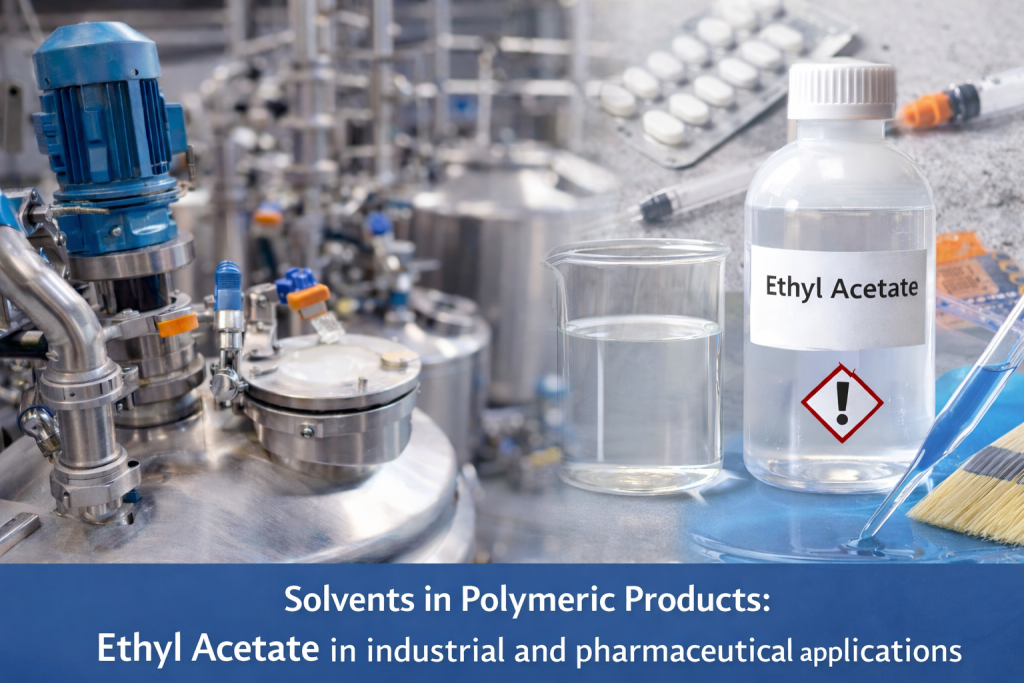
Ethyl Acetate is a volatile organic solvent used in coatings, adhesives, printing inks, pharmaceutical manufacturing, extraction, laboratory analysis, and polymer processing. Its ability to dissolve many organic compounds, combined with rapid evaporation and broad industrial utility, makes it valuable in applications where solvent compatibility and drying behavior must be carefully controlled.
What Is Ethyl Acetate?
Ethyl Acetate is an organic ester with the chemical formula C4H8O2. It is a colorless, volatile liquid with a characteristic fruity odor. Commercial production commonly involves the esterification of ethanol with acetic acid, although industrial manufacturing routes can vary.
In manufacturing, ethyl acetate is valued for its solvency, relatively low boiling point, and compatibility with many organic resins and formulation ingredients. However, its suitability depends on the specific material, process conditions, required purity, and applicable safety regulations.
Ethyl Acetate: Technical Specifications
| Property | Typical Value or Description |
|---|---|
| Chemical name | Ethyl acetate |
| Synonyms | Acetic acid ethyl ester; ethyl ethanoate |
| CAS number | 141-78-6 |
| Molecular formula | C4H8O2 |
| Molecular weight | 88.11 g/mol |
| Appearance | Clear, colorless liquid |
| Boiling point | Approximately 77.1°C at 101.3 kPa |
| Density | Approximately 0.90 g/cm³ at 20°C |
| Flash point | Approximately -4°C; method and test conditions affect the reported value |
| Water solubility | Limited; approximately 80–90 g/L near room temperature |
| Primary characteristics | Volatile ester solvent with good solvency for many organic compounds |
Values are representative reference data, not a product specification. Confirm the applicable test method, purity, and supplier documentation before using ethyl acetate in a regulated or process-critical application. For additional chemical identification data, consult PubChem’s ethyl acetate record.
7 Key Uses of Ethyl Acetate
1. Paints, Coatings, and Varnishes
One of the major uses of ethyl acetate is as a solvent in selected paints, varnishes, and industrial coating formulations. It helps dissolve compatible resins, adjust formulation viscosity, and control the drying profile during application.
Because ethyl acetate evaporates relatively quickly, it can support shorter drying times in suitable systems. However, excessively rapid evaporation may cause poor flow, uneven film formation, or other surface defects if the formulation and application conditions are not balanced.
Selection factors: Resin compatibility, coating thickness, application temperature, airflow, desired drying time, and the presence of other solvents all influence performance.
2. Adhesives and Sealant Formulations
Ethyl acetate is used in selected solvent-based adhesives, particularly formulations containing compatible polymers and resins. It can help dissolve adhesive components and support wetting and spreading across a substrate before the solvent evaporates.
Adhesive performance depends on more than the solvent alone. Polymer selection, substrate surface energy, adhesive coat weight, open time, and drying conditions influence the final bond. Ethyl acetate may be appropriate for some rubber-based and resin-based systems, but it is not universally compatible with every adhesive polymer or substrate.
Manufacturers should test the complete formulation on the intended materials, especially when bonding plastics that may soften, swell, or craze after solvent exposure.
3. Printing Inks and Packaging Graphics
Ethyl acetate is used in certain printing inks, including selected flexographic and gravure formulations. It can dissolve compatible binders and help control ink viscosity and drying behavior during high-speed printing.
In packaging production, solvent selection affects print quality, color consistency, press speed, and residual-solvent management. The optimum evaporation profile must allow adequate transfer and leveling while supporting efficient drying.
For food packaging and other sensitive uses, manufacturers must assess the complete ink system, substrate, curing or drying conditions, and applicable migration or residual-solvent requirements. The presence of ethyl acetate in an ink does not, by itself, establish that the finished packaging is suitable for food contact.
4. Pharmaceutical Manufacturing
Ethyl acetate can serve as a process solvent in pharmaceutical manufacturing, particularly during extraction, purification, crystallization, and selected chemical synthesis steps. Its usefulness depends on the solubility of the target compound, separation requirements, and compatibility with other process materials.
Pharmaceutical applications require careful control of solvent quality, impurities, recovery procedures, and residual levels in the finished substance or product. Ethyl acetate is listed as a Class 3 solvent in the ICH Q3C residual-solvents guidance, which addresses solvents with relatively low toxic potential under the guideline’s conditions. This classification does not mean that every use or exposure is risk-free.
Pharmaceutical manufacturers must apply the relevant current regulatory guidance and establish appropriate limits based on the product, process, and intended use. Ethyl acetate should not be described as automatically suitable for capsules, injectable products, or any other finished dosage form without application-specific validation.
See the ICH quality guidelines for official guidance related to pharmaceutical quality and residual solvents.
5. Extraction and Separation of Organic Compounds
Ethyl acetate is widely used as an extraction solvent in chemical processing, natural-product research, and analytical workflows. Its usefulness comes from its ability to dissolve many organic compounds while remaining only partially miscible with water.
In liquid-liquid extraction, a compound may preferentially partition into the ethyl acetate-rich phase rather than the aqueous phase. The actual distribution depends on the compound’s chemical structure, pH, temperature, solvent ratio, and other components in the mixture.
Applications can include extracting selected organic acids, neutral compounds, and constituents from natural materials. Process developers should evaluate extraction yield, selectivity, phase separation, solvent recovery, and impurity carryover before scaling up.
6. Polymer Processing and Resin Formulation
Ethyl acetate is used in selected polymer and resin systems where its solvency profile matches the material being processed. It may help prepare polymer solutions, adjust viscosity, and support the production of films, coatings, laminates, and other solvent-based products.
Compatibility must be confirmed for each polymer grade. A solvent that dissolves one resin may swell, precipitate, or fail to dissolve another. Processing teams should also consider the solvent’s evaporation rate, residual-solvent requirements, and potential effects on film formation and mechanical properties.
Ethyl acetate should not be assumed to dissolve all polymers or to be suitable for every composite or plastic manufacturing process. Laboratory compatibility tests and formulation trials are important before commercial implementation.
7. Laboratory Analysis and Sample Preparation
Laboratories use ethyl acetate for sample extraction, chromatographic preparation, and other analytical procedures. Its solvent properties can help transfer selected analytes into a suitable liquid phase, while its volatility can simplify solvent removal when the method permits.
The required grade depends on the analytical technique. Trace analysis may require high-purity solvent with controlled contaminant levels, while routine industrial testing may have different specifications. For chromatography and regulated testing, laboratories should follow the validated method and supplier purity specifications rather than substituting solvents solely on cost.
Advantages and Limitations of Ethyl Acetate
| Characteristic | Practical Benefit | Important Limitation |
|---|---|---|
| Good organic solvency | Useful for many resins and organic compounds | Not compatible with every polymer or formulation ingredient |
| Rapid evaporation | Can support fast-drying processes | May cause flow or film defects if evaporation is too rapid |
| Relatively low boiling point | Can facilitate solvent removal | Requires effective vapor control and appropriate process design |
| Partial miscibility with water | Useful in selected liquid-liquid extraction systems | Partitioning and separation depend on the mixture and conditions |
| Potential for solvent recovery | May reduce fresh-solvent demand in suitable processes | Recovery requires appropriate equipment, energy, and impurity control |
How to Select the Right Ethyl Acetate Grade
Choosing ethyl acetate for industrial or pharmaceutical use requires more than checking its chemical name. Buyers and process engineers should evaluate the following factors:
- Purity and grade: Match the specification to the application, whether industrial, laboratory, food-related, or pharmaceutical.
- Solvent compatibility: Verify solubility and stability with the target resin, active ingredient, adhesive polymer, or extracted compound.
- Evaporation requirements: Assess drying time, ventilation, process temperature, and the possibility of residual solvent.
- Regulatory requirements: Confirm applicable limits and documentation for the destination market and end use.
- Storage and handling: Consider flammability controls, container compatibility, grounding, ventilation, and safe transfer procedures.
- Recovery and waste management: Determine whether solvent recovery is technically and economically practical for the process.
For industrial sourcing, compare the supplier’s certificate of analysis and safety data sheet with the required specification. You can review the AasadChimie products page or contact the team with your application and grade requirements.
Safety, Storage, and Handling
Ethyl acetate is a highly flammable liquid. Its vapor can form ignitable mixtures with air and may travel to an ignition source. Handling systems should therefore control ignition risks and provide suitable ventilation.
- Store containers in a cool, well-ventilated area away from heat, sparks, flames, and incompatible materials.
- Use suitable closed-transfer or vapor-control systems where required by the process.
- Select gloves, eye protection, and other personal protective equipment based on the safety data sheet and the exposure assessment.
- Ground and bond relevant containers and transfer equipment when needed to control static discharge.
- Prevent uncontrolled releases and follow applicable procedures for spill response, waste collection, and fire protection.
Ethyl acetate can irritate the eyes and may cause dizziness or other effects at elevated vapor concentrations. Its risk depends on the exposure level, duration, and conditions. Consult the current safety data sheet and applicable occupational-safety requirements before handling the solvent.
The NIOSH Pocket Guide to Chemical Hazards is a useful occupational-safety reference for evaluating chemical hazards and exposure controls.
Environmental Considerations
Ethyl acetate can biodegrade under suitable environmental conditions, but biodegradability alone does not establish that a solvent is environmentally harmless. Releases to air, water, or soil should be prevented, and disposal must follow local requirements.
Ethyl acetate is a volatile organic compound (VOC). Its use may contribute to workplace vapor exposure and atmospheric emissions, depending on the process and applicable regulatory definitions. It should not be described as a zero-VOC solvent. Closed systems, effective ventilation, vapor capture, and solvent recovery may help reduce emissions and solvent losses.
Manufacturers comparing solvents should consider the full process, including worker exposure, fire risk, solvent consumption, recovery energy, emissions, and waste treatment. The most suitable option depends on both technical performance and the site’s environmental and regulatory obligations.
Conclusion
Ethyl acetate is an important solvent across coatings, adhesives, printing inks, pharmaceutical processing, extraction, polymer formulation, and laboratory analysis. Its solvency and relatively rapid evaporation can improve process performance when the solvent is compatible with the material and the production conditions.
For reliable results, manufacturers should verify the required grade, test formulation compatibility, control flammable vapors, and follow the relevant safety and regulatory requirements. Careful solvent selection helps balance process efficiency, product quality, worker protection, and environmental management.
References
- PubChem – Ethyl Acetate
- International Council for Harmonisation (ICH) – Quality Guidelines
- NIOSH Pocket Guide to Chemical Hazards
What are the main industrial uses of ethyl acetate?
Ethyl acetate is used in coatings, adhesives, printing inks, pharmaceutical processing, extraction, polymer formulation, and laboratory analysis.
Why is ethyl acetate used in coatings and inks?
It can dissolve compatible resins and help control viscosity and drying behavior. The final performance depends on the complete formulation and application conditions.
Is ethyl acetate used in pharmaceutical manufacturing?
Yes. It can be used as a process solvent for extraction, purification, and synthesis. Its suitability depends on the process, solvent quality, residual-solvent controls, and applicable regulatory requirements.
Is ethyl acetate a low-toxicity solvent?
It is often considered a useful solvent alternative in certain applications, but it is still flammable and can cause irritation or effects from vapor exposure. Risk depends on the conditions of use.
Is ethyl acetate environmentally friendly?
It can biodegrade under suitable conditions, but it is still a VOC and requires appropriate emission, waste, and exposure controls. Environmental impact depends on the full life cycle and use scenario.
What should buyers check before purchasing ethyl acetate?
Buyers should verify purity, grade, relevant test specifications, certificate of analysis, safety data sheet, application compatibility, and any regulatory requirements.
Thanks