


Table of Contents
- MEK Solvent: Technical Specifications
- What Makes MEK Different from Other Solvents?
- Where Is MEK Solvent Used?
- 1. Paints and Industrial Coatings
- 2. Adhesives and Bonding Formulations
- 3. Printing Inks and Packaging
- 4. Polymer and Rubber Processing
- 5. Industrial Cleaning and Surface Preparation
- MEK vs. Acetone: Which Solvent Should You Choose?
- How to Select the Right MEK Grade
- Safety, Storage, and Handling
- Conclusion
- What is MEK solvent mainly used for?
- What is the chemical formula of MEK?
- Does MEK evaporate faster than acetone?
- Can MEK be used on all plastics?
- Is MEK solvent flammable?
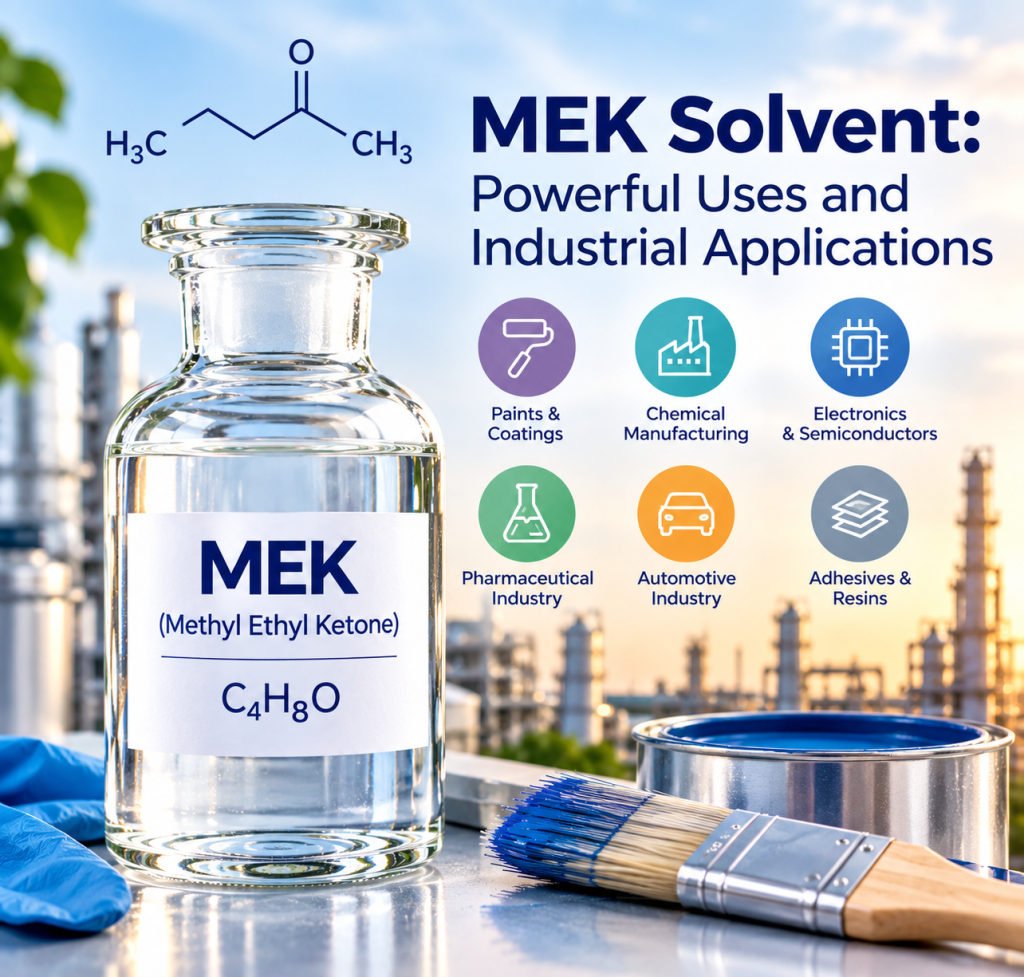
MEK solvent, also known as methyl ethyl ketone or 2-butanone, is a fast-evaporating industrial solvent used in coatings, printing inks, adhesives, and selected manufacturing processes. Its ability to dissolve many resins and organic compounds makes it valuable in formulations that require effective solvency and controlled drying.
With the molecular formula C4H8O and CAS number 78-93-3, MEK is a clear, colorless, highly flammable liquid. Its performance depends on the formulation, substrate, and process conditions, so manufacturers should verify compatibility before use.
MEK Solvent: Technical Specifications
| Property | Typical Reference Value |
|---|---|
| Chemical name | 2-Butanone |
| Common names | Methyl Ethyl Ketone, MEK, Butan-2-one |
| Molecular formula | C4H8O |
| CAS number | 78-93-3 |
| EC number | 201-159-0 |
| Molecular weight | 72.11 g/mol |
| Appearance | Clear, colorless liquid |
| Boiling point | Approximately 79.6°C at atmospheric pressure |
| Melting point | Approximately -86°C |
| Flash point | Approximately -9°C, closed-cup reference value; method-dependent |
| Density | Approximately 0.805 g/cm³ at 20°C |
| Dynamic viscosity | Approximately 0.4 mPa·s at 20°C |
| Water solubility | Miscible to a limited extent; approximately 290 g/L at 20°C |
Note: Values are approximate reference data and can vary with temperature, test method, and product specification. Consult the supplier’s Technical Data Sheet (TDS) and Certificate of Analysis (CoA) for the exact commercial grade.
What Makes MEK Different from Other Solvents?
MEK is a ketone solvent with strong solvency for many resins, polymers, and organic substances. Its boiling point of approximately 79.6°C supports relatively rapid evaporation, making it useful in processes where drying time influences production speed.
Compared with acetone, MEK generally evaporates more slowly and may offer a different balance of solvency and drying behavior. The best choice depends on the resin system, required film properties, substrate compatibility, and workplace controls. Review the PubChem reference for 2-butanone for additional chemical information.
Where Is MEK Solvent Used?
1. Paints and Industrial Coatings
MEK is used in selected solvent-based paints, lacquers, and industrial coatings. It can dissolve compatible resins and help control formulation viscosity and evaporation during application.
Coating manufacturers should evaluate the solvent against resin compatibility, film formation, drying time, and the properties of the target surface. A suitable formulation must also meet applicable emissions and workplace safety requirements.
2. Adhesives and Bonding Formulations
Some solvent-based adhesives use MEK to dissolve compatible polymers and resins. As the solvent evaporates, the adhesive system can develop the characteristics required for bonding, depending on its chemistry and application method.
Selection depends on the adhesive polymer, substrate, open time, and required bond performance. Because MEK can affect certain plastics and elastomers, compatibility testing is important before production use.
3. Printing Inks and Packaging
MEK is used in certain industrial printing inks, including formulations designed for fast production processes. Its solvency can help dissolve compatible ink resins, while its evaporation rate can support drying on suitable substrates.
Ink manufacturers should consider print speed, substrate type, resin chemistry, drying equipment, and solvent recovery or ventilation requirements when designing a formulation.
4. Polymer and Rubber Processing
Selected polymer and rubber operations use MEK as a solvent for compatible materials or as part of surface preparation and formulation processes. Its effectiveness varies considerably by polymer type.
MEK is not compatible with every plastic or elastomer and may soften, swell, or damage certain materials. Manufacturers should consult material compatibility data and test the solvent under representative process conditions.
5. Industrial Cleaning and Surface Preparation
MEK can remove selected resin deposits, adhesive residues, oils, and other organic contaminants from compatible equipment and surfaces. Its rapid evaporation may reduce waiting time before a subsequent manufacturing step.
However, its flammability and solvency make it unsuitable for some cleaning environments and materials. Buyers should compare alternatives based on cleaning effectiveness, residue, drying time, worker exposure, and fire risk.
MEK vs. Acetone: Which Solvent Should You Choose?
| Consideration | MEK | Acetone |
|---|---|---|
| Boiling point | Approximately 79.6°C | Approximately 56.1°C |
| Evaporation | Generally slower | Generally faster |
| Solvency | Effective for many compatible resins and polymers | Effective for many organic compounds and selected resins |
| Typical selection factor | Balance of solvency and drying behavior | Rapid evaporation and cleaning requirements |
Neither solvent is universally better. The correct option depends on the formulation, drying requirements, substrate compatibility, cost, and safety controls. Testing under actual operating conditions is recommended before replacing one solvent with another.
How to Select the Right MEK Grade
Industrial buyers should review these factors before purchasing:
- Purity: Verify the assay and allowable impurities.
- Moisture content: Confirm water limits for moisture-sensitive formulations.
- Process compatibility: Check the resin, polymer, coating, or substrate involved.
- Quality documentation: Request a current CoA and Safety Data Sheet (SDS), as well as a TDS when available.
- Supply requirements: Confirm packaging compatibility, batch consistency, and delivery conditions.
The right grade should meet the formulation’s technical specifications and the applicable regulatory requirements. A general industrial grade should not automatically be substituted for a grade with stricter purity limits.
Safety, Storage, and Handling
MEK is highly flammable and produces vapors that can ignite when exposed to flames, sparks, hot surfaces, or other ignition sources. Use it only with appropriate ventilation and suitable controls for flammable solvents.
Keep containers tightly closed and store them in a designated area away from ignition sources. Use appropriate protective equipment, follow the supplier’s SDS, and implement procedures for spill response and fire prevention. Avoid breathing concentrated vapors and prevent unnecessary skin or eye contact.
Facilities should follow applicable requirements for flammable-liquid storage, transport, and waste management. Consult the NIOSH Pocket Guide to Chemical Hazards and the product-specific SDS for additional safety guidance.
Conclusion
MEK solvent is used in selected coatings, adhesives, printing inks, polymer processes, and industrial cleaning applications. Its solvency and relatively rapid evaporation can support efficient manufacturing, but the suitability of the solvent depends on formulation requirements, substrate compatibility, and workplace controls.
Before purchasing, compare purity, moisture content, technical documentation, and the needs of the intended process. Explore the Aasad Chimie product directory or contact Aasad Chimie to discuss industrial chemical sourcing requirements.
What is MEK solvent mainly used for?
MEK is used in selected paints, coatings, adhesives, printing inks, polymer processes, and industrial cleaning applications.
What is the chemical formula of MEK?
Its molecular formula is C₄H₈O, and its CAS number is 78-93-3.
Does MEK evaporate faster than acetone?
No. Acetone has a lower boiling point and generally evaporates faster than MEK under comparable conditions.
Can MEK be used on all plastics?
No. It can damage or affect certain plastics and elastomers. Material compatibility should be checked before use.
Is MEK solvent flammable?
Yes. MEK is highly flammable and requires suitable ventilation, ignition-source control, and appropriate storage procedures.