


Table of Contents
PP impact testing evaluates the resistance of polypropylene (PP) to sudden loading and helps manufacturers compare impact performance under standardized conditions. Izod and Charpy are two widely used methods for assessing the impact behaviour of plastics. Understanding the differences between these methods helps manufacturers select suitable polypropylene grades for industrial components, packaging, automotive parts, and other applications exposed to sudden mechanical stress.
What Is PP Impact Testing?
PP impact testing measures how a polypropylene specimen responds when struck by a moving pendulum. The test determines the energy absorbed during fracture or impact, according to the applicable testing method. This information helps engineers evaluate material performance and compare different polypropylene formulations.
Impact resistance is an important consideration when selecting polypropylene compounds for products that may experience drops, collisions, handling damage, or sudden loads. However, impact-test results should be interpreted alongside other mechanical properties rather than used as the only measure of material quality.
The reliability of PP impact testing depends on specimen dimensions, notch configuration, temperature, conditioning, and the selected test standard. Consistent testing conditions are essential when comparing different grades or formulations.
Izod vs Charpy: What Is the Difference?
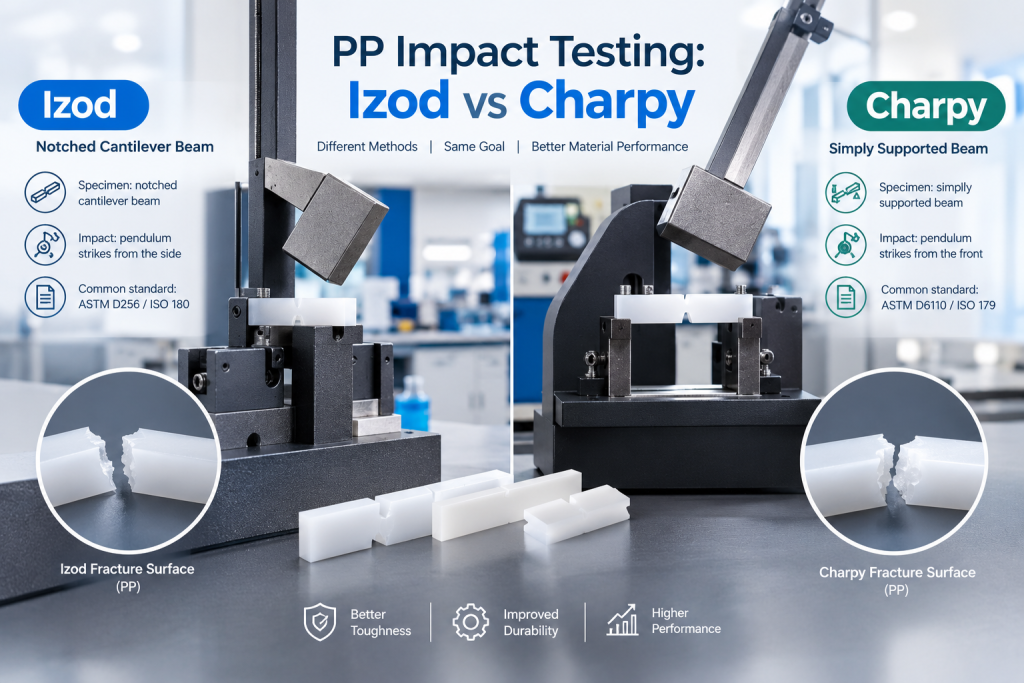
Izod and Charpy tests use a pendulum impact machine, but they differ in specimen arrangement and impact configuration. These differences affect how the specimen is supported and how the resulting measurements should be interpreted.
| Feature | Izod Test | Charpy Test |
|---|---|---|
| Specimen arrangement | Typically held vertically as a cantilever | Typically supported horizontally at both ends |
| Impact configuration | The specimen is struck above its support or clamp according to the method | The specimen is struck between its supports |
| Common standard | ISO 180 | ISO 179-1 |
| Typical application | Comparing impact performance under specified Izod conditions | Comparing impact performance under specified Charpy conditions |
| Key variables | Notch, dimensions, temperature, and conditioning | Notch, dimensions, support span, temperature, and conditioning |
Neither method is universally superior. The appropriate choice depends on the product specification, customer requirements, and applicable test standard. When comparing polypropylene grades, PP impact testing should use the same method, specimen configuration, and temperature to ensure meaningful results.
For detailed requirements, consult the official standards: ISO 180 for Izod impact strength and ISO 179-1 for Charpy impact properties. Confirm the applicable edition and requirements before testing.
How Is Polypropylene Impact Strength Measured?
Impact results may be reported as absorbed energy or impact strength, depending on the test method and reporting requirements. Absorbed energy is commonly expressed in joules (J), while impact strength may be reported in kilojoules per square metre (kJ/m²) when calculated according to the relevant standard.
These measurements are not interchangeable. Absorbed energy describes the energy recorded during the test, whereas impact strength is calculated according to the applicable method and specimen dimensions. Always check the units and calculation method before comparing laboratory reports.
A useful report should identify the test standard, specimen dimensions, notch configuration, conditioning procedure, test temperature, and units. Without these details, comparisons between suppliers or formulations may be misleading.
How Does Temperature Affect PP Impact Testing?
Temperature is an important variable in PP impact testing because polypropylene can respond differently to sudden loading at room temperature and at lower service temperatures. The magnitude of this change depends on the polymer grade, formulation, specimen preparation, and test conditions.
For components used in cold storage, outdoor environments, or refrigerated logistics, testing at a relevant service temperature can provide more useful information than relying exclusively on room-temperature results.
When comparing two polypropylene materials, use consistent temperature and conditioning procedures. Otherwise, differences in test results may reflect the testing environment rather than the actual performance of the formulations.
Notched vs Unnotched Impact Tests
A notch creates a defined stress-concentration point that can affect crack initiation and propagation. Notched impact tests help assess material behaviour under this controlled condition, while unnotched tests evaluate impact response without a prepared notch.
Notched and unnotched results should be reported and interpreted separately because they represent different test configurations. The notch dimensions, specimen preparation, and testing procedure must comply with the selected standard.
For reliable PP impact testing, laboratories should use consistent specimen preparation and inspect samples for defects that could affect the result. Even small differences in geometry or preparation may reduce the comparability of measurements.
What Factors Affect PP Impact Test Results?
- Polypropylene grade: Different PP grades can have different impact behaviour because of variations in polymer structure and grade specifications.
- Formulation and additives: Impact modifiers, mineral fillers, and other additives can change the balance between stiffness and impact resistance.
- Specimen preparation: Moulding conditions, dimensions, and surface defects can influence the measured response.
- Notch geometry: Notch dimensions and preparation affect stress concentration and fracture behaviour.
- Temperature and conditioning: Different test environments may produce different results.
- Test method: Izod and Charpy tests use different configurations, so their results should not be treated as directly equivalent.
Reliable PP impact testing requires consistent specimen preparation, controlled conditioning, and accurate reporting of test conditions. For formulation development, impact results should also be evaluated alongside tensile strength, flexural modulus, heat resistance, and other properties relevant to the intended application.
Manufacturers investigating formulation options can read more about polypropylene impact modifiers and the types and uses of plastic additives.
How to Choose the Right Impact Test for PP Compounds
Start with the product specification or customer requirement. Confirm whether Izod or Charpy testing is required, identify the applicable standard and edition, and establish the specimen geometry, notch configuration, and test temperature.
If a polypropylene component will operate under demanding environmental conditions, consider whether additional testing at representative service temperatures is appropriate. The test plan should reflect the actual performance requirements rather than rely on a single result obtained under unrelated conditions.
When comparing suppliers, request reports that use consistent test methods and clearly state the specimen details, units, and test conditions. This makes it easier for procurement, quality, and engineering teams to assess material data accurately.
Conclusion
PP impact testing helps manufacturers evaluate the impact resistance of polypropylene grades and make better-informed material selection decisions. Izod and Charpy methods both provide useful information, but their specimen configurations and results are not directly interchangeable.
Standardized specimen preparation, controlled temperature, accurate reporting, and consistent test methods are essential for meaningful comparisons. For industrial applications, impact performance should also be considered alongside stiffness, tensile properties, heat resistance, and the product’s intended service conditions.
To explore available materials, visit the Aasad Chimie products page. You can also browse our technical article library or contact Aasad Chimie to discuss your industrial material requirements.