


Table of Contents
- Quick Answer: How Can You Improve PP Melt Flow?
- Why PP Melt Flow Matters in Manufacturing
- Main Factors Affecting Polypropylene Melt Flow
- 8 Methods to Improve PP Melt Flow
- 1. Select the Right Polypropylene Resin Grade
- 2. Optimize Processing Temperatures
- 3. Evaluate Compatible Plastic Processing Additives
- 4. Improve Filler Dispersion
- 5. Optimize Calcium Carbonate Loading
- 6. Monitor Melt Flow Rate Consistently
- 7. Maintain Extrusion Equipment
- 8. Balance Screw Speed and Production Rate
- Industries That Benefit from Optimized PP Melt Flow
- Common Mistakes That Affect Polypropylene Processing
- Supporting Chemicals for Polypropylene Processing
- Conclusion
- References
- What causes poor melt flow in polypropylene?
- How can you improve polypropylene melt flow?
- Can processing additives improve polypropylene melt flow?
- How does calcium carbonate affect polypropylene melt flow?
- What is the difference between MFR and MFI?
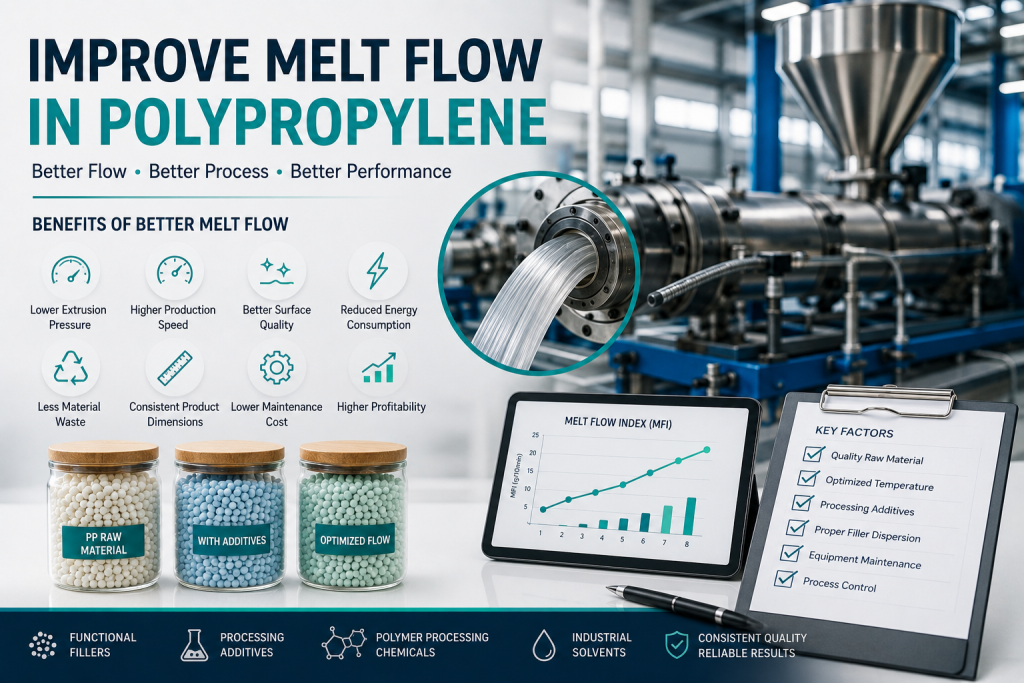
PP Melt Flow is an important factor in polypropylene manufacturing because it affects processing stability, production speed, surface quality, and material waste. Manufacturers can optimize melt flow by selecting the correct resin grade, controlling processing temperatures, improving filler dispersion, using compatible additives, and maintaining extrusion equipment.
These methods are relevant to polypropylene applications such as woven bags, raffia tapes, BOPP films, injection-molded components, pipes, and plastic packaging. The appropriate solution depends on the polymer grade, equipment design, and final product requirements.
Quick Answer: How Can You Improve PP Melt Flow?
To improve PP melt flow, select a suitable polypropylene grade, optimize barrel temperatures, maintain consistent material feeding, evaluate compatible processing additives, control filler loading, and monitor equipment performance. Always validate adjustments through controlled production trials to avoid polymer degradation or reduced product quality.
Why PP Melt Flow Matters in Manufacturing
Melt flow describes how molten polypropylene moves under specified processing conditions. The Melt Flow Rate (MFR), often called the Melt Flow Index (MFI) in industry, is a standardized measurement used to compare the flow behavior of thermoplastics under defined test conditions.
Inadequate or inconsistent flow behavior may contribute to:
- High extrusion pressure
- Uneven product dimensions
- Rough or inconsistent surface finishes
- Unstable production rates
- Higher scrap and material waste
- Inconsistent filling during injection molding
- Unplanned production interruptions
These symptoms can also result from equipment wear, contamination, poor temperature control, or incorrect die design. Therefore, manufacturers should identify the underlying cause before changing the resin formulation.
Main Factors Affecting Polypropylene Melt Flow
| Factor | Potential Effect | What to Check |
|---|---|---|
| Resin grade | Changes flow behavior | MFR specification and consistency |
| Processing temperature | Changes melt viscosity | Recommended temperature profile |
| Material feeding | Affects process stability | Feed rate and consistency |
| Processing additives | May improve processing behavior | Compatibility and dosage |
| Filler loading and dispersion | Can change viscosity and pressure | Filler type, concentration, and distribution |
| Equipment condition | May cause pressure fluctuations | Screw, die, filters, and sensors |
8 Methods to Improve PP Melt Flow
1. Select the Right Polypropylene Resin Grade
Choosing the correct polypropylene resin is the first step toward stable processing. Different grades have different molecular characteristics and melt flow rates, making them suitable for different manufacturing processes.
For example, a grade used for injection molding may not be suitable for a woven tape or film application. Compare the supplier’s MFR specification with the requirements of the finished product and processing equipment.
Do not select a resin solely because it has a higher MFR. Mechanical strength, impact resistance, dimensional stability, and end-use requirements must also be considered.
2. Optimize Processing Temperatures
Processing temperature influences polypropylene melt viscosity. Temperatures that are too low may cause excessive pressure or incomplete filling, while excessive heat or prolonged residence time can contribute to polymer degradation.
Establish a suitable barrel temperature profile according to the resin manufacturer’s technical data sheet, equipment design, and production conditions. Monitor actual melt temperature where possible instead of relying only on heater setpoints.
Make adjustments gradually and evaluate their effects on pressure, output, surface appearance, and mechanical properties.
3. Evaluate Compatible Plastic Processing Additives
Selected processing additives can improve processing stability, reduce certain forms of friction, or support more consistent material flow. Their performance depends on the additive chemistry, polymer grade, dosage, and application.
Before introducing an additive, establish a production baseline and compare results under controlled conditions. Measure relevant indicators such as extrusion pressure, throughput, scrap rate, and finished-product quality.
Read our guide to plastic processing additives to learn more about their role in polymer manufacturing.
4. Improve Filler Dispersion
Fillers can affect the viscosity, surface quality, and mechanical properties of polypropylene compounds. Poor dispersion may cause agglomerates, inconsistent material properties, and visible defects.
Review filler compatibility, masterbatch quality, feeding consistency, mixing conditions, and screw configuration. A well-dispersed formulation can provide more consistent processing, although the result depends on the specific filler and polymer system.
Explore our resources on functional fillers and functional filler powder for more information.
5. Optimize Calcium Carbonate Loading
Calcium carbonate filler masterbatch is used in selected polypropylene applications to manage formulation costs and modify material properties. However, increasing the filler concentration does not automatically improve melt flow.
Excessive loading or poor dispersion may increase processing resistance, affect surface appearance, or reduce impact performance. Test different concentrations while monitoring extrusion pressure, product quality, and mechanical properties.
Our guide to calcium carbonate filler masterbatch explains important formulation considerations.
6. Monitor Melt Flow Rate Consistently
Regular MFR testing helps manufacturers identify variations between polypropylene batches. A change in measured MFR may indicate a difference in resin grade, material condition, or polymer characteristics.
Use a standardized test method, consistent sample preparation, and the specified test temperature and load. Compare results with the supplier’s specification and the production team’s acceptance limits.
MFR is useful for quality control, but it does not describe every aspect of polymer rheology. Two materials with similar MFR values may behave differently under actual processing conditions.
7. Maintain Extrusion Equipment
Equipment condition can affect melt pressure, material flow, and production consistency. Worn screws, contaminated dies, blocked screen packs, and inaccurate temperature sensors may contribute to processing problems.
Preventive maintenance should include:
- Inspecting and cleaning dies according to equipment procedures
- Checking screen packs and melt filters for blockage
- Inspecting screws and barrels for wear
- Verifying temperature sensors and control systems
- Monitoring melt pressure and pressure fluctuations
- Checking cooling and material-feeding systems
Regular maintenance can help reduce unplanned downtime and make it easier to identify the actual cause of unstable melt flow.
8. Balance Screw Speed and Production Rate
Increasing screw speed or material feed rate without adjusting other process conditions may cause unstable output, excessive pressure, or inconsistent product quality. The optimal settings depend on the extruder design, resin grade, die, and cooling system.
Evaluate screw speed, feed rate, temperature profile, and cooling conditions together. Record the settings that produce stable output and acceptable product properties, then use them as a baseline for future production runs.
| Parameter | Production Objective |
|---|---|
| Screw speed | Stable and consistent output |
| Temperature profile | Suitable melt viscosity without degradation |
| Feed rate | Consistent material supply |
| Cooling conditions | Consistent dimensions and shape |
| Pressure monitoring | Early detection of process variation |
Industries That Benefit from Optimized PP Melt Flow
| Application | Potential Benefit |
|---|---|
| Woven bags and raffia tapes | More consistent tape production |
| BOPP film manufacturing | Improved process stability |
| Injection molding | More consistent mold filling |
| Plastic pipe production | Better control of dimensions |
| Plastic packaging | Reduced processing variation |
| Automotive components | Consistent processing and product quality |
Manufacturers in India, Turkey, and other industrial markets can apply these methods to improve production consistency. Actual cost savings depend on the resin, equipment, energy costs, production volume, and quality requirements of each facility.
Common Mistakes That Affect Polypropylene Processing
- Changing resin grades without checking end-use requirements
- Increasing temperature without considering polymer degradation
- Adding excessive filler without testing product performance
- Using incompatible processing additives
- Ignoring changes in melt pressure or MFR
- Operating equipment with blocked filters or worn components
- Increasing production speed without validating process stability
- Comparing materials tested under different MFR conditions
A systematic troubleshooting process helps manufacturers distinguish material-related issues from equipment and operating problems before making expensive changes.
Supporting Chemicals for Polypropylene Processing
Specialty chemicals and processing additives may support particular manufacturing requirements, but their selection should be based on the application and verified performance data.
Read our guide to polymer processing chemicals for more information about materials used in polymer production. You can also learn how to reduce extrusion defects through better process control.
To explore available materials, visit the AasadChimie products page. For product specifications or application-related inquiries, use our contact page.
Conclusion
Optimizing PP Melt Flow requires a combination of suitable resin selection, temperature control, compatible additives, proper filler dispersion, routine MFR testing, and equipment maintenance. No single adjustment works for every polypropylene application.
Manufacturers should identify the underlying processing issue, make controlled adjustments, and verify results against production efficiency and finished-product specifications. This approach helps improve process consistency while avoiding unnecessary formulation changes or quality compromises.
References
What causes poor melt flow in polypropylene?
Poor melt flow may result from an unsuitable resin grade, low processing temperatures, inconsistent material feeding, excessive filler loading, contamination, or equipment problems.
How can you improve polypropylene melt flow?
You can improve processing behavior by selecting a suitable resin grade, optimizing temperature settings, checking material feeding, evaluating compatible additives, and maintaining extrusion equipment.
Can processing additives improve polypropylene melt flow?
Yes. Some processing additives can improve processing stability or reduce friction under suitable conditions. Their effectiveness depends on the additive chemistry, polymer grade, dosage, and manufacturing process.
How does calcium carbonate affect polypropylene melt flow?
Calcium carbonate can change the flow behavior and viscosity of polypropylene compounds. The effect depends on filler concentration, particle characteristics, dispersion, and the polymer formulation.
What is the difference between MFR and MFI?
Melt Flow Rate (MFR) is the standardized term commonly used for measuring the mass of thermoplastic flowing through a specified die under defined conditions. Melt Flow Index (MFI) is a widely used industry term for this measurement.