


Table of Contents
- What Is the Best Industrial Solvent for Manufacturing?
- Why Industrial Solvent Selection Matters
- Key Factors for Choosing an Industrial Solvent
- 1. Solvency Power and Chemical Compatibility
- 2. Evaporation Rate and Drying Time
- 3. Purity and Product Consistency
- 4. Viscosity, Solubility, and Formulation Requirements
- 5. Safety, Flammability, and Exposure
- 6. VOC Emissions and Environmental Compliance
- 7. Total Cost of Use
- Main Types of Industrial Solvents
- Popular Industrial Solvents Compared
- How to Choose a Solvent for Different Industries
- Paints and Coatings
- Printing Inks
- Plastic Manufacturing
- Adhesives and Sealants
- Electronics and Precision Cleaning
- Battery and Specialty Chemical Manufacturing
- Common Mistakes When Selecting an Industrial Solvent
- Industrial Solvent Safety and Storage
- How to Evaluate an Industrial Solvent Supplier
- How to Compare Solvent Suppliers Before Buying
- Industrial Solvent Market Trends
- Conclusion
- References
- Why Choose AasadChimie?
- What is the best industrial solvent for manufacturing?
- Which industrial solvent is best for cleaning?
- How do manufacturers choose the correct solvent grade?
- Why is solvent evaporation rate important?
- How can manufacturers reduce industrial solvent costs?
- What documents should an industrial solvent supplier provide?
- What should buyers check before switching to another solvent?
Selecting the best industrial solvent requires evaluating solvency, evaporation rate, material compatibility, purity, safety, and total operating cost. The right solvent helps manufacturers maintain product quality, improve processing efficiency, and reduce waste. However, the most suitable option depends on the formulation, equipment, and intended application.
Manufacturers in paints and coatings, plastics, adhesives, printing, electronics, and specialty chemicals use industrial solvents to dissolve resins, adjust viscosity, remove contaminants, and control drying behavior. This buyer’s guide explains how to compare solvent options, assess technical specifications, and choose a reliable supplier.
What Is the Best Industrial Solvent for Manufacturing?
The best industrial solvent is the product that meets a manufacturing process’s technical requirements while satisfying applicable safety, environmental, and cost constraints. No single chemical is suitable for every application.
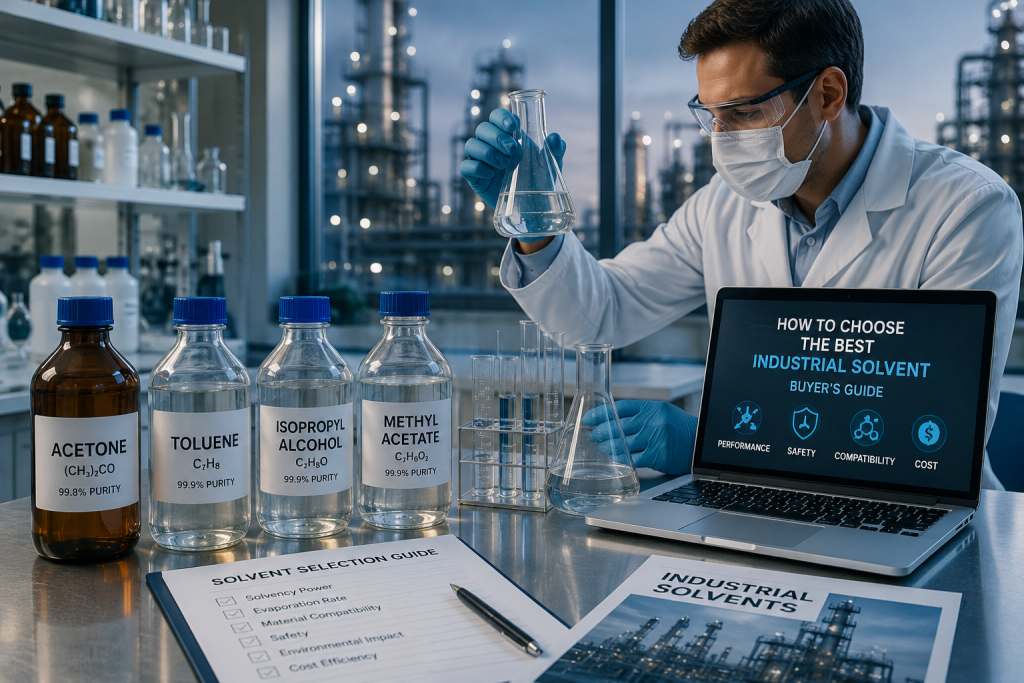
Acetone may be suitable for certain fast-drying cleaning and formulation processes, while isopropyl alcohol (IPA) is commonly considered for precision cleaning. Methyl acetate may be appropriate for selected printing inks and coatings, whereas propylene carbonate serves specialized applications that require a polar, low-volatility solvent.
Before purchasing, manufacturers should identify the target material, required purity, operating temperature, acceptable drying time, equipment limitations, and destination-market regulations. These requirements provide a practical basis for comparing products and requesting quotations.
Why Industrial Solvent Selection Matters
Solvent selection affects production speed, surface finish, equipment compatibility, worker exposure, waste generation, and overall manufacturing costs. An unsuitable product can cause formulation instability, surface defects, excessive evaporation losses, or damage to sensitive materials.
Choosing an appropriate solvent can help manufacturers:
- Maintain consistent product quality and formulation performance.
- Achieve the required viscosity and application properties.
- Control drying time and production scheduling.
- Remove oils, residues, or contaminants when chemically suitable.
- Reduce material waste, rework, and production interruptions.
- Protect equipment and finished products from chemical damage.
- Meet applicable workplace safety and environmental requirements.
Manufacturers should establish technical suitability before comparing purchase prices. A low-cost chemical may become expensive if it increases consumption, creates defects, or requires additional process controls.
Key Factors for Choosing an Industrial Solvent
1. Solvency Power and Chemical Compatibility
Solvency describes a solvent’s ability to dissolve a specific substance. The appropriate choice depends on the chemical structure of the target material, including resins, polymers, oils, adhesives, and coatings.
Test the product against the actual formulation or contaminant instead of relying exclusively on general descriptions such as strong solvent or universal cleaner. Verify compatibility with seals, hoses, tanks, plastics, elastomers, coatings, and other equipment components.
2. Evaporation Rate and Drying Time
Evaporation rate determines how quickly a solvent leaves a formulation or treated surface. Fast evaporation can support rapid production, but it may also cause premature drying, poor leveling, or uneven film formation. Slower evaporation provides more working time but can extend drying cycles.
Compare evaporation data under equivalent test conditions. Temperature, airflow, humidity, film thickness, and formulation composition can significantly influence actual drying performance.
3. Purity and Product Consistency
Purity is particularly important in electronics, pharmaceutical manufacturing, specialty coatings, and processes sensitive to trace contamination. Water content, residual impurities, acidity, and other specifications can affect the final product.
Request a Certificate of Analysis (COA) for the supplied batch and verify that its specifications meet your process requirements. Higher nominal purity is not automatically necessary for every application; the appropriate grade depends on the intended use.
4. Viscosity, Solubility, and Formulation Requirements
In paints, inks, coatings, and adhesives, a solvent can influence viscosity, flow, wetting, application behavior, and film formation. Its polarity and compatibility with other ingredients also affect formulation stability.
Evaluate the solvent in the complete formulation at the intended concentration. A product that performs well independently may produce undesirable results when combined with a resin, pigment, additive, or another solvent.
5. Safety, Flammability, and Exposure
Before purchasing an industrial solvent, review its Safety Data Sheet (SDS), including hazard classification, flash point, exposure controls, storage requirements, and emergency procedures.
Determine whether the process requires local exhaust ventilation, appropriately rated electrical equipment, ignition-source controls, or specific personal protective equipment. The necessary precautions depend on the chemical, quantity handled, operating conditions, and applicable regulations.
6. VOC Emissions and Environmental Compliance
Volatile organic compound (VOC) requirements can influence solvent selection in coatings, printing, and other industrial applications. Manufacturers should verify the regulations that apply to their facility, products, and destination markets.
Alternative solvent systems may help reduce emissions in certain processes, but their suitability must be assessed against performance, worker safety, environmental impact, and waste-management requirements. A solvent should not be considered environmentally preferable based on a single property alone.
7. Total Cost of Use
The purchase price per kilogram or liter represents only one part of the total cost. Other factors include consumption rate, evaporation losses, drying time, ventilation, storage, transportation, waste treatment, and quality-related rework.
Compare the total cost of achieving the required manufacturing result. A more expensive product may provide better value if it reduces consumption or improves process consistency. Conversely, a less expensive alternative may be preferable when it meets all technical requirements without increasing operating expenses.
Main Types of Industrial Solvents
Industrial solvents are commonly classified by chemical family. Each group contains products with different solvency characteristics, evaporation behavior, hazards, and application limits.
| Solvent Type | Examples | Typical Applications | Key Consideration |
|---|---|---|---|
| Ketones | Acetone, MEK | Selected coatings, cleaning, and formulations | Fast evaporation and material compatibility |
| Alcohols | Isopropyl alcohol, ethanol | Cleaning, inks, and specialty formulations | Purity, water content, and residue |
| Aromatic hydrocarbons | Toluene, xylene | Selected coatings, adhesives, and rubber formulations | Solvency, exposure hazards, and restrictions |
| Esters | Methyl acetate, ethyl acetate | Printing inks, coatings, and adhesives | Drying balance and resin compatibility |
| Glycol ethers | Selected glycol ether grades | Specialty coatings, cleaners, and formulations | Grade-specific hazards and evaporation |
| Carbonates | Propylene carbonate, ethylene carbonate | Specialty chemicals and selected battery applications | Polarity, purity, and process requirements |
Chemical family is a useful starting point, not a substitute for testing. Products within the same family can behave differently because of their molecular structure, purity, and interactions with the target formulation.
Popular Industrial Solvents Compared
| Solvent | Typical Applications | Relative Evaporation | Important Considerations |
|---|---|---|---|
| Acetone | Selected cleaning, coatings, and formulations | Very fast | Highly flammable; may damage some plastics and coatings |
| Isopropyl Alcohol (IPA) | Precision cleaning and selected electronics applications | Fast | Grade, water content, residue, and surface compatibility |
| Toluene | Selected resin, adhesive, rubber, and coating formulations | Moderate to fast | Health hazards, flammability, and regulatory restrictions |
| Methyl Acetate | Selected printing inks, coatings, and formulations | Very fast | Resin compatibility, flammability, and drying behavior |
| Propylene Carbonate | Specialty formulations and selected electrolyte applications | Slow | High boiling point and low volatility |
These comparisons are general guidelines rather than universal recommendations. Actual performance depends on grade, formulation, operating conditions, and intended use. Confirm technical specifications and conduct application testing before replacing an existing product.
How to Choose a Solvent for Different Industries
Paints and Coatings
Coatings manufacturers should evaluate resin solvency, viscosity control, application method, film leveling, drying time, and final coating properties. The selected product must support the formulation without causing defects such as poor adhesion, uneven appearance, or inadequate film formation.
Acetone, esters, and aromatic solvents may be relevant to different formulations. Resin compatibility, emissions requirements, and application conditions determine whether a particular grade is suitable.
Printing Inks
Printing operations require a solvent that matches the ink resin, printing technology, substrate, and production speed. Evaporation rate influences ink transfer, drying, print definition, and the risk of premature drying during operation.
Manufacturers should assess performance on the intended substrate under actual production conditions rather than selecting a product solely on evaporation speed.
Plastic Manufacturing
Solvents may be used for equipment cleaning, surface preparation, or selected coating and bonding applications in plastics manufacturing. Compatibility is critical because certain chemicals can cause swelling, softening, stress cracking, or permanent damage to polymer components.
Confirm the exact polymer grade and part condition before using a solvent. A product suitable for one plastic may be unsuitable for another, even when the materials appear similar.
Adhesives and Sealants
Adhesive manufacturers should consider polymer solubility, viscosity, open time, drying behavior, substrate compatibility, and final bond performance. The solvent must support processing while allowing the adhesive to develop its intended properties.
Evaluate the complete formulation and review exposure and emissions requirements before selecting a replacement product.
Electronics and Precision Cleaning
Precision cleaning applications may require controlled purity, low residue, and compatibility with sensitive components. IPA is used in certain cleaning processes, but suitability depends on the contaminant, material, process specification, and electronic assembly requirements.
Confirm that the selected grade is approved for the application. Not all electronic components, coatings, or assemblies can be cleaned safely with the same chemical.
Battery and Specialty Chemical Manufacturing
Battery-related processes and specialty chemical formulations may require solvents with carefully controlled moisture levels, purity, polarity, and electrochemical properties. Propylene carbonate is used in certain electrolyte-related applications, but it is not a universal choice for all battery chemistries.
Manufacturers should follow the relevant formulation specifications and supplier documentation, particularly when trace contaminants can affect process performance.
Common Mistakes When Selecting an Industrial Solvent
Several purchasing mistakes can increase costs or compromise product quality. Avoid the following issues:
- Choosing a solvent based only on its purchase price.
- Ignoring the effect of evaporation rate on production.
- Overlooking compatibility with polymers, seals, and coatings.
- Purchasing a grade without verifying its specifications.
- Assuming one solvent can serve every manufacturing process.
- Ignoring workplace exposure and environmental requirements.
- Switching products without conducting application tests.
- Buying from suppliers that cannot provide batch documentation.
A documented evaluation process helps purchasing teams compare alternatives consistently and reduces the risk of unplanned production problems.
Industrial Solvent Safety and Storage
Safe handling is essential throughout transportation, storage, dispensing, and use. Requirements vary by chemical and jurisdiction, so the product-specific SDS and applicable regulations should guide operating procedures.
- Store products in compatible, properly labeled containers.
- Follow the specified temperature and storage conditions.
- Keep flammable solvents away from ignition sources.
- Provide suitable ventilation and exposure controls.
- Use the recommended protective equipment.
- Maintain spill-response and emergency procedures.
- Separate incompatible chemicals where required.
- Manage and dispose of solvent waste according to local requirements.
For additional guidance, consult the Occupational Safety and Health Administration (OSHA), the National Institute for Occupational Safety and Health (NIOSH), and the relevant chemical supplier documentation.
How to Evaluate an Industrial Solvent Supplier
Finding the right product also requires choosing a supplier that can meet technical, documentation, and delivery requirements. Reliable supply is particularly important for manufacturers that depend on consistent formulations and uninterrupted production.
Before placing an order, verify that the supplier can provide:
- Clear product specifications and grade information.
- A batch-specific Certificate of Analysis (COA).
- An up-to-date Safety Data Sheet (SDS).
- Consistent quality and appropriate quality-control procedures.
- Suitable packaging and handling documentation.
- Reliable inventory and delivery arrangements.
- Export documentation and international shipping support, where needed.
- Responsive communication and relevant technical information.
Ask for a sample or trial quantity when practical. Test it against your process requirements and confirm that the supplied grade meets the agreed specification before committing to larger orders.
Manufacturers sourcing chemicals for international operations can explore the AasadChimie product range and contact the team through the Contact Us page to discuss product availability, specifications, and purchasing requirements.
How to Compare Solvent Suppliers Before Buying
A structured comparison helps procurement teams make decisions based on measurable requirements instead of marketing claims. Use the following checklist when reviewing quotations.
| Evaluation Criterion | What to Verify |
|---|---|
| Product identity | Chemical name, grade, and applicable specifications |
| Quality documentation | COA, SDS, and batch traceability |
| Technical suitability | Solvency, evaporation, compatibility, and purity |
| Commercial terms | Price, minimum order quantity, payment, and packaging |
| Logistics | Lead time, delivery arrangements, and export documentation |
| Regulatory compliance | Applicable safety, transport, and environmental requirements |
| Supply reliability | Availability, continuity, and communication |
For an accurate comparison, request quotations for the same grade, specification, packaging size, and delivery terms. Comparing different grades or incomplete quotations can produce misleading cost estimates.
Industrial Solvent Market Trends
Industrial solvent purchasing increasingly involves balancing technical performance with workplace safety, emissions control, supply reliability, and regulatory compliance. Manufacturers are also assessing alternative formulations when conventional products no longer meet their process or environmental requirements.
For companies operating across markets such as India, Turkey, and the Middle East, the relevant regulations, transport requirements, and customer specifications may differ. Buyers should verify requirements for each destination rather than assuming that a product approved for one market is automatically suitable for another.
Reliable product documentation, consistent quality, and transparent delivery terms remain important when sourcing industrial chemicals for international manufacturing operations.
Conclusion
Choosing the best industrial solvent requires a systematic assessment of solvency, evaporation rate, material compatibility, purity, safety, regulatory requirements, and total operating cost. The most appropriate product is the one that consistently meets the technical requirements of the intended application.
Manufacturers should verify product specifications, review safety documentation, test compatibility, and compare suppliers using consistent purchasing criteria. These steps help reduce production risks, control costs, and maintain product quality.
To explore available chemical products or discuss your manufacturing requirements, visit AasadChimie’s Products page or contact our team for further information.
References
- PubChem: Chemical Information
- OSHA: Occupational Safety and Health
- NIOSH: Workplace Safety and Chemical Hazards
- European Chemicals Agency (ECHA)
- ASTM International: Standards and Testing
Why Choose AasadChimie?
AasadChimie supplies industrial chemicals for manufacturers seeking dependable product quality and practical sourcing support. Selecting the right chemical requires attention to grade specifications, application requirements, documentation, and delivery conditions.
Contact AasadChimie to discuss your requirements, request product information, and identify suitable options for your manufacturing process.
What is the best industrial solvent for manufacturing?
The best industrial solvent depends on the application, target material, required purity, evaporation rate, safety requirements, and operating conditions. Manufacturers should verify compatibility and test performance before purchasing.
Which industrial solvent is best for cleaning?
Acetone and isopropyl alcohol are used in certain industrial cleaning applications. The appropriate choice depends on the contaminant, surface material, residue requirements, and workplace safety controls.
How do manufacturers choose the correct solvent grade?
Manufacturers should review the technical specification, purity, water content, compatibility, and applicable process requirements. A batch-specific Certificate of Analysis helps verify whether the supplied grade meets the agreed specification.
Why is solvent evaporation rate important?
Evaporation rate affects drying time, production speed, coating quality, and material losses. The ideal rate depends on the formulation, application method, operating conditions, and desired finish.
How can manufacturers reduce industrial solvent costs?
Manufacturers can reduce costs by optimizing consumption, minimizing evaporation losses, preventing rework, selecting the correct grade, and comparing the total operating cost rather than purchase price alone.
What documents should an industrial solvent supplier provide?
Buyers should request a Safety Data Sheet, a Certificate of Analysis where applicable, product specifications, and relevant transport or regulatory documentation. Export shipments may require additional documents depending on the chemical and destination.
What should buyers check before switching to another solvent?
They should evaluate chemical compatibility, formulation stability, drying performance, safety hazards, environmental requirements, and total cost. Testing under actual operating conditions helps identify potential problems before full-scale implementation.