


Table of Contents
- Quick Answer: How Can Manufacturers Improve Plastic Quality?
- Why Plastic Quality Matters in Manufacturing
- What Factors Affect Plastic Quality?
- Selecting the Right Plastic Raw Materials
- How Polymer Additives Support Plastic Quality
- 10 Practical Ways to Improve Plastic Quality
- 1. Choose Consistent Raw Materials
- 2. Optimize Processing Parameters
- 3. Select Compatible Polymer Additives
- 4. Control Moisture Before Processing
- 5. Use Appropriate Quality Testing
- 6. Train Production Operators
- 7. Maintain Machines and Tooling
- 8. Monitor Every Production Batch
- 9. Evaluate Supplier Reliability
- 10. Establish Continuous Improvement
- Common Plastic Quality Problems and Their Causes
- How to Measure Plastic Quality Improvements
- Future Trends in Plastic Quality Control
- Conclusion
- Related Articles
- References
- Explore Plastic Materials and Additives
- What factors affect plastic product quality the most?
- How can manufacturers improve plastic product quality?
- How do polymer additives improve plastic performance?
- Why is moisture control important in plastic manufacturing?
- Which tests help verify plastic product quality?
- Can better raw materials reduce manufacturing costs?
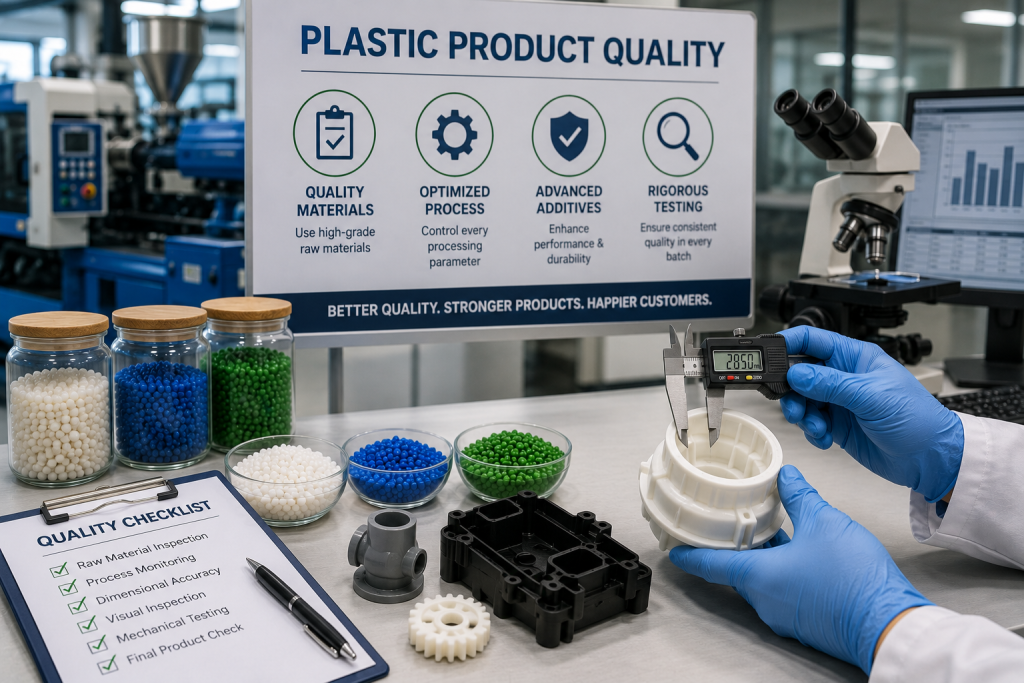
Plastic quality depends on raw material selection, polymer formulation, processing conditions, equipment maintenance, and product testing. Manufacturers can improve strength, durability, appearance, and dimensional consistency by controlling these factors throughout production.
For companies producing packaging, automotive components, pipes, household goods, agricultural films, and engineering parts, consistent quality reduces waste and helps meet customer specifications. This guide explains 10 practical ways to improve plastic quality and maintain reliable manufacturing performance.
Quick Answer: How Can Manufacturers Improve Plastic Quality?
Manufacturers can improve plastic quality by choosing suitable raw materials, optimizing processing parameters, selecting compatible polymer additives, controlling moisture, maintaining equipment, training operators, and testing finished products. Monitoring these factors helps reduce defects, improve production consistency, and control manufacturing costs.
Why Plastic Quality Matters in Manufacturing
Plastic quality directly affects product performance, customer satisfaction, production efficiency, and long-term reliability. Depending on the application, buyers may require specific mechanical properties, precise dimensions, consistent color, chemical resistance, or resistance to environmental exposure.
Poor quality can result in rejected batches, production delays, customer complaints, and expensive rework. A structured quality management system helps manufacturers detect problems early and maintain consistent product specifications.
The main benefits of effective quality control include:
- Lower scrap and rejection rates.
- More consistent product appearance and dimensions.
- Improved mechanical performance and durability.
- Fewer customer complaints and returns.
- Reduced downtime and rework costs.
- Better compliance with customer and industry requirements.
- Greater confidence among domestic and international buyers.
What Factors Affect Plastic Quality?
Several factors influence the final properties of a plastic product. Resin grade determines many of its basic characteristics, while additives can modify selected properties. Processing conditions, mold or die design, cooling, and equipment condition also affect the finished product.
Manufacturers should evaluate these factors together rather than treating a defect as an isolated material problem. For example, brittleness may result from unsuitable resin selection, excessive thermal exposure, contamination, or an incompatible formulation. Identifying the actual cause is essential before changing the production process.
Selecting the Right Plastic Raw Materials
Suitable plastic raw materials provide the foundation for consistent production. Different polymer grades vary in melt flow rate, density, stiffness, impact strength, chemical resistance, and thermal performance. Choosing a grade that matches the application helps establish the required performance from the beginning.
When evaluating materials, manufacturers should consider:
- Polymer grade: Confirm suitability for injection molding, extrusion, blow molding, or the intended production method.
- Melt flow rate: Check whether the material flows appropriately under the specified test conditions.
- Mechanical properties: Review tensile strength, elongation, stiffness, and impact resistance when relevant.
- Thermal performance: Consider processing temperatures and the expected service environment.
- Chemical resistance: Verify compatibility with substances that may contact the product.
- Batch consistency: Compare technical documentation and incoming inspection results.
- Regulatory requirements: Check applicable requirements for food contact, construction, electrical components, or other regulated applications.
Material price should not be the only purchasing criterion. A lower-cost resin may increase overall expenses if it produces more rejects, requires longer processing cycles, or fails to meet performance requirements.
Review relevant material categories on the AasadChimie Products page and compare available product information with your manufacturing specifications.
How Polymer Additives Support Plastic Quality
Polymer additives can help manufacturers achieve specific processing and performance targets. The appropriate formulation depends on the base resin, production method, target properties, and conditions in which the finished product will be used.
- Antioxidants: Help protect suitable polymers against oxidative degradation during processing and service.
- UV stabilizers: Help reduce degradation caused by ultraviolet exposure in outdoor applications.
- Impact modifiers: Can improve toughness and impact resistance in compatible polymer systems.
- Processing aids: May improve processing stability, melt behavior, or surface characteristics, depending on the formulation.
- Slip additives: Can reduce friction between plastic surfaces in suitable film applications.
- Anti-block additives: Help reduce unwanted adhesion between contacting film layers.
- Flame retardants: Can help formulations meet specified fire-performance requirements when appropriately selected and tested.
- Chain extenders: May increase molecular weight in selected polymer systems, including certain recycled polymers.
Additives are not universal solutions. Incorrect dosage, poor dispersion, or incompatibility with the base polymer can create new defects. Manufacturers should review technical data sheets, follow recommended processing guidance, and validate formulation changes through controlled trials.
10 Practical Ways to Improve Plastic Quality
1. Choose Consistent Raw Materials
Start with a resin grade that meets the product specification and suits the manufacturing process. Review the technical data sheet, batch documentation, storage requirements, and relevant certifications before approving a material.
Establish incoming inspection criteria for properties such as melt flow rate, moisture content, color, or density when these measurements are relevant to the application. Consistent material handling also helps prevent contamination and unwanted variation between batches.
2. Optimize Processing Parameters
Incorrect processing conditions can cause dimensional variation, incomplete filling, surface imperfections, and material degradation. A validated processing window helps operators maintain repeatable production and identify deviations before they affect large quantities of product.
Depending on the manufacturing method, monitor:
- Melt and barrel temperatures.
- Mold temperature.
- Injection and holding pressure.
- Cooling time and total cycle time.
- Screw speed and material residence time.
- Extrusion output and production line speed.
Record approved settings and investigate changes in defect rates or product dimensions. Where practical, adjust one variable at a time so that the effect of each change can be evaluated.
3. Select Compatible Polymer Additives
Additives can support thermal stability, weather resistance, impact performance, and processing efficiency. Their effectiveness depends on compatibility with the base resin and the requirements of the final product.
Before selecting an additive package, identify the property that needs improvement. Review dosage recommendations, dispersion requirements, processing conditions, and possible effects on other product characteristics. Laboratory testing and production trials should confirm the results before a formulation is adopted at scale.
4. Control Moisture Before Processing
Some polymers absorb moisture from the surrounding environment. Processing moisture-sensitive materials without adequate drying can contribute to bubbles, silver streaks, hydrolytic degradation, or reduced mechanical performance.
Follow the resin supplier’s recommendations for drying temperature, drying time, and target moisture content. Check dryer performance, airflow, hopper conditions, and material handling practices. Drying requirements vary by polymer, so one procedure should not automatically be applied to every resin.
5. Use Appropriate Quality Testing
Testing verifies whether raw materials and finished products meet defined specifications. The correct test methods depend on the polymer, product function, customer requirements, and applicable standards.
Common tests include:
- Melt flow rate: Evaluates melt flow behavior under specified test conditions.
- Density: Helps verify material identity or formulation consistency.
- Moisture content: Checks processing readiness for moisture-sensitive materials.
- Tensile testing: Measures strength and elongation under defined conditions.
- Impact testing: Evaluates resistance to impact using an appropriate method.
- Color measurement: Checks shade consistency against an approved reference.
- Dimensional inspection: Confirms that critical dimensions meet specified tolerances.
Testing frequency should reflect production risk, batch variability, customer specifications, and the consequences of product failure. Reliable measurements are essential for making informed process adjustments.
6. Train Production Operators
Operator knowledge is an important part of consistent manufacturing. Training should cover material handling, machine setup, defect recognition, process documentation, and escalation procedures.
Clear work instructions help different operators follow the same approved settings. Operators should also understand when a parameter change requires approval and when production must be paused for investigation.
7. Maintain Machines and Tooling
Worn screws, damaged heaters, blocked cooling channels, contaminated molds, and poorly maintained dies can cause defects that resemble material problems. Preventive maintenance helps identify these issues before they lead to repeated production losses.
Maintenance procedures should include appropriate equipment inspection, cleaning, calibration, and replacement of worn components. For injection molding, inspect mold vents, parting surfaces, cooling channels, and alignment. For extrusion, check the screw, barrel, die, temperature controls, and downstream equipment.
8. Monitor Every Production Batch
Batch monitoring helps manufacturers identify changes before they generate large quantities of rejected products. Record material lot numbers, process settings, inspection results, downtime, and corrective actions.
Trend analysis can reveal gradual changes in melt flow, dimensions, color, cycle time, or defect frequency. Statistical process control may help identify unusual variation when suitable data and measurement systems are available.
9. Evaluate Supplier Reliability
Reliable suppliers provide consistent materials, clear technical documentation, traceable batch information, and timely communication about specification changes. These factors help manufacturers manage material-related risks.
Supplier evaluation should consider product consistency, technical support, delivery reliability, relevant certifications, and the ability to investigate quality issues. Verify certification and regulatory claims instead of assuming that every product meets every application requirement.
10. Establish Continuous Improvement
Quality management should continue after a product passes inspection. Manufacturers should review customer feedback, production data, laboratory results, and recurring defects to identify opportunities for improvement.
A practical improvement cycle includes defining the problem, identifying its root cause, testing corrective actions, verifying the results, and updating production procedures. This approach helps prevent recurring problems and supports more reliable manufacturing.
Common Plastic Quality Problems and Their Causes
| Defect | Possible Cause | Initial Check |
|---|---|---|
| Warpage | Uneven cooling or shrinkage | Cooling balance, geometry, and material behavior |
| Sink marks | Insufficient packing or thick sections | Holding conditions and gate freeze-off |
| Flow lines | Unstable filling or surface solidification | Filling profile, gate design, and mold temperature |
| Burn marks | Trapped gas or material degradation | Mold venting and thermal conditions |
| Brittleness | Degradation or unsuitable formulation | Resin grade, processing history, and impact testing |
| Discoloration | Contamination or thermal degradation | Material handling, temperature, and residence time |
| Bubbles | Moisture, trapped air, or volatile substances | Drying, venting, and material condition |
| Dimensional variation | Process instability or inconsistent shrinkage | Machine settings, cooling, and measurement system |
How to Measure Plastic Quality Improvements
Manufacturers should evaluate improvements using measurable indicators rather than general impressions. Choose indicators that reflect customer requirements and production performance.
- Scrap rate: The proportion of production rejected as unusable.
- First-pass yield: The proportion of products meeting requirements without rework.
- Customer complaint rate: The frequency of reported quality problems.
- Dimensional capability: The ability of a stable process to meet specified tolerances.
- Downtime: Production time lost because of equipment or quality problems.
- Batch variation: Differences in measured properties between production lots.
Establish a baseline before introducing changes. Compare results over a suitable period and confirm that an improvement in one measure does not create unacceptable changes in another property.
Future Trends in Plastic Quality Control
Machine vision, automated inspection, smart sensors, and data analytics are helping manufacturers monitor production more consistently. These technologies can identify visible defects, track dimensional variation, and alert operators when process signals move outside defined limits.
Artificial intelligence can support pattern recognition and predictive maintenance when suitable data and validated systems are available. However, automated inspection does not replace appropriate test methods, calibrated equipment, or root-cause analysis.
The growing use of recycled polymers also increases the importance of material traceability, contamination control, and formulation validation. Manufacturers should evaluate recycled grades according to end-use requirements rather than assuming that all recycled materials perform identically.
Conclusion
Improving plastic quality requires coordinated control of materials, formulations, processing conditions, equipment, and testing. No single additive or machine adjustment can resolve every manufacturing problem.
By selecting suitable raw materials, maintaining stable production settings, training operators, and investigating root causes, manufacturers can reduce waste and improve product consistency. A documented continuous improvement system helps turn individual corrections into repeatable manufacturing practices.
For product-related inquiries, visit the AasadChimie Products page or contact the team through the Contact Us page.
Related Articles
- Plastic Raw Materials: Selection Guide
- How to Reduce Plastic Manufacturing Costs
- Plastic Processing Aids Explained
- UV Stabilizers for Plastics
- Polymer Additives List
- Plastic Additives for Different Polymers
References
- Plastics Europe
- ASTM International
- ScienceDirect
- American Chemistry Council
- British Plastics Federation
Explore Plastic Materials and Additives
Choosing suitable materials and additives requires reviewing the intended application, technical specifications, processing conditions, and applicable quality requirements. Manufacturers should validate material changes before using them in full-scale production.
Explore product categories on the AasadChimie Products page or submit a product-related inquiry through the Contact Us page.
What factors affect plastic product quality the most?
Material selection, processing conditions, additive formulation, equipment maintenance, and quality testing are major factors affecting product consistency and performance.
How can manufacturers improve plastic product quality?
They can select suitable raw materials, control processing parameters, maintain equipment, train operators, test finished products, and investigate recurring defects.
How do polymer additives improve plastic performance?
Depending on the formulation, additives can improve thermal stability, UV resistance, impact performance, processing behavior, or other specified properties.
Why is moisture control important in plastic manufacturing?
Moisture can cause processing problems or degradation in moisture-sensitive polymers. Drying and handling procedures should follow the resin supplier's recommendations.
Which tests help verify plastic product quality?
Relevant tests may include melt flow rate, moisture content, tensile strength, impact resistance, color measurement, density, and dimensional inspection.
Can better raw materials reduce manufacturing costs?
Consistent materials can reduce scrap, rework, and process variation. The financial benefit depends on the application, material cost, and production conditions.