


Table of Contents
- Why Plastic Additives Differ by Polymer Type
- How to Select Plastic Additives for Industrial Applications
- Plastic Additives for Polyethylene (PE)
- Recommended Plastic Additives for PE
- Plastic Additives for Polypropylene (PP)
- Recommended Plastic Additives for PP
- Plastic Additives for PVC
- Recommended Plastic Additives for PVC
- Plastic Additives for ABS
- Recommended Plastic Additives for ABS
- Plastic Additives for PET
- Recommended Plastic Additives for PET
- Plastic Additives for Engineering Plastics
- Common Additive Categories for Engineering Plastics
- Plastic Additives for Recycled Polymers
- Common Additives for Recycled Plastics
- Plastic Additives Comparison by Polymer
- Common Mistakes When Selecting Plastic Additives
- How to Choose the Right Plastic Additives
- Explore Plastic Additives for Your Application
- Related Articles
- References
- What are the most commonly used plastic additives?
- Do all polymers need the same additives?
- Which additives are commonly used in polyethylene?
- Which additives are important for polypropylene?
- Why does PVC need heat stabilizers?
- Which additives can improve recycled PET?
- How can manufacturers choose the right additive package?
Plastic additives improve polymer processing, stability, mechanical performance, surface quality, and service life. Choosing the right plastic additives for different polymers depends on the resin type, manufacturing process, operating environment, and final product requirements. This guide explains how manufacturers select plastic additives for polyethylene (PE), polypropylene (PP), PVC, ABS, PET, engineering plastics, and recycled polymers.
Different polymers respond differently to heat, oxidation, ultraviolet radiation, mechanical stress, and chemical exposure. As a result, no single additive package is suitable for every resin. Understanding the function of each additive helps manufacturers improve production consistency, reduce defects, and meet the performance requirements of industrial plastic products.
Why Plastic Additives Differ by Polymer Type
Every polymer has a distinct molecular structure, processing temperature, and performance profile. These differences determine which plastic additives are effective and how they should be combined.
For example, polyethylene often requires additives that support film handling and outdoor durability. Polypropylene needs careful oxidation control, while PVC requires a suitable heat-stabilizer system during processing. PET may need molecular-weight management, especially when recycled material is used, whereas engineering plastics often require specialized thermal, mechanical, or flame-performance solutions.
Manufacturers should therefore select plastic additives according to the resin and intended application rather than relying on a universal formulation. Compatibility between the polymer, additive, pigments, fillers, and other ingredients is equally important.
How to Select Plastic Additives for Industrial Applications
Before selecting plastic additives, manufacturers should evaluate five essential factors:
- Polymer type: Identify the resin family, grade, and existing formulation.
- Processing method: Consider extrusion, injection molding, blow molding, thermoforming, or compounding.
- Required properties: Determine the required impact strength, stiffness, flexibility, transparency, surface finish, and durability.
- Operating environment: Assess exposure to heat, sunlight, moisture, chemicals, and mechanical stress.
- Regulatory requirements: Check food-contact, medical, electrical, environmental, and fire-performance requirements where applicable.
These factors help determine whether the formulation needs antioxidants, UV stabilizers, processing aids, lubricants, impact modifiers, or several plastic additives working together. For more information about processing-related solutions, read our guide to plastic processing aids.
Plastic Additives for Polyethylene (PE)
Polyethylene is widely used in packaging films, containers, bottles, pipes, geomembranes, agricultural films, and household products. Its chemical resistance, flexibility, and versatility make it suitable for many industrial applications. However, polyethylene products may require additional protection against oxidation, ultraviolet radiation, surface friction, and film blocking.
Recommended Plastic Additives for PE
- Antioxidants: Help control thermal oxidation during processing and, where appropriate, during product service.
- UV stabilizers: Reduce UV-induced degradation in suitable outdoor applications. HALS-based systems may be appropriate for certain agricultural and industrial films.
- Slip additives: Reduce surface friction and can improve film handling on packaging lines.
- Anti-block additives: Reduce the tendency of film layers to stick together during winding, storage, and handling.
- Processing aids: Selected grades can improve extrusion stability, surface quality, or melt processing.
- Color masterbatch: Provides controlled color and may introduce other functional ingredients, depending on its formulation.
For greenhouse films, irrigation pipes, and other outdoor polyethylene products, the plastic additives must be selected according to the expected sunlight exposure, climate, product thickness, and required service life. Combining antioxidants with an appropriate UV-stabilization system can improve durability, but performance should be confirmed through relevant testing.
Related reading: UV stabilizers for plastics and anti-block additives.
Plastic Additives for Polypropylene (PP)
Polypropylene is used in automotive components, woven bags, household appliances, fibers, food packaging, and consumer products. It offers low density, useful stiffness, and good chemical resistance. However, thermal oxidation during processing and ultraviolet exposure can affect the properties of polypropylene over time.
Recommended Plastic Additives for PP
- Primary and secondary antioxidants: Provide complementary protection against oxidation during processing and service.
- UV stabilizers: Help reduce photodegradation in outdoor polypropylene applications.
- Nucleating agents: Modify crystallization behavior and may improve stiffness, cycle time, or other selected properties.
- Clarifying agents: Improve transparency in suitable polypropylene grades.
- Impact modifiers: Improve impact performance when the modifier is compatible with the resin and target formulation.
- Lubricants and processing aids: Support flow, processing consistency, or release where required.
For automotive and appliance manufacturers, selecting plastic additives for polypropylene involves balancing impact resistance, stiffness, dimensional stability, appearance, and cost. The correct formulation depends on the resin grade, part design, processing conditions, and service environment.
Explore our related guides on antioxidants for polymers and impact modifiers for polypropylene.
Plastic Additives for PVC
Polyvinyl chloride (PVC) needs a carefully designed additive package because heat and shear during processing can trigger thermal degradation. This process can cause discoloration, release hydrogen chloride, and reduce material performance. A suitable heat-stabilizer system is therefore central to PVC formulation.
Recommended Plastic Additives for PVC
- Heat stabilizers: Help control thermal degradation during processing and, where required, during service.
- Processing aids: Support fusion, melt strength, or surface quality, depending on the grade and application.
- Lubricants: Control friction and fusion behavior. Internal and external lubrication must be balanced for the formulation.
- Impact modifiers: Improve impact resistance in applications that require greater toughness.
- UV stabilizers and pigments: Help meet weathering and appearance requirements for selected outdoor products.
- Flame-retardant components: May be required for particular applications, subject to finished-product testing and applicable standards.
The plastic additives used in rigid PVC pipes, window profiles, cable compounds, and flexible sheets can differ substantially. Outdoor window profiles may prioritize weathering and color retention, while cable compounds may require specific thermal, electrical, and fire-performance properties.
Do not select PVC additives based only on their general category. Confirm compatibility with the resin, lubricant package, fillers, pigments, processing conditions, and applicable regulations.
Plastic Additives for ABS
Acrylonitrile butadiene styrene (ABS) is widely used in electronic housings, appliance components, automotive interiors, luggage, and consumer products. It offers a useful balance of impact resistance, rigidity, and surface finish, making appearance and consistency important in many applications.
Recommended Plastic Additives for ABS
- Antioxidants and processing stabilizers: Help control degradation during melt processing and subsequent use.
- UV stabilizers: Reduce light-induced degradation in suitable grades and applications.
- Flame retardants: Used when the finished product must meet specified fire-performance requirements.
- Color masterbatch: Helps achieve consistent color when compatible with the resin and process.
- Processing lubricants: Can assist flow and release where required by the formulation.
For visible ABS components, manufacturers should test gloss, color consistency, surface defects, impact strength, and dimensional stability. Outdoor products may need specialized grades or protective designs because UV resistance varies with the material formulation.
Plastic Additives for PET
Polyethylene terephthalate (PET) is used in beverage bottles, food packaging, polyester fibers, thermoformed trays, and selected engineering applications. PET processing is sensitive to moisture and thermal history. Hydrolysis and thermal degradation can reduce molecular weight and intrinsic viscosity, affecting processing behavior and finished-product performance.
Recommended Plastic Additives for PET
- Processing stabilizers: Selected systems can help manage degradation under defined processing conditions.
- Antioxidants: May be used when compatible with the PET grade and end-use requirements.
- Chain extenders: Certain reactive systems can increase molecular weight or help recover intrinsic viscosity in suitable recycled PET processes.
- Acetaldehyde scavengers: Used in selected bottle-grade applications to control acetaldehyde levels.
- UV stabilizers: May be appropriate for PET products exposed to sunlight, subject to optical and regulatory requirements.
For recycled PET, selecting plastic additives should follow an assessment of moisture, contamination, intrinsic viscosity, color, and previous processing history. Chain extenders do not replace proper drying or contamination control, and their effectiveness depends on the reactive chemistry and process conditions.
For food packaging and other sensitive applications, confirm that every additive meets the applicable end-use requirements.
Plastic Additives for Engineering Plastics
Engineering plastics such as polyamide (PA), polycarbonate (PC), polybutylene terephthalate (PBT), polyoxymethylene (POM), and polyphenylene sulfide (PPS) serve demanding applications that may require dimensional stability, heat resistance, electrical performance, chemical resistance, and long-term mechanical reliability.
Because these polymers have different processing characteristics and degradation mechanisms, their additive systems must be tailored to the specific resin. Plastic additives suitable for PA, for example, should not automatically be transferred to PC, PBT, POM, or PPS without compatibility testing.
Common Additive Categories for Engineering Plastics
- Heat stabilizers and antioxidants: Help preserve properties under defined processing and service conditions.
- Flame retardants: Used to achieve required fire performance in electrical, electronic, and industrial components.
- UV stabilizers: Selected for products exposed to sunlight or other UV sources.
- Coupling agents: Improve bonding between compatible reinforcing fillers and the polymer matrix.
- Processing lubricants: Support processing and mold release when compatible with the resin.
- Antistatic additives: Used when reduced surface charge accumulation is required.
Glass-fiber-reinforced engineering plastics require attention to fiber-matrix adhesion, moisture, dispersion, and mechanical performance. The finished compound should be evaluated through relevant mechanical, thermal, electrical, and flammability tests rather than relying only on the additive’s general description.
Plastic Additives for Recycled Polymers
Recycled polymers may contain mixed resin grades, pigments, contaminants, and residues from earlier applications. Previous thermal and mechanical processing can also affect molecular weight, odor, color, and processing consistency.
Effective recycling formulations use plastic additives to address specific material limitations identified through testing. The required package depends on the polymer type, feedstock quality, degradation level, and intended application.
Common Additives for Recycled Plastics
- Primary and secondary antioxidants: Help manage oxidation during reprocessing.
- Chain extenders: Can increase molecular weight in compatible systems, particularly selected PET recycling processes.
- Compatibilizers: Improve interfacial adhesion in certain polymer blends and mixed-material recycling streams.
- Processing aids: May improve extrusion stability or melt processing.
- Odor-control additives: Can reduce selected odor compounds, although results depend on the source and nature of contamination.
- Color correction systems: Help manage color consistency when compatible with the intended product.
Not every recycled polymer requires a chain extender, and an odor-control additive cannot remove every type of contamination. Effective recycling begins with suitable feedstock sorting, cleaning, and drying where required. Additives should address the remaining limitations and be validated at production scale.
Plastic Additives Comparison by Polymer
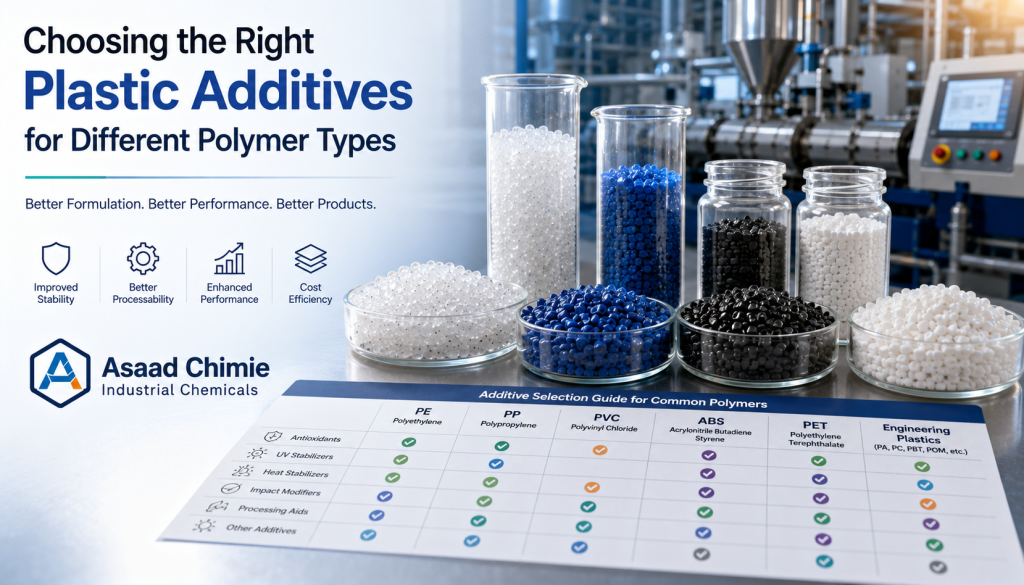
| Polymer | Common Plastic Additives | Main Selection Considerations |
|---|---|---|
| Polyethylene (PE) | Antioxidants, UV stabilizers, slip agents, anti-block additives | Film handling, oxidation resistance, and outdoor exposure |
| Polypropylene (PP) | Antioxidants, UV stabilizers, nucleating agents, impact modifiers | Thermal history, stiffness, impact strength, and weathering |
| PVC | Heat stabilizers, lubricants, processing aids, impact modifiers | Thermal stability, fusion behavior, and final product type |
| ABS | Stabilizers, UV stabilizers, color masterbatch, selected flame retardants | Appearance, impact performance, and end-use requirements |
| PET | Processing stabilizers, selected antioxidants, chain extenders, acetaldehyde scavengers | Moisture control, intrinsic viscosity, clarity, and compliance |
| Engineering plastics | Heat stabilizers, flame retardants, coupling agents, processing lubricants | Resin compatibility and long-term performance |
| Recycled polymers | Antioxidants, compatibilizers, selected chain extenders, odor-control additives | Feedstock quality, degradation, contamination, and consistency |
Common Mistakes When Selecting Plastic Additives
- Using one formulation for every resin: Different polymers need different stabilization and processing strategies.
- Ignoring additive interactions: Ingredients can affect dispersion, migration, color, and final performance.
- Choosing only by price: A low-cost additive may increase scrap, reduce productivity, or fail to meet specifications.
- Overlooking processing conditions: Temperature, shear, residence time, and moisture can change additive performance.
- Assuming additives guarantee compliance: Food-contact suitability, flame ratings, and other regulated properties must be confirmed for the complete finished formulation.
- Skipping production trials: Laboratory results should be verified under representative manufacturing conditions.
How to Choose the Right Plastic Additives
- Confirm the polymer family and exact resin grade.
- Define the manufacturing process and processing window.
- Identify the primary performance problem to solve.
- Review existing additives, fillers, pigments, and other formulation ingredients.
- Check regulatory, food-contact, environmental, and safety requirements.
- Review the supplier’s technical data sheet and safety data sheet.
- Conduct laboratory tests and production trials at suitable addition levels.
- Verify finished-product performance before approving the formulation.
A structured selection process helps manufacturers compare plastic additives against measurable requirements, improve production consistency, and avoid unnecessary formulation costs.
Explore Plastic Additives for Your Application
The most suitable plastic additives depend on the polymer, processing method, required performance, and end-use conditions. Review the available product categories and contact the AasadChimie team through the Contact Us page to discuss your technical requirements and identify suitable options for evaluation.
Related Articles
- Plastic Processing Aids
- Antioxidants for Polymers
- UV Stabilizers for Plastics
- Slip Additives
- Anti-Block Additives
- Impact Modifiers for Polypropylene
References
What are the most commonly used plastic additives?
Common categories include antioxidants, UV stabilizers, heat stabilizers, processing aids, lubricants, impact modifiers, slip agents, anti-block additives, and color masterbatch. The required combination depends on the polymer and application.
Do all polymers need the same additives?
No. PE, PP, PVC, ABS, PET, and engineering plastics have different processing and performance requirements. Additives should be selected for the specific resin grade and intended use.
Which additives are commonly used in polyethylene?
Polyethylene formulations may use antioxidants, UV stabilizers, slip additives, anti-block additives, and processing aids. The exact package depends on whether the product is a film, pipe, container, or outdoor component.
Which additives are important for polypropylene?
Antioxidants are commonly used to manage thermal oxidation. Depending on the application, PP may also require UV stabilizers, nucleating agents, clarifying agents, or impact modifiers.
Why does PVC need heat stabilizers?
PVC can undergo thermal degradation during processing. A suitable heat-stabilizer system helps control this degradation and supports consistent processing and product quality.
Which additives can improve recycled PET?
Selected chain extenders and stabilization systems can help address molecular degradation in compatible recycled PET processes. Drying, contamination control, and intrinsic-viscosity testing remain essential.
How can manufacturers choose the right additive package?
Manufacturers should assess the resin grade, processing conditions, required mechanical and surface properties, environmental exposure, regulatory requirements, and compatibility with existing ingredients. Laboratory testing and production trials should confirm the final choice.