


Table of Contents
- Introduction to Solvents in Polymeric Products
- Importance of Solvents in Polymer Processing
- Applications of Solvents in Polymeric Products
- Introduction to Methyl Ethyl Ketone (MEK)
- Properties of MEK
- MEK in Adhesives and Coatings
- Use of MEK in Printing and Packaging
- Safety and Handling of MEK
- Environmental Considerations
- Future of Solvents in Polymeric Products
- Conclusion
- References
Solvents in polymeric products play a crucial role in ensuring proper processing, application, and final performance of polymer-based materials. These solvents are not just auxiliary substances; they directly affect viscosity, film formation, adhesion, and surface quality in polymeric systems. From industrial coatings and adhesives to elastomers and synthetic resins, the correct choice of solvent determines product quality and manufacturing efficiency.
Introduction to Solvents in Polymeric Products
Polymeric products, including plastics, resins, coatings, adhesives, and inks, rely heavily on solvents to modify physical properties, improve processability, and achieve uniform application. Solvents dissolve, swell, or disperse polymer chains, enabling smooth flow and better interaction with substrates. By controlling evaporation rates and compatibility, solvents help prevent defects such as uneven coatings, poor adhesion, or cracking in the final polymer product.
Importance of Solvents in Polymer Processing
During polymer manufacturing, solvents perform several essential functions:
- Dissolution: Breaking down polymer chains to create homogenous mixtures.
- Viscosity Control: Adjusting flow for spraying, rolling, extrusion, or casting.
- Film Formation: Allowing even spreading and smooth surface finish.
- Processing Efficiency: Reducing energy requirements and enabling better substrate adhesion.
Different polymer systems require solvents with specific polarity, boiling points, and evaporation rates. Incorrect solvent selection can cause uneven coatings, blistering, or inconsistent mechanical properties, which may compromise product performance.
Applications of Solvents in Polymeric Products
Solvents are essential in multiple stages of polymer-based product manufacturing:
- Industrial adhesives and sealants
- Coatings, paints, and varnishes
- Printing inks and packaging films
- Plastic and resin manufacturing
- Synthetic rubber and elastomer processing
Each of these applications depends on the solvent’s ability to dissolve polymers, control drying, and improve surface adhesion while maintaining the polymer’s mechanical and aesthetic properties.
Introduction to Methyl Ethyl Ketone (MEK)
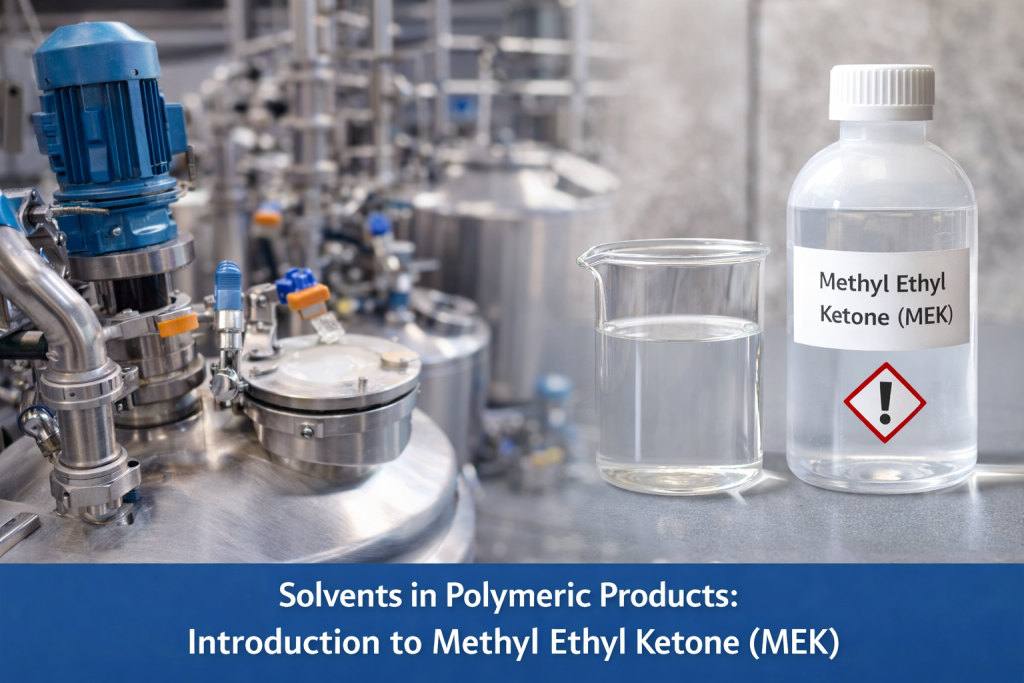
Methyl Ethyl Ketone (MEK) is a colorless, volatile industrial solvent widely used in polymer-based manufacturing. It is recognized for its excellent solvency power, compatibility with various polymers, and controlled evaporation rate, making it highly suitable for adhesives, coatings, inks, and plastic films.
Properties of MEK
- Strong solvency for PVC, polystyrene, acrylic resins, and synthetic rubbers
- Medium evaporation rate allowing smooth film formation
- Low viscosity contribution for improved processability
- Compatibility with many solvent blends and polymer systems
MEK in Adhesives and Coatings
MEK is a common solvent in industrial adhesives, providing uniform polymer dissolution and strong bonding on diverse substrates. In coatings, MEK ensures consistent viscosity, smooth film formation, and rapid drying without compromising surface quality. It is particularly effective for high-performance applications requiring precise control of polymer layers and surface adhesion.
Use of MEK in Printing and Packaging
Printing inks and flexible packaging films benefit from MEK’s high solvency. The solvent helps disperse pigments, binders, and additives uniformly, resulting in vibrant colors and stable coatings. Its controlled evaporation ensures that films and printed surfaces dry evenly without defects such as pinholes or wrinkling.
Safety and Handling of MEK
While MEK is highly effective, it must be handled with proper safety precautions. It should be stored in sealed containers in cool, well-ventilated areas away from ignition sources. Use of personal protective equipment (PPE) such as gloves and goggles is recommended during handling. Industrial facilities often implement solvent recovery systems to minimize emissions and improve environmental compliance.
Environmental Considerations
MEK use is regulated in many countries due to VOC emissions and potential health impacts. Modern industrial practices include solvent recycling, emission reduction technologies, and alternative solvent blends to balance environmental safety with performance. Despite these challenges, MEK remains widely used because of its efficiency and reliability in polymer processing.
Future of Solvents in Polymeric Products
As the polymer industry advances, the focus is shifting toward greener and more sustainable solvents. However, high-performance solvents like MEK continue to play a crucial role in ensuring high-quality, industrial-scale polymer production. Innovations in solvent blends, recovery systems, and process optimization will further enhance performance while addressing environmental concerns.
Conclusion
Solvents in polymeric products are essential for achieving optimal processing, adhesion, and surface quality. Methyl Ethyl Ketone (MEK) stands out as a versatile and high-performance industrial solvent widely used in adhesives, coatings, printing inks, and plastic manufacturing. Proper selection, handling, and environmental management of solvents ensure both product quality and regulatory compliance in modern polymer industries.