


Table of Contents
- n-Butyl Acetate: Quick Technical Specifications
- What Is n-Butyl Acetate Used For?
- 1. Paints and Industrial Coatings
- 2. Printing Inks
- 3. Adhesives and Resin Formulations
- 4. Chemical Manufacturing and Specialty Formulations
- What Factors Affect n-Butyl Acetate Performance?
- n-Butyl Acetate vs. Other Industrial Solvents
- How to Select an Industrial Grade
- Safety, Handling, and Storage
- Packaging and Industrial Supply
- Where to Source n-Butyl Acetate
- Technical References
- What is n-Butyl Acetate mainly used for?
- What is the CAS number of n-Butyl Acetate?
- Is n-Butyl Acetate suitable for paint and coating production?
- What should buyers check before purchasing n-Butyl Acetate in bulk?
- Is n-Butyl Acetate flammable?
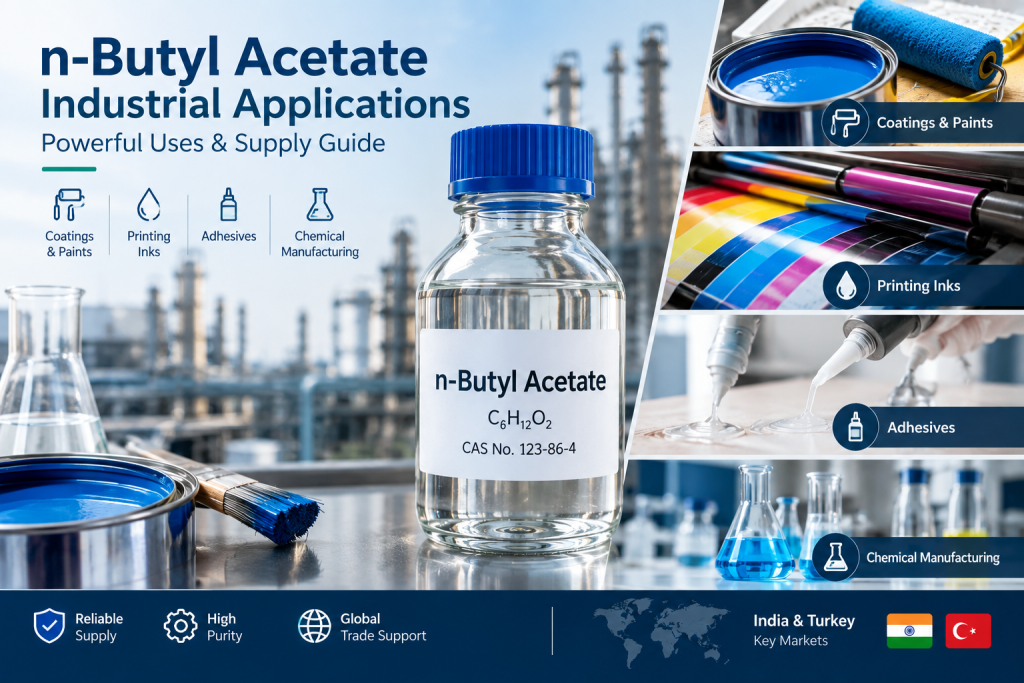
n-Butyl Acetate is an organic ester solvent widely used in paints, coatings, printing inks, adhesives, and selected industrial formulations. Its balanced evaporation rate, solvency, and compatibility with many organic resins make it useful for manufacturers seeking consistent application performance. This guide explains its technical properties, industrial applications, grade selection, safety requirements, and supply considerations.
n-Butyl Acetate: Quick Technical Specifications
| Property | Typical Value |
|---|---|
| Chemical name | n-Butyl Acetate |
| Synonyms | Butyl acetate, butyl ethanoate |
| CAS number | 123-86-4 |
| Molecular formula | C6H12O2 |
| Molecular weight | 116.16 g/mol |
| Appearance | Clear, colorless liquid |
| Boiling point | Approximately 126°C at 1 atm |
| Density | Approximately 0.88 g/cm³ near 20°C |
| Flash point | Typically around 22–31°C, depending on test method |
| Water solubility | Approximately 7 g/L near room temperature |
| Viscosity | Approximately 0.7–0.8 mPa·s near 20°C |
These figures are representative reference values, not a substitute for a supplier’s current Technical Data Sheet (TDS) or Safety Data Sheet (SDS). Confirm the applicable test method, temperature, and product grade before using specifications for purchasing or process design.
What Is n-Butyl Acetate Used For?
n-Butyl Acetate is primarily used as a solvent in industrial formulations. It can dissolve or help disperse selected resins and organic ingredients, while its evaporation profile influences film formation, surface appearance, and drying behavior. The exact performance depends on the resin system, solvent blend, application method, and production conditions.
1. Paints and Industrial Coatings
In paints and coatings, n-Butyl Acetate acts as a solvent for compatible binders and formulation ingredients. It can help control viscosity, application behavior, leveling, and film formation. Coating manufacturers may evaluate it for automotive refinishing, industrial finishes, and other solvent-based systems.
Its suitability depends on resin chemistry, required drying time, film thickness, ambient temperature, and ventilation. Formulators should conduct compatibility and application tests rather than choosing a solvent based on evaporation rate alone.
2. Printing Inks
Printing ink manufacturers may use n-Butyl Acetate in selected solvent-based ink systems. The solvent blend influences viscosity, transfer, drying, and compatibility with the ink’s resin and pigment system. Suitability varies by printing technology, substrate, and production speed.
Before adopting a grade, manufacturers should verify solvent purity, water content, residual impurities, and the relevant specifications for the finished ink. Food-contact packaging applications may require additional regulatory and migration assessments.
3. Adhesives and Resin Formulations
n-Butyl Acetate can serve as a solvent or formulation component in certain adhesive and resin systems. Its role may include adjusting viscosity and supporting uniform application. However, it is not suitable for every adhesive chemistry, and the final formulation must meet requirements for bonding strength, drying, emissions, and substrate compatibility.
4. Chemical Manufacturing and Specialty Formulations
Some chemical manufacturers use n-Butyl Acetate as a processing solvent or formulation ingredient. Its usefulness depends on the solubility of the target materials, process temperature, solvent recovery requirements, and applicable safety controls.
For industrial procurement, buyers should distinguish between use as a process solvent, a formulation ingredient, and a chemical intermediate. These roles can require different purity limits and documentation.
What Factors Affect n-Butyl Acetate Performance?
- Evaporation rate: Influences drying behavior and the time available for leveling.
- Solvency: Depends on the resin, polymer, and other formulation components.
- Purity: Water and other impurities may affect process consistency.
- Temperature: Changes evaporation behavior and can affect viscosity.
- Formulation balance: A solvent blend may perform differently from a single solvent.
n-Butyl Acetate vs. Other Industrial Solvents
| Solvent | General Characteristics | Selection Consideration |
|---|---|---|
| n-Butyl Acetate | Ester solvent with a moderate evaporation profile | Evaluate for coatings, inks, and compatible resin systems |
| Ethyl Acetate | Generally faster-evaporating ester solvent | Consider when faster drying is required and formulation compatibility is confirmed |
| Methyl Acetate | Low-boiling ester solvent with rapid evaporation | Assess process controls, emissions, and drying requirements |
The most appropriate solvent depends on the formulation, performance targets, workplace controls, and local regulatory requirements. Review Ethyl Acetate and Methyl Acetate as potential alternatives when comparing solvent systems.
How to Select an Industrial Grade
When sourcing n-Butyl Acetate, buyers should match the product specification to the intended process. Relevant checks include:
- Purity and limits for relevant impurities
- Water content and acidity, where specified
- Appearance and consistency between batches
- Compatibility with the resin or formulation
- Current TDS, SDS, and Certificate of Analysis (CoA)
- Packaging, transport requirements, and supplier traceability
There is no single grade that is automatically suitable for every application. Coatings, inks, adhesives, and chemical processing may require different acceptance criteria. Buyers in Iran, India, and Turkey should confirm the applicable import, labeling, transport, and storage requirements before placing an order.
Safety, Handling, and Storage
n-Butyl Acetate is a flammable liquid. Its vapors may irritate the eyes or respiratory tract, and exposure can cause symptoms such as dizziness. Always consult the current SDS for the exact product supplied and follow the site’s chemical risk assessment.
- Use suitable ventilation and avoid breathing concentrated vapors.
- Keep the solvent away from heat, sparks, open flames, and other ignition sources.
- Use compatible, properly closed containers in a cool, designated storage area.
- Follow the SDS for personal protective equipment, spill response, and firefighting measures.
- Store and transport the product in accordance with applicable local regulations.
Packaging and Industrial Supply
Packaging options and minimum order quantities depend on supplier availability, destination, and transport requirements. Before confirming an order, request the current specification, CoA, SDS, available packaging formats, lead time, and delivery terms. This helps procurement teams compare offers on technical suitability as well as price.
Where to Source n-Butyl Acetate
Aasad Chimie provides information about its n-Butyl Acetate product for industrial buyers. Review the available chemical product range and contact the team to confirm current specifications, packaging, availability, and supply terms.
For product inquiries, use the Aasad Chimie contact page to discuss your application and purchasing requirements.
Technical References
- PubChem: n-Butyl Acetate chemical information
- European Chemicals Agency (ECHA): Chemical safety information
Technical review: Aasad Chimie Technical Team
Last updated: October 2026
What is n-Butyl Acetate mainly used for?
n-Butyl Acetate is mainly used as an industrial solvent in selected paints, coatings, printing inks, adhesives, and chemical formulations. Its suitability depends on solvent compatibility, evaporation behavior, and the required product specifications. Manufacturers should test the formulation before changing solvents or adopting a new commercial grade.
What is the CAS number of n-Butyl Acetate?
The CAS number of n-Butyl Acetate is 123-86-4. Its molecular formula is C₆H₁₂O₂, and its molecular weight is approximately 116.16 g/mol. Buyers should confirm product identity and technical specifications against the supplier's current Technical Data Sheet and batch-specific Certificate of Analysis before use.
Is n-Butyl Acetate suitable for paint and coating production?
It can be suitable for selected solvent-based paints and coatings because of its solvency and evaporation characteristics. The correct choice depends on resin compatibility, application method, drying requirements, and desired surface finish. Manufacturers should conduct formulation tests before using it in production.
What should buyers check before purchasing n-Butyl Acetate in bulk?
Buyers should confirm purity, water content, impurity limits, batch documentation, packaging, destination, and lead time. Request a current Safety Data Sheet and a batch-specific Certificate of Analysis. International buyers should also verify applicable transport, import, labeling, and chemical handling requirements.
Is n-Butyl Acetate flammable?
Yes. It is a flammable liquid and must be kept away from ignition sources. Store it in compatible, closed containers under the conditions specified by the supplier. Follow the product-specific Safety Data Sheet for ventilation, protective equipment, fire precautions, spill response, and transport requirements.