


Table of Contents
- Methyl Acetate: Quick Technical Specifications
- What Are the Main Methyl Acetate Industrial Applications?
- 1. Methyl Acetate in Coatings and Paints
- 2. Methyl Acetate for Adhesive Manufacturing
- 3. Methyl Acetate in Printing Inks and Packaging
- 4. Chemical Formulations and Industrial Processing
- Why Does Methyl Acetate Evaporate Quickly?
- Methyl Acetate vs. Other Industrial Solvents
- How to Select the Right Methyl Acetate Grade
- Methyl Acetate Supply for Iran, India, and Turkey
- Methyl Acetate Safety, Handling, and Storage
- Where to Source Methyl Acetate
- Technical References
- What are the main industrial applications of Methyl Acetate?
- Why is Methyl Acetate used in industrial formulations?
- How should buyers choose a Methyl Acetate supplier?
- Is Methyl Acetate suitable for every coating or adhesive?
- What precautions are required when handling this solvent?
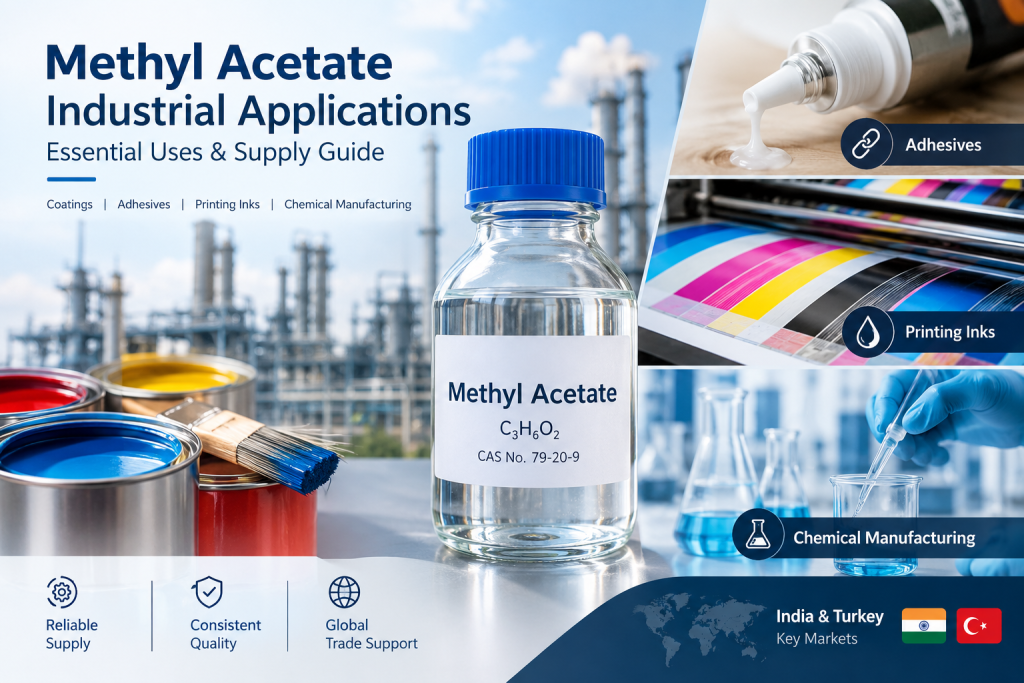
Methyl Acetate is a volatile ester solvent used in selected coatings, adhesives, printing inks, and chemical formulations. Its relatively low boiling point and rapid evaporation make Methyl Acetate useful in manufacturing processes that require specific drying characteristics and suitable solvency. Industrial buyers should evaluate its technical specifications, purity, safety requirements, and supply conditions before selecting a grade.
Methyl Acetate: Quick Technical Specifications
| Property | Typical Value |
|---|---|
| Chemical name | Methyl Acetate |
| Synonyms | Methyl ethanoate, acetic acid methyl ester |
| CAS number | 79-20-9 |
| Molecular formula | C3H6O2 |
| Molecular weight | 74.08 g/mol |
| Appearance | Clear, colorless liquid |
| Boiling point | Approximately 57°C at 1 atm |
| Density | Approximately 0.93 g/cm³ near 20°C |
| Flash point | Approximately -10°C; confirm the test method and current SDS |
| Water solubility | Soluble in water; reported values depend on temperature and test conditions |
| Viscosity | Approximately 0.36 mPa·s near 20°C |
These figures are representative reference values and are not guaranteed specifications for every commercial grade. Before purchasing, verify the current Technical Data Sheet (TDS), Safety Data Sheet (SDS), and Certificate of Analysis (CoA) for the product being offered.
What Are the Main Methyl Acetate Industrial Applications?
The main Methyl Acetate industrial applications involve its use as a solvent in selected manufacturing processes. Its solvency and rapid evaporation can help formulators adjust drying behavior and solvent balance. The suitability of Methyl Acetate depends on resin chemistry, other ingredients, temperature, airflow, and the performance requirements of the finished product.
1. Methyl Acetate in Coatings and Paints
One important use of Methyl Acetate is in selected paint and coating formulations. It can dissolve compatible ingredients and contribute to the solvent balance of a formulation. Its relatively fast evaporation may be beneficial when a coating system requires rapid solvent release during application and drying.
However, fast evaporation does not automatically produce better coating quality. Manufacturers should assess resin compatibility, surface leveling, film appearance, application temperature, and drying time. Laboratory compatibility tests can help determine whether this solvent performs as expected before it is introduced into routine production.
For coatings manufacturers, solvent selection should be based on the complete formulation rather than a single property. The balance between evaporation, flow, and film formation can affect the final surface quality and manufacturing consistency.
2. Methyl Acetate for Adhesive Manufacturing
Methyl Acetate may serve as a formulation solvent in selected solvent-based adhesives. Depending on the adhesive chemistry, it can help dissolve compatible components or influence viscosity and drying behavior. These characteristics may be useful when the formulation requires a specific solvent profile.
Before choosing a grade, manufacturers should test compatibility with the polymer, resin, additives, and intended substrate. Bond strength, open time, drying behavior, and workplace exposure requirements should also be assessed. Methyl Acetate is not suitable for every adhesive formulation, so technical testing is essential.
Manufacturers should also review whether the solvent affects the finished adhesive’s performance under expected storage and application conditions. Any formulation change should be validated before full-scale production.
3. Methyl Acetate in Printing Inks and Packaging
Printing inks are another area of Methyl Acetate industrial applications. In compatible solvent-based systems, this ester can contribute to the solvent balance and influence drying characteristics. Performance depends on the ink resin, pigment system, printing method, substrate, and production speed.
Packaging manufacturers should confirm compatibility with the complete ink formulation and intended substrate. Applications involving food-contact packaging may require additional regulatory review and migration assessment. Suitability should be established from the actual formulation and applicable requirements rather than assumed from the solvent’s chemical identity alone.
For high-volume printing operations, consistency between batches is also important. Buyers should agree on acceptance criteria and verify product documentation before using a new supply source.
4. Chemical Formulations and Industrial Processing
Chemical manufacturers may use Methyl Acetate as a solvent or processing component in selected operations. The decision depends on the materials being processed, required solubility, operating temperature, solvent recovery arrangements, and finished-product specifications.
For process use, buyers should define acceptable purity limits, water content, and relevant impurities. If the solvent will be recovered and reused, additional process controls may be needed to maintain consistent quality across production cycles.
These uses should be assessed individually. A grade that works well in one formulation may not meet the requirements of another process, even when both applications use the same solvent family.
Why Does Methyl Acetate Evaporate Quickly?
Methyl Acetate has a boiling point of approximately 57°C at atmospheric pressure. This relatively low boiling point contributes to its volatility compared with many higher-boiling ester solvents. In practical applications, evaporation also depends on temperature, airflow, exposed surface area, film thickness, and the composition of the solvent blend.
Rapid evaporation may support shorter drying times in suitable formulations, but it can also reduce the time available for leveling or application. Manufacturers should therefore evaluate the complete formulation rather than selecting a solvent based on boiling point alone.
When comparing solvents, technical teams should consider the required drying window, workplace ventilation, emissions controls, and finished-product performance. These factors help determine whether the evaporation profile is suitable for a particular production line.
Methyl Acetate vs. Other Industrial Solvents
| Solvent | General Characteristics | Selection Considerations |
|---|---|---|
| Methyl Acetate | Low-boiling ester with rapid evaporation | Consider when fast solvent release and compatible solvency are required |
| Ethyl Acetate | Ester solvent with a higher boiling point | Compare drying behavior, resin compatibility, and formulation performance |
| n-Butyl Acetate | Higher-boiling ester with a slower evaporation profile | Evaluate when a longer evaporation window may be beneficial |
These solvents are not automatically interchangeable. Substitution can affect viscosity, drying time, film formation, emissions, and finished-product performance. Manufacturers should conduct controlled trials and review applicable safety requirements before changing a solvent blend.
For further comparison, review the product information for Ethyl Acetate and n-Butyl Acetate.
How to Select the Right Methyl Acetate Grade
Choosing a suitable Methyl Acetate supplier involves more than comparing prices. Buyers should establish clear technical requirements and verify that the offered grade meets them. Important considerations include purity, water content, batch consistency, compatibility, documentation, packaging, and delivery conditions.
- Purity: Confirm the required assay and limits for relevant impurities.
- Water content: Check whether the process has a specific moisture limit.
- Batch consistency: Request a Certificate of Analysis and agree on acceptance criteria.
- Compatibility: Test the solvent with the intended resin, polymer, or formulation.
- Documentation: Obtain current TDS and SDS documents before use.
- Packaging: Confirm available container types, order quantities, and handling requirements.
- Delivery: Review lead time, transport conditions, and required shipping documentation.
Different applications may require different acceptance criteria. A formulation solvent may need different quality controls from a solvent used in a controlled manufacturing process. Buyers should specify the intended application before agreeing on a grade.
For bulk procurement, it is also useful to confirm order minimums, shipment scheduling, and procedures for addressing nonconforming batches. These checks help purchasing teams compare offers on technical suitability as well as commercial terms.
Methyl Acetate Supply for Iran, India, and Turkey
Industrial buyers in Iran, India, and Turkey should evaluate technical suitability alongside procurement and logistics requirements. Product availability, packaging options, order quantities, delivery schedules, and import documentation can vary by supplier and destination.
For recurring manufacturing needs, request current specifications, a representative CoA, an SDS, available packaging formats, estimated lead time, and delivery terms. Buyers should also verify local chemical handling, labeling, transport, and import requirements before confirming a shipment.
Companies seeking Methyl Acetate in Iran, India, or Turkey should confirm the intended grade and application requirements with the supplier. Availability and delivery conditions should be verified directly rather than assumed from general product information.
Explore the Aasad Chimie product range to review available industrial chemical products and contact the team to discuss current specifications and supply requirements.
Methyl Acetate Safety, Handling, and Storage
Methyl Acetate is a highly flammable, volatile liquid. Its vapors can form hazardous mixtures with air, and exposure may cause irritation or central nervous system effects such as dizziness. The current SDS for the supplied grade should guide workplace risk assessment, personal protective equipment, spill response, and emergency procedures.
- Keep the liquid away from heat, sparks, open flames, and other ignition sources.
- Use suitable ventilation and avoid breathing concentrated vapors.
- Keep containers tightly closed and use compatible storage materials.
- Apply appropriate grounding and bonding procedures where required during liquid transfer.
- Follow the SDS for protective equipment, spill management, firefighting, and first aid.
- Store and transport the material in accordance with applicable regulations.
Do not rely on general online specifications as a substitute for the current SDS. Confirm the product’s classification and handling instructions before receiving or using it at an industrial facility.
Where to Source Methyl Acetate
When purchasing Methyl Acetate, buyers should match the product specification to the intended formulation and confirm documentation, packaging, availability, and delivery terms. Clear purchasing requirements can reduce the risk of receiving material that is unsuitable for the process.
Visit the Aasad Chimie Methyl Acetate product page for product information. For technical documentation and supply inquiries, use the contact page.
Technical References
Technical review: Aasad Chimie Technical Team
Last updated: October 2026
What are the main industrial applications of Methyl Acetate?
Methyl Acetate is used as a solvent in selected coatings, adhesives, printing inks, and chemical formulations. Its rapid evaporation and solvency can benefit suitable manufacturing processes. The best application depends on formulation compatibility, process conditions, safety controls, and the performance requirements of the finished product.
Why is Methyl Acetate used in industrial formulations?
Its relatively low boiling point and solvent properties can help manufacturers adjust drying behavior and solvent balance. However, rapid evaporation is not ideal for every formulation. Compatibility testing and production trials help establish whether it meets the process requirements.
How should buyers choose a Methyl Acetate supplier?
Buyers should compare purity, water content, batch consistency, technical documentation, packaging, delivery terms, and product availability. A current Technical Data Sheet, Safety Data Sheet, and Certificate of Analysis help verify whether the supplied grade meets the intended application's requirements.
Is Methyl Acetate suitable for every coating or adhesive?
No. Suitability depends on the resin, polymer, additives, substrate, and desired application performance. Rapid evaporation may help in some systems but cause problems in others. Laboratory testing and controlled production trials should precede changes to an established formulation.
What precautions are required when handling this solvent?
It is a highly flammable, volatile liquid. Appropriate ventilation, ignition-source controls, compatible closed containers, and suitable protective equipment are important. Workers should follow the current product SDS and applicable workplace, storage, and transport regulations.