


Table of Contents
- What Are Solvents for Agricultural Chemicals?
- Why Are Solvents for Agricultural Formulations Important?
- Common Solvent Types Used in Agricultural Chemicals
- Solvents for Herbicides, Insecticides, and Fungicides
- Herbicide Formulations
- Insecticide Formulations
- Fungicide Formulations
- How to Select Solvents for Agricultural Chemicals
- Low-VOC and Alternative Solvent Systems
- Safety and Regulatory Considerations
- Industrial Solvent Sourcing for Agricultural Formulations
- Conclusion
- What are solvents for agricultural chemicals used for?
- Which solvents are used in agrochemical formulations?
- does solvent selection affect pesticide formulation?
- Can low-VOC solvents be used in agricultural chemicals?
- What should manufacturers check before purchasing formulation solvents?
Solvents for Agricultural chemical formulations help dissolve selected active ingredients and support the production of liquid crop-protection products. These formulation components can influence solubility, viscosity, stability, processing, and application performance. Selecting suitable solvents for agricultural chemicals requires evaluating the active ingredient, formulation type, safety profile, and regulatory requirements of the target market.
What Are Solvents for Agricultural Chemicals?
Solvents for Agricultural chemical products are liquids used to dissolve certain active ingredients or support the preparation of suitable formulations. Depending on the product, a formulation may also contain water, emulsifiers, surfactants, stabilizers, and other functional ingredients.
The required solvent depends on the chemical properties of the active ingredient, the desired concentration, and the intended formulation. A solvent suitable for one pesticide may be incompatible with another. Manufacturers should therefore evaluate solubility, chemical compatibility, phase behavior, and storage stability before choosing a solvent system.
The US Environmental Protection Agency’s guidance on pesticide ingredients provides background on the role of ingredients in pesticide products. Regulatory acceptance must be assessed for the intended product and market.
Why Are Solvents for Agricultural Formulations Important?
Solvents for Agricultural formulations can perform several technical functions. Their contribution depends on the active ingredient, other formulation components, and the final product design.
- Active ingredient solubility: A compatible solvent can dissolve an active ingredient that has limited solubility in water or another formulation medium.
- Formulation stability: The solvent system can influence crystallization, phase separation, and physical stability during storage.
- Viscosity and handling: Solvent properties can affect mixing, pumping, filling, and product handling.
- Application characteristics: The complete formulation can influence spreading, deposition, and drying behavior, depending on the product and application method.
- Manufacturing efficiency: Appropriate solvent selection can support consistent mixing and processing when validated for the formulation.
Solvents for agricultural chemicals must be assessed as part of the complete formulation. Selecting a solvent based only on its ability to dissolve an active ingredient may overlook stability, compatibility, safety, and regulatory considerations.
Common Solvent Types Used in Agricultural Chemicals
The selection of Solvents for Agricultural applications depends on the active ingredient, formulation requirements, and compatibility with other components. The following solvent families may be considered for technical evaluation, but none is universally suitable for all pesticide products.
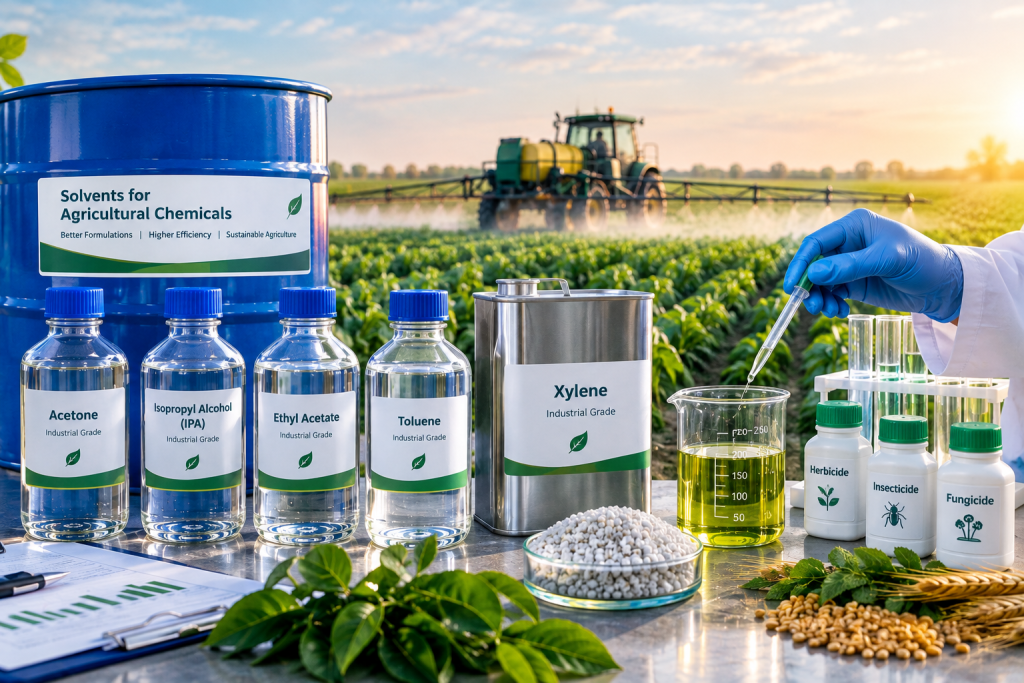
- Aromatic hydrocarbons: Toluene and xylene can dissolve selected organic compounds. Their suitability depends on formulation performance, exposure controls, environmental considerations, and applicable regulations.
- Ketones: Acetone and methyl ethyl ketone (MEK) provide useful solvency and evaporation characteristics in some chemical processes. Their compatibility and regulatory status must be confirmed for the intended formulation.
- Esters: Ethyl acetate and related esters may be evaluated when their solvency, volatility, and material compatibility meet technical requirements.
- Alcohols: Certain alcohols can support selected formulation systems, depending on polarity, water compatibility, and interactions with other ingredients.
- Water-based systems: Water can serve as a formulation medium when the active ingredient and other components can form a stable product.
- Specialized solvent blends: Blends may be developed to balance solubility, viscosity, stability, and handling characteristics.
For industrial chemical sourcing information, explore the Aasad Chimie product range. Each candidate material should be evaluated for the specific agricultural formulation before use.
Solvents for Herbicides, Insecticides, and Fungicides
Solvents for Agricultural products must match the formulation’s purpose and the properties of its active ingredient. Herbicides, insecticides, and fungicides can have different solubility and stability requirements, so a single solvent system should not be assumed to work for every product.
Herbicide Formulations
Herbicides are designed to control unwanted plants. In suitable formulations, a solvent may help dissolve an active ingredient or support a liquid concentrate. Formulators should assess the required concentration, storage stability, compatibility with other ingredients, and performance after dilution where applicable.
Insecticide Formulations
Insecticide products may use solvent systems to maintain selected active ingredients in solution or support specific liquid formulations. Testing should examine crystallization, phase separation, packaging compatibility, and consistency under expected storage conditions.
Fungicide Formulations
Fungicide formulations may require a solvent system that supports active ingredient compatibility and reliable product handling. Evaluation should include chemical stability, physical uniformity, and suitability for the intended application method.
For all three product categories, solvent choice should follow laboratory testing and a review of the applicable registration requirements. General industrial use does not automatically establish suitability for agricultural chemical products.
How to Select Solvents for Agricultural Chemicals
Selecting Solvents for Agricultural formulations requires a structured technical assessment. Manufacturers should evaluate the complete formulation under relevant processing, storage, and application conditions.
- Solubility: Confirm that the solvent achieves the required active ingredient concentration at relevant temperatures.
- Chemical compatibility: Check for reactions or degradation involving the active ingredient, stabilizers, surfactants, and other formulation components.
- Physical stability: Evaluate crystallization, sedimentation, phase separation, and changes during storage.
- Viscosity and handling: Confirm that the formulation can be mixed, transferred, packaged, and used as intended.
- Volatility and flammability: Assess vapor generation, ignition risks, ventilation requirements, and storage conditions.
- Packaging compatibility: Test whether the solvent affects containers, seals, liners, hoses, or other materials that contact the product.
- Worker and environmental safety: Review exposure risks, emissions, waste handling, and the relevant Safety Data Sheet (SDS).
- Regulatory acceptance: Verify that the ingredient and complete product formulation meet the requirements of the target market and intended use.
Evaluating solvents for agricultural formulations also requires compatibility testing, storage stability studies, and review of the intended product’s regulatory requirements. Laboratory results should guide the final selection rather than assumptions based on solvent type alone.
Low-VOC and Alternative Solvent Systems
Manufacturers may evaluate lower-emission solvent systems and alternative formulation technologies to address workplace exposure, emissions, and environmental objectives. The most appropriate option depends on the active ingredient, product performance requirements, and local regulations.
Lower volatility alone does not establish that a solvent is safer or environmentally preferable. A meaningful assessment should consider toxicity, environmental fate, flammability, relevant biodegradability data, and the performance of the complete formulation.
Water-based systems may be feasible for some active ingredients, but they can introduce challenges such as limited solubility, preservation requirements, or physical stability issues. Manufacturers should conduct formulation trials before adopting an alternative solvent system.
Safety and Regulatory Considerations
Solvents for Agricultural chemical manufacturing must be handled according to their specific hazard profiles. Some organic solvents are flammable, can produce harmful vapors, or require occupational exposure controls. Manufacturers should follow the relevant SDS, provide suitable ventilation and protective equipment, control ignition sources where necessary, and establish procedures for storage, spills, and waste management.
The United Nations Globally Harmonized System (GHS) provides a framework for chemical hazard classification and communication, including labels and safety data sheets. Applicable national requirements and pesticide registration rules must also be checked for each target market.
Regulatory review may cover the complete pesticide formulation rather than only the active ingredient. The EPA guidance on pesticide inert ingredients explains how formulation ingredients are considered within the US registration process. Other markets may apply different requirements.
Industrial Solvent Sourcing for Agricultural Formulations
When sourcing Solvents for Agricultural formulations, manufacturers should consider product specifications, batch consistency, documentation, packaging options, supply reliability, and technical support. A clear specification and current SDS help the formulation team evaluate whether a candidate material meets project requirements.
Aasad Chimie supplies industrial chemicals for a range of applications. Review the product range and contact the team to discuss availability and technical documentation. Final suitability for agricultural chemical formulations must be established through compatibility testing and the required regulatory review.
Conclusion
Solvents for Agricultural chemical formulations can influence active ingredient solubility, physical stability, processing, handling, and application characteristics. The appropriate choice depends on the complete formulation, intended use, safety requirements, and regulatory status in the target market.
For manufacturers serving markets such as India, Turkey, and Iran, technical evaluation and compliance checks are essential before selecting a solvent for a crop-protection product. Laboratory testing, documented specifications, and review of local requirements can help identify a suitable formulation system.
Choosing suitable solvents for agricultural formulations requires balancing technical performance, worker safety, environmental considerations, and market-specific regulations. To discuss industrial solvent sourcing, visit the Aasad Chimie products page or contact Aasad Chimie for further information.
What are solvents for agricultural chemicals used for?
Solvents for agricultural chemicals can dissolve selected active ingredients or help create suitable liquid formulations. Depending on the product, they may influence solubility, viscosity, stability, and handling. Their role varies by formulation type, and each candidate solvent must be assessed for compatibility, safety, and regulatory acceptance before use.
Which solvents are used in agrochemical formulations?
Depending on the active ingredient and formulation design, manufacturers may evaluate aromatic hydrocarbons, ketones, esters, alcohols, water, or specialized blends. No single solvent is suitable for every pesticide. Selection requires solubility testing, compatibility assessment, stability studies, and confirmation that the ingredient is acceptable for the intended product and market.
does solvent selection affect pesticide formulation?
Solvent selection can affect active ingredient solubility, crystallization, phase separation, viscosity, processing, and storage stability. It may also influence handling and application characteristics. Formulators should test the complete mixture under relevant conditions because a solvent that performs well with one active ingredient may be unsuitable for another.
Can low-VOC solvents be used in agricultural chemicals?
Some lower-VOC solvent systems may be suitable for specific agricultural chemical formulations. However, lower VOC emissions alone do not establish overall safety or regulatory suitability. Manufacturers should assess solvency, stability, toxicity, environmental effects, product performance, and applicable registration requirements before adopting an alternative solvent system.
What should manufacturers check before purchasing formulation solvents?
Manufacturers should review the product specification, purity, batch consistency, SDS, packaging compatibility, supply reliability, and available technical documentation. They should also verify compatibility with the active ingredient and confirm regulatory suitability for the intended formulation. Supplier documentation supports evaluation but does not replace product testing or registration review.