


Table of Contents
- Quick Chemical Specifications
- What Is Acetic Acid?
- Major Industrial Applications
- 1. Chemical Manufacturing
- 2. Acetate Ester Production
- 3. Textile Processing and Dyeing
- 4. Plastics and Polymer Manufacturing
- 5. Industrial Processing and pH Control
- 6. Chemical and Specialty Intermediates
- How to Select an Industrial Grade
- Safety and Handling
- Glacial Acetic Acid vs. Diluted Solutions
- Conclusion
- References
- What is acetic acid mainly used for?
- What is glacial acetic acid?
- Is acetic acid soluble in water?
- What safety precautions are necessary when handling acetic acid?
- How should buyers choose an industrial acetic acid grade?
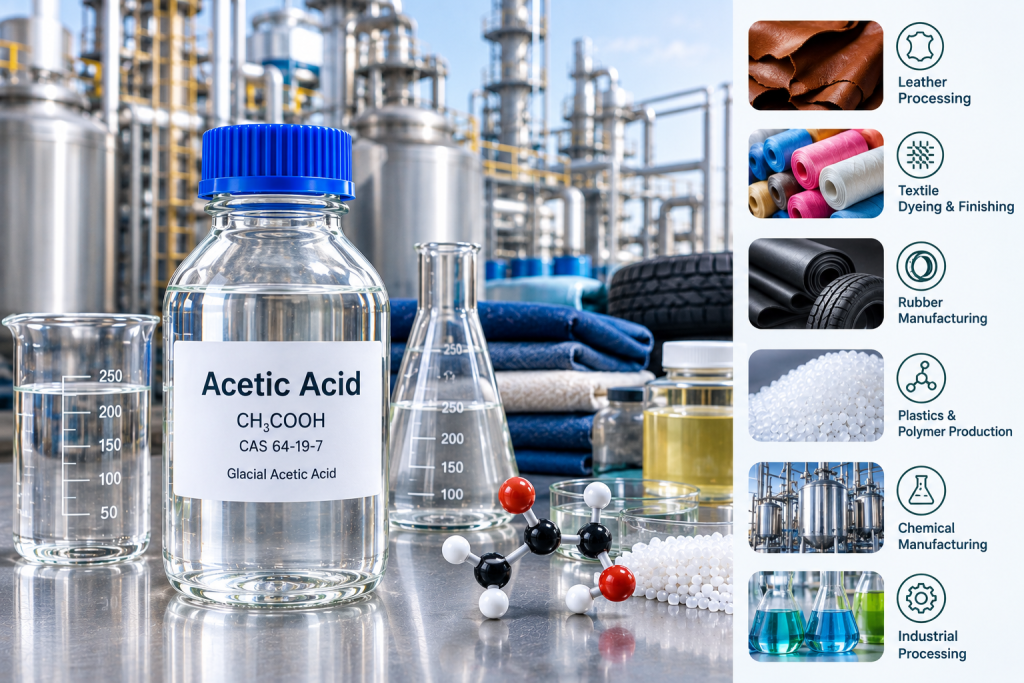
Acetic Acid, also known as ethanoic acid, is an important raw material for chemical manufacturing, acetate ester production, textile processing, and specialty chemicals. It functions as a chemical intermediate or processing agent, depending on the application. Manufacturers should select a suitable grade based on concentration, purity, process compatibility, and technical specifications.
Quick Chemical Specifications
| Property | Typical Value |
|---|---|
| Chemical name | Acetic acid |
| Synonyms | Ethanoic acid; glacial acetic acid for the concentrated form |
| Molecular formula | CH₃COOH (C₂H₄O₂) |
| CAS number | 64-19-7 |
| EC number | 200-580-7 |
| Molecular weight | 60.05 g/mol |
| Appearance | Clear, colorless liquid above its melting point |
| Melting point | Approximately 16.6°C for pure material |
| Boiling point | Approximately 118°C at atmospheric pressure |
| Flash point | Approximately 39°C, closed cup; method-dependent |
| Density | Approximately 1.04–1.05 g/cm³ near 20–25°C |
| Water solubility | Miscible |
These figures are reference values rather than guaranteed commercial specifications. Temperature, concentration, and test methods can affect reported results. Consult the supplier’s technical data sheet (TDS), safety data sheet (SDS), and certificate of analysis (CoA) for the grade being purchased. PubChem’s chemical record provides additional reference information.
What Is Acetic Acid?
This organic compound belongs to the carboxylic acid family and has a characteristic pungent, vinegar-like odor. It is present in dilute form in vinegar, while highly concentrated material is commonly called glacial acetic acid. Pure material may solidify below approximately 16.6°C.
Its chemical reactivity makes it useful in esterification and other industrial reactions. Manufacturers use it as a feedstock, a reaction component, or an acidity-control agent, depending on the process design and end-product requirements.
Major Industrial Applications
1. Chemical Manufacturing
One of the major uses of this organic acid is the production of chemical intermediates and derivatives. It serves as a feedstock or reactant in processes that manufacture acetate compounds and other industrial chemicals. Feedstock quality, impurity limits, and process conditions influence conversion efficiency and product consistency.
2. Acetate Ester Production
The material is an important raw material for producing acetate esters, including ethyl acetate and normal butyl acetate. These downstream products are used as solvents in coatings, printing inks, adhesives, and other formulations.
Production generally involves reacting the acid with an appropriate alcohol under controlled conditions. Catalyst selection, water management, feedstock quality, and process design can influence the resulting ester’s purity and yield.
3. Textile Processing and Dyeing
Textile manufacturers use this chemical in selected dyeing and finishing operations to adjust pH and establish suitable processing conditions. The required dosage depends on the dye system, fabric type, bath composition, and equipment.
Operators should follow the textile formulation and equipment supplier’s recommendations to reduce the risk of fabric damage, inconsistent dyeing, or unnecessary wastewater treatment loads.
4. Plastics and Polymer Manufacturing
This acid is used to manufacture intermediates for polymer and specialty-material supply chains. One important derivative is vinyl acetate monomer, which is used in producing polyvinyl acetate and ethylene-vinyl acetate materials.
Industrial processes may require strict control of feedstock purity and trace impurities. Buyers should confirm the required concentration and specification with their technical team rather than assuming one grade suits every polymer-related application.
5. Industrial Processing and pH Control
In selected industrial operations, the chemical serves as a pH-adjusting agent or processing aid. Its suitability depends on the target acidity, buffering capacity, equipment materials, and compatibility with other process chemicals.
Before use, operators should assess dilution procedures, corrosion risks, mixing conditions, and wastewater implications. Concentrated solutions require particular care during transfer and handling.
6. Chemical and Specialty Intermediates
The compound also participates in the manufacture of specialty chemicals and other intermediates. Depending on the process, it may function as a reactant, a component of a reaction medium, or an acidity-control agent.
Applications with demanding purity requirements call for clear impurity limits, batch documentation, and appropriate quality controls. The specification should match the intended process and any applicable regulatory requirements.
How to Select an Industrial Grade
Choosing a suitable grade requires matching its specifications to the intended manufacturing process. Price alone is not a reliable indicator of technical suitability.
- Concentration and purity: Confirm the required assay and impurity limits.
- Application: Identify whether the material is intended for synthesis, ester production, textile processing, or pH adjustment.
- Quality documentation: Request a current TDS, SDS, and batch-specific CoA.
- Equipment compatibility: Assess corrosion resistance and compatibility of tanks, piping, seals, and transfer equipment.
- Packaging and logistics: Confirm container type, order volume, transport conditions, and delivery requirements.
- Storage conditions: Account for the melting point of pure material and expected storage temperatures.
For product information, visit the Aasad Chimie products page. You can also contact the team with your target concentration, required quantity, destination, and documentation needs.
Safety and Handling
Concentrated material can cause severe skin burns and eye damage. Vapors may irritate the respiratory system, and the substance can be combustible. Handling procedures should be based on a site-specific risk assessment, the current SDS, and applicable workplace regulations.
- Provide suitable ventilation and use closed-transfer systems where practical.
- Wear chemical-resistant gloves, protective clothing, and eye or face protection specified by the SDS.
- Keep the material away from ignition sources and follow applicable storage requirements.
- Use compatible tanks, piping, and transfer equipment to reduce corrosion risks.
- Separate it from incompatible chemicals, especially strong oxidizers and strong caustics.
- Train workers in spill response, emergency procedures, and safe handling practices.
For additional occupational safety information, consult the NIOSH Pocket Guide entry. Always follow the product-specific SDS because hazards and controls vary with concentration.
Glacial Acetic Acid vs. Diluted Solutions
Glacial acetic acid is the common name for a highly concentrated form of the compound. Diluted aqueous solutions contain a lower proportion of the active chemical and can have different handling requirements. The terms should not be treated as interchangeable when preparing a purchase specification.
When requesting a quotation, state the required concentration or assay, acceptable impurity limits, packaging, and documentation. This helps suppliers identify a product that meets the intended process requirements.
Conclusion
Acetic Acid supports a range of industrial activities, including chemical manufacturing, acetate ester production, textile processing, polymer-related supply chains, and pH control. Its versatility makes it a useful industrial raw material, but the appropriate grade depends on concentration, purity, process compatibility, and equipment requirements.
Before purchasing, review the technical specifications and safety documentation. For industrial chemical inquiries, visit the products page or contact Aasad Chimie to discuss your requirements.
References
- PubChem: Acetic Acid — chemical identity and properties
- NIOSH Pocket Guide — occupational safety information
What is acetic acid mainly used for?
Acetic acid is used in chemical manufacturing, acetate ester production, textile processing, and the production of intermediates for polymers and specialty chemicals. It can also be used to adjust acidity in selected industrial processes. The appropriate concentration and grade depend on the intended application and process specifications.
What is glacial acetic acid?
Glacial acetic acid is the common name for a highly concentrated form of acetic acid. Pure acetic acid has a melting point of approximately 16.6°C and may solidify in cooler conditions. Buyers should confirm the actual concentration and specification before purchasing.
Is acetic acid soluble in water?
Yes. Acetic acid is miscible with water, meaning it can mix with water in all proportions. However, dilution can release heat, particularly when concentrated material is involved. Industrial dilution should follow the supplier's safety guidance and established site procedures.
What safety precautions are necessary when handling acetic acid?
Concentrated acetic acid can cause severe skin burns and eye damage, and its vapors may irritate the respiratory system. Suitable ventilation, chemical-resistant PPE, compatible equipment, and correct storage are essential. Always follow the current SDS and applicable workplace regulations.
How should buyers choose an industrial acetic acid grade?
Buyers should verify concentration, purity, impurity limits, packaging, batch documentation, and compatibility with the intended process. They should also review storage and transport conditions and request a current certificate of analysis when appropriate. The grade should meet the manufacturer's technical and regulatory requirements.