


Table of Contents
- Propylene Glycol: Technical Specifications
- What Makes Propylene Glycol Useful in Industry?
- Key Industrial Applications
- 1. Coatings, Paints, and Surface Treatments
- 2. Chemical Manufacturing and Intermediates
- 3. Polymer and Resin Formulations
- 4. Heat-Transfer Fluids
- 5. Industrial Solvent and Carrier Applications
- How to Select the Appropriate Grade
- Safety, Storage, and Handling
- Conclusion
- What is propylene glycol used for in industry?
- What is the chemical formula of propylene glycol?
- Does propylene glycol mix with water?
- Is propylene glycol a fast-evaporating solvent?
- How should industrial buyers choose a propylene glycol grade?
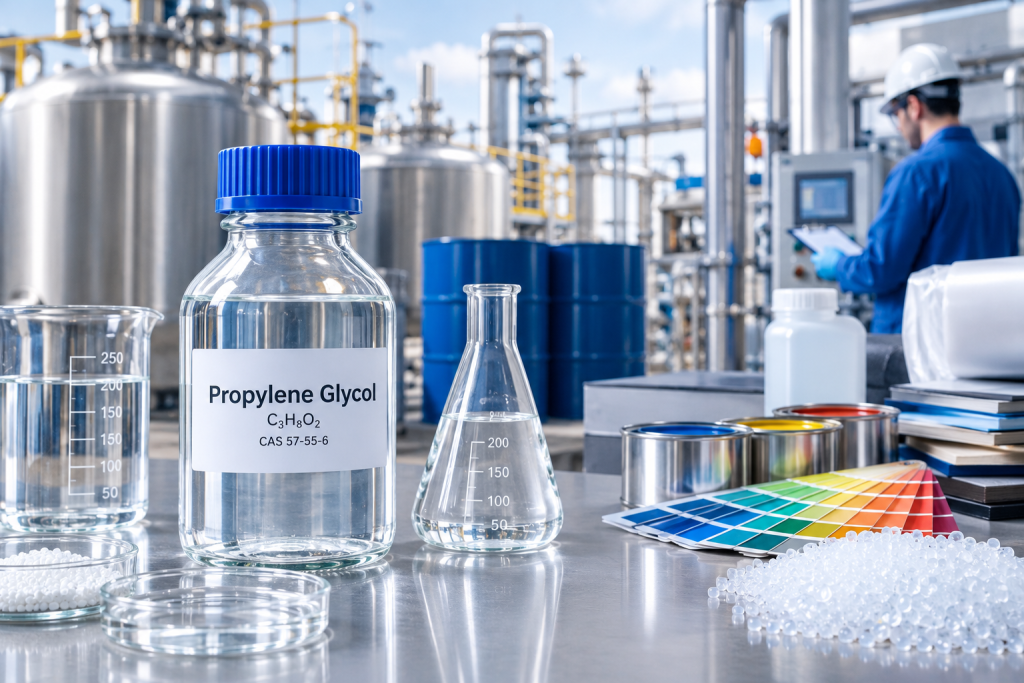
Propylene Glycol is a versatile industrial chemical used in formulated fluids, coatings, chemical manufacturing, polymer production, and selected heat-transfer applications. Its ability to mix with water, dissolve certain ingredients, and remain relatively slow to evaporate makes it useful in products that require controlled formulation performance.
Also known as 1,2-propanediol, this colorless liquid is available in different commercial grades. The appropriate grade depends on the intended process, purity requirements, and applicable product specifications.
Propylene Glycol: Technical Specifications
| Property | Typical Reference Value |
|---|---|
| Chemical name | Propylene Glycol |
| Synonyms | 1,2-Propanediol, Propane-1,2-diol |
| Molecular formula | C3H8O2 |
| CAS number | 57-55-6 |
| EC number | 200-338-0 |
| Molecular weight | 76.09 g/mol |
| Appearance | Clear, colorless, viscous liquid |
| Melting point | Approximately -59°C |
| Boiling point | Approximately 188°C at atmospheric pressure |
| Flash point | Approximately 99°C, closed-cup reference value; method-dependent |
| Density | Approximately 1.036 g/cm³ at 20°C |
| Dynamic viscosity | Approximately 55 mPa·s at 20°C |
| Water solubility | Miscible with water |
Note: Values are approximate reference data for relatively pure propylene glycol. Actual specifications can vary with grade, temperature, purity, and test method. Check the supplier’s Technical Data Sheet (TDS) and Certificate of Analysis (CoA) before purchase.
What Makes Propylene Glycol Useful in Industry?
Propylene glycol is a diol, which means its molecular structure contains two hydroxyl groups. These groups contribute to its interaction with water and other ingredients. Its relatively low volatility compared with many common solvents can also help formulators control evaporation and processing behavior.
Depending on the application, it can function as a solvent, carrier, chemical intermediate, or component of a formulated fluid. More chemical data is available in the PubChem Propylene Glycol reference.
Key Industrial Applications
1. Coatings, Paints, and Surface Treatments
Selected coating formulations use propylene glycol as a solvent or formulation aid. It can help manage the compatibility of water and other ingredients, depending on the product’s chemistry. Its relatively slow evaporation may also influence working time and drying behavior.
Its function varies by formulation, so manufacturers should conduct compatibility and performance testing before introducing it into a coating system.
2. Chemical Manufacturing and Intermediates
The compound is used as a raw material or intermediate in the production of selected chemicals, resins, and specialty formulations. Its hydroxyl groups allow it to participate in chemical reactions used to manufacture other materials.
In these processes, purity, moisture content, and impurity limits can affect reaction consistency. Buyers should match the material specification to the chemistry and operating conditions of their production process.
3. Polymer and Resin Formulations
Propylene glycol has applications in selected resin and polymer systems, where it may serve as a chemical building block or formulation ingredient. The exact role depends on the type of resin, reaction pathway, and required final properties.
It should not be treated as a universal raw material for all plastics. Manufacturers need to confirm compatibility with the specific polymer system and review the supplier’s technical documentation.
4. Heat-Transfer Fluids
Propylene glycol is used in formulated heat-transfer fluids for certain industrial heating and cooling systems. When blended with water and suitable additives, it can help lower the fluid’s freezing point and support temperature control.
Performance depends on concentration, operating temperature, viscosity, corrosion inhibitors, and system materials. Buyers should select a complete fluid formulation that meets equipment requirements rather than relying on the properties of the glycol alone.
5. Industrial Solvent and Carrier Applications
In some industrial formulations, propylene glycol acts as a solvent or carrier for selected ingredients. Its water miscibility and relatively low volatility can be useful where formulators need compatibility and controlled evaporation.
However, it does not replace fast-evaporating solvents in every application. Solvent selection should consider solvency, drying time, material compatibility, process conditions, and applicable environmental or workplace requirements.
How to Select the Appropriate Grade
Before purchasing propylene glycol, industrial buyers should evaluate the following factors:
- Purity: Confirm the assay and permitted impurity levels for the intended use.
- Water content: Check moisture limits where water can affect processing or product quality.
- Application: Distinguish between use as a chemical feedstock, formulation ingredient, or heat-transfer fluid component.
- Documentation: Request a current CoA and Safety Data Sheet (SDS), plus a TDS when available.
- Supply consistency: Confirm packaging, batch traceability, and delivery requirements.
The appropriate grade is the one that meets the process specification and relevant regulatory requirements. A grade suitable for one application may not be suitable for another.
Safety, Storage, and Handling
Although propylene glycol is generally less volatile than many conventional industrial solvents, it still requires appropriate handling. Avoid unnecessary contact, follow the supplier’s SDS, and use protective equipment appropriate to the task and exposure risk.
Keep containers sealed, correctly labeled, and stored under the supplier’s recommended conditions. Prevent contamination and spills, and follow local requirements for workplace safety, transportation, and waste management.
Conclusion
Propylene glycol supports a range of industrial processes, including coatings, chemical manufacturing, selected polymer systems, and formulated heat-transfer fluids. Its water miscibility and relatively low volatility make it useful where ingredient compatibility and controlled formulation behavior are important.
For reliable procurement, compare technical specifications, confirm the grade’s suitability, and review the supplier’s quality and safety documentation. Explore the Aasad Chimie product directory or contact Aasad Chimie to discuss your industrial chemical sourcing requirements.
What is propylene glycol used for in industry?
It is used in selected coatings, chemical formulations, polymer systems, and heat-transfer fluids.
What is the chemical formula of propylene glycol?
Its molecular formula is C₃H₈O₂, and its CAS number is 57-55-6.
Does propylene glycol mix with water?
Yes. Propylene glycol is miscible with water, meaning it can mix with water in all proportions.
Is propylene glycol a fast-evaporating solvent?
No. It is relatively low in volatility compared with many common industrial solvents, so its evaporation behavior differs from solvents such as acetone.
How should industrial buyers choose a propylene glycol grade?
Buyers should compare purity, water content, application requirements, batch specifications, and the supplier's technical and safety documentation.