


Table of Contents
- What Are Industrial Solvents for Paints and Coatings?
- Common Types of Industrial Paint Solvents
- Industrial Applications of Paint and Coating Solvents
- How Solvents Affect Coating Quality
- Comparing Toluene, Xylene, Acetone, MEK, and Ethyl Acetate
- How to Choose Industrial Solvents for Paints and Coatings
- Low-VOC and Alternative Coating Technologies
- Safety and Regulatory Considerations
- Source Industrial Solvents from Aasad Chimie
- What are industrial solvents for paints and coatings used for?
- Which solvents are commonly used in industrial paints?
- How do solvents affect paint drying time?
- How should manufacturers choose a coating solvent?
- Are low-VOC solvents suitable for industrial coatings?
Industrial Solvents for Paints and Coatings: Uses and Selection
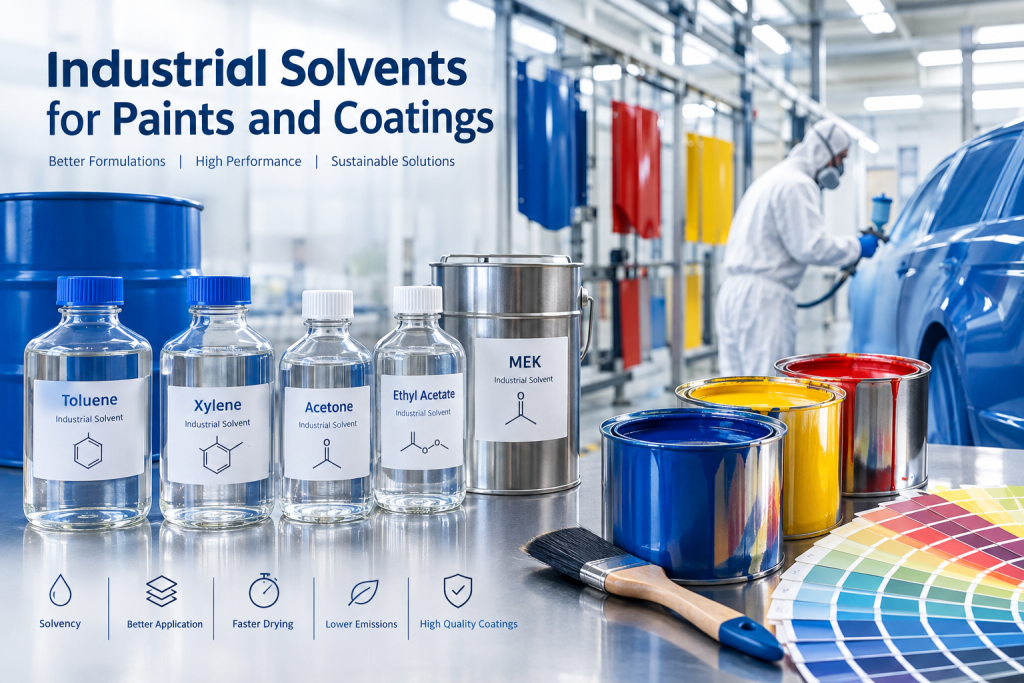
Industrial Solvents for Paints and Coatings help manufacturers control resin compatibility, viscosity, flow, and drying behavior in solvent-based coating formulations. Selecting the right solvent system can improve application consistency, surface appearance, and production efficiency across automotive, metal finishing, furniture, machinery, and protective coating industries.
What Are Industrial Solvents for Paints and Coatings?
Industrial solvents for paints and coatings are liquid chemicals used to dissolve compatible resins, adjust formulation viscosity, and support the application of coating products. Depending on the formulation, they influence flow, leveling, drying time, and the formation of a uniform coating film.
Solvents are not interchangeable. Their performance depends on the resin or binder, other formulation ingredients, application method, substrate, and drying conditions. Some coatings use a single solvent, while others require a carefully balanced blend to achieve the required properties.
Common Types of Industrial Paint Solvents
Manufacturers select industrial solvents for paints and coatings according to their solvency, evaporation characteristics, compatibility, and safety profile. Common solvent families include the following.
- Aromatic hydrocarbons: Toluene and xylene can provide solvency for selected resins and coating systems. Their use requires consideration of occupational exposure and environmental regulations.
- Ketones: Acetone and methyl ethyl ketone (MEK) offer strong solvency for compatible formulation components. Their relatively rapid evaporation can be useful in selected applications.
- Esters: Ethyl acetate is used in suitable coating and related formulations where its solvency and evaporation profile meet the technical requirements.
- Alcohols: Selected alcohols can serve as solvents or blend components in compatible formulations, depending on resin chemistry and application needs.
For a broader introduction to chemical solvent families, read our guide to industrial solvents. You can also explore the Aasad Chimie product directory for available chemical materials.
Industrial Applications of Paint and Coating Solvents
Industrial Solvents for Paints and Coatings support formulation and application processes across a wide range of manufacturing sectors. The specific solvent blend depends on the coating technology and the performance required from the finished film.
- Automotive coatings: Suitable solvent systems help control viscosity and application behavior in selected primers, topcoats, and refinishing products.
- Protective metal coatings: Solvents help maintain workable formulations for selected industrial coatings used on metal structures, machinery, and equipment.
- Furniture and wood finishes: Solvent selection influences flow, leveling, drying, and the final appearance of compatible wood coatings.
- Machinery and equipment: Coating formulations use appropriate solvents to achieve the required application properties and protective film characteristics.
- Industrial maintenance: Solvent-borne coating systems may be selected for specific maintenance and refurbishment applications according to product specifications.
Solvent selection should always match the coating manufacturer’s technical requirements. A solvent that works well with one resin may produce poor compatibility or film defects in another formulation.
How Solvents Affect Coating Quality
The performance of industrial solvents for paints and coatings depends on more than solvency strength. Several properties influence the quality of the finished coating.
- Resin compatibility: The solvent must be compatible with the binder and other formulation ingredients to maintain stability.
- Viscosity: Appropriate viscosity supports consistent application by spraying, brushing, rolling, or other approved methods.
- Evaporation rate: Rapid evaporation may shorten drying time, while a slower rate can provide more time for flow and leveling. An unsuitable rate can contribute to surface defects.
- Film formation: The solvent blend can affect how the coating spreads and forms a uniform film as the solvent evaporates.
- Substrate compatibility: The complete coating system must be suitable for the surface, including any existing finish or primer.
- Safety and compliance: Flammability, workplace exposure, VOC limits, and storage requirements must be assessed before use.
A solvent with high solvency is not automatically the best option. The correct balance depends on the formulation, application equipment, environmental conditions, and desired final properties.
Comparing Toluene, Xylene, Acetone, MEK, and Ethyl Acetate
Several industrial solvents for paints and coatings are used in different formulation contexts. Their suitability depends on the resin and the technical requirements of the coating.
Toluene can provide solvency for selected resin systems. Xylene has a different evaporation profile and may be suitable where the formulation requires its specific solvency characteristics.
Acetone evaporates rapidly and can be useful in compatible formulations requiring fast evaporation. MEK provides a different balance of solvency and evaporation, while ethyl acetate is considered in formulations where ester-based solvency is appropriate.
These solvents should not be substituted for one another without testing. Manufacturers should compare resin compatibility, viscosity, drying behavior, film appearance, safety data, and regulatory requirements before changing a formulation.
How to Choose Industrial Solvents for Paints and Coatings
Choosing industrial solvents for paints and coatings starts with identifying the coating technology, binder, and intended application. The following criteria help guide the selection process.
- Identify the resin system: Confirm the solvent’s compatibility with the binder and other ingredients.
- Define application requirements: Consider spraying, brushing, rolling, or other methods and establish the required viscosity.
- Match the evaporation profile: Evaluate drying conditions, film thickness, temperature, airflow, and production speed.
- Test the finished coating: Assess appearance, leveling, adhesion, film integrity, and other relevant performance specifications.
- Review safety requirements: Check flammability, exposure controls, storage conditions, and the applicable Safety Data Sheet (SDS).
- Consider total cost: Evaluate formulation performance, material consumption, production efficiency, waste, and compliance costs rather than purchase price alone.
Laboratory testing and controlled production trials are important before approving a new solvent or blend. Technical specifications and supplier documentation should guide final selection.
Low-VOC and Alternative Coating Technologies
Environmental requirements are encouraging manufacturers to assess lower-emission coating technologies. Depending on the application, alternatives may include waterborne coatings, high-solids formulations, powder coatings, and suitable bio-based solvent options.
Each technology has different equipment, curing, application, and performance requirements. Lower VOC content alone does not establish that a product is safer or technically suitable; manufacturers should assess chemical hazards and the complete production process.
Learn more in our guides to low-VOC solvents and bio-based solvents.
Safety and Regulatory Considerations
Many industrial paint solvents are flammable, and some can cause harmful exposure through inhalation or skin contact. Facilities should provide appropriate ventilation, control ignition sources, use suitable personal protective equipment, and store chemicals in compatible, correctly labelled containers.
Workers should follow the relevant SDS, workplace procedures, and local environmental regulations. Chemical hazard classification and communication guidance is available through the United Nations Globally Harmonized System (GHS).
Source Industrial Solvents from Aasad Chimie
Industrial Solvents for Paints and Coatings influence formulation stability, viscosity, application behavior, drying, and final coating quality. Selecting the right solvent requires balancing resin compatibility, evaporation characteristics, safety, environmental requirements, and production performance.
To explore available chemical materials, visit the Aasad Chimie product directory. For sourcing enquiries or technical requirements, contact Aasad Chimie to discuss your application.
What are industrial solvents for paints and coatings used for?
They help dissolve compatible resins, adjust viscosity, improve application properties, and control drying behavior in solvent-based coating formulations.
Which solvents are commonly used in industrial paints?
Common options include toluene, xylene, acetone, MEK, and ethyl acetate. The appropriate choice depends on the resin, formulation, application method, and required coating properties.
How do solvents affect paint drying time?
Solvent evaporation characteristics influence drying time, flow, leveling, and film formation. The appropriate evaporation profile depends on the coating formulation and application conditions.
How should manufacturers choose a coating solvent?
They should evaluate resin compatibility, viscosity, evaporation rate, substrate requirements, finished-film performance, safety, VOC regulations, and total production cost.
Are low-VOC solvents suitable for industrial coatings?
They can be suitable when their solvency, compatibility, application behavior, and performance meet the formulation requirements. Waterborne, high-solids, and other coating technologies may also be alternatives.